
Little Rock Look Back: The Assassination of Dr. King

On April 4, 1968,  when Dr. King was assassinated, Little Rock did not see the unrest that many cities did.  Part of that was probably due to quick action by Governor Winthrop Rockefeller.

The Governor released a statement fairly quickly expressing his sorrow at the tragedy and calling for a day of mourning. He also made the State Capitol available for the NAACP to have a public memorial, as well as worked with a group of ministers to host an interdenominational service.

Little Rock Mayor Martin Borchert issued a statement as well:

We in Little Rock are disturbed about the incident in Memphis. We are disturbed regardless of where it had happened.  Killing is not the Christian solution to any of our problems today.

In Little Rock, we feel we have come a long way in 10 years toward solving some of our problems of living and working together regardless of race, creed or color.

The city Board of Directors in Little Rock has pledged itself toward continuing efforts to make Little Rock a better place in which to live and work for all our citizens.

We feel the efforts of all thus far have proved we can live in harmony in Little Rock and are confident such an incident as has happened will not occur in Little Rock.  We will continue our most earnest efforts toward the full needs of our citizens.

The day after Dr. King was assassinated, a group of Philander Smith College students undertook a spontaneous walk to the nearby State Capitol, sang “We Shall Overcome” and then walked back to the campus.  President Ernest T. Dixon, Jr., of the college then hosted a 90 minute prayer service in the Wesley Chapel on the campus.

On the Sunday following Dr. King’s assassination, some churches featured messages about Dr. King.  As it was part of Holy Week, the Catholic Bishop for the Diocese of Little Rock had instructed all priests to include messages about Dr. King in their homilies. Some protestant ministers did as well. The Arkansas Gazette noted that Dr. Dale Cowling of Second Baptist Church downtown (who had received many threats because of his pro-integration stance in 1957) had preached about Dr. King and his legacy that morning.

Later that day, Governor Rockefeller participated in a public memorial service on the front steps of the State Capitol. The crowd, which started at 1,000 and grew to 3,000 before it was over, was racially mixed. At the conclusion of the ceremony, Governor and Mrs. Rockefeller joined hands with African American ministers and sang “We Shall Overcome.”

That evening, Trinity Episcopal Cathedral was the site of an interdenominational service which featured Methodist Bishop Rev. Paul V. Galloway, Catholic Bishop Most Rev. Albert L. Fletcher, Episcopal Bishop Rt. Rev. Robert R. Brown, Rabbi E. E. Palnick of Temple B’Nai Israel, Gov. Rockefeller, Philander Smith President Dixon, and Rufus King Young of Bethel AME Church.

Earlier in the day, Mayor Borchert stated:

We are gathered this afternoon to memorialize and pay tribute to a great American….To achieve equality of opportunity for all will require men of compassion and understanding on the one hand and men of reason and desire on the other.
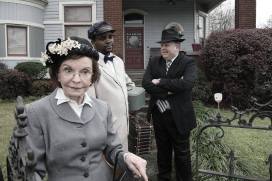
Pulitzers play Little Rock – DRIVING MISS DAISY

TWT DMDWith minimal set needs and only three actors, Alfred Uhry’s Driving Miss Daisy has been popular with theatres of all levels since it premiered in 1987.  There have been numerous Little Rock productions over the past thirty years.

Actress and director Judy Trice starred in the Weekend Theater’s production in 2016.  Her costars were Jermaine McClure and Jay Clark.  The play was directed by Andy Hall (who is currently directing Assassins for the Weekend Theater).  The three actors obviously relished the chance to age several decades over the course of the play and mine Uhry’s script for its humor and humanity.

While many plays may fall out of favor over time, it is likely that Driving Miss Daisy will continue to be performed repeatedly.

2018 marks the 100th anniversary of the first Pulitzer Prize for Drama being given. To pay tribute to 100 years of the Pulitzer for Drama, each day this month a different Little Rock production of a Pulitzer Prize winning play will be highlighted.  Many of these titles have been produced numerous times.  This look will veer from high school to national tours in an attempt to give a glimpse into Little Rock’s breadth and depth of theatrical history.

Little Rock Look Back: LR Voters approve additional funds for Robinson Center in 1940

Though Joseph Taylor Robinson Memorial Auditorium opened in February 1940, there was still money that needed to be raised to finish the construction and the building’s furnishing.  Ten days after the auditorium opening, the City Council approved an ordinance to call a special election on April 2, 1940, for the purposes of approving bonds for three separate projects.  One of these was for $30,000 for the completion of the auditorium; the bonds would not require any additional tax levy.
At the same meeting, a letter was read from the Young Men’s Business Association expressing support for the auditorium in the election, which was to be held in conjunction with the annual municipal general election. The Auditorium Commission had previously asked the City Council to consider issuing the bonds to pay for additional equipment for the building.  In their request to the aldermen, the members stressed that due to the current bond structure, these new bonds would not necessitate any tax increase.

The campaign for the new bonds used a similar structure and message as the 1937 election to build the auditorium.  There were newspaper ads by the steering committee (this time simply called the Citizen’s Committee and led by Omar Throgmorton) and support from civic organizations.  One thing very different from the 1937 campaign was the presence of an actual building.  On Sunday, March 31, just two days before the election, there was an open house for the public to explore the edifice.  From 1:00 p.m. to 9:00 p.m., members of various Little Rock Boy Scout troops led 4,000 visitors on tours of the auditorium.  Visitors were shown all over the building; one scout calculated that the walking tour equated to two miles.  Though most people were from Little Rock, the guest registry indicated visitors from California and Pennsylvania.

On April 2, 1940, Little Rock voters approved the new bonds 1,413 to 423.  Every precinct in every ward of the city voted in favor of the new bonds.  Shortly after the election, the bonds were issued.  The auditorium construction which had first been broached in 1904 was now completed in 1940.

Pulitzers play Little Rock – OF THEE I SING

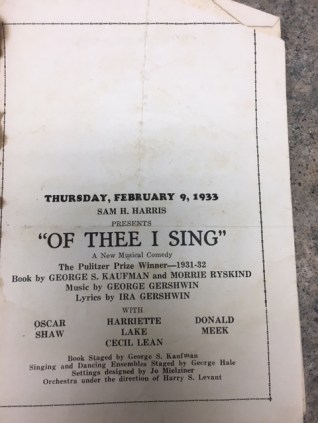
OfTheeISingBefore Robinson Auditorium opened, the stage of Little Rock High School (now Central High) was the prime performance location in Little Rock.  In 1933, it welcomed the national tour of the Pulitzer Prize winning musical Of Thee I Sing.

This was the first musical to win the Pulitzer Prize for Drama.  In fact, because no musical had won the award before, the jury appeared to not know how to handle a composer in a writing category.  Librettists Morris Ryskind and George S. Kaufman and lyricist Ira Gershwin were named as recipients. But composer George Gershwin did not receive the Pulitzer.  (In 1998, he received a posthumous Special Pulitzer.)

The musical, a satire of politics and popular culture, was directed by Mr. Kaufman.  The tour came to Little Rock for one performance on February 9, 1933. The Broadway production had closed less than a month earlier after 441 performances (a very long run at the time).

The tour starred Oscar Shaw (who had played the male lead in the original production of the Gershwins’ Oh Kay!) and Harriette Lake.  She would later change her name to Ann Sothern.  Other main roles were played by Donald Meek and Cecil Lean.   A few months after Little Rock, the tour played a month on Broadway.  Miss Lake continued in her role, but the men were replaced by their original Broadway counterparts.

2018 marks the 100th anniversary of the first Pulitzer Prize for Drama being given. To pay tribute to 100 years of the Pulitzer for Drama, each day this month a different Little Rock production of a Pulitzer Prize winning play will be highlighted.  Many of these titles have been produced numerous times.  This look will veer from high school to national tours in an attempt to give a glimpse into Little Rock’s breadth and depth of theatrical history.

Little Rock Look Back: SPRINGTIME FOR HENRY plays Robinson

On Monday, April 1, 1940, Edward Everett Horton came to Little Rock in the comedy SPRINGTIME FOR HENRY.  This was a play in which he had appeared regularly on tours and in summer stock. He would create productions of it in between film roles from the 1930s to the 1950s.

The play concerned a industrial heir whose dalliances put his family’s business in jeopardy.  It was a boulevard comedy (or a sex comedy—without the sex).  Originally performed on Broadway in 1931, it was written by Benn W. Levy.  He would later serve as a member of Parliament.

By the time Horton arrived in Little Rock, he was an accomplished stage and screen actor.  He was a staple of many Astaire-Rogers films.

The performance at Robinson did not go off without a hitch.  Because Spring had arrived in Little Rock, it was warmer outside.  This necessitated the air conditioner being turned on.   The fans rumbling through the vents made such a noise that it was difficult for the audience to hear the actors.  The air cooler was turned off for the remainder of the performance.  In the days after the performance, the Auditorium staff put buffering in the vents in the muffle the noise.

Easter Bunnies on Parade

Little Rock has at least four different sculptures of rabbits.  Since today is Easter Sunday and the Easter Bunny is making his rounds, it seems a good day to highlight these sculptures.

RB MonThe newest sculpture is Dan Ostermiller’s R. B. Monument.  A gift to the citizens of Little Rock by the Little Rock Garden Club, it was dedicated in 2017.

Located at the southeast corner of Kavanaugh and Pierce, this rabbit has quickly become a landmark. It is a favorite for kids and adults as they walk or drive by.  The rabbit is situated so that people can easily pose for photos with it, without the photographer having to stand in the street.  At Christmas and Easter, the rabbit has been bedecked with an appropriate wreath to add to its festive nature.

Bun BumIn the Vogel Schwartz Sculpture Garden, Laurel Peterson Gregory’s Bunny Bump has been providing whimsy since 2010.
After she sculpts an animal in wax or oil-based clay, traditional lost-wax casting processes immortalize the design in bronze. One aspect of particular interest to me, and one for which I plan early in the sculpting phase, is the complex and rich patinas that constitute another hallmark of my limited-edition sculptures. Multiple layers of chemicals and oxides are applied to the heated bronze to achieve a range of unique effects, both translucent and opaque, that complement each design.

Two stylized rabbits make for an interesting piece of artwork when they are not only dancing, but also doing the butt bump while dancing. The smooth surface and color of the bronze add to the illusion. This small piece has been placed on a pedestal to elevate more to eye level.

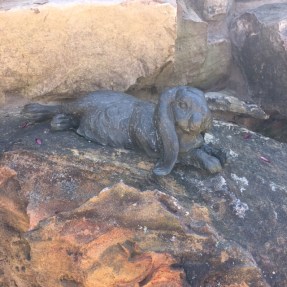
LopsA few yards from the bumping bunnies, James Paulsen’s Lopsided presents a much more laconic rabbit.

Paulsen is a self-taught artist. Alternately studying the wilds of the northern forest, and the open beauty of the American Southwest, he concentrates his work on natural subjects he has grown up with, and is heavily influenced by his family’s artistic background, being raised by an artist-illustrator and an author. In his work, he explores merging the beauty he sees in the natural world with the expressiveness of clay and bronze.

While having most of his work in galleries or private collections across the country, he has recently completed two public commissions

And at the corner of President Clinton Avenue and Sherman Street, Tim Cherry’s Rabbit Reach welcomes visitors to the River Market.

The sculpture is located at the corner of Sherman Street and President Clinton Avenue across from the Museum of Discovery.

The sculpture is a gift from Whitlow Wyatt and the Carey Cox Wyatt Charitable Foundation. It was given in memory of George Wyatt and Frank Kumpuris.  Those two gentlemen were the fathers of Whitlow Wyatt and Dean & Drew Kumpuris.

Cherry’s sculpture was selected for this spot because of its proximity to children at the Museum and in the River Market district.  The design and size of the sculpture encourages children to climb on it and to play around the rabbit.  While some public art is situated so it cannot be touched, this one is situated to be touched as part of the appreciation experience.

Pulitzers play Little Rock – HARVEY

harveybrown3

Joe E. Brown in HARVEY

2018 marks the 100th anniversary of the first Pulitzer Prize for Drama being given. It went to Jesse Lynch Williams’ Why Marry?  To pay tribute to 100 years of the Pulitzer for Drama, each day this month a different Little Rock production of a Pulitzer Prize winning play.  Many of these titles have been produced numerous times.  This look will veer from high school to national tours in an attempt to give a glimpse into Little Rock’s breadth and depth of theatrical history.

First up – an appropriate on Easter Sunday, a look at Mary Chase’s HARVEY.  Though not the Easter bunny, it does revolve around a rabbit—or does it?

The winner of the 1945 Pulitzer came to Little Rock in 1948 on its national tour.  Comedian Joe E. Brown was playing the leading role when the show came to Robinson Auditorium.  That same year, Brown received a special Tony Award for starring in the Harvey tour.