
125 years of Basketball in Little Rock

On April 7, 1893, the Arkansas Gazette ran stories about the final day of horse racing at Clinton Park racetrack (the park stretched roughly from what is today’s Clinton Presidential Park through the East Village to Clinton National Airport), the men who were soon to take office as aldermen met to plan for their upcoming City Council terms, and a preview of a new sport coming to Little Rock.

Less than two years earlier in Springfield, Massachusetts, a YMCA instructor named James Naismith had invented the new game of Basket Ball.  The sport caught on in popularity and spread throughout the country through the network of YMCAs.

Now, on April 7, 1893, Little Rock residents would get their first glimpse of the game.  Two hundred men and women gathered at the Little Rock YMCA (located at the northeast corner of Fourth and Main Streets) to see the game, which started at 8:30pm.

The Little Rock YMCA team (which had only formed the night before) took on the Pine Bluff YMCA team.  The Pine Bluff young men had been practicing for six months.  The results of the game reflected that.  At the end, Pine Bluff had scored 70 points and Little Rock had scored 9 points.

Following the game, the Little Rock chapter hosted both teams for refreshments.  Little Rock was scheduled to go to Pine Bluff to play again during the YMCA statewide convention at the end of April.

From those meager beginnings, Little Rock has seen its fair share of basketball triumphs.

Pulitzers play Little Rock – SOUTH PACIFIC at Murry’s Dinner Playhouse in 1981

MDP SoPaIn the summer of 1981, the touring production of The Best Little Whorehouse in Texas was causing controversy by bleeping out “whore” in its radio ads in the Little Rock market.  At the same time, a formerly controversial musical was settling in for a seven week run in the Arkansas capital city at Murry’s Dinner Playhouse.

When Richard Rodgers and Oscar Hammerstein II had originally collaborated with Joshua Logan on South Pacific, the team attracted some complaints for the preachiness of the story as it tackled racism.  It was the look at these social issues which probably prompted the Pulitzer committee to make South Pacific only the second musical to win the prize.  (It was also the first Drama Pulitzer recipient to be based on another Pulitzer recipient – in this case James Michener’s Tales of the South Pacific.)

With a leading character from Little Rock, South Pacific was caught up in anti-Arkansas backlash during and after the Central High integration crisis.  A production on Long Island received boos when the character of Nellie announced she was from Little Rock.  The original national tour had a hard time booking spots in the south due to the themes.  Shifts in attitudes about race and miscegenation had rendered South Pacific a period piece by 1981 – and a non-threatening summer fare for Murry’s.

Directed by Jack Payne, the cast included Mary Winston Smith, Greg Carter, Bruce Rainey, Leslie Hall (now Basham), Dianne Tack, Chip Huddleston, and Beth Buffalo.

2018 marks the 100th anniversary of the first Pulitzer Prize for Drama being given. To pay tribute to 100 years of the Pulitzer for Drama, each day this month a different Little Rock production of a Pulitzer Prize winning play will be highlighted.  Many of these titles have been produced numerous times.  This look will veer from high school to national tours in an attempt to give a glimpse into Little Rock’s breadth and depth of theatrical history.


Little Rock Look Back: First Council Meeting in 1908 City Hall

City Hall circa 1908

On April 6, 1908, the first City Council meeting took place in the new Little Rock City Hall.  Located at the corner of Markham and Broadway Streets, this three story structure was designed by Charles L. Thompson.

The idea of a new City Hall had first been raised by Mayor W. E. Lenon in 1904.  After a couple of false starts and delays, the project finally got underway in the autumn of 1906.  (The date on the front of the building is the optimistic and ultimately wrong 1907.  But it is etched in stone and set into the exterior.)

City offices started moving in during January and February 1908 while construction continued.  By the end of March, the building was complete and all offices moved in.  The final City Council meeting in the 1868 City Hall took place on March 30.  One week later, the body reassembled in their new space.

All sixteen of the aldermen were present for this meeting, which was a rare occurrence.  The regular order of business was dispensed with except for approval of payments for the bills and payroll for March.  That totaled $25,719.56. (This is the equivalent of $664,729.65 in 2018).

The floor was then turned over to Mayor Lenon to make an announcement.  In his remarks, the Mayor praised the new building, and then stated he was resigning immediately.  His business interests were such that he did not have time to be mayor.

The Council reluctantly accepted the resignation.  Because there was over a year remaining in the term, a special election would need to be called to select a successor.  If Mayor Lenon had waited two more weeks to resign, the Council would have appointed a new mayor for the duration of the term.

Alderman John Herndon Hollis was chosen to serve as mayor until the special election could be held.  First elected in 1904, he was about to start his third term as an alderman.  Though he did not have to give up his seat (and in fact served as an alderman until 1918), he was referred to as Mayor Hollis during his brief tenure.  He is counted as one of Little Rock’s mayors.  Unlike other times where there was an acting mayor while a mayor was out of town, in 1908, there was no other mayor for whom Mayor Hollis was acting in absentia.

After the selection of the new mayor, a committee was appointed to draft a resolution praising retiring Mayor Lenon.  The final business at the meeting was the reading of a resolution memorializing longtime City Clerk H. Clay Jones.  The former city official had died in March.

Pulitzers play Little Rock – Arkansas Rep’s CAT ON A HOT TIN ROOF

cat20tin20roof-webMendacity hangs in the air through any production of Tennessee Williams’ Cat on a Hot Tin Roof.   Since it premiered on Broadway in 1955, it has been performed in Little Rock numerous times.
In 2010, the Arkansas Repertory Theatre presented this play in a languid, steaming production.  Directed by Robert Hupp, the cast was led by Trista Moldovan, Michael Ellison, and Joe Vincent.  Rep favorites Amy Tribbey and Jeff Bailey were in the cast as well as Kathleen Doyle, Brian Wallace, and Roger Jerome.

The design team included Mike Nichols (sets), Margaret A. McKowen (costumes), Matthew Webb (lighting), Jason Pruzin (sound) and Lynda J. Kwallek (props).

2018 marks the 100th anniversary of the first Pulitzer Prize for Drama being given. To pay tribute to 100 years of the Pulitzer for Drama, each day this month a different Little Rock production of a Pulitzer Prize winning play will be highlighted.  Many of these titles have been produced numerous times.  This look will veer from high school to national tours in an attempt to give a glimpse into Little Rock’s breadth and depth of theatrical history.

Pulitzers play Little Rock – UA Little Rock’s THE FLICK in 2017

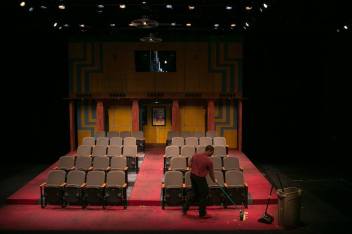
In 2UA Little Rock Flick014, Annie Baker’s The Flick won the Pulitzer Prize for Drama. The play mixes dialogue with long moments of no spoken words as the characters perform tasks on stage.

It is set in a run-down Massachusetts movie theatre and focuses on three millennials as they endure modern-day situations of race, class, and economy, all while working as underpaid employees.  The three actors are tasked with performing the cleaning of the set, just as the characters would be doing in between showings.  The original production received mixed reviews and sharply divided the audiences who saw it.  Feelings that were expressed ranged from brilliant to boring.

In February 2017, UA Little Rock’s Theatre and Dance Department presented the play.  It may have been the first production of it in Arkansas, it was certainly the first in Little Rock.  Giving the students the chance to work on such a new and challenging play is an example of the value of educational theatre.

2018 marks the 100th anniversary of the first Pulitzer Prize for Drama being given. To pay tribute to 100 years of the Pulitzer for Drama, each day this month a different Little Rock production of a Pulitzer Prize winning play will be highlighted.  Many of these titles have been produced numerous times.  This look will veer from high school to national tours in an attempt to give a glimpse into Little Rock’s breadth and depth of theatrical history.

90 years of Maya Angelou

Though she left this earth physically in 2014, Maya Angelou’s work and legacy continue on in the lives she touched and her writings.   Ninety years ago today, she was born in St. Louis.

On February 23, 1998, Maya Angelou appeared with the Arkansas Symphony Orchestra in a concert at Robinson Center.  The evening featured Dr. Angelou narrating Joseph Schwantner’s tribute to Dr. Martin Luther King Jr., “New Morning for the World.”

Dr. Angelou, a former resident of Stamps, Arkansas, was not a stranger to Little Rock. She had appeared before at Wildwood Park and would later appear at the Clinton Presidential Center.

A former Poet Laureate of the United States and Tony nominated actor, she won a Grammy Award for her reading of “On the Pulse of the Morning” which had been written for the first inauguration of Bill Clinton as President of the United States.

A poet, author, educator, dancer, singer, actor, and activist, she wrote seven autobiographies. The most notable was arguably I Know Why the Caged Bird Sings.  Born in St. Louis, she spent part of her childhood in Arkansas before moving to California.  She led a peripatetic life both geographically and career-wise ending as a professor at Wake Forest and residing in North Carolina.  It was there that she died in May 2014.

One of the ways her work continues is through the Celebrate Maya project which is led by Janis Kearney.

Pulitzers play Little Rock – Arkansas Rep’s 2013 DEATH OF A SALESMAN

Rep SalesmanOne of the seminal plays of the 20th century, Death of a Salesman explored and exploded the post-war view of the American Dream.  Arthur Miller won his only Pulitzer Prize for this play.

In 2013, Robert Hupp directed a production at the Arkansas Repertory Theatre, where he was Producing Artistic Director at the time. It starred TV and stage actor Robert Walden, who was living in Arkansas then, and Broadway veteran Carolyn Mignini.  Avery Clark (who had starred in several Rep productions), Craig Maravich, William Metzo, Jay E Raphael and Joe Menino were also featured in key roles.

Members of the cast and creative team appeared in a panel as part of the Clinton School Speaker Series.  A video of that panel can be viewed here.

2018 marks the 100th anniversary of the first Pulitzer Prize for Drama being given. To pay tribute to 100 years of the Pulitzer for Drama, each day this month a different Little Rock production of a Pulitzer Prize winning play will be highlighted.  Many of these titles have been produced numerous times.  This look will veer from high school to national tours in an attempt to give a glimpse into Little Rock’s breadth and depth of theatrical history.