Tonight on the South on Main stage – Nora Jane Struthers & The Party Line

som nora janeTonight (February 18) at 8:00 PM, the Oxford American magazine is excited to welcome Nora Jane Struthers & The Party Line to the South on Main stage!

This is the third show of their Americana Series. Doors open at 6:00 PM, with dinner and drinks available for purchase at that time. This series is made possible by the presenting sponsor, Ben E. Keith Foods Mid-South Division, and in part by the generosity of The Summer Foundation.

Single tickets are still available. Here is the ticketing and seating information.


Born in Fairfax, Virginia, Nora Jane Struthers is a singer-songwriter based in Nashville. Performing with her band, The Party Line, the group has enjoyed critical acclaim since their formation in 2012. American Songwriter is calling the most recent release, Wake, “Nora Jane’s best album to date,” which speaks volumes about what’s happening on Nora Jane Struthers’ latest record. For the thirty-one year old singer-songwriter, it’s “wake” in several senses of the word. There’s the trail of a life and career behind her, the slipstream of lessons learned. There’s the quiet observance and letting go of who she has been up until now as both an artist and a person. And most of all, there’s the stirring of something new, an opening of a door and wide-eyed rush forward into a place of discovery and dizzying possibilities. And it’s all set to a soundtrack that resonates with the warm uplift of the first day of spring.

“The whole album is about strength through vulnerability,” she says. “That’s what I’ve come to as an artist, and a human being, and I think it’s the most powerful force in my life. I feel so much more like my childhood self now than I did over the past five years, than I have in my whole adult life. In my twenties, I had a tendency to compartmentalize pieces of my musical identity. For instance, how could I reconcile my love of both bluegrass and Pearl Jam? I did the same thing in my personal life, where I had this sort of idea of who I wanted to be, and ignored all these other pieces of myself, because I didn’t think they fit into some imagined big picture.”
Black History Month Spotlight – Central High School National Historic Site

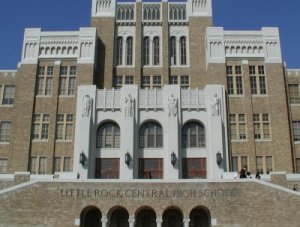
Little Rock 2011 036The new Arkansas Civil Rights History Audio Tour was launched in November 2015. Produced by the City of Little Rock and the University of Arkansas at Little Rock allows the many places and stories of the City’s Civil Rights history to come to life an interactive tour.  This month, during Black History Month, the Culture Vulture looks at some of the stops on this tour which focus on African American history.

In September 1957, Central High School was at the center of international attention when Gov. Orval E. Faubus ordered the National Guard to prevent nine black students from attending. President Dwight D. Eisenhower later federalized the National Guard and sent in federal troops to escort the students to class. The school became a crucial battleground in the struggle for civil rights. Dramatic media images of the conflict seared themselves into public memory.

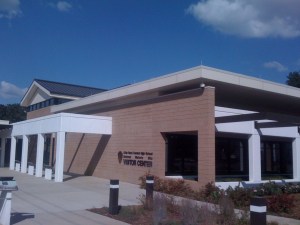
The Little Rock Central High School National Historic Site and Visitor Center opened in September 2007 to mark the fiftieth anniversary of the school’s desegregation. The interactive displays include interviews with the Little Rock Nine and historic video clips. The Center presents a broad view of civil and human rights struggles in the United States and around the world. Central High School is the only functioning high school in the United States to be located within the boundary of a national historic site.

The app, funded by a generous grant from the Arkansas Humanities Council, was a collaboration among UALR’s Institute on Race and Ethnicity, the City of Little Rock, the Mayor’s Tourism Commission, and KUAR, UALR’s public radio station, with assistance from the Little Rock Convention and Visitors Bureau.

Isaac Alexander takes the stage tonight at South on Main as part of Sessions series

som isaacNext for the South on Main February Sessions, curated by Amy Garland, Isaac Alexander takes the stage!

The concert begins tonight (February 17) at 8:30 pm.

Amy Garland says, “The first person who comes to mind when I hear the word “artist” is Isaac Alexander. He’s a prolific songwriter, multi-instrumentalist, performer, graphic designer, and illustrator. And he is a great guy! I met what I lovingly refer to as the “White County crew” when I met my husband, Bart, many moons ago. He was playing with some young fellas (Big Silver) from Searcy. Led by Isaac, they were just starting to play in Little Rock, so I asked them to open for me at Juanitas. That was all she wrote.”

Isaac Alexander has been playing, writing, and recording in Little Rock since 1999 and has put out a total of twelve records under various band names—Big Silver, The Easys, Molten Lava, Greers Ferry to name a few. He’s played drums in the legendary Little Rock band, The Boondogs and has played and recorded with a number of local artists, including The Salty Dogs, Brother Andy and His Big Damn Mouth, Cosby, The Big Cats, Jonathan Wilkins, Jesse Aycock, Chris Micheals, and Jim Mize.

The last few years Alexander has been working on solo albums with his friends. He has so far released See Thru Me and Antivenin Suite and is working on a third record presently. See Thru Me was No. 6 on the Arkansas Times Music Poll’s best Arkansas albums list.

Black History Month Spotlight – Central High School

centralentranceThe new Arkansas Civil Rights History Audio Tour was launched in November 2015. Produced by the City of Little Rock and the University of Arkansas at Little Rock allows the many places and stories of the City’s Civil Rights history to come to life an interactive tour.  This month, during Black History Month, the Culture Vulture looks at some of the stops on this tour which focus on African American history.

In September 1957 Little Rock’s Central High School made headlines around the world in a struggle over school desegregation. In its 1954 Brown v. Board of Education decision, the United States Supreme Court declared an end to segregated schools. Little Rock drew up a gradual plan for desegregation starting with Central High. The local branch of the National Association for the Advancement of Colored People opposed the plan on the grounds that it was too slow moving, but the federal courts upheld it. The night before the school was due to desegregate, Gov. Orval Faubus surrounded Central with National Guard soldiers. The next day, black students were denied entry.

Eventually, Faubus was persuaded to remove the soldiers. When nine black students attempted to desegregate the school, a white mob formed outside. The students were removed for their safety. Finally, President Dwight D. Eisenhower sent in federal troops to desegregate the school. Even then, the ordeal of the Little Rock Nine was not over. They suffered numerous attacks inside the school. At the end of the school year Ernest Green, the only senior in the group, became the first black student to graduate from Central in May 1958.

The app, funded by a generous grant from the Arkansas Humanities Council, was a collaboration among UALR’s Institute on Race and Ethnicity, the City of Little Rock, the Mayor’s Tourism Commission, and KUAR, UALR’s public radio station, with assistance from the Little Rock Convention and Visitors Bureau.

“The Good Story: Inspiring Leadership” is focus of Clinton School program this evening

uacs hafreyLeigh Hafrey, author and a senior lecturer at the MIT Sloan School of Management, has worked in professional ethics for over two decades, with a focus on ethical leadership, teaching college courses at Harvard Business School and MIT and consulting for private organizations around the world. For 17 years, along with his wife, Sandra Naddaff, Hafrey was a co-Master of Mather House, one of the 12 residential complexes in Harvard College.

Hafrey is a sought after expert on the relationship between storytelling and inspiring leadership.  He has been featured at conferences all over the world discussing the connection between leadership and the ability to tell a good story.  As he told The Power of Storytelling in 2015:

Storytelling supplies a narrative logic to events past, present, and future. Presentations by definition work with the principles of storytelling: plot, place, character, conflict and resolution.  Some people do it better than others, and those individuals reach leadership positions in part because of their skill as storytellers. Think Gandhi, Martin Luther King, Jr., Aung San Suu Kyi, Muhammad Yunus and Vaclav Havel.

In his most recent book, War Stories: Fighting, Competing, Imagining, Leading, Hafrey covers the arc of military American self-perception on the screen, in print, and in public conversation over the past 20 years.

Black History Month Spotlight – Joseph Taylor Robinson Auditorium

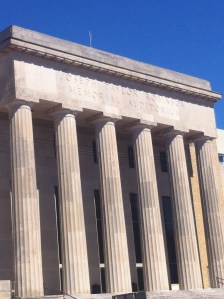
IMG_7690The new Arkansas Civil Rights History Audio Tour was launched in November 2015. Produced by the City of Little Rock and the University of Arkansas at Little Rock allows the many places and stories of the City’s Civil Rights history to come to life an interactive tour.  This month, during Black History Month, the Culture Vulture looks at some of the stops on this tour which focus on African American history.

In March 1974, Little Rock hosted the second National Black Political Convention at the Joseph T. Robinson Auditorium and Camelot Hotel (now a Doubletree Hotel). The first convention was held in Gary, Indiana, in 1972, and garnered much publicity, producing a National Black Political Agenda that included demands for the election of a proportionate number of black representatives to Congress, community control of schools, and national health insurance. The Little Rock convention was co-convened by Congressman Charles Diggs of Detroit, Michigan; Mayor Richard Hatcher of Gary, Indiana; and poet Amiri Baraka. Plenary speakers included Atlanta Mayor Maynard Jackson and comedian and activist Dick Gregory. Jesse Jackson was also in town for the convention. The convention featured a moving testimonial and tribute to local civil rights leader Daisy Bates at Central High School.

For many years, the lower Exhibition Hall of Robinson Auditorium hosted many concerts, dances and sporting events, popular with black audiences. However, because the large concert hall upstairs had segregated seating, Duke Ellington declined to play there in 1961. Louis Armstrong played to the first integrated audience in 1966 after the 1964 Civil Rights Act ended segregation in public facilities and accommodations.

The app, funded by a generous grant from the Arkansas Humanities Council, was a collaboration among UALR’s Institute on Race and Ethnicity, the City of Little Rock, the Mayor’s Tourism Commission, and KUAR, UALR’s public radio station, with assistance from the Little Rock Convention and Visitors Bureau.

Little Rock Look Back: Robinson Auditorium opens in 1940

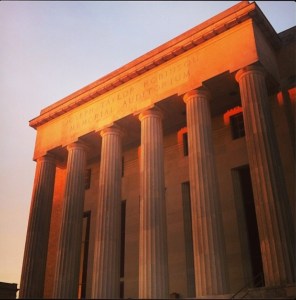
auditoriumduskOn February 16, 1940, after three years of planning and construction including several delays due to lack of funding, the Joseph Taylor Robinson Memorial Auditorium officially opened. It was a cold, rainy night, but those in attendance did not care.

Searchlights painting arcs in the sky greeted attendees. They were borrowed from the Arkansas National Guard. Newspaper accounts noted that only a few of the men who attended were in tuxedos, most were simply in suits. The work to get the building opened had been so harried, that it was discovered there was not an Arkansas Flag to fly in front of the building. Mayor Satterfield found one at the last minute courtesy of the Arkansas Department of the Spanish War Veterans.

The weather delayed arrivals, so the program started fifteen minutes late. Following a performance of Sibelius’ Finlandia by the fledgling Arkansas State Symphony Orchestra, Mayor J. V. Satterfield, Mrs. Joseph T. Robinson, Mrs. Grady Miller (the Senator’s sister-in-law and a member of the Auditorium Commission) and D. Hodson Lewis of the Chamber of Commerce participated in a brief ribbon cutting ceremony. Mrs Robinson cut the ribbon on her second attempt (once again proving that nothing connected with getting the building open was easy).

The ceremony was originally set to be outside of the building but was moved indoors due to the inclement weather. The ribbon cutting took place on the stage with the ribbon stretched out in front of the curtain. The opening remarks were broadcast on radio station KGHI.

Mr. Lewis, Mrs. Miller and Mayor Satterfield look on as Mrs. Robinson cuts the ribbon

Mr. Lewis, Mrs. Miller and Mayor Satterfield look on as Mrs. Robinson cuts the ribbon

Though he had previously discussed how he had voted against the auditorium in 1937 before entering public life, the mayor’s remarks that evening were appropriately gracious, statesmanlike and a testament to the effort he had invested to get it open upon becoming mayor. “We hope you have a very pleasant evening and hope further that it will be the first in a long series which you will enjoy in this, your auditorium.”

Tickets for the event, advertised as being tax exempt, were at four different pricing levels: $2.50, $2.00, $1.50 and $1.00.

The estimated attendance was 1700. Following the ribbon cutting, the main performance took place. The headliner for the grand opening was the San Francisco Opera Ballet accompanied by the new Arkansas State Symphony Orchestra (not related to the current Arkansas Symphony Orchestra). The featured soloist with the ballet was Zoe Dell Lantis who was billed as “The Most Photographed Miss at the San Francisco World’s Fair.”

At the same time that the gala was going on upstairs in the music hall, a high school basketball double-header was taking place in the downstairs convention hall. North Little Rock lost to Beebe in the first game, while the Little Rock High School Tigers upset Pine Bluff in the marquee game.