David Starr & Ben Harris headline tonight’s Local Live at South on Main

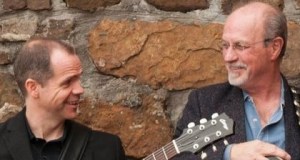
llsom dsbhThis week’s installment of South on Main’s Local Live concert series features David Starr & Ben Harris.  Presented by the Oxford American magazine, Local Live showcases the best of local and regional music talent and is always free and open to the public. Call ahead to South on Main to make your reservations and ensure a table: (501) 244-9660.

The concert starts at 7:30 tonight (January 13).


David Starr is a singer/songwriter/musician with Arkansas roots and a Colorado mountain address. He has shared the stage with artists as diverse as John Oates, Kenny Edwards, John McEuen, Dan Fogleberg, and Sonny Bono.

His sixth solo album, Love and Sabotage, includes fifteen songs (originals, co-writes and one cover) as well as cameo vocal and instrumental performances by John Oates, Steve Cropper, Richie Furay, and Dana Cooper.

Starr tours stateside and in the UK, both as a solo artist and with guitarist Ben Harris. He also fronts the David Starr Band several times a year. Ben Harris is a versatile guitarist and educator based in Fayetteville, Arkansas, he is the Instructor of Guitar at the University of Arkansas.

Free performance by ASO Rockefeller Quartet at the Capital Hotel this evening at 5:15

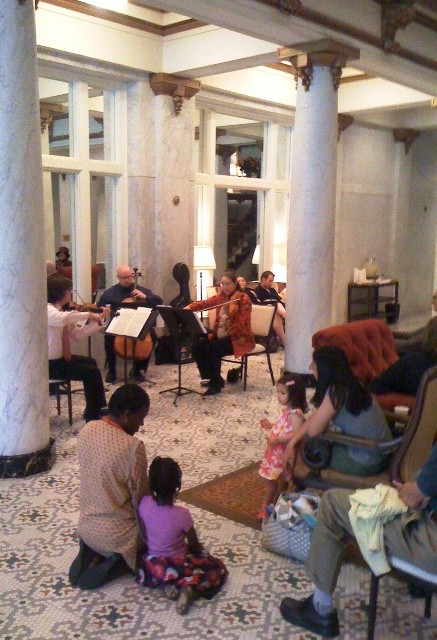
ASO at CHMusicians from the Arkansas Symphony Orchestra will be performing this evening (January 13) in the lobby of the historic Capital Hotel. The music will start at 5:15 pm.

The concert will feature the Rockefeller Quartet.  Members of the quartet will introduce the pieces to be performed.

The Rockefeller Quartet will perform an eclectic program featuring tangos, Scott Joplin Rags, selections from Beethoven and Borodin, and even a popular surprise.

Unlike concerts in music halls, guests here are encouraged to bring drinks to their seats or to stand and move around while the musicians are playing.  It is a relaxed, informal atmosphere where the audience and musicians alike are able to interact with each other.

In 2011, the ASO started these free concerts in the lobby of the Capital Hotel.  The marble and tile of this historic lobby provide a wonderful acoustic backdrop for the musicians.

Reinventing the Classroom, Rethinking Education this evening at the Clinton School

This evening (January 12) at 6pm at the Clinton School, Dr. Harry Lewis will be discussing “Reinventing the Classroom, Rethinking Education.

Harry Lewis, the Gordon McKay Professor of Computer Science in the School of Engineering and Applied Sciences at Harvard University, is the author of numerous books and articles, including his celebrated book on higher education, “Excellence Without a Soul: Does Liberal Education Have a Future?”

As a member of the Harvard faculty since 1974 and the former Dean of Harvard College, he has helped launch thousands of Harvard undergraduates, including both Bill Gates and Mark Zuckerberg, into careers in computer science.

With “Reinventing the Classroom, Rethinking Education,” Lewis explores the movement of information online and how it challenges the old rule of the lecture hall as the place where information from the professor is passed on to the students, while also exploring the emergence of mass online education and rethinking how faculty use classroom time.

Architecture Design Network tonight presents Tommy Pacello discussing Innovations in City Building

150511_Tommy_U3_Philly_Langdon_004INNOVATIONS IN CITY BUILDING: Lessons from Memphis, a lecture by Tommy Pacello

     DATE: Tuesday, January 19, 2016

    TIME:  6:00 p.m., preceded by a reception at 5:30 p.m

PLACE: Arkansas Arts Center, 9th and Commerce, Little Rock, AR

Tommy Pacello will talk about lessons to be learned from the Memphis (TN) Mayor’s Innovation Delivery Team (MMIDT), a body charged with helping struggling city neighborhoods become economically viable once again. Tasked with bringing about change, team members, with the assistance of public-private partnerships, work with distressed  communities as they deal with the challenges of urban blight, vacant properties, youth gun violence and the lack of adequate community services. Through the team’s efforts many distressed neighborhoods have been made livable again and enabled to sustain their viability.

Tommy Pacello is an attorney and city planner. He specializes in innovative yet pragmatic approaches to city buildings. He is currently consulting with U3 Advisors developing an Anchor Strategy around nine institutional anchors in Memphis, TN.

Prior to working with U3 Advisors, Tommy served as the Director of the Innovation Delivery Team in Memphis, Tennessee. This non-profit team, originally funded by Bloomberg Philanthropies, is charged with developing strategies to address the city’s most pressing challenges. In Memphis, the team’s focus is on generating economic vitality in core city neighborhoods, reducing youth gun violence, reducing the number of blighted and vacant properties, and improving service delivery among city departments.

Tommy previously worked with the Austin, Texas based firm Code Studio where he managed several national planning and development code projects. Tommy started his career as an Assistant City Attorney in Memphis representing the city on legal matters involving planning, zoning, and constitutional law and managed the development of the city’s first unified development code.

Tommy was recently named one of the top 40 Real Estate Professionals under the age of 40 by Urban Land Magazine and serves as the Chairman of Mission Advancement for the Memphis Chapter of the Urban Land Institute. He is also actively involved with the Congress for the New Urbanism and is a frequent national speaker on civic innovation and urban issues.

Tommy earned his Bachelor of Business Administration from the University of Georgia, Terry College of Business, and a Master of City and Regional Planning from the University of Memphis’ School of Urban Affairs and Public Policy.  Tommy holds a Juris Doctor from the University of Memphis’ Cecil C. Humphreys School of Law.

Pacello’s lecture is free and open to the public. Reservations are not required.

ADN supporters include the Arkansas Arts Center, the UA Fay Jones School of Architecture and Design, the Central Arkansas Section of the Arkansas Chapter of the American Institute of Architects and friends in the community.

For additional information, contact ardenetwork@me.com .  

Little Rock Look Back: Little Rock City Hall resumes after Civil War

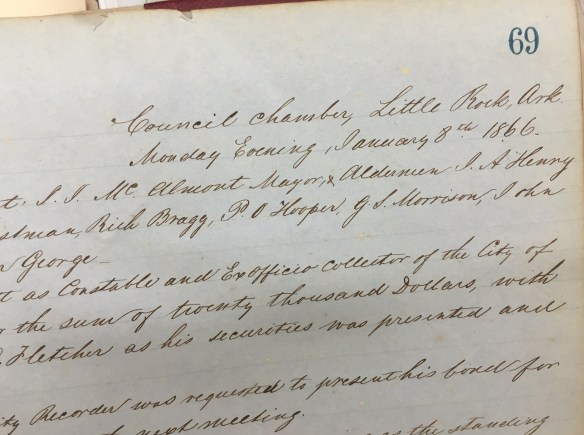
Jan 1866 minsOne hundred and fifty years ago this month, Little Rock City Hall resumed functioning after the Civil War.  The City government had disbanded in September 1863 after the Battle of Little Rock.  From September 1863 through the end of the war (on on through part of Reconstruction), Little Rock was under control of Union forces.

Following the April 1865 conclusion of the Civil War, plans were made to restart local government in Little Rock.  Even though Arkansas would not have Congressional representation in Washington until June 1868 (becoming the second Confederate state after Tennessee), the establishment of local government took place in January 1866.

The first City Council meeting took place on Monday, January 8, 1866. The council met again on Tuesday, January 9 and Monday, January 15 as they were trying to establish committees and rules for the new government.

The first post-Civil War mayor was Dr. J. J. McAlmont, who was a physician and pharmacist. Following his service as the city’s chief executive, he would later be a co-founder of what is now UAMS.  The initial aldermen were I.A. Henry (who had been on the City Council when it ceased in 1863), Henry Ashley, M. H. Eastman, Rick Bragg, P. O. Hooper, G. S. Morrison, John Collins and Alexander George.

Their first action was to approve the bond of Thomas C. Scott as Constable and City Collector.  Vouching for him were S. H. Tucker and John Gould Fletcher.  The Recorder was asked to present his bond and the next meeting.

The Mayor then established several committees of the City Council and named his appointments. Among the committees were Finances, Streets, Ordinances, Mount Holly Cemetery, Fire Department and Police.

That meeting and the following two meetings, the City continued to approve motions, resolutions and ordinances to set up the duties and responsibilities of a government.

Ordinance Number 1 established the rates of Licenses for 1866.  Among those were:

  • $100 for the privilege of selling goods at auction
  • $20 for a one-horse wagon, paid quarterly
  • $35 for a two-horse wagon, paid quarterly
  • $50 for a four-horse wagon, paid quarterly
  • $25 to run a cab or bus (which would have been in some horse drawn conveyance), paid quarterly
  • $40 a month to sell liquor, wine, ale, beer, etc., by the glass or bottle to be consumed in a store, tavern, shop or store
  • $25 each quarter for each billiard table
  • $50 each quarter for each ten pin alley


Little Rock Look Back: Robinson Baskeball Arena

Former entrance to Robinson off Garland Street. Used to attend basketball games.

Former entrance to Robinson off Garland Street. Used to attend basketball games.

While Joseph Taylor Robinson Memorial Auditorium is known today as a performance and meeting venue, in its early days it was also the home to sports. Seventy-six years ago tonight the first basketball game was played at Robinson.

One of the first regular activities which took place in the lower level exhibition hall was a series of boxing and wrestling matches.  Building on the success of this, basketball came to the convention hall in January 1940.

A series of games featuring Little Rock High School and North Little Rock High School were announced by Coach Earl Quigley to take place from January 11 through February 16, the official opening day for the facility.

At that time, neither high school had a gymnasium; therefore both schools played their basketball games on their school auditorium stages with fans seated in the audience. The convention hall offered a regulation size floor (made of pecan block parquet) with seating for over 1,300 people along the sidelines and in the balcony.  The first men’s basketball game in Robinson Auditorium took place between the Little Rock High School Tigers and the North Little Rock High School Wildcats on January 11, 1940.

The Tigers lost the game before a crowd estimated to be 1,300.  Earlier in the evening there had been an exhibition between two women’s basketball teams.  The cost for admission to the games was 35 cents for the reserved seating and 25 cents for general admission.

Little Rock Look Back: Final meeting of Pulaski Heights City Council

Final PHCC mtg

The signatures by Recorder A. M. Edwards and Mayor L. H. Bradley on the final Pulaski Heights City Council minutes.

100 years ago today, the Pulaski Heights City Council held its final meeting.  Following the January 4 annexation election, Mayor L. H. Bradley convened the Pulaski Height City Council for the final time on January 10, 1916.

Five of the eight aldermen were present for the final meeting.  E. T. Reaves, R. G. Trickett, W.A. Turner, J. B. Webster, and H.C. Locklar.  Absent were J. S. Murphy, J.H. Hicks, and W. H. Keeton.

The City Recorder was A. M. Edwards, while O. E. White was Treasurer and Jonathan P. Streepey was City Attorney.

At the meeting, bills were paid and allowances were made for the transfer of assets and responsibilities to the City of Little Rock.  The minutes do not reflect if there were any valedictory addresses by any of the elected officials, which were common at that era.

Once Mayor Bradley and the Council had worked their way through the agenda, Alderman Reaves made the motion to adjourn the council sine die which was seconded by Alderman Webster. The motion passed unanimously.  With that, the Pulaski Heights City Council, which had first met in 1904, finished its business.