Little Rock Look Back: Mayor C. P. Bertrand

Bertra1On November 23, 1808, future Mayor Charles P. Bertrand was born in New York.  He was the son of Pierre and Eliza Wilson Bertrand; his father died in 1809 in an uprising in Haiti and his mother eventually remarried.  With her new husband, Dr. Matthew Cunningham, she and the family moved to Little Rock in 1820.

After apprenticing with family friend William Woodruff at the Arkansas Gazette, Bertrand opened the Arkansas Advocate newspaper.  He later studied law under Robert Crittenden and entered the legal profession.

In 1835-1836, he served as State Treasurer for the Arkansas Territory, and in 1836 as secretary for the first constitutional convention. He was a member of the Arkansas House of Representatives from 1840-1841 and 1844-1849.

Bertrand followed in his stepfather’s footsteps and became Mayor of Little Rock.  (Dr. Cunningham had been the first Little Rock Mayor in 1831.)  He was in office from January 1855 through January 1857, serving two one-year terms.  He later served on the City Council and filled in as acting mayor. (Another influence on his upbringing was studying under future Mayor Jesse Brown who taught at the first school in Little Rock.)

Bertrand, as acting mayor, was involved in the negotiations of the surrender of Little Rock to federal troops in 1863.  He also later corresponded with President Lincoln on behalf of Little Rock citizens.

Though a staunch Confederate, his good will toward the Union soldiers and federal officials is credited with helping to save Little Rock from the destruction which befell many other Southern cities.  He is also credited with delaying the start of the Civil War.  Prior to the attack on Fort Sumner, members of the Arkansas Militia were planning to attack the Federal Arsenal at Little Rock during the absence of Governor Rector.  This would have been viewed as an act of war.  Bertrand was able to dissuade them from the attack.  Had he been unsuccessful, the Civil War would have likely started in Arkansas instead of South Carolina.

He had put his considerable fortune into Confederate money during the war. At the Civil War’s conclusion, the family was financially ruined. Though they had vast land holdings, those would be sold off in parcels to pay for taxes.

Bertrand died August 27, 1865, shortly after the conclusion of the Civil War.  He, like his mother, step-father, and several other relatives, is buried in Mt. Holly Cemetery.

Little Rock Look Back: Remembering JFK

JFK LROn November 22, 1963, President John Fitzgerald Kennedy was felled by an assassin’s bullet in Dallas.  A mere seven weeks earlier he had delighted crowds in Little Rock and at Greers Ferry.

Little Rock Mayor Byron Morse issued a proclamation declaring November 25, 1963, an official day of mourning in Little Rock.  On December 2, 1963, the Little Rock City Board passed a resolution mourning the loss of President Kennedy and expressing their support for his successor President Johnson.

While he had made remarks to open the State Fair on that day in October, the President was actually in the state to speak at the dedication of the Greers Ferry Dam. He agreed to make that appearance as a part of a negotiation with Congressman Wilbur Mills as they were deadlocked over changes to the tax code.  He had previously visited Little Rock in 1957 when he came to the state to address the Arkansas Bar Association meeting in Hot Springs.  In his speeches, he went into detail praising the six members of Arkansas’ congressional delegation – each of whom held powerful leadership positions and committee chairmanships.

On the day after the President was killed, the Arkansas Gazette ran quotes from several Arkansas leaders, still shocked and in profound mourning.  Senator J. William Fulbright called the killing “a tragedy beyond words.”  Senator John L. McClellan noted he was “shocked beyond expression.”  Congressman Mills declared he was ‘too shaken and stunned to say much at this time.”  Congressman Oren Harris confessed he “could not adequately express” his feelings, while Congressman J. W. Trimble called it “very, very tragic” and Congressman E. C. Gathings termed it “a calamity.”

John Fitzgerald Kennedy was born on May 29, 1917, the second of nine children. Groomed for leadership by his father Joe and mother Rose, he was thrust even more into the path of political greatness following the World War II death of his elder brother Joe Jr.  A war hero himself, following his leadership after the attack of PT-109, he was first elected to Congress from Massachusetts in 1946. He would be re-elected in 1948 and 1950.  In 1952, he challenged incumbent Senator Henry Cabot Lodge and beat him.  He was re-elected to the Senate in 1958.


Following the oldest President (at the time), the young Kennedy administration seemed to captivate the country.  During his 1000 days in office, Kennedy faced many challenges both foreign (Bay of Pigs, Cuba missile crisis, start of Vietnam) and domestic (civil rights, organized crime). His ambitious “New Frontier” focused on education, additional services to rural areas and medical care for the elderly.  He also focused on getting the US to the moon.

Together with Franklin Roosevelt and Ronald Reagan, JFK embodied not only his generation but the mood of the country.  And his quotes resonate today including:

My fellow Americans, ask not what your country can do for you, ask what you can do for your country.

Let every nation know, whether it wishes us well or ill, that we shall pay any price, bear any burden, meet any hardship, support any friend, oppose any foe to assure the survival and the success of liberty.

Ich bin ein Berliner

Sculpture Vulture: Native Knowledge

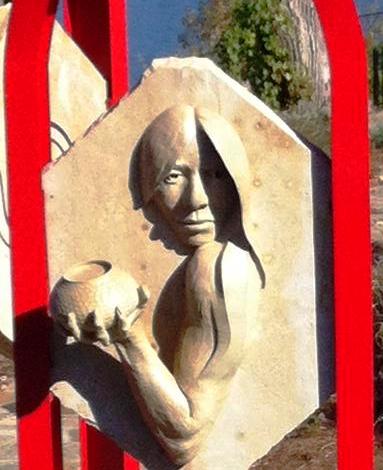
Native American Face

November is Native American Heritage Month.  One way to learn more about Native Americans in Little Rock’s history is to visit Riverfront Park.

There are several exhibits in the park that discuss the importance of Native Americans in this region prior to and since the settlement of Little Rock.  Denny Haskew’s Native Knowledge is a tribute to the Caddo, Osage, and Quapaw Native American Cultures of Arkansas.

It is sited near the Quapaw Line and La Petite Roche.  The location is important because the Quapaw Line was used as demarcation to separate the Quapaw Tribe from land available for white settlers.  It ran from La Petite Roche due south.  In addition, La Petite Roche was a stop along the “Trail of Tears” as Native American tribes were resettled from their original homes in the American Southeast to points west.

Three bronze twice life-size representational sculptures are mounted on 6” thick hexagonal buff colored sandstone panels suspended between I-beam arches representing the outline of theout canoes of the Osage, Caddo and Quapaw. The bronze sculptures are patinated to match the stone panels giving the appearance of being carved from stone. The back of each panel is etched with a pottery design from each of the three tribes mentioned above.

Late Night at South on Main tonight – Big Piph & Tomorrow Maybe

big-piph-34.jpg.190x140_q60_cropSouth on Main brings Big Piph & Tomorrow Maybe back to their stage tonight!

Doors open at 4:00 PM, show begins at 10:00 PM. Wristbands can be purchased for $15 after doors open. Call (501) 244-9660 to reserve your table for this show in advance.

“One of Arkansas’ best bands” and “hip-hop ensemble” are terms often used for the collective known as Big Piph & Tomorrow Maybe. However, although they are both deserving titles, they have proven to be too confining of descriptions. The creativity, work, and showmanship that BPTM put into their jazz, soul, funk, and rock infused hip-hop experiences will soon have them recognized as one of the best bands.. period.

Although he was already enjoying a successful solo rap career, Epiphany looked to further separate himself from the pack of competitive emcees by joining forces with a stellar live band, and in 2012 he did just that. Each of the seven members approaches the apex of their field and is a “frontman” in their own right. However, when their paths finally overlapped, the collective of Paul Campbell (percussion), Dre Franklin (keys), Bijoux Pighee (vocals), Epiphany “Big Piph” Morrow (MC/lead vocalist), Dee Dee Jones (vocals), “Cool Hand” Lucas Murray (guitar), and Corey Harris (bass) formed something special.

Arkansas Sounds brings legendary Cate Brothers Band to Ron Robinson Theater tonight

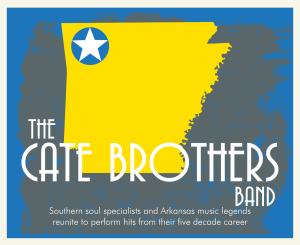
cate_brothersArkansas Sounds music series brings Arkansas music legends The Cate Brothers Band to the Ron Robinson Theater stage tonight.  The band reunites for a special performance of their biggest and best songs.

Arkansas music legends Earl and Ernie Cate, twin brothers from Fayetteville, Arkansas, performed southern soul music in the mid-1960s at clubs throughout the South. Both are singers, with Earl on guitar and Ernie on piano. Since the mid-1970s, they have been prolific performers and recording artists of their signature blued-eyed soul and rock music.

At this special performance, they will perform their biggest and best songs, including their Top 25 hit, “Union Man.”

Admission is $20, the concert starts at 7pm.

Arkansas Sounds is a project of the Butler Center for Arkansas Studies, a department of the Central Arkansas Library System. Focused on Arkansas music and musicians both past and present, Arkansas Sounds presents concerts, workshops, and other events to showcase Arkansas’s musical culture.

Jonathan William Moyer organ recital tonight

cacago moyerThe Central Arkansas Chapter of the American Guild of Organists welcomes Jonathan William Moyer for a recital tonight.  It starts at 8pm at Pulaski Heights United Methodist Church and is free.

Jonathan William Moyer maintains a dynamic career as an organist, pianist, singer, and conductor. He has performed throughout the United States, Europe, and Japan, including such venues as Washington National Cathedral, the Musashino Civic Cultural Hall in Tokyo, and at the Dvôrák Spring Festival in Prague and Vienna. He is a member of the critically acclaimed early music vocal ensemble Quire Cleveland.

At the Church of the Covenant in Cleveland, Moyer oversees a music program consisting of a professional and amateur choir, children’s youth and handbell choirs, one of Cleveland’s largest pipe organs (E.M. Skinner/Aeolian Skinner/Holtkamp), the Newberry baroque organ (Richards Fowkes), and a 47-bell Dutch carillon.

In 2008, Moyer performed the complete organ works of Olivier Messiaen in four recitals at the Cathedral of Mary Our Queen in Baltimore, celebrating the centenary of the composer’s birth and the renovation of the cathedral’s organ. Also that year, he received second prize in the Sixth International Musashino Organ Competition in Tokyo, Japan. In 2005, he was one of four finalists in the St. Albans International Organ Competition. He has served on the executive committee of the Cleveland Chapter of the American Guild of Organists.


Music inspired by Shakespeare focus of program with youth divisions of ASO and Ballet Arkansas

ballet_and_ASOYEThe future of the arts is on display tonight in downtown Little Rock at the Albert Pike Memorial Temple at 7:30pm

The Arkansas Symphony Youth Orchestra and Ballet Arkansas Preparatory Program present their annual partnership and a celebration of the 400th anniversary of Shakespeare’s death.  The music comes from musical works adapted from Shakespeare’s plays.

The program includes music from Prokofiev’s Romeo and Juliet Suite No. 2, Bernstein’s West Side Story and Mendelssohn’s “A Midsummer Night’s Dream.” ASYO is the premier ensemble of the Arkansas Symphony Youth Ensembles Program.


For the 3rd consecutive year, the dancers from Ballet Arkansas’ Preparatory Program under the direction of Kim Nygren Cox join the members of the Arkansas Symphony Youth Orchestra under the direction of Geoffrey Robson for a joint performance.

Don’t miss this delighful collaboration! $20 General Admission, $10 for Students