

A Rep-trospective

It was one year ago today, on April 24, 2018, that the Arkansas Repertory Theatre announced it was cancelling its last production of the season and suspending operations.

Most of its fans were in shock.  Some had heard rumblings that not everything was copasetic financially.

As supporters worked through the stages of grief, they asked: “How had this happened?” “Is there a path forward?” “What can we do to Save the Rep?”

In the coming days it was confirmed that the situation had not happened overnight. As with many other businesses and people, the Rep had been living off of future proceeds. And when those failed to materialize from ticket sales and donations, something drastic had to be done.

And many things were done.

After the decision to suspend operations and lay off most of the staff (with the remaining staff having no assurances of continued employment come Labor Day), longtime supporters Ruth Shepherd and Bill Rector stepped in as part of a volunteer interim leadership team.  Together with Board members and other supporters they were able to map out a strategy to stem financial losses which gave the organization a modicum of breathing room in order to assess more permanent next steps. (Incidentally, Rector’s father performed much the same function for the Arkansas Arts Center fifty years earlier in 1968 when it had faced a similar situation.)

Rep founder Cliff Fannin Baker stepped in to as interim artistic director to help determine options for moving forward, provided that finances stabilized.

The John & Robyn Horn Foundation approved a challenge grant of $25,000 designated for “General Support” and the Windgate Charitable Foundation provided a challenge grant for $1,000,000, with an initial payment of $75,000 for operating needs. Unlike some challenge grants, Windgate did not withhold payment until the entire $1,000,000 had been raised.

Community leaders including Skip Rutherford and Stacy Sells staged a “Save the Rep” rally which drew hundreds of people to Main Street on a sweltering May evening and raised money for the Rep.

Education offerings continued at the Rep’s annex on Main Street and, in fact, were expanded under the leadership of Anna Fraley Kimmell.

One of the Rep’s problems had been it owned four properties which made it real estate rich, but cash poor.  In August, the Rep sold an apartment building used to house visiting actors.  The sale cut the property debt in half and offered some much-needed financial assets.  Also that month, the biennial Gridiron show pledged all of its proceeds to support the Rep.

Focus groups and community meetings garnered input from patrons throughout Central Arkansas.

Then, just as it appeared the Rep was hitting its stride on the way to renewal, the unthinkable happened.  Baker suffered an aneurysm and died a few days later.  In addition to working on setting the season, he was set to direct the first show of the rebooted Arkansas Rep.

Through grief, the Rep continued to push forward.  In November, the new season was announced. It would be four shows plus a youth show running throughout 2019.  A few weeks later, the Rep’s new leadership was announced.

Tony winning Broadway producer Will Trice, a Little Rock native who acted on the Rep’s stage in the 1990s as a teenager, would become the theatre’s Executive Artistic Director.  While he won’t be in Little Rock as a full-time resident until the summer, he is already on the job as he splits his time between New York City and Little Rock.  The staff is gradually getting built out, as well.

Native Gardens opened last week as the second production of the season (following February’s run of Chicago).

Whither Arkansas Rep in the future?

Long-term financial stability is still a goal, not yet a guaranteed reality.  Finances are in better shape, to be certain.  But the fact remains – theatre is expensive. Even though the Rep has a leaner structure, there are basic levels that cost.  There still is the ever-present balancing act of offering productions that audiences will want to see yet are economically feasible.

The influx of money that was given over the past year must be maintained…and grown. Each year! There is not an apartment building to sell for $750,000 this year.  While there are ticket sales, unlike this time last year, those sales are not pure profit. And the profit margin on musicals is traditionally smaller than on plays.

Audiences cannot lapse into the “Arkansas Rep has reopened, all crises averted” fallacy.  Their attendance, their money, their passion, their excitement, their word of mouth, their money (yes it is that crucial that it bears repeating) is needed.  In non-profit theatre, ticket sales NEVER cover all the costs. This applies to Rep, for certain. And while no dollar amount is too small, moving it forward will require people to increase their investment.

And the Rep’s financial need is not occurring in a vacuum. Major cultural institutions and smaller organizations are also needing financial support.  Area universities are struggling because of declines in student enrollment (due partially to dropping birth rates two decades ago) so they need increased donations to sustain operations. Few large Arkansas-based businesses are able to provide substantial contributions.

When it comes to the Rep and other cultural entities, it cannot be either/or. It must be a both/and mentality.

So…. Where is Arkansas Rep today?

Certainly better off than it was a year ago.

It has defied the odds and come back from the suspension of operations. Many, if not most, theatres that take a pause never resume.

There is a lot of work left to do. But with a collective effort, it is possible.

To quote from Tony Kushner’s Pulitzer Prize winning Angels in America, which the Rep produced in the 1990s, “The world only spins forward. We will be citizens. The time has come. … More Life. The Great Work Begins.”

“Project Row Houses at 25” is focus of Architecture and Design Network June Freeman Lecture tonight

Image may contain: sky, tree, outdoor and nature

Architecture and Design Network (ADN) continues its 2018/2019 June Freeman lecture series by welcoming Eureka Gilkey, Project Row Houses’ Executive Director. Project Row Houses is a nonprofit organization in Houston, Texas that is dedicated to empowering people and enriching the Third Ward community through engagement, art and direct action. PRH was founded 25 years ago with a mission to be the catalyst for the transformation of community through the celebration of art and African American history and culture.

PRH’s work with the Third Ward community began in 1993 when seven visionary African-American artists recognized real potential in a block and a half of derelict shotgun houses at the corner of Holman and Live Oak. Where others saw poverty, these artists saw a future site for positive, creative, and transformative experiences in the Third Ward. So, together they began to explore how they could be a resource to the community and how art might be an engine for social transformation. This is how the PRH story began.

With the founders engaged with a community of creative thinkers and the neighbors around them, Project Row Houses quickly began to shift the understanding of art from traditional studio practice to a more conceptual base of transforming the social environment. While they were artists, they were also advocates.
Over the next 25 years the organization brought together groups and pooled resources to materialize sustainable opportunities for artists, young mothers, small businesses, and Third Ward Residents helping to cultivate independent change agents by supporting people and their ideas so that they have tools and capacity to do the same for others.

PRH is, and has always been a unique experiment in activating the intersections between art, enrichment, and preservation. The lecture will cover PRH’s rich 25 year history and how the nonprofit became an international model for artists and communities to address their needs for historic preservation and community enrichment.

Architecture and Design Network lectures are free and open to the public. No reservations are required. Supporters of ADN include the Fay Jones School of Architecture and Design, the Central Section of the Arkansas Chapter of the American Institute of Architects and friends in the community.

#5WomenArtists – Reita Walker Miller

November Birds 
1980
22 x 29 1/2 in.
watercolor on paper
Arkansas Arts Center Foundation Collection:
Gift of the Mid-Southern Watercolorists Exhibition. 1980.008

Through their social media campaign #5WomenArtists, the National Museum of Women in the Arts (NMWA) asks, “Can you name five women artists?

In response to that, this month five artists with Little Rock connections will be highlighted throughout March.  The final one for 2019 is Reita Walker Miller.

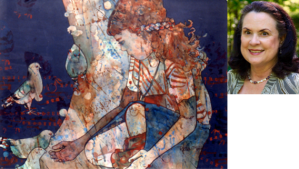
Reita mainly paints in watercolor. She has long been active in the Mid-Southern Watercolorists and held many leadership positions within the organization; she is currently serving as an at-large board member.

In addition to being a talented artist, she is known as an educator and encourager of others whether it is in watercolors or another artform.  She helped establish the art program at the Central Arkansas Library System during her tenure on staff there. She was also a founding member of Little Rock’s Arts+Culture Commission.

Her artwork is in numerous collections. The Arkansas Arts Center has three of her pieces in its permanent collection.

Women Making History – Jeannette Edris Rockefeller

Jeannette Edris Rockefeller only lived in Arkansas for about fifteen years. But her impact on the cultural life of Little Rock and all of Arkansas continues to be felt today.

Born and raised in Seattle, as a young mother she met Winthrop Rockefeller while both were in New York.  He moved to Arkansas in 1953; after their 1956 marriage, she joined him. They split their time between Little Rock and Petit Jean.

In 1959, she was asked to become involved in plans for a new art museum in Little Rock.  She became a tireless advocate and fundraiser for the new Arkansas Arts Center.   In 1960, she assumed the role of president of the Arkansas Arts Center Board of Trustees, a position she held until 1968.  During that time period she oversaw the planning, construction and opening of the building.  She also invited Townsend Wolfe, who she had met when he taught some classes at the Arts Center, to apply to become the museum’s first executive director.

From 1967 to 1971, she was First Lady of Arkansas.  In that capacity, she supervised renovation of the Governor’s Mansion and started the tradition of displaying art on the walls.

Shortly after her 1971 divorce from Rockefeller, she relocated to California.  She continued to be a supporter of the Arts Center.  One of the galleries in the Arts Center is named in her honor.  In addition, one of the sculptures on the lawn of the Arts Center, Standing Red, was dedicated in 1970 in recognition of her service on the Arts Center Board.

G-O-N-E. Final weekend for CHARLOTTE’S WEBB at Arkansas Arts Center Children’s Theatre

Charlotte's WebThe 2018–2019 Arkansas Arts Center Children’s Theatre continues this spring with Charlotte’s Web. The closes on Sunday, March 31, 2019. Performances of Charlotte’s Web are Fridays at 7 p.m. and Saturdays and Sundays at 2 p.m. Tickets are $10 each for Arkansas Arts Center members or $12.50 for non-members.

Wilbur the piglet is the runt of his litter. But under the loving care of eight-year-old Fern Arable—and due in no small part to the delicious and plentiful slops on her Uncle Homer’s farm—Wilbur grows up into a fine specimen of a pig. Pink and plump and so polite.

Yep. Wilbur is no ordinary pig, and thanks to the acrobatic web-writing of his friend Charlotte, a kindly barn spider, the world soon learns just how “terrific” and “radiant” he is. But Charlotte’s greatest gift to Wilbur goes beyond just flattering words spun in a web. Through this gentle creature, he experiences the true meaning of responsibility, friendship, and loyalty. Come join in this heart-warming barnyard adventure and marvel at the wonder of Charlotte’s web.

Charlotte’s Web is based on the book by E. B. White. It was adapted by Joseph Robinette. The Arkansas Arts Center Children’s Theatre’s production of Charlotte’s Webis directed by Katie Campbell. Bradley D. Anderson is the Artistic Director. Original music was composed by Lori Isner, set design by Vandy Scoates, costume design by Erin Larkin, properties design by Cathleen Brignac, and lighting design by Mike Stacks. Rivka Kuperman is the stage manager. Charlotte’s Web is produced with special arrangement with DRAMATIC PUBLISHING, Woodstock, Illinois

The cast includes:

  • Harper Keith of Alexander as Fern Arable
  • Jared Thomas Kneip Gibson of St. Louis as John Arable and Gander
  • Beck Hudelson of Little Rock as Avery Arable
  • Paige Carpenter of Little Rock as Mrs. Arable and President of the Fair
  • Braxton Johnson of Texarkana as Homer Zuckerman
  • Stephen Jones of Little Rock as Lurvy and Judge at the Fair
  • Walt Wenger of North Little Rock as Young Wilbur
  • Anthony McBride of Benton as Adult Wilbur
  • Mark Hansen of Little Rock as Templeton
  • Verda Davenport of Little Rock as Charlotte
  • Mackenzie Holtzclaw of North Little Rock as Goose and Judge at the Fair
  • Georgeann Burbank of Benton as Sheep and Judge at the Fair
  • Bethany Post of Austintown, Ohio as Uncle Pig, Reporter and Mrs. Carter
  • John Isner of Little Rock as Narrator

Darby Haddock, Kennedy Laster, and Reese von Storch are Baby Spiders. Via Benjamine Gahi, Isabelle Marchese, and Dylan Sykes are the ensemble.

#5WomenArtists – Marjorie Williams-Smith

Through their social media campaign #5WomenArtists, the National Museum of Women in the Arts (NMWA) asks, “Can you name five women artists?

In response to that, this month five artists with Little Rock connections will be highlighted throughout March.  Up next is Marjorie Williams-Smith. 

Marjorie Williams-Smith has worked with silverpoint for over 30 years. Silverpoint is an especially challenging medium, but that is part of the allure. The effect of light on the silver lines creates a shimmering quality that is quite different from any other drawing medium.

She draws with a metal stylus on a prepared surface.  Hatched and cross-hatched lines create values and textures.  The white of the page provides the contrast. Since erasing is not possible with silverpoint, every line has to be premeditated.

Silverpoint is the perfect medium for the subject matter of Marjorie’s work: nature. She uses these natural forms as symbols for the spiritual energy that exists within us all.

Two of her works were included in the recent exhibition: ON THEIR OWN TERMS which was on display at the University of Arkansas at Little Rock. Earlier this month, she received the Individual Artist Award at the 2019 Governor’s Arts Awards presented by Governor Asa Hutchinson and the Arkansas Arts Council.

#5WomenArtists – Robyn Horn

Through their social media campaign #5WomenArtists, the National Museum of Women in the Arts (NMWA) asks, “Can you name five women artists?

In response to that, this month five artists with Little Rock connections will be highlighted throughout March.  Up next is Robyn Horn. She is a talented artist who also is an avid collector and promoter of other artists.

Born in Fort Smith, Horn graduated from Hendrix College with a degree in art.  In the late 1970s, she was the photographer for Arkansas Parks and Tourism.

Her work as an wood artist started in 1983.  Since then, she has worked in a variety of styles that have evolved over the years. Horn is drawn to abstract, geometric sculpture, the volume of it, the form, the textures, the negative spaces. She is influenced by the nature of the material and its resistance to being changed and thinks in terms of wood and stone,.  Her works explore line and mass, the interplay of angles and planes to create effects of light and shadow, with a strong emphasis on visual grace, and a sense of structural strength and unity.  She has also resumed painting.

Currently her works can be seen at the Clinton Presidential Center (in the White House Craft exhibit which runs through the end of the month) and at Galleries at Library Square on the CALS campus. Her work is also part of the Arkansas Arts Center permanent collection as well as on display at Crystal Bridges and other locations throughout Arkansas and beyond.  In 2018, she published a book The Sculpture of Robyn Horn.