Little Rock Look Back: The Sun shines in as HAIR plays Robinson Center

Ad for the original production of HAIR in Little Rock. Note the ticket prices. And that they could be purchased at Moses Music Shops.

Ad for the original production of HAIR in Little Rock. Note the ticket prices. And that they could be purchased at Moses Music Shops.

Forty-five years ago today, on January 18, 1972, the musical Hair settled in for a week-long run at Robinson Auditorium.  The saga to bring the national tour to Little Rock had actually begun eleven months earlier.

In February 1971, a young Little Rock attorney named Phil Kaplan petitioned the Little Rock Board of Censors to see if it would allow a production of Hair to play in the city. He was asking on behalf of a client who was interested in bringing a national tour to Arkansas’ capital city. The show, which had opened on Broadway to great acclaim in April 1968 after an Off Broadway run in 1967, was known for containing a nude scene as well for a script which was fairly liberally sprinkled with four-letter words. The Censors stated they could not offer an opinion without having seen a production.

By July 1971, Kaplan and his client (who by then had been identified as Southwest Productions) were seeking permission for a January 1972 booking of Hair from the City’s Auditorium Commission which was charged with overseeing operations at Robinson Auditorium. At its July meeting, the Commissioners voted against allowing Hair because of its “brief nude scene” and “bawdy language.”

Kaplan decried the decision. He stated that the body couldn’t “sit in censorship of legitimate theatrical productions.” He noted courts had held that Hair  could be produced and that the Auditorium Commission, as an agent for the State, “clearly can’t exercise prior censorship.” He proffered that if the production was obscene it would be a matter for law enforcement not the Auditorium Commission.

The Commission countered that they had an opinion from City Attorney Joseph Kemp stating they had the authority. One of the Commissioners, Mrs. Grady Miller (sister-in-law of the building’s namesake the late Senator Robinson, she had served on the Commission since 1940), expressed her concern that allowing Hair would open the door to other productions such as Oh! Calcutta!

On July 26, 1971, Southwest Productions filed suit against the Auditorium Commission. Four days later there was a hearing before federal Judge G. Thomas Eisele. At that hearing, Auditorium Commission member Lee Rogers read aloud excerpts from the script he found objectionable. Under questioning from Kaplan, a recent touring production of Neil Simon’s Plaza Suite was discussed. That play has adultery as a central theme of one of its acts. Rogers admitted he found the play funny, and that since the adultery did not take place on stage, he did not object to it. Among those testifying in favor of it was Robert Reddington, who was director of performing arts at the Arkansas Arts Center.

Judge Eisele offered a ruling on August 11 which compelled the Auditorium Commission to allow Hair to be performed. Prior to the ruling, some of the Auditorium Commissioners had publicly stated that if they had to allow Hair, they would close it after the first performance on the grounds of obscenity. To combat this, Judge Eisele stated that the Commission had to allow Hair to perform the entire six day engagement it sought.

Upon hearing of the Judge’s ruling, Commissioner Miller offered a succinct, two word response. “Oh, Dear!”

In the end, the production of Hair at Robinson would not be the first performance in the state.  The tour came through Fayetteville for two performances in October 1971 at Barnhill Arena.

On January 18, 1972, Hair played the first of its 8 performances over 6 days at Robinson Auditorium.  In his review the next day, the Arkansas Gazette’s Bill Lewis noted that Hair “threw out all it had to offer” and that Little Rock had survived.

The ads promoting the production carried the tagline “Arkansas will never be the same.”  Tickets (from $2 all the way up to $8.50) could be purchased at Moses Melody Shops both downtown and in “The Mall” (meaning Park Plaza). That business is gone from downtown, but the scion of that family, Jimmy Moses, is actively involved in building downtown through countless projects. His sons are carrying on the family tradition too.

Little Rock was by no means unique in trying to stop productions of Hair.  St. Louis, Birmingham, Los Angeles, Tallahassee, Boston, Atlanta, Charlotte NC, West Palm Beach, Oklahoma City, Mobile and Chattanooga all tried unsuccessfully to stop performances in their public auditoriums.  Despite Judge Eisele’s ruling against the City of Little Rock, members of the Fort Smith City Council also tried to stop a production later in 1972 in that city. This was despite warnings from City staff that there was not legal standing.

Within a few years, the Board of Censors of the City of Little Rock would be dissolved (as similar bodies also were disappearing across the US). Likewise, the Auditorium Commission was discontinued before Hair even opened with its duties being taken over by the Advertising and Promotion Commission and the Convention & Visitors Bureau staff.  This was not connected to the Hair decision; it was, instead, related to expanding convention facilities in Robinson and the new adjacent hotel.  Regardless of the reasons for their demise, both bygone bodies were vestiges of earlier, simpler and differently focused days in Little Rock.

Little Rock Look Back: Mayor John Gould Fletcher

Future Little Rock Mayor John Gould Fletcher was born on this date in 1831. The son of Henry Lewis and Mary Lindsey Fletcher, he later served as a Captain in the Capital Guards during the Civil War. One of his fellow soldiers was Peter Hotze.
Following the war, he and Hotze began a general merchandise store in Little Rock. They were so successful that they eventually dropped the retail trade and dealt only in cotton. Peter Hotze had his office in New York, while Fletcher supervised company operations in Little Rock. In 1878 Fletcher married Miss Adolphine Krause, sister-in-law of Hotze.
John Gould Fletcher was elected Mayor of Little Rock from 1875 to 1881. He was the first Mayor under Arkansas’ new constitution which returned all executive powers to the office of the Mayor (they had been split under a reconstruction constitution). Following his service as Mayor, he served one term as Pulaski County Sheriff. Mayor Fletcher also later served as president of the German National Bank in Little Rock.
Mayor and Mrs. Fletcher had five children, three of whom lived into adulthood. Their son was future Pulitzer Prize winning poet John Gould Fletcher (neither father nor son used the Sr. or Jr. designation). Their two daughters who lived to adulthood were Adolphine Fletcher Terry (whose husband David served in Congress) and Mary Fletcher Drennan.
In 1889, Mayor Fletcher purchased the Pike House in downtown Little Rock. The structure later became known as the Pike-Fletcher-Terry House. It was from this house that Adolphine Fletcher Terry organized the Women’s Emergency Committee which worked to reopen the Little Rock public schools during the 1958-1959 school year.
In the 1960s, sisters Adolphine Fletcher Terry and Mary Fletcher Drennan deeded the house to the City of Little Rock for use by the Arkansas Arts Center. For several decades it served as home to the Arts Center’s contemporary craft collection. It now is used for special events and exhibitions.
Mayor Fletcher died in 1906 and is buried in Mount Holly Cemetery along with various members of his family. Several of his descendants still reside in Little Rock.

Little Rock Look Back: Groundbreaking for Museum of Fine Arts (forerunner to Arkansas Arts Center)

MFA postcardOn January 3, 1936, the ground was broken for the Museum of Fine Arts building in City Park.  The facility would face Ninth Street and be to the west of the Arsenal Tower Building.   That building was the one remaining structure of more than 30 which had populated the grounds when it was a federal military establishment.

Excavation for the building uncovered the foundation for another structure.  New footings for the Museum would be poured into the old footings.

The cornerstone would be laid in October 1936, and the building would open in October 1937.  The building would serve as the museum’s home until the new construction for the new Arkansas Arts Center began in 1961. That construction would enclose the original Museum of Fine Arts.  By that time, the City had long renamed the park in honor of General Douglas MacArthur, who was born there when it had been a military installation.

Subsequent additions to the Arkansas Arts Center over the decades have further expanded the museum’s footprint.  After the 2000 expansion, the original 1937 facade was featured more prominently than it had been since 1963. With the Arkansas Arts Center again slated for renovation and expansion, the original 1937 facade will be maintained and possibly even further highlighted.

But it all began on January 3, 1936.

UALR Historian Dr. Deborah Baldwin to serve as interim provost

baldwin-cropped-700x709Dr. Deborah Baldwin, associate provost of collections and archives and director of the Center for Arkansas History and Culture, has been named the interim provost and vice chancellor of academic affairs for the University of Arkansas at Little Rock.

Baldwin will serve as the interim provost for the spring 2017 semester, following the departure of UALR Executive Vice Chancellor for Academic and Student Affairs and Provost Dr. Zulma Toro, who will begin her tenure as president of Central Connecticut State University on Jan. 3. The university will conduct a search for a permanent provost with an anticipated start date of July 1, 2017.

Baldwin has served the university in a number of positions, including six years as the chair of the Department of History and nearly 20 years as the dean of the College of Arts, Humanities, and Social Sciences.

Throughout her years of administrative service, Baldwin has continued to teach in the public history program and has overseen graduate student work with community organizations. Baldwin holds a Ph.D. in history from the University of Chicago.

Through her public history teaching, Baldwin and her students have helped to document the history of various Little Rock businesses and institutions. Among those are the Arkansas Arts Center, Arkansas Symphony Orchestra, Museum of Discovery and Little Rock Zoo.

The Arkansas Arts Center chooses Studio Gang as design architect

The Arkansas Arts Center (AAC) announced on Tuesday the selection of Studio Gang as design architect for its upcoming building project.
“We had a number of highly qualified firms respond to our RFQ, and narrowing this impressive group down to the five finalists was extremely difficult,” said Todd Herman, executive director for the Arkansas Arts Center. “All five finalists were incredibly talented with international reputations and credentials. The Arts Center would have been well served by any one of them. We were in a great position to choose from such an impressive pool of talent.”

The five firms selected as finalists were Allied Works (Portland, Ore./New York), Shigeru Ban (New York/Paris/Tokyo, Japan), Studio Gang (Chicago/New York), Thomas Phifer (New York) and Snohetta (Oslo, Norway/New York/San Francisco).

Herman said the selection committee felt Studio Gang was the best fit for the project, due to the firm’s elegant and smart approach to architecture, their understanding of the issues posed by the AAC’s current facility, their vision for the center as a cultural beacon for Central Arkansas and their commitment to sustainability and strength as urban planners.

Founded by MacArthur Fellow Jeanne Gang, Studio Gang is an award-winning architecture and urbanism practice based out of Chicago and New York. A recipient of the 2013 National Design Award, Jeanne Gang was also named the 2016 Archiitect of the Year by the Architectural Review and the firm was awarded the 2016 Architizer A+ award for Firm of the Year.

Studio Gang is recognized internationally for a design process that foregrounds the relationships between individuals, communities and environments. The firm has extensive knowledge in museum, theatre and artist studio spaces, with projects ranging from the Writers Theatre in Glencoe, Ill. to the Aqua Tower in Chicago to the expansion of the American Museum of Natural History in New York.

“Designing a re-envisioned Arkansas Arts Center is a truly exciting commission,” Gang said. “Its extraordinary collection, historic MacArthur Park setting, and rich mix of programs present a unique opportunity to redefine how the arts can strengthen local communities and surrounding regions. We look forward to working closely with the AAC to discover how architecture can enhance the Center’s important civic and cultural mission by creating new connections between people and the arts in Little Rock and beyond.”

An RFQ for a local architect to collaborate on the project will be issued later this month.

“When the Arkansas Arts Center project is completed, it will not just be a renovated facility, it will be a re-envisioned experience,” Little Rock Mayor Mark Stodola said. “The enhanced building will offer opportunities for an even higher level of exhibits, classes, children’s theatre productions and special events, making the Arkansas Arts Center not only a signature tourist attraction, but an even more important cultural anchor for the arts community in Little Rock.”

“It is well known that businesses looking to locate or expand look at a city’s quality of life offerings,” Stodola said. “An enhanced Arkansas Arts Center will be a showcase which will enable us to attract and retain quality job creators in a variety of sectors.”

Herman said he is looking at the project holistically, including Historic MacArthur Park, and reevaluating how the Arts Center meets the needs of its community.

“This project is about more than just addressing the physical issues of the current building. It requires rethinking how the AAC fits into the downtown fabric,” said Herman. “How can we best serve the community, and how do the AAC and MacArthur Park connect to other social and cultural nodes in downtown Little Rock? We want to do more than build; we want to transform the cultural experience.”

The five finalists presented their firm’s general project approach and design philosophies to the selection committee on November 1, 2016. The presentations took place in the AAC lower lobby lecture hall and were open for public viewing. More than 100 people were in attendance at the presentations, including students, community members and media.

The committee determined their selection at a public meeting on December 6, 2016. The selection committee included: AAC Executive Director Todd Herman; City Director Dean Kumpuris; Director of Little Rock Parks and Recreation Truman Tolefree; AAC Board Chair Mary Ellen Irons; AAC Board members Isabel Anthony, Van Tilbury and Chucki Bradbury; AAC Foundation Chair Bobby Tucker; Little Rock Small Business Development official Chauncey Holloman; and past Director of the Central Arkansas Library System Bobby Roberts.

A technical review panel was responsible for reviewing all proposals and recommending a slate of finalists to the selection committee, based on specialized criteria outlined in an RFQ that reflected the specific needs and goals of the AAC.  The technical review panel included: AAC Executive Director Todd Herman, AAC Chief Curator Brian Lang, Architect Ken Sims, Dean of the Fay Jones School of Architecture Peter MacKeith, Chair of the AAC Buildings and Grounds Committee Kaki Hockersmith and international museum consultant Deborah Frieden.

The leadership phase of a capital campaign to maximize the impact of public dollars dedicated to the project is currently underway.

“Anyone and everyone can participate in the creation of a new Arkansas Arts Center,” Herman said. “The Arts Center is a symbol of the importance that this community ­– and state – places on culture, arts education and quality of life, and all Arkansans will have the opportunity to share in that civic pride.”

The Elves and the Shoemaker up next at Arkansas Arts Center Children’s Theatre

The Elves and the ShoemakerThe Arkansas Arts Center Children’s Theatre will bring the spirit of the holiday season to the stage in The Elves and the Shoemaker, a musical adapted from the folktales of the Brothers Grimm. The show will run December 2 through December 18.
The holiday reimagining of the Grimm’s folktale tells the story of a poor cobbler with a good heart and a grateful spirit. Jack Shoemaker and his family have fallen on hard times. Jack’s debts are coming due with the new year, and his family’s chances of a happy Christmas are looking bleak. But just when he seems to be losing all hope, he receives a strange visit in the night. Elves grant a magical gift that reminds him what is truly important in life: family. And when that family gratefully returns the elves’ kind gesture, they are doubly blessed with the happiest, most love-filled Christmas ever. This traditional family favorite is ideal for the holiday season of giving.

The Arkansas Arts Center Children’s Theatre performance of The Elves and the Shoemaker is directed by Keith Smith. Bradley D. Anderson is the artistic director. The sets are designed by Miranda Young, costumes are designed by Nikki Webster, technical direction by Drew Posey, lighting design by Mike Stacks, choreography by Erin Fowler and musical direction by Lori Isner. Rivka Kuperman is the stage manager.

The cast includes:

  • Aleigha Morton as Herself
  • Jeremy Matthey as Himself
  • Barlow Brenner as Slumber
  • Connor Hadden as Chimney
  • Brady Chandler as Pantry
  • Collete Crochet  as Emily
  • Katie Campbell as Anna
  • John Isner as Jack
  • Mark Hansen as Man
  • Simon Gess  as Boy

Tickets can always be purchased in person, online or by phone.  Prices are $10 for AAC members; $12.50 for non-members.

Little Rock Look Back: Arkansas Rep’s First Show

rep-firstOn November 11, 1976, the curtain went up on the first Arkansas Repertory Theatre production.  It was the Kurt Weill-Bertolt Brecht musical The Threepenny Opera.  Rep founder Cliff Baker directed the show and played the leading role of Macheath aka Mack the Knife.

Others in the cast included local attorney Herb Rule, Jean Lind, Theresa Glasscock, Connie Gordon and Guy Couch.  Byl Harriell was the technical director and production designer while Donia Crofton was the costume designer.

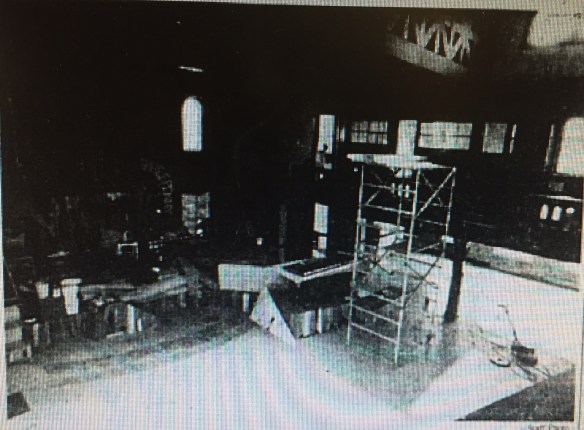
The production took place in the Rep’s home which was the converted former home of Hunter United Methodist Church on the eastern edge of MacArthur Park.  (Harriell’s business Bylites is now in that location.)

Baker had previously worked at the Arkansas Arts Center theatre when it was attached to a degree granting MFA program. He had also directed shows in other parts of Arkansas.  He returned to Little Rock and founded the Arkansas Philharmonic Theatre which performed in Hillcrest.  The Arkansas Repertory Theatre was a step forward with the establishment of a professional repertory company.

The first season of the Rep would include Company, Suddenly Last Summer, Marat/Sade, and Stop the World–I Want to Get Off. Season tickets for a total of seven shows were $30.

Baker served as Artistic Director of Arkansas Rep from 1976 until 1999.  Earlier this year, he stepped in as Interim Artistic Director between the tenures of Bob Hupp and John Miller-Stephany.  He is currently preparing to direct Sister Act for the Rep in January 2017.