

The 1906 plans for City Hall with the Municipal Auditorium on the left portion.
Little Rock Mayor Warren E. Lenon had been advocating for a new City Hall a municipal auditorium since shortly after taking office in April 1903. After plans were approved in July 1906, a group of citizens, led by Arkansas Gazette publisher J. N. Heiskell, filed suit to stop the City.
The closing arguments in the trial against plans for a new City Hall and auditorium complex had been heard on Monday, July 30. The case was heard by Chancery Judge J. C. Hart. Serving as an advisor to Chancellor Hart throughout the trial (though with no official legal standing) was Pulaski County Circuit Court Judge Robert J. Lea. To accommodate the expected large attendance, the trial had been moved into his courtroom which was larger than Chancellor Hart’s.
On Friday, August 3, Pulaski County Chancery Judge J. C. Hart issued an injunction to keep the City from signing a contract for the construction of a city hall, jail and auditorium. Chancellor Hart concurred with the plaintiffs that Arkansas’ constitution and laws dictated all taxation must be for public purposes. He found there was nothing in Arkansas case law which defined an auditorium to be used for conventions as a public purpose.
As had been the case throughout the trial, the tone of the coverage of the decision differed greatly in the city’s two daily papers. The subheading in the Democrat noted that the plaintiffs would be liable for any losses to the municipal government’s coffers due to a delay in commencing the construction if Little Rock eventually prevailed. That fact is not mentioned by the Gazette. Both papers did make note that Judge Lea agreed with the Chancellor’s decision.
For now, it looked as if the City of Little Rock would be stuck in the 1867 City Hall on Markham between Main and Louisiana. Mr. Heiskell and his compatriots waited to see if the City would appeal the decision.
While August would be a quiet month publicly, work would go on behind the scenes. More on that, in the future.
 On July 20, 1969, at 3:17 pm (Little Rock time), the lunar module Eagle set down in the Sea of Tranquility on the moon. Astronaut Neil Armstrong radioed to Mission Control in Houston, “The Eagle has landed.”
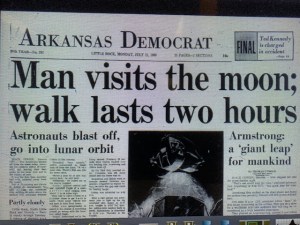 At 9:39 pm, several hours ahead of schedule, Armstrong opened the hatch and started his slow descent to the lunar surface. At 9:56 pm, he set his booted foot on the moon and uttered his now famous (and garbled) statement: “That’s one small step for a man, one giant leap for mankind.”
 On July 16, 1969, Apollo 11 lifted off from Florida as 528 million people (15% of the world’s population at the time) viewed it on television. As would be expected for that historic trip to the moon, both the Arkansas Gazette and the Arkansas Democrat were filled with stories covering all aspects of the preparations and the launch.
 On May 27, 1955, on the stage of Robinson Auditorium, the Dunbar High School senior class graduated. This academic year marked not only the 25th anniversary of Dunbar’s opening, but it was the last year that the school building would offer junior high through junior college classes.
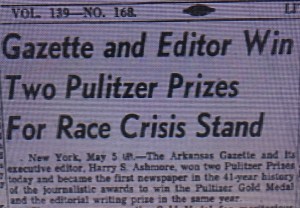 On May 5, 1958, it was announced that the Arkansas Gazette had received two Pulitzer Prizes. These were for the coverage of the 1957 integration (or lack thereof) at Little Rock Central High School.
 Today, May the 4th, is Star Wars Day.
 The 2019 Pulitzer Prizes are announced later today. Over the years, there have been several Pulitzer winners with connections to Little Rock.
 Little Rock Culture Vulture