Little Rock Look Back: 2 Pulitzers for the ARKANSAS GAZETTE

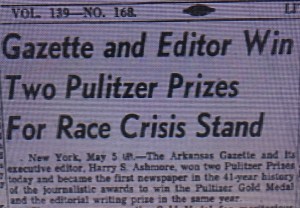
On May 5, 1958, it was announced that the Arkansas Gazette had received two Pulitzer Prizes.  These were for the coverage of the 1957 integration (or lack thereof) at Little Rock Central High School.

The first Pulitzer was for Public Service.  It was awarded to the newspaper.  The citation stated:

For demonstrating the highest qualities of civic leadership, journalistic responsibility and moral courage in the face of great public tension during the school integration crisis of 1957. The newspaper’s fearless and completely objective news coverage, plus its reasoned and moderate policy, did much to restore calmness and order to an overwrought community, reflecting great credit on its editors and its management.

The second Pulitzer was for Editorial Writing.  It was awarded to Harry Ashmore.  The citation read:

For the forcefulness, dispassionate analysis and clarity of his editorials on the school integration conflict in Little Rock.

This was the first time that the Pulitzer for Public Service and Editorial Writing went to the same publication in the same year.

The newspaper coverage in the afternoon Arkansas Democrat and morning Arkansas Gazette was provided by the Associated Press.  The Democrat‘s story ran on the afternoon of the announcement. The front page story had the headline “Pulitzer Honors Go to Gazette.”  The next morning the Gazette ran a longer story under the headline “Gazette and Editor Win Two Pulitzer Prizes for Race Crisis Stand.”  It included a quote from publisher Hugh Patterson, Jr.  He stated, “This recognition belongs to every member of the staff of the Gazette.  I am proud to be associated with these men and women.”

The Pulitzer for National Reporting went to Relman Morin of the Associated Press for his coverage of the events.  His citation noted:
for his dramatic and incisive eyewitness report of mob violence on September 23, 1957, during the integration crisis at the Central High School in Little Rock, Arkansas.

Photographer Will Counts of the Arkansas Democrat was the unanimous choice of the jury to receive the Pulitzer in photography for his photo of the crowd jeering at Elizabeth Eckford.  The board overruled that selection, as was their purview. Speculation was that the board may not have wanted to award four Pulitzers for the same news story.

STAR WARS DAY Strikes Back

Today, May the 4th, is Star Wars Day.

This year marks 41 years since the first (fourth?/fifth?/soon to be sixth?) movie first opened!

The classic film first opened in May 1977 (though after May 4).  It did not reach Little Rock until June 24, 1977.

Given its status as a sleeper hit, it is no surprise that it came into Little Rock largely unnoticed.  In that day, major films opening on a Friday would be heralded the previous Sunday with a substantial advertisement.  The first Star Wars ad ran on Thursday, June 23, 1977, the day before it opened.  By contrast, Herbie Goes to Monte Carlo, which would play at the same theatre, had a large ad on Sunday, June 19.

The day it opened, there was a fairly large ad which incorporated the familiar beefcake Luke, Leia in flowing gowns, and Darth Vader mask.  On the Sunday after it opened, there was a slightly smaller ad with the same artwork.  McCain Mall also ran a small add for both Star Wars and Herbie. It noted that Star Wars was a film that management “does not recommend for children.”

Three years later, The Empire Strikes Back opened nationwide on May 21, 1980. Opening a film on the same date was a newer phenomenon, due in part to the success of Star Wars.  For the opening weeks, The Empire Strikes Back played an exclusive showing at the UA Cinema 150.  It would eventually play at other theatres in Little Rock.

On the day The Empire Strikes Back opened, the Arkansas Gazette had four different stories about the movie in that day’s edition.  While the Arkansas Democrat did not have any stories that day (though they would in subsequent days), they did carry a story on David Letterman preparing to start his (what would turn out to be short-lived) morning TV show.

On May 25, 1983, The Return of the Jedi opened.  The cost to see The Return of the Jedi in Little Rock in 1983 was $5.00 for adults and $2.50 for children.  (That would be the equivalent of $12.37 today for an adult ticket.)

Putting the LIT in Pulitzer

two_medalsThe 2018 Pulitzer Prizes are announced later today.  Over the years, there have been several Pulitzer winners with connections to Little Rock.
In 1939,  Little Rock native John Gould Fletcher, a scion of a politically prominent family, won the Pulitzer Prize in Poetry for his work Selected Poems.  He appears to be the first Pulitzer Prize winner with Little Rock connections.

The 1950 Pulitzer Prize for Drama went to South Pacific. With a leading lady who is from Little Rock, this Richard Rodgers, Oscar Hammerstein II, and Joshua Logan musical explores race against the backdrop of World War II.  It is based on James Michener’s Tales of the South Pacific, which won the 1948 Pulitzer for Fiction. (Because it was a collection of interrelated short stories, the category was changed from Novel to Fiction from that year onward.)  But in the Michener book, Forbush is not from Little Rock.  In fact, she is not even from Arkansas, but hails from Alabama.

The Arkansas Gazette made Pulitzer history in 1958 by winning both the Public Service and Editorial prizes in the same year. This was the first time that one organization had received both awards in the same year.  These were for the coverage of and response to the 1957 integration of Central High School by the Little Rock Nine.  J. N. Heiskell was the paper’s owner and editor, while Harry Ashmore led the editorial page.  Relman Morin of the Associated Press received the Pulitzer for National Reporting for his coverage of the events at Central.  Apparently Will Counts of the Arkansas Democrat was the jurors’ choice to receive the Pulitzer for Photography. But the Board opted to give the prize to another photographer.  Some speculate that the Pulitzer Board did not want to give four prizes in the same year for the same story.

Current Little Rock resident Paul Greenberg won the 1969 Pulitzer for Editorial Writing.  at the time, he worked for the Pine Bluff Commercial.   In 1986, he was a finalist in the same category.  Greenberg moved to Little Rock to join the staff of the Arkansas Democrat-Gazette in 1992.  While no longer the Editorial Page Editor, Greenberg continues to write columns for the newspaper.

Former Little Rock resident Richard Ford received the 1996 Pulitzer for Fiction for his novel Independence Day.  As a young boy of eight, and for several years after, Ford spent much time at Little Rock’s Marion Hotel with his grandparents.  In making the presentation, the Pulitzer Board noted it was, “A visionary account of American life, Independence Day reveals a man and country with unflinching comedy and the specter of hope and even permanence…”

The Pulitzer Prize for Drama in 2001 went to David Auburn.  A 1987 graduate of Hall High School, Auburn was recognized for his play Proof.  The Pulitzer Board described Proof thus: “This poignant drama about love and reconciliation unfolds on the back porch of a house settled in a suburban university town, that is, like David Auburn’s writing, both simple and elegant.”  Auburn also served as a 2014 juror for the Pulitzer Prize for Drama.  While a student in Little Rock, Auburn participated in theatre at the Arkansas Arts Center.

Little Rock Look Back: OKLAHOMA! first comes to LR

OkLRbill

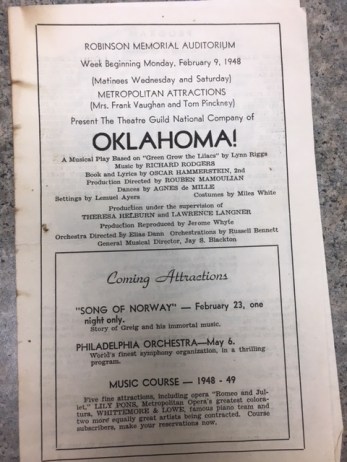
Program cover from OKLAHOMA!’s February 1948 visit to Little Rock. From the collection of Mary and Booker Worthen.

On March 31, 1943, Alfred Drake sauntered on the stage of Broadway’s St. James Theatre and sang “Oh, what a beautiful mornin'” to launch OKLAHOMA! into not only theatrical history but popular culture as well.

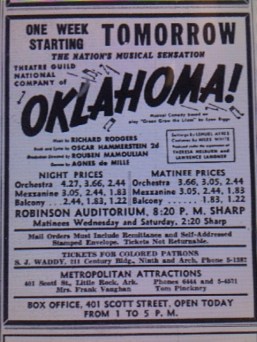
In February 1948, as the original Broadway run was about to mark five years on Broadway, the national tour of Oklahoma! made its way to Little Rock for eight performances. The week-long stay it had in Little Rock at Robinson Center was a record for that building that would last until Wicked came in 2010.  (Hello, Dolly! in 1966 and Beauty and the Beast in 2002 had both equalled the record.)

By the time Richard Rodgers and Oscar Hammerstein II’s first show made it to Little Rock, they were working on their fourth stage show, South Pacific, which had a leading character from Little Rock.

To get Robinson Auditorium ready for Oklahoma!, the Auditorium Commission had to spend $2,000 on upgrades.  That would be the equivalent of just under $21,000 today.

Oklahoma! opened at Robinson on Monday, February 9, 1948.  With eight performances, approximately 24,000 tickets were on sale during the run of the show.  There was a cast of 67 actors and 28 musicians.  The cast was led by Ridge Bond, Carolyn Adair, Alfred Cibelli Jr., Patricia Englund, and David Morris.  Mr. Bond had relatives who lived in Little Rock.  He was a native of Claremore, Oklahoma, which was the town in which the story took place.

OkAdLR

Ad in ARKANSAS GAZETTE on February 8, 1948.

While they were in Little Rock, the stars of the show made an appearance at Reed Music on February 10.  The music store (located at 112 and 114 East 7th Street–across the street from the Donaghey Building) was promoting the sale of the Oklahoma! cast albums, sheet music, and recordings of songs from Oklahoma! by other singers.

Both the Arkansas Gazette and Arkansas Democrat carried reviews of the show.  Another item, which appeared in the paper that week was a syndicated column which noted that the film rights for the show had been sold. It was speculated that the star would be Bing Crosby.  It would actually be 1955 before the film was made, and Mr. Crosby had no connection to that movie.  By the time it was made, the stars were Gordon MacRae and Shirley Jones.  Mr. MacRae would appear in Little Rock for the 1963 opening of the Arkansas Arts Center.  Ms. Jones has made several concert appearances in Little Rock over the years.

Little Rock had seen its fair share of top Broadway shows on tour.  Prior to Robinson’s opening and since then, many well-known actors and popular shows had played Little Rock.  But just as it had been on Broadway, Oklahoma! in Little Rock was more than a show — it was an event!

Over the years, Oklahoma! has been performed by schools, churches, community theatres, dinner theatres, and colleges.  National tours have come through Arkansas again.  People have become jaded or dismissive of it, because they have seen it performed so often — and sometimes badly.  So it is hard to understand the excitement that was felt by Little Rock audiences in 1948 when they first saw it on the stage of Robinson Center.

But 75 years later (and 25 years after it was commemorated by the US Postal Service with its own stamp), Oklahoma! is still doing fine.  Countless new generations sing the songs and say the lines.

Two upcoming cultural events in Little Rock are a testament to the genius that helped create Oklahoma!  In May, Ballet Arkansas will present a dance piece which was the final dance created by Agnes de Mille.  Before choreographing Oklahoma!, Miss de Mille was already making her mark in the world of ballet.  She alternated between the two for decades.  At the 1993 Tony Awards, Miss de Mille accepted a special Tony upon the show’s 50th anniversary milestone.

The second connection to Oklahoma! will take place in February 2019.  The Arkansas Symphony Orchestra is bringing Oscar “Andy” Hammerstein III, grandson of the beloved librettist and lyricist Oscar Hammerstein II, to host a celebration of some of America’s most cherished music from the stage.

LR Women Making History – Bernie Babcock

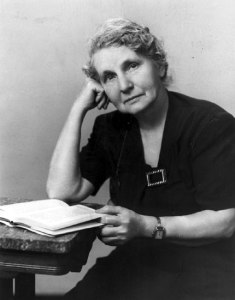
Julia Burnelle “Bernie” Smade Babcock was an author and museum founder.  When her husband died, leaving her with five children, she starting writing for money. She published several temperance novels and later wrote for the Arkansas Democrat.  She also published a magazine, wrote plays which were performed in New York, and authored a poetry anthology.  She later became recognized as an expert on Abraham Lincoln and wrote several books about him, as well as other historical figures.  For her writing skills, she became the first Arkansas woman to be included in Who’s Who in America.

In 1927, after professional curmudgeon H. L. Mencken wrote derisively of Arkansas, she decided to start a museum. The Museum of Natural History and Antiquities was first located in a Main Street storefront.  In 1929, she “gave the City of Little Rock a Christmas present” by giving the museum to the city.  It was relocated to the unfinished third floor of City Hall, with her as its employee. After being closed during part of the Great Depression, she relocated the museum to the Arsenal Building and reopened it as the Museum of Natural History.  She was involved in the efforts to rename City Park in honor of Douglas MacArthur (who had been born there) and welcomed him when he came to Little Rock in 1952.

Following her retirement in 1953, she moved to Petit Jean Mountain where she wrote and painted.

After more name changes and a relocation, her museum is now known as the Museum of Discovery and is an anchor in the River Market district.

LR Women Making History – Peg Newton Smith

While the Culture Vulture remains a huge fan of Peg Newton Smith, it is better for this entry to be taken from a tribute written by her longtime friend Bill Worthen.

Peg Newton Smith was a pioneer in the field of history and historic preservation.  A founder of both the Arkansas Museums Association and the Quapaw Quarter Association, Little Rock’s historic preservation organization, she served as a significant resource for many local history researchers and historians.

Born February 10, 1915, Peg Smith came from a family deeply engaged in Arkansas history. Two Arkansas counties – Newton and Hempstead – are named after ancestors.  She married George Rose Smith, himself from a prominent Arkansas family, in 1938. Peg Smith became his most vigorous supporter as George Rose Smith was elected and  reelected to the State Supreme Court, ultimately offering 38 years of service as Associate Justice.

She  enjoyed a sixty-two year career as a volunteer at the Historic Arkansas Museum, where she served as Commission Chair from 1978 to 1983. On the museum’s first day, she was dressed in period garb as a volunteer.  She was named Chair Emerita of the Commission in 2002. Her commitment to history has also included decades of service on the Mount Holly Cemetery Association Board of Directors, where she was famous with Mary Worthen for tours of the cemetery, often hot items at charity auctions.

Because of her instrumental work for the Arkansas Museums Association and the Quapaw Quarter Association, both organizations named significant annual awards after her. She was appointed to the inaugural Review Committee of the State Historic Preservation Program and with architect Edwin Cromwell was the first Arkansan named to the Board of Advisors of the National Trust for Historic Preservation. She was appointed to the Arkansas Bicentennial Commission, was elected president of the Junior League of Little Rock, was a founding member of the Board of the Historic Preservation Alliance of Arkansas, and was active in the Pulaski County Historical Society.  She also was an early supporter of the MacArthur Museum of Arkansas Military History.

She was honored by many groups, being named 1967 Greater Little Rock Woman of the Year by the Arkansas Democrat, Shield of the Trojan Award winner from the UALR Alumni Association in 1979, Fellow of the Museum of Science and History in 1981, and Candlelight Gala Honoree of the Historic Arkansas Museum in 1994. She became the first recipient of the Lifetime Achievement Award from the Arkansas Museums Association in 2003.

Peg Newton Smith died on July 20, 2003.

Because of her love of Arkansas history and Arkansas art, the Historic Arkansas Museum commissioned the pARTy for Peg sculpture which dances near the north entrance to the museum.  pARTy for Peg is not a portrait of our dear friend—it is a sculpture inspired by her spirit. It had been her brainchild for the museum to have a separate gallery devoted to contemporary Arkansas artists. She also founded the Museum Store, filled with Arkansas crafts.

Little Rock Look Back: US Supreme Court rules in Bates v. City of LR

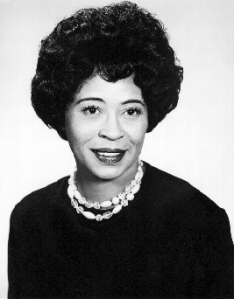
On February 23, 1960, the U. S. Supreme Court handed down a decision in the case of Daisy BATES et al., Petitioners, v. CITY OF LITTLE ROCK et al.  This case had been argued before the Court in November 1959.

Daisy Bates of Little Rock and Birdie Williams of North Little Rock were the petitioners.  Each had been convicted of violating an identical ordinance of an Arkansas municipality by refusing a demand to furnish city officials with a list of the names of the members of a local branch of the National Association for the Advancement of Colored People. The question for decision was whether these convictions can stand under the Due Process Clause of the Fourteenth Amendment to the United States Constitution.

The Little Rock ordinance (10,638) was passed on October 14, 1957. It charged that certain non-profits were actually functioning as businesses and using non-profit status to skirt the law. Therefore it required the non-profits to disclose their members and sources of dues.  North Little Rock passed an identical ordinance.

(Mayor Woodrow Mann was not present at the meeting of the LR Council when the ordinance was passed. But he signed all of the resolutions and ordinances approved that night.  Ordinance 10,638 was the only legislation that night which had also been signed by Acting Mayor Franklin Loy.  Mayor Mann crossed through Loy’s name and signed his own.)

Mrs. Bates and Mrs. Williams as keepers of the records for their respective chapters of the NAACP refused to comply with the law.  While they provided most of the information requested, they contended they did not have to provide the membership rosters and dues paid.

After refusing upon further demand to submit the names of the members of her organization, each was tried, convicted, and fined for a violation of the ordinance of her respective municipality. At the Bates trial evidence was offered to show that many former members of the local organization had declined to renew their membership because of the existence of the ordinance in question. Similar evidence was received in the Williams trial, as well as evidence that those who had been publicly identified in the community as members of the National Association for the Advancement of Colored People had been subjected to harassment and threats of bodily harm.

Each woman was convicted in the court of Pulaski Circuit Court, First Division, William J. KirbyJudge. They were fined $25 a person.  On appeal the cases were consolidated in the Supreme Court of Arkansas in 1958. The convictions were upheld by five justices with George Rose Smith and J. Seaborn Holt dissenting.

Mrs. Bates and Mrs. Williams then appealed to the U. S. Supreme Court.  The pair’s legal team included Robert L. Carter and George Howard, Jr. (who would later become a federal judge).  Little Rock City Attorney Joseph Kemp argued the case for the City.  The arguments before the U. S. Supreme Court were heard on November 18, 1959.

The SCOTUS decision was written by Associate Justice Potter Stewart.  He was joined by Chief Justice Earl Warren and Associate Justices Felix Frankfurter, Tom C. Clark, John M. Harlan II, William J. Brennan and Charles E. Whittaker.  Justices Hugo Black and William O. Douglas wrote a concurring opinion.

The U. S. Supreme Court reversed the lower courts.

In sum, there is a complete failure in this record to show (1) that the organizations were engaged in any occupation for which a license would be required, even if the occupation were conducted for a profit; (2) that the cities have ever asserted a claim against the organizations for payment of an occupation license tax; (3) that the organizations have ever asserted exemption from a tax imposed by the municipalities, either because of their alleged nonprofit character or for any other reason.

We conclude that the municipalities have failed to demonstrate a controlling justification for the deterrence of free association which compulsory disclosure of the membership lists would cause. The petitioners cannot be punished for refusing to produce information which the municipalities could not constitutionally require. The judgments cannot stand.

In their concurring opinion, Justices Black and Douglas wrote that they felt the facts not only violated freedom of speech and assembly from the First Amendment, but also aspects of the Fourteenth Amendment. They wrote that the freedom of assembly (including freedom of association) was a principle to be applied “to all people under our Constitution irrespective of their race, color, politics, or religion. That is, for us, the essence of the present opinion of the Court.”

Neither the Gazette or Democrat carried any reaction from City leaders. There was a City Board meeting the evening of the decision. If it was mentioned, the minutes from the meeting do not reflect it.

Arkansas Attorney General Bruce Bennett, on the other hand, was very vocal in his outrage. The city laws were known as Bennett Laws because they had been drafted by him as ways to intimidate African Americans and others he viewed as agitators.

In 1960 Bennett was challenging Governor Orval Faubus for the Democratic gubernatorial nomination.  In reaction to the to the Supreme Court he vowed that, if elected Governor, he would “de-integrate” (a term he proudly took credit for coining) the state.

For his part, and not to be outdone by the AG, Faubus fretted that the Court’s decision meant that Communists would be able to give money to the NAACP.