Little Rock Look Back: Museum of Discovery opens in River Market

Museum of Discovery Logo when it opened in 1998

Founded in 1927 as the Arkansas Museum of Natural History and Antiquities in a downtown storefront, by 1997, the museum had been located in at least two other spots and had several different names.  On February 21, 1998, it reopened as the Museum of Discovery in its new location in the recently launched River Market district.  It occupied space on the first floor and basement of the Museum Center building (formerly the Terminal building the erstwhile train station which later was used for printing the Arkansas Democrat.)

The new name and new space reflected a greater emphasis on the science aspect of the museum’s mission.  It featured many hands on and interactive exhibits.

The museum spent one-third of its $10.6 million cost on exhibits.  Of the $10.2 million pledged for the museum, 47 percent — or about $4 million — came from a half-cent city sales tax approved by voters about five years ago. Another 14 percent came from foundations and 2 percent from private organizations and individuals. The remaining 37 percent came from corporations, sometimes in connection with specific exhibits.

Following a February 20, 1998, preview party, the official grand opening was held on February 21, 1998.

The previous museum space (inside the Arsenal building in MacArthur Park) occupied 14,000 square feet, 8,000 of which was display space. After the move, the museum had 35,000 square feet of display space.

Little Rock Look Back: LR Votes FOR a Municipal Auditorium

On January 26, 1937, Little Rock voters went to the polls to vote on three different municipal bond issues.  One of them was the construction of a municipal auditorium.

The bonds for the auditorium would be $468,000 in general obligation bonds which would be paid off between 1940 and 1971. This was toward a total cost of $760,000 for the entire project.

The official campaign for the auditorium was sponsored by the Little Rock Forward Committee which was led by W. H. Williams. In campaign advertisements it showed the value of conventions in New York City which was estimated at $100 per convention attendee. Little Rock organizers were estimating a $10 a day expenditure by visitors, which the committee stressed was very conservative. The campaign committee emphasized the importance of acting at that time due to the federal government money involved.

Various committees and organizations endorsed the auditorium project including the Little Rock Chamber of Commerce, Little Rock Federation of Women’s Clubs, and the Young Business Men’s Association.

The thrust of the campaign focused on the economic benefit to Little Rock as well as the fact that the auditorium would be for all citizens. This message was picked up in editorials by both the Democrat and Gazette. In editorials on January 23 and 25, the Democratopined that the benefits of the auditorium would be distributed among all classes of the citizenry. The next day, both papers ran editorials which touted the economic boon an auditorium would bring through conventions and meetings.

The Democrat’s approach broke down the current value of conventions to Little Rock with, what it termed, the city’s “existing inadequate” facilities. The paper emphasized a conservative estimate of what the added value to Little Rock’s economy would be with the new auditorium.

In expressing support for the auditorium the Gazette stressed the values for local, statewide and national groups. “An auditorium would provide a more convenient and better adapted community center for all kinds of local gathering,” and continued that it would make Little Rock “the logical meeting place for state conventions of every sort.” In discussing the value of state, regional and national meetings the paper stressed that the outside money spent by convention attendees has an impact beyond stores, hotels and restaurants.

Both papers also echoed the importance of the federal government financing to make this possible. The Democrat noted that the Public Works Administration grant and federal low cost loan made this an ideal time.

On January 26, 1937, Little Rock voters approved the auditorium bond by a vote of 1,518 to 519. It passed in each of the city’s 23 precincts. Little Rock Mayor R. E. Overman expressed his pleasure at the outcome of the vote and extended his thanks to the voters.

After the election, a Gazette editorial commented on the low turnout for the special election by commenting that the weather had been nice and there were no other barriers to voting. The editorial writer opined that those not voting in the election must not have been opposed to the endeavor.

Little Rock Look Back: 27 students attempt to integrate LR schools in 1956

Arkansas Democrat photo by staff photographer Mr. Bisgood.

On Monday, January 23, 1956, twenty-seven African American students attempted to integrate four Little Rock schools.  By the end of the day, all four school principals had refused entry and some of the students had met with LRSD Superintendent Virgil Blossom.

Eight girls who were students at Horace Mann High School arrived at Central High at 9:30 am accompanied by Daisy Bates and Frank W. Smith both of the NAACP.  One male student attempted to integrate Little Rock Technical High School.  Four students arrived at Forest Heights Junior High (accompanied by three adults) and fourteen students attempted to integrate Forest Park Elementary (accompanied by four adults).  Neither the Arkansas Gazette nor the Arkansas Democrat broke down the age or gender of the junior high and elementary students.

Though all were referred to meet with Mr. Blossom, only the young women from Horace Mann visited with him.  After the conversation both he and Mrs. Bates declared the conversation had been friendly.   Mr. Blossom, in denying the request, noted that the Little Rock School District had a plan for integration. To allow them to integrate immediately would have been going against the plan.  The integration plan was connected to the completion of the new high school.  If it were ready to open in the fall of 1957, then integration at the high schools would start then.  The newspapers noted that there was no timeline for when it would extend down to the junior high and elementary levels.

That evening, Rev. J. C. Crenchaw, the president of the Little Rock NAACP, issued a statement.  In it he expressed frustration that the LRSD was vague on its timeline for integration.  He noted that the students lived near the schools which they tried to integrate and were therefore forced to travel several extra miles each day to attend school.  He also commented that the young man who attempted to enroll at Tech was not afforded the training available there at his current school.

The Arkansas Democrat ran a photo of the meeting with Mr. Blossom.  It identified the seven students who were pictured.  No mention was made as to whether the eighth student was present but not photographed, or if she did not attend the meeting.  As was the practice at the time, the addresses of the students were listed by their names.  Based on those addresses, the students lived between 0.4 and 0.9 miles from Central High School and were between 2.1 and 3.2 miles away from Horace Mann High School.  Of the seven students in the photo, two were seniors, three were juniors, and three were sophomores.  None of the students named became part of the Little Rock Nine who did integrate Central High twenty-one months later.

On January 24, the Gazette editorial writer opined they were glad for the amicable nature of the conversations. They hoped it did not affect the good race relations in Little Rock.  The writer concluded by saying they did not want it to incite extremists (but did not specify if they viewed the extremists as being for or against integration.)

Little Rock Look Back: MLK in LR

greyvilletstudenternestgreenshakinghandswithnaacpheaddaisybatesandrevmartinlutherking_iG363671SRXCF00Z

Ernest Green, Dr. King and Daisy Bates share a relaxed moment — which was probably rare for the three in 1958

Today is the Martin Luther King Jr. Holiday.  It is an apt time to think about Dr. King and Little Rock.

A friend of L. C. and Daisy Bates, he attended the 1958 Central High School graduation to witness Ernest Green receiving a diploma. Each senior only received eight tickets to the ceremony at Quigley Stadium. Dr. King was in the state to address the Arkansas AM&N (now UAPB) graduation.

His attendance was briefly mentioned in the local press, but there was no media photo of him at the ceremony.  The Little Rock School District limited the press to one Democrat and one Gazette photographer. Other press were limited to the press box.

Ernest Green has a photo of him with Daisy Bates and Dr. King (pictured on this entry).

In 1968, when Dr. King was assassinated, Little Rock did not see the unrest that many cities did.  Part of that was probably due to quick action by Governor Winthrop Rockefeller. The Governor released a statement fairly quickly expressing his sorrow at the tragedy and calling for a day of mourning. He also made the State Capitol available for the NAACP to have a public memorial, as well as worked with a group of ministers to host an interdenominational service.

Little Rock Mayor Martin Borchert issued a statement as well:

We in Little Rock are disturbed about the incident in Memphis. We are disturbed regardless of where it had happened.  Killing is not the Christian solution to any of our problems today.

In Little Rock, we feel we have come a long way in 10 years toward solving some of our problems of living and working together regardless of race, creed or color.

The city Board of Directors in Little Rock has pledged itself toward continuing efforts to make Little Rock a better place in which to live and work for all our citizens.

We feel the efforts of all thus far have proved we can live in harmony in Little Rock and are confident such an incident as has happened will not occur in Little Rock.  We will continue our most earnest efforts toward the full needs of our citizens.

The day after Dr. King was assassinated, a group of Philander Smith College students undertook a spontaneous walk to the nearby State Capitol, sang “We Shall Overcome” and then walked back to the campus.  President Ernest T. Dixon, Jr., of the college then hosted a 90 minute prayer service in the Wesley Chapel on the campus.

On the Sunday following Dr. King’s assassination, some churches featured messages about Dr. King.  As it was part of Holy Week, the Catholic Bishop for the Diocese of Little Rock had instructed all priests to include messages about Dr. King in their homilies. Some protestant ministers did as well. The Arkansas Gazette noted that Dr. Dale Cowling of Second Baptist Church downtown (who had received many threats because of his pro-integration stance in 1957) had preached about Dr. King and his legacy that morning.

Later that day, Governor Rockefeller participated in a public memorial service on the front steps of the State Capitol. The crowd, which started at 1,000 and grew to 3,000 before it was over, was racially mixed. At the conclusion of the ceremony, Governor and Mrs. Rockefeller joined hands with African American ministers and sang “We Shall Overcome.”

That evening, Trinity Episcopal Cathedral was the site of an interdenominational service which featured Methodist Bishop Rev. Paul V. Galloway, Catholic Bishop Most Rev. Albert L. Fletcher, Episcopal Bishop Rt. Rev. Robert R. Brown, Rabbi E. E. Palnick of Temple B’Nai Israel, Gov. Rockefeller, Philander Smith President Dixon, and Rufus King Young of Bethel AME Church.

Earlier in the day, Mayor Borchert stated:

We are gathered this afternoon to memorialize and pay tribute to a great American….To achieve equality of opportunity for all will require men of compassion and understanding on the one hand and men of reason and desire on the other.

Mayor Borchert pledged City resources to strive for equality.

Another Little Rock Mayor, Sharon Priest, participated in a ceremony 24 years after Dr. King’s assassination to rename High Street for Dr. King in January 1992.  The name change had been approved in March 1991 to take effect in January 1992 in conjunction with activities celebrating Dr. King’s life.  At the ceremony, Daisy Bates and Annie Abrams joined with other civil rights leaders and city officials to commemorate the name change.

Little Rock Look Back: Robinson Auditorium groundbreaking 80 years ago today


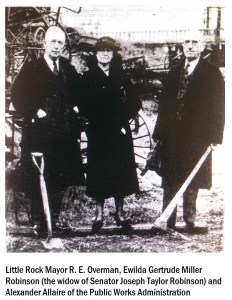
122437 GroundbreakOn December 24, 1937, at 11:30 a.m., Little Rock Mayor R. E. Overman, Ewilda Gertrude Miller Robinson (the widow of Senator Joseph Taylor Robinson) and  Alexander Allaire of the PWA turned dirt to participate in the brief groundbreaking ceremony for Little Rock’s municipal auditorium.  That morning, the Arkansas Gazette ran a brief story on the upcoming groundbreaking.  The story mentioned that the building would be named in memory of the late beloved Arkansas politician.  This appears to be the first public pronouncement of the Robinson name for this civic structure.

Among others in attendance at the groundbreaking were Mrs. Charles Miller (sister-in-law of Mrs. Robinson), Mr. and Mrs. Grady Miller (brother and sister-in-law of Mrs. Robinson), the mayor’s wife, the three architects (George Wittenberg, Lawson Delony and Eugene John Stern), and D. H. Daugherty and Will Terry of the City’s Board of Public Affairs.

Construction had to start by January 1, 1938, in order to receive PWA funds.  By breaking ground on December 24, there was over a week to spare.  The site had been selected in late October 1937, and the purchase had not been finalized.  But the PWA did give permission for the City to let a contract for excavation, demolition and filling on the site.

The groundbreaking took place at the corner of Garland and Spring Streets which was on the northeast corner of the block set aside for the auditorium.  Today, Spring Street does not extend north of Markham; the street was closed to make way for the parking structure and what is now the Doubletree Hotel.  Garland Street is basically an alley that runs parallel to Markham north of City Hall, Robinson Auditorium and the Doubletree Hotel.

Central to Creativity – Deborah Mathis

Deborah Mathis has deep Arkansas roots.  She grew up in Little Rock the daughter of Rev. Lloyd Myers, a Baptist minister, and Rachel A. Myers Jones, a teacher.

Her journalistic pursuits began as early as junior high school, when she became the first black editor of West Side Junior High’s school newspaper. In 1970 she became the first black and first female editor of Central High School’s Tiger student newspaper. From the early 70′s through the early 90′s, Mathis was busy establishing herself as a journalist and broadcaster. She served in various positions ” reporter, editor, columnist and anchor ” at statewide media outlets including the Arkansas DemocratArkansas Gazette, KARK-Channel 4, KTH V-Channel 11, and KATV-Channel 7 From Arkansas, Mathis career took her to briefly to Jackson, Mississippi before she landed in Washington, D.C., where she was a White House Correspondent for Gannett News Service from 1993-2000.

Since 1992, Mathis has been a syndicated columnist, appearing in more than 100 U.S. publications and periodicals. She is also a contributor to such outlets as USA Today and BlackAmericaWeb.com and a frequent commentator on political and public affairs talk shows such as PBS’s Frontline, CNNs Inside Politics NPR’s All Things Considered America’s Black Forum and Oprah, to name a few. She also field-produced, wrote and narrated two nationally aired documentaries: “Edukashun: The Cost of Failure” (1982) and “Return of the Little Rock Nine” (1987).

Mathis is the author of Yet A Stranger Why Black Americans Still Don’t Feel at Home, Sole Sisters: The Joy and Pains of Single Black Women and What God Can Do: How Faith Changes Lives for the Better.  She has also been an assistant professor at Northwestern University’s Medill School of Journalism (Washington office).  In 2003, she was inducted into the Arkansas Black Hall of Fame.

Central to Creativity – Phyllis Brandon

Phyllis D. Brandon played a unique role in shaping and supporting Little Rock’s cultural life.  As the first and longtime editor of the Arkansas Democrat-Gazette‘s High Profile section, she promoted cultural institutions, supporters and practitioners.

Since it started in 1986, being featured in High Profile has been akin to the Good Housekeeping Seal of Approval.  It exposes cultural institutions and events to new and wider audiences.  There is no way to put a monetary measure on the support Brandon gave to Little Rock’s cultural life during her time leading High Profile from 1986 to 2009.  From 2009 to 2011, she served as editor of Arkansas Life magazine, again supporting and promoting cultural life.

With her unassuming manner, she coaxed stories out of interview subjects and captured photos which highlighted events.  A journalist since her junior high school days in Little Rock, Brandon has also been a witness to history.  As a recent graduate of the University of Arkansas, Brandon returned to her alma mater, Little Rock Central High, to cover the events in early September 1957 for the Arkansas Democrat.  Eleven years later, she was in Chicago for the contentious and violent 1968 Democratic National Convention as a delegate.

From 1957 until 1986, she alternated between careers in journalism and the business world, as well as being a stay-at-home mother.  Upon becoming founding editor of High Profile, she came into her own combining her nose for news and her life-long connections within the Little Rock community.  As a writer and photographer, she created art in her own right. A look through High Profile provides a rich historical snapshot of the changes in Little Rock and Arkansas in the latter part of the 20th Century and start of the 21st Century.