Little Rock Look Back: US Supreme Court decision in BATES V. LITTLE ROCK

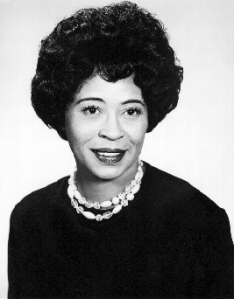
bates daisyOn February 23, 1960, the U. S. Supreme Court handed down a decision in the case of Daisy BATES et al., Petitioners, v. CITY OF LITTLE ROCK et al.  This case had been argued before the Court in November 1959.

Daisy Bates of Little Rock and Birdie Williams of North Little Rock were the petitioners.  Each had been convicted of violating an identical ordinance of an Arkansas municipality by refusing a demand to furnish city officials with a list of the names of the members of a local branch of the National Association for the Advancement of Colored People. The question for decision was whether these convictions can stand under the Due Process Clause of the Fourteenth Amendment to the United States Constitution.

The Little Rock ordinance (10,638) was passed on October 14, 1957. It charged that certain non-profits were actually functioning as businesses and using non-profit status to skirt the law. Therefore it required the non-profits to disclose their members and sources of dues.  North Little Rock passed an identical ordinance.

(Mayor Woodrow Mann was not present at the meeting of the LR Council when the ordinance was passed. But he signed all of the resolutions and ordinances approved that night.  Ordinance 10,638 was the only legislation that night which had also been signed by Acting Mayor Franklin Loy.  Mayor Mann crossed through Loy’s name and signed his own.)

Mrs. Bates and Mrs. Williams as keepers of the records for their respective chapters of the NAACP refused to comply with the law.  While they provided most of the information requested, they contended they did not have to provide the membership rosters and dues paid.

After refusing upon further demand to submit the names of the members of her organization, each was tried, convicted, and fined for a violation of the ordinance of her respective municipality. At the Bates trial evidence was offered to show that many former members of the local organization had declined to renew their membership because of the existence of the ordinance in question. Similar evidence was received in the Williams trial, as well as evidence that those who had been publicly identified in the community as members of the National Association for the Advancement of Colored People had been subjected to harassment and threats of bodily harm.

Each woman was convicted in the court of Pulaski Circuit Court, First Division, William J. KirbyJudge. They were fined $25 a person.  On appeal the cases were consolidated in the Supreme Court of Arkansas in 1958. The convictions were upheld by five justices with George Rose Smith and J. Seaborn Holt dissenting.

Mrs. Bates and Mrs. Williams then appealed to the U. S. Supreme Court.  The pair’s legal team included Robert L. Carter and George Howard, Jr. (who would later become a federal judge).  Little Rock City Attorney Joseph Kemp argued the case for the City.  The arguments before the U. S. Supreme Court were heard on November 18, 1959.

The SCOTUS decision was written by Associate Justice Potter Stewart.  He was joined by Chief Justice Earl Warren and Associate Justices Felix Frankfurter, Tom C. Clark, John M. Harlan II, William J. Brennan and Charles E. Whittaker.  Justices Hugo Black and William O. Douglas wrote a concurring opinion.

The U. S. Supreme Court reversed the lower courts.

In sum, there is a complete failure in this record to show (1) that the organizations were engaged in any occupation for which a license would be required, even if the occupation were conducted for a profit; (2) that the cities have ever asserted a claim against the organizations for payment of an occupation license tax; (3) that the organizations have ever asserted exemption from a tax imposed by the municipalities, either because of their alleged nonprofit character or for any other reason.

We conclude that the municipalities have failed to demonstrate a controlling justification for the deterrence of free association which compulsory disclosure of the membership lists would cause. The petitioners cannot be punished for refusing to produce information which the municipalities could not constitutionally require. The judgments cannot stand.

In their concurring opinion, Justices Black and Douglas wrote that they felt the facts not only violated freedom of speech and assembly from the First Amendment, but also aspects of the Fourteenth Amendment. They wrote that the freedom of assembly (including freedom of association) was a principle to be applied “to all people under our Constitution irrespective of their race, color, politics, or religion. That is, for us, the essence of the present opinion of the Court.”

Neither the Gazette or Democrat carried any reaction from City leaders. There was a City Board meeting the evening of the decision. If it was mentioned, the minutes from the meeting do not reflect it.

Arkansas Attorney General Bruce Bennett, on the other hand, was very vocal in his outrage. The city laws were known as Bennett Laws because they had been drafted by him as ways to intimidate African Americans and others he viewed as agitators.

In 1960 Bennett was challenging Governor Orval Faubus for the Democratic gubernatorial nomination.  In reaction to the to the Supreme Court he vowed that, if elected Governor, he would “de-integrate” (a term he proudly took credit for coining) the state.

For his part, and not to be outdone by the AG, Faubus fretted that the Court’s decision meant that Communists would be able to give money to the NAACP.
Little Rock Look Back: Movie Star Mania at Robinson Center

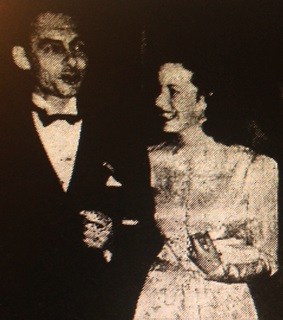
Mayor J V Satterfield escorting actress Maureen O'Hara at the Movie Ball (photo from Arkansas Democrat)

Mayor J V Satterfield escorting actress Maureen O’Hara at the Movie Ball (photo from Arkansas Democrat)

As final preparations were being made for the opening of the Joseph Taylor Robinson Municipal Auditorium in early 1940, a glamorous evening took place in Robinson’s lower level convention hall on February 1.

In conjunction with a meeting of film executives and movie theatre owners sponsored by Robb and Rowley Theaters (which later became the United Artists theatre chain), several Hollywood actors were in Little Rock and headlined a Movie Ball. While in Little Rock, Maureen O’Hara, Phyllis Brooks, Arleen Whelan, Tim Holt and Gene Autry had also made a variety of public appearances.

Mr. Autrey had to miss the ball because he had to return to Hollywood early to attend to business matters. Actress Ilona Massey had also been scheduled to attend the events but was unable due to illness.

The quartet who did appear at the Movie Ball caused quite a scene. Upon their entrance, so many of the attendees crowded around for autographs that the evening’s grand march could not take place (a newspaper headline in the Democrat innocently used the word “orgy” to describe the crowd). After two attempts, Little Rock Mayor J. V. Satterfield (who was escorting Miss O’Hara) and the other members of the Little Rock host delegation led the Hollywood foursome to their reserved table. For quite a while that evening, the table was besieged by autograph seekers.

Though it is unknown as to whether he sought an autograph, photos from the evening showed a very satisfied Mayor Satterfield with Miss O’Hara on his arm. Satterfield family lore joked that Mrs. Satterfield (who had stayed home that night to tend to a sick son) was not a fan of Miss O’Hara’s films after that evening.

The Movie Ball showed Little Rock citizens the value of Robinson Auditorium even before it had been officially dedicated. The film industry meetings had taken place at the Albert Pike Hotel which did not feature a ballroom large enough to host the ball. Without the auditorium’s availability for the gala, organizers might not have chosen Little Rock for the meeting.

With the auditorium’s convention hall not attached to any hotel, it opened up the chance for Little Rock to host more events. This had been one of the key arguments for an auditorium since Mayor W. E. Lenon’s first proposal back in 1904. Having a glamorous event this early in the auditorium’s life validated that contention. After having endured the challenges to open the building, it was a nice lagniappe for the auditorium’s proponents who were present.

The actor Tim Holt would again be connected to Little Rock. In September 1951, he tried to obtain a divorce in Arkansas and stated that he had been a resident of the state for at least six weeks. He also had someone else testify to that fact. In October 1951, the divorce was granted. Later Mr. Holt was charged with perjury and fined $200 for falsely representing his length of residence in Arkansas. Judicial sanctions for his legal team, which included a State Senator, were eventually reviewed by the Arkansas Supreme Court.

Little Rock Look Back: Voters approve Municipal Auditorium

1937-robinson-electionOn January 26, 1937, Little Rock voters went to the polls to vote on three different municipal bond issues.  One of them was the construction of a municipal auditorium.

The bonds for the auditorium would be $468,000 in general obligation bonds which would be paid off between 1940 and 1971. This was toward a total cost of $760,000 for the entire project.

The official campaign for the auditorium was sponsored by the Little Rock Forward Committee which was led by W. H. Williams. In campaign advertisements it showed the value of conventions in New York City which was estimated at $100 per convention attendee. Little Rock organizers were estimating a $10 a day expenditure by visitors, which the committee stressed was very conservative. The campaign committee emphasized the importance of acting at that time due to the federal government money involved.

Various committees and organizations endorsed the auditorium project including the Little Rock Chamber of Commerce, Little Rock Federation of Women’s Clubs, and the Young Business Men’s Association.

The thrust of the campaign focused on the economic benefit to Little Rock as well as the fact that the auditorium would be for all citizens. This message was picked up in editorials by both the Democrat and Gazette. In editorials on January 23 and 25, the Democrat opined that the benefits of the auditorium would be distributed among all classes of the citizenry. The next day, both papers ran editorials which touted the economic boon an auditorium would bring through conventions and meetings.

The Democrat’s approach broke down the current value of conventions to Little Rock with, what it termed, the city’s “existing inadequate” facilities. The paper emphasized a conservative estimate of what the added value to Little Rock’s economy would be with the new auditorium.

In expressing support for the auditorium the Gazette stressed the values for local, statewide and national groups. “An auditorium would provide a more convenient and better adapted community center for all kinds of local gathering,” and continued that it would make Little Rock “the logical meeting place for state conventions of every sort.” In discussing the value of state, regional and national meetings the paper stressed that the outside money spent by convention attendees has an impact beyond stores, hotels and restaurants.

Both papers also echoed the importance of the federal government financing to make this possible. The Democrat noted that the Public Works Administration grant and federal low cost loan made this an ideal time.


On January 26, 1937, Little Rock voters approved the auditorium bond by a vote of 1,518 to 519. It passed in each of the city’s 23 precincts. Little Rock Mayor R. E. Overman expressed his pleasure at the outcome of the vote and extended his thanks to the voters.

After the election, a Gazette editorial commented on the low turnout for the special election by commenting that the weather had been nice and there were no other barriers to voting. The editorial writer opined that those not voting in the election must not have been opposed to the endeavor.

Little Rock Look Back: Robinson Auditorium Groundbreaking

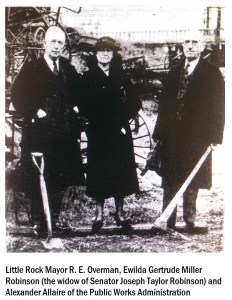
122437 GroundbreakOn December 24, 1937, at 11:30 a.m., Little Rock Mayor R. E. Overman, Ewilda Gertrude Miller Robinson (the widow of Senator Joseph Taylor Robinson) and  Alexander Allaire of the PWA turned dirt to participate in the brief groundbreaking ceremony for Little Rock’s municipal auditorium.  That morning, the Arkansas Gazette ran a brief story on the upcoming groundbreaking.  The story mentioned that the building would be named in memory of the late beloved Arkansas politician.  This appears to be the first public pronouncement of the Robinson name for this civic structure.

Among others in attendance at the groundbreaking were Mrs. Charles Miller (sister-in-law of Mrs. Robinson), Mr. and Mrs. Grady Miller (brother and sister-in-law of Mrs. Robinson), the mayor’s wife, the three architects (George Wittenberg, Lawson Delony and Eugene John Stern), and D. H. Daugherty and Will Terry of the City’s Board of Public Affairs.

Construction had to start by January 1, 1938, in order to receive PWA funds.  By breaking ground on December 24, there was over a week to spare.  The site had been selected in late October 1937, and the purchase had not been finalized.  But the PWA did give permission for the City to let a contract for excavation, demolition and filling on the site.

The groundbreaking took place at the corner of Garland and Spring Streets which was on the northeast corner of the block set aside for the auditorium.  Today, Spring Street does not extend north of Markham; the street was closed to make way for the parking structure and what is now the Doubletree Hotel.  Garland Street is basically an alley that runs parallel to Markham north of City Hall, Robinson Auditorium and the Doubletree Hotel.

Little Rock Look Back: Prohibition Repealed on December 5, 1933

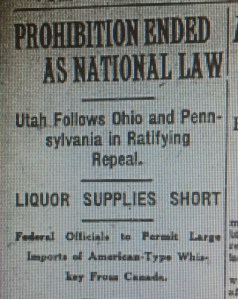
prohibition-repealOn December 5, 1933, Ohio, Pennsylvania and Utah provided the necessary support to officially repeal “the great experiment.”

Because this was such a foregone conclusion, the Arkansas Gazette and Arkansas Democrat carried only small, single column stories on their front pages.  Perhaps because this was Arkansas, it did not appear that any Little Rock businesses immediately set about to capitalize on this.  At least there were not any large scale advertisements in the days following that would indicate any specials or activities planned for the December 15 official end.

In fact, the only mention in the newspapers on December 15 was that President Roosevelt was trying to decide what the alcohol taxing structure should be.

One amusing story that ran in the Arkansas Democrat on December 6 was that Mrs. Roosevelt was keeping the wine glasses in storage at the White House for the time being.  She was awaiting action by Congress once it convened in January 1934 as to how it would deal with properly ending Prohibition in the District of Columbia.  Over 3,000 wine glasses had been in storage since Prohibition had been enacted.

Little Rock Look Back: November 8 Presidential Election Arkansas Newspapers

November 8 has been a Presidential Election Day in Arkansas six times.  The first time such a date happened in the US, Arkansas did not participate because it was 1864.  The times it has happened have been 1892, 1904, 1932, 1960, 1988, and today.

A look back at newspaper headlines from the previous years tells a lot about not only the elections, but also the way news was delivered.  For the 1892 and 1904 elections, only the Arkansas Gazette is available.  Though the Arkansas Democrat existed, it did not yet publish every day.  Tuesdays do not appear to have been dates it was published.  (The Gazette itself would not be at seven days until the early 1900s when it finally started publishing a Monday edition.)

elex-ag-1892The 1892 election day Gazette intersperses news stories with advertisements.  One headline states poetically:  “Ballots: Like flakes of snow they will gently fall throughout the Union today.”  Another headline stated “Confident.  Democrats everywhere feel assured of Grover Cleveland’s election today.”  Indeed, Cleveland returned to the White House in 1892 after four years of Benjamin Harrison.

elex-ag-04By 1904, most front page advertising at the Gazette had been banished from the front page, although an small box ad for Blass Department Store is at the top.  Only three of the seven columns on the front page have above-the-fold headlines devoted to election stories, and two of those are about the State of New York.  This reflects new editor J. N. Heiskell’s desire to have the Gazette be national in scope. While early Gazettes often relied on national news to fill space, by the post Reconstruction era, the focus was largely on local news.   The lone local headline was “Arkansas will go Democratic” which was certainly a foregone conclusion at the time.  While Arkansas did go Democratic, Theodore Roosevelt kept the presidency in the hands of the GOP.  Interestingly another headline was about efforts to get Prohibition adopted in the state.  It would become an election issue for years to come.

elex-ag-32By 1932, both the Gazette and Democrat published Election Day editions.  The Gazette’s stories included predictions that FDR would win and a record number of ballots would be cast.  There were also separate stories which highlighted the final day of campaigning for both FDR and Hoover.  One of Mr. Heiskell’s above-the-fold editorials encouraged voting No on a variety of measures which dealt with public school financing, sales tax reduction, bond issuance, and reorganization of county election commissions and state government.

elex-ad-32The afternoon Democrat featured stories on Hoover and FDR in the last hours of the campaigns. Like the Gazette it anticipated a record turnout and showed that Pulaski County was experiencing heavy turnout.  The headline trumpeted that FDR had a lead as early results were starting to trickle in.  The Democrat also offered succinct analysis of key battleground states.  In the end, FDR did carry 42 of the 48 states in an election that saw a record of 38,582, 531 people casting votes for one of the two top candidates.

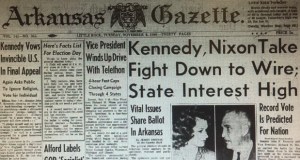
elex-ag-60The 1960 election ended up being one of the closest in popular vote in US history, with only 112,827 votes separating JFK from Nixon.  The Gazette headline was “Kennedy, Nixon take fight down to wire; State interest high.”  The front page also featured stories about Kennedy’s and Nixon’s last full day on the campaign trail.  A box on the front page reminded readers that liquor stores and beer sales could not take place during polling hours. Only persons who had paid their 1960 poll tax were eligible to vote–with an exception made for those who turned 21 after the poll tax deadline and through election day.  The last reminder was that the names of the parties, but not the candidates themselves, would appear on the ballot in the presidential race.

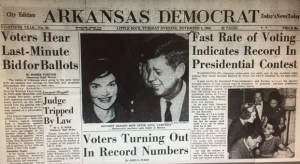
elex-ad-60The afternoon Democrat ran a large photo of Jackie and JFK after they had voted and a slightly smaller one of the Nixon family voting.  Two stories discussed the record turnout that appeared to be taking place — one was on a national scale, and the other was focused on Arkansas.  There was also a story on last minute campaigning.  In the end, over 68,000,000 votes were cast which was a record at the time.

elex-ag-88The most recent presidential election to take place on November 8 was in 1988.  It featured Vice President George H. W. Bush against Massachusetts Governor Michael Dukakis.  The Gazette (covering its final presidential election — though no one knew it at the time) featured a story on Bush and Dukakis in the final day of campaigning.  It also featured a guide to watching the returns and discussed how the networks made their decisions about calling states.  There was also a box highlighting key battleground states which included Massachusetts, Pennsylvania, New York, Illinois and Texas.  Interestingly, two of those were the home states of the candidates.

elex-ad-88By 1988, the Democrat had been a morning paper for several years going head to head with the Gazette.  It carried its own photos of Bush and Dukakis on the final full day of campaigning.  An inside story was highlighted on the cover which featured a Monday rally in Little Rock with Texas Senator Lloyd Bentsen (Dukakis’ running mate).  The 1988 campaign was long, by the standards of the time, but would be considered abbreviated today.  The 1988 election would mark the third consecutive presidential election that the GOP candidate carried Arkansas.

Little Rock Look Back: Central & Hall Football at 2-0

lrchs-lrhhsAfter two weeks of prep gridiron (that is high school football to those who don’t write like a 1950s inky wretch), Little Rock Central and Little Rock Hall are both posting records of 2 wins and 0 losses.  This feat has not been achieved in quite a while.

How long?  37 seasons!  It was 1979, the last time that the Tigers and Warriors were both out of the gate at 2-0.

1979

Jimmy Carter was in the White House. Bill Clinton was in his first term as Governor. First Lady Hillary Rodham was several months pregnant with Chelsea. Hall High and Razorback standout Webb Hubbell was Mayor of Little Rock.  The City’s population was in the 150,000s (it would be 159,151 after the 1980 census).  Little Rock had an area of approximately 80 square miles.  (Today it is approximately 200,000 citizens over 122 square miles.)

Lou Holtz was coaching the Arkansas Razorbacks in the Southwest Conference.  Harry Hall was in his first season as Commissioner of the Arkansas Intercollegiate Conference.  Rex Nelson was a student at Ouachita.  Paul Eells was in his second year with KATV, while Dave Woodman was finishing his first decade at KARK.  Gary Hogan was anchoring sports for KTHV.  Hogs football games were broadcast on KAAY radio.  While Bob Buice and Jim Elder were ruling the airwaves at KARN, Craig O’Neill was dominating mornings at KLAZ.

Orville Henry, Jim Bailey, and Wadie Moore covered college and high school sports for the Arkansas Gazette.  The Arkansas Democrat had switched to morning delivery and hired John Robert Starr as editor.  Both papers carried ads for Kempners, Golds, M.M. Cohn, Skaggs Albertsons, Minute Man, Union National Bank, Commercial National Bank, Worthen National Bank, and First National Bank.

Metrocentre Mall existed with bricked over streets on Main and Capitol. The Grady Manning Hotel and Hotel Marion still stood (though in their twilight days before their February 1980 date with demolition.)

So a lot has changed since Central and Hall previously achieved this.  In the interval, Central has been 2-0 a dozen times and Hall has achieved that a brace. But the schools never managed it during the same season.  Three times the schools both managed 1-1 seasons and seven times they each started at 0-2.

The 1979 Warriors were helmed by C. W. Keopple, who would lead the team from the 1960s into the 1980s winning four conference/state titles. (When your conference is statewide, winning one got you the other.)  Bernie Cox was in his fifth season as the Tigers’ mentor, with two state championships already under his belt, five more would be in his future.

The teams stayed tied through the fourth week. But in the fifth week, while Central won, Hall lost to Parkview by a score of 7-0.  The following week, the Warriors rebounded, while the Tigers settled for a 0 to 0 tie with Ole Main.  Weeks seven through ten saw both teams notching another win each week.  This set up a Thanksgiving Day classic with the state’s top two teams facing off.  Central was slightly favored, but season records seldom carried any weight when the two cross-town rivals played on Thanksgiving afternoon.  In an upset, Hall bested Central by a score of 17 to 0.

From 1987 to 1990, the second game of the season was the Hall-Central matchup, which meant that it would have been impossible to both start with a 2-0 record.  This second week matchup was made necessary by the fact that not only could the two teams no longer face off on Thanksgiving after 1982, but the two schools were not in the same conference from 1983 through 2000. So the faceoff was early in the season, during the non-conference portion.

Due to subsequent restructurings by the Arkansas Activities Association, the two schools have not played a football game since 2005.  The bell from the “Battle of the Bell” which was supposed to replace the pageantry and intense rivalry of the Thanksgiving Day matchups, sat forlornly and largely forgotten in the trophy case at Central following the 2005 edition which Central won by a score of 24 to 7.  (That season Central started at 0-2 on the way to a 5-5 record and Hall started at 1-1 on the way to a 3-7 record.)  UPDATE: As noted in a comment on this piece, the Bell has now been refurbished and sits proudly at Quigley Stadium.  Thank you Belinda Stilwell for the information!

Who knows how the 2016 season will turn out for these two teams?  In the past 2-0 has led both to State Championships and to a 6-4 record.  But for two schools that have struggled in the past few seasons, to start with a 2-0 record is quite an accomplishment. For both to start with that record is remarkable.


While the blog hiatus and a restructuring continue, this was a bit of history that needed mentioning.