Elvis Has Left the Building (Robinson Center, that is) – May 16, 1956

Photo by Wayne Cranford

After two visits in 1955 where he was down on the bill, Elvis Presley made his third and final appearance at Robinson Auditorium on May 16, 1956.  This time he was the star and Robinson was packed. The tickets were $1.50 in advance at Walgreens and $2.00 at the box office.

The ads featured 8 great acts in “his” variety show which consisted of the Jordonaires; Rick and Emil Flaim and their orchestra; vocalists Frankie Conners and Jackie Little and comedian-magician Phil Maraquin. A second show was added at 9:30 p.m. to accommodate the ticket demand.

About 30 minutes late, due to a missed flight, Elvis appeared on stage in a purple blazer and started singing “Heartbreak Hotel.”  The crowd rushed the stage. Little Rock police officers were able to control them eventually and get the teenagers back to their seats.  While the crowd was impressed, the police officers were less so.  One of the patrolmen told the Arkansas Gazettereporter: “I wouldn’t know him if I saw him. And I wouldn’t be here unless I was being paid.”

Disc jockey Ray Green recorded the concert that night.  Copies of the concert on CD (which also includes an interview with Presley) are prized possessions of Presley collectors.

The Arkansas Democrat-Gazette has a special section on its website containing quotes from some of the concert attendees.
Little Rock Look Back: Pulitzer Prize to SOUTH PACIFIC

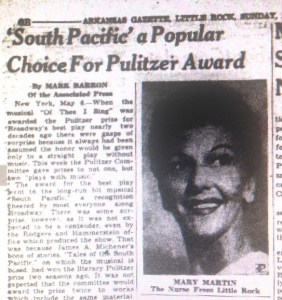
On May 5, 1950, the Rodgers and Hammerstein musical South Pacific captured the Pulitzer Prize in Drama. This would receive special attention in the Arkansas Gazette. The reason this carried such weight in Arkansas was that the musical had a connection to Little Rock.
The 1950 Pulitzer for Drama went to a musical, for only the second time in the history of the awards. The recipient was South Pacific by Richard Rodgers, Oscar Hammerstein II and Joshua Logan. The character was the leading lady of Nellie Forbush. She was an Navy ensign and a nurse stationed on an exotic island during World War II. The musical was based on a Pulitzer Prize winning novel, James Michener’s Tales of the South Pacific.

In the Michener novel, Miss Forbush is not from Little Rock. She is actually from a small town in Alabama. But the book does mention Nellie and her mother visiting Little Rock.  The part was written for Mary Martin from Weatherford, Texas. Rodgers, Hammerstein & Logan did not discuss why they relocated Nellie’s birthplace.

Originally the musical contained a song entitled “My Girl Back Home” in which Nellie sang of being from “Little Rock, A-R-K” while another character sang of being from “Philadelphia, P-A” and “Princeton, N-J.” It is possible the change to Little Rock was made because it offered more lyrical possibilities, but that is only a supposition on the part of the Culture Vulture. That song did appear in the movie version in which Mitzi Gaynor played Nellie Forbush. It was also featured in the 2008 Broadway revival, this time with Kelli O’Hara playing Nellie.

In the musical, Nellie struggles with her own prejudices. This issue of prejudice became an instance of fact meeting fiction. In 1957, a few weeks after Eisenhower sent troops into Little Rock to ensure that Central High would be desegregated, a production of South Pacific on Long Island was temporarily halted when the audience booed and yelled after Nellie mentioned she was from Little Rock. Interestingly, the movie was released in 1958, but retained references to Little Rock. That was either a testament to the expense of re-editing it, or the fact that audience reaction had lessened.

Little Rock Look Back: 2 Pulitzers for the ARKANSAS GAZETTE

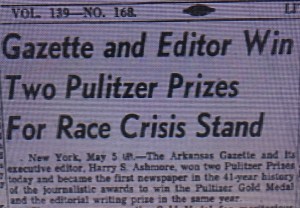
On May 5, 1958, it was announced that the Arkansas Gazette had received two Pulitzer Prizes.  These were for the coverage of the 1957 integration (or lack thereof) at Little Rock Central High School.

The first Pulitzer was for Public Service.  It was awarded to the newspaper.  The citation stated:

For demonstrating the highest qualities of civic leadership, journalistic responsibility and moral courage in the face of great public tension during the school integration crisis of 1957. The newspaper’s fearless and completely objective news coverage, plus its reasoned and moderate policy, did much to restore calmness and order to an overwrought community, reflecting great credit on its editors and its management.

The second Pulitzer was for Editorial Writing.  It was awarded to Harry Ashmore.  The citation read:

For the forcefulness, dispassionate analysis and clarity of his editorials on the school integration conflict in Little Rock.

This was the first time that the Pulitzer for Public Service and Editorial Writing went to the same publication in the same year.

The newspaper coverage in the afternoon Arkansas Democrat and morning Arkansas Gazette was provided by the Associated Press.  The Democrat‘s story ran on the afternoon of the announcement. The front page story had the headline “Pulitzer Honors Go to Gazette.”  The next morning the Gazette ran a longer story under the headline “Gazette and Editor Win Two Pulitzer Prizes for Race Crisis Stand.”  It included a quote from publisher Hugh Patterson, Jr.  He stated, “This recognition belongs to every member of the staff of the Gazette.  I am proud to be associated with these men and women.”

The Pulitzer for National Reporting went to Relman Morin of the Associated Press for his coverage of the events.  His citation noted:
for his dramatic and incisive eyewitness report of mob violence on September 23, 1957, during the integration crisis at the Central High School in Little Rock, Arkansas.

Photographer Will Counts of the Arkansas Democrat was the unanimous choice of the jury to receive the Pulitzer in photography for his photo of the crowd jeering at Elizabeth Eckford.  The board overruled that selection, as was their purview. Speculation was that the board may not have wanted to award four Pulitzers for the same news story.

STAR WARS DAY Strikes Back

Today, May the 4th, is Star Wars Day.

This year marks 41 years since the first (fourth?/fifth?/soon to be sixth?) movie first opened!

The classic film first opened in May 1977 (though after May 4).  It did not reach Little Rock until June 24, 1977.

Given its status as a sleeper hit, it is no surprise that it came into Little Rock largely unnoticed.  In that day, major films opening on a Friday would be heralded the previous Sunday with a substantial advertisement.  The first Star Wars ad ran on Thursday, June 23, 1977, the day before it opened.  By contrast, Herbie Goes to Monte Carlo, which would play at the same theatre, had a large ad on Sunday, June 19.

The day it opened, there was a fairly large ad which incorporated the familiar beefcake Luke, Leia in flowing gowns, and Darth Vader mask.  On the Sunday after it opened, there was a slightly smaller ad with the same artwork.  McCain Mall also ran a small add for both Star Wars and Herbie. It noted that Star Wars was a film that management “does not recommend for children.”

Three years later, The Empire Strikes Back opened nationwide on May 21, 1980. Opening a film on the same date was a newer phenomenon, due in part to the success of Star Wars.  For the opening weeks, The Empire Strikes Back played an exclusive showing at the UA Cinema 150.  It would eventually play at other theatres in Little Rock.

On the day The Empire Strikes Back opened, the Arkansas Gazette had four different stories about the movie in that day’s edition.  While the Arkansas Democrat did not have any stories that day (though they would in subsequent days), they did carry a story on David Letterman preparing to start his (what would turn out to be short-lived) morning TV show.

On May 25, 1983, The Return of the Jedi opened.  The cost to see The Return of the Jedi in Little Rock in 1983 was $5.00 for adults and $2.50 for children.  (That would be the equivalent of $12.37 today for an adult ticket.)

Little Rock Look Back: National Balloon Race starts in Little Rock

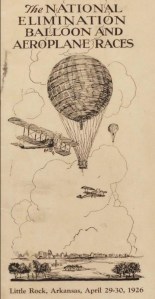
On April 29, 1926, nine hot air balloons took off from Little Rock’s airport (which was actually just an airfield at the time) in a national race to win the Litchfield Trophy.  In addition to the trophy, the winner would be on the American team in an international balloon race in Belgium.

The New York Times coverage noted that the weather conditions were ideal as the balloons took off in five minute intervals between 5:00pm and 5:30pm.  The test balloon (akin to a pace car in a car race) was the Arkansas Gazette‘s Skylark.  It took off at 4:25 and headed in the direction of the northeast, which was the desired direction.

The nine balloons, in order of liftoff were: the US Army from Phillips Field in Maryland; the US Army from McCook Field in Ohio; the Goodyear Southern California; the Detroit; the Goodyear IV (whose pilot Ward T. Van Orman had won the 1924 and 1925 contests); US Army from Scott Field; a balloon piloted by a Danish pilot Svend A. U. Rasmussen; US Army balloon from Langley Field in Virginia; and the Akron National Aeronautic Association balloon.

The pilots carried provisions for 48 hours and were equipped for sea flying.  Each had a radio and loud speaker.  KTHS radio of Hot Springs (a forerunner to today’s KTHV TV station) was broadcasting the location of each balloon.  As they left the Arkansas radio station’s range, there was a network of other stations which would do the same.

It was expected that the race would last between eighteen and thirty-six hours.  The last balloon aloft was Van Orman for the third year.  He lasted approximately 31 hours and landed near Chesapeake Bay.

Though no headcount was given, the New York Times called the viewing audience “the largest crowd ever assembled in Little Rock.”

Many thanks to Brian Lang of the Arkansas Arts Center for giving me the tip on this.

Pulitzers Play Little Rock: ‘NIGHT, MOTHER on Arkansas Rep stage with Oscar winner Mercedes McCambridge

MercedesIt is not often that an Oscar winner has appeared in a play on a Little Rock stage.  But in the spring of 1986, Mercedes McCambridge starred in Marsha Norman’s ‘night, Mother at Arkansas Repertory Theatre.
She had moved to Little Rock a few years prior to live full time to be close to family. From time to time, she and Cliff Baker (the Rep’s founder) would have conversations about potential projects. But it was not until 1986, that the stars aligned.  By this point, she had moved away from Little Rock, but was still back from time to time to visit family.  (In an interview with the Arkansas Gazette, she also praised Fred Poe and noted that he was her travel agent for her many excursions.)

Appearing on stage with McCambridge in Norman’s two-hander was Rep veteran Cathey Crowell Sawyer.

Though noted for her film work, McCambridge had appeared on Broadway several times including opposite Little Rock native Ben Piazza in Who’s Afraid of Virginia Woolf? and receiving a Tony nomination for her work in the play The Love Suicide at Schofield Barracks.

Prior to appearing at the Rep, she had recently toured in the play Agnes of God.  She related to the Gazette that she had been approached to do that play prior to Broadway but did not feel the character she was to play was believable.  When the national tour came about, a conversation with playwright John Pielmeier changed her mind.

Her last Broadway appearance was in Neil Simon’s Pulitzer Prize winning Lost in Yonkers.

2018 marks the 100th anniversary of the first Pulitzer Prize for Drama being given. To pay tribute to 100 years of the Pulitzer for Drama, each day this month a different Little Rock production of a Pulitzer Prize winning play will be highlighted.  Many of these titles have been produced numerous times.  This look will veer from high school to national tours in an attempt to give a glimpse into Little Rock’s breadth and depth of theatrical history.

On Pulitzer Day, prizing Mount Holly Cemetery

The Pulitzer Prizes are to be announced today.  This year marks the 101st anniversary of the prizes, though not all of the current categories have been around since 1917.

Mount Holly Cemetery not only touts that it is the site of a whole host of elected officials, it is also the only place in Arkansas where two Pulitzer Prize recipients are buried. The cemetery is open every day, but a special visit to these two prize winner gravesites can be made on Sunday, April 30, during the Mount Holly Cemetery Association’s annual “Rest in Perpetuity” fundraiser picnic.

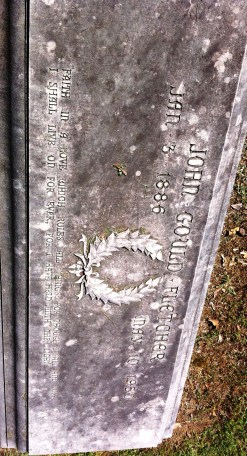
In 1939, John Gould Fletcher became the first Southern poet to win the Pulitzer Prize for Poetry.  He was born into a prominent Little Rock family in 1886.  Fletcher was awarded the prize for his collection Selected Poems which was published by Farrar in 1938.  Two years earlier, he had been commissioned by the Arkansas Gazette to compose an epic poem about the history of Arkansas in conjunction with the state’s centennial.

Fletcher is buried next to his wife, author Charlie May Simon and his parents (his father was former Little Rock Mayor John Gould Fletcher).  Other relatives are buried nearby in the cemetery.

The other Pulitzer Prize winner buried in Mount Holly is J. N. Heiskell, the longtime editor of the Arkansas Gazette.  It was Heiskell, in fact, who asked Fletcher to compose the poem about Arkansas.  Heiskell served as editor of the Gazette from 1902 through 1972.  He died at the age of 100 in 1972.

Under his leadership, the Gazette earned two Pulitzer Prizes for its coverage of the 1957 desegregation of Little Rock Central High.  One was for Harry Ashmore’s editorial writing and the other was for Public Service.

Heiskell remained in charge of the Gazette until his death in 1972.  He is buried alongside his wife with other relatives nearby.  Also not too far from Mr. Heiskell are two of his nemeses, proving that death and cemeteries can be the great equalizer. In the early days of his Gazette stewardship, he often locked horns with Senator (and former Governor) Jeff Davis. Later in Mr. Heiskell’s career, he vehemently disagreed with Dr. Dale Alford, who had been elected to Congress on a segregationist platform.