Little Rock Look Back: Halloweens Past

A recent romp through an Arkansas Gazette gave insight into Halloween in Little Rock in the middle of the 20th Century.

Apparently by late afternoon on Halloween 1950, downtown Little Rock was filled with kids and teens in costumes. Much of the focus seemed to be on tricks as many of these revelers were utilizing water guns to soak people, throwing enough talcum powder to create an aroma downtown, shooting off firecrackers, and soaping store windows. Several industrious store owners had coated there windows with glycerine so that soap would not mark them.

The mayhem was enough to cause even more problems to traffic at rush hour. Police officers were helpless as they were directing traffic.  One city bus filled with passengers was attacked by a phalanx of waterguns, until the windows were all closed.

A Gazette writer noted that two teen boys were dressed rather convincingly as girls. One was described as “rather pretty” until letting out an expletive which the paper reported as “g— d—–” and thus outing the individual as a male.

Not everyone was focused on tricks.  Merchants in the Heights neighborhood created a block party with a carnival. It was deemed to be so successful that it would become an annual event.

Little Rock Look Back: Final ARKANSAS GAZETTE

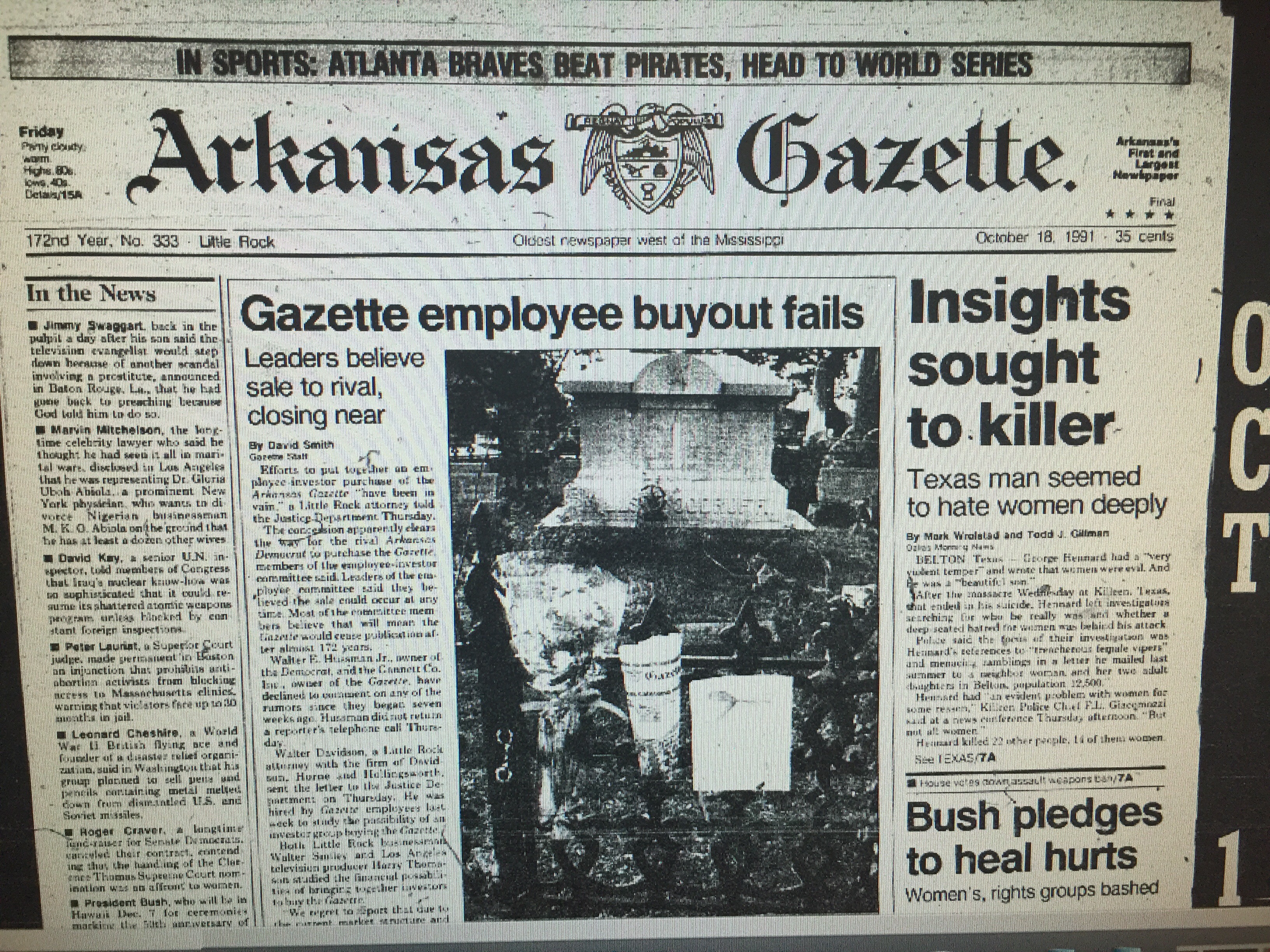
Twenty-five years ago today, on October 18, 1991, the final edition of the Arkansas Gazette was delivered. 

The front page featured a story on the demise of a Gazette employee effort to buy the paper. 

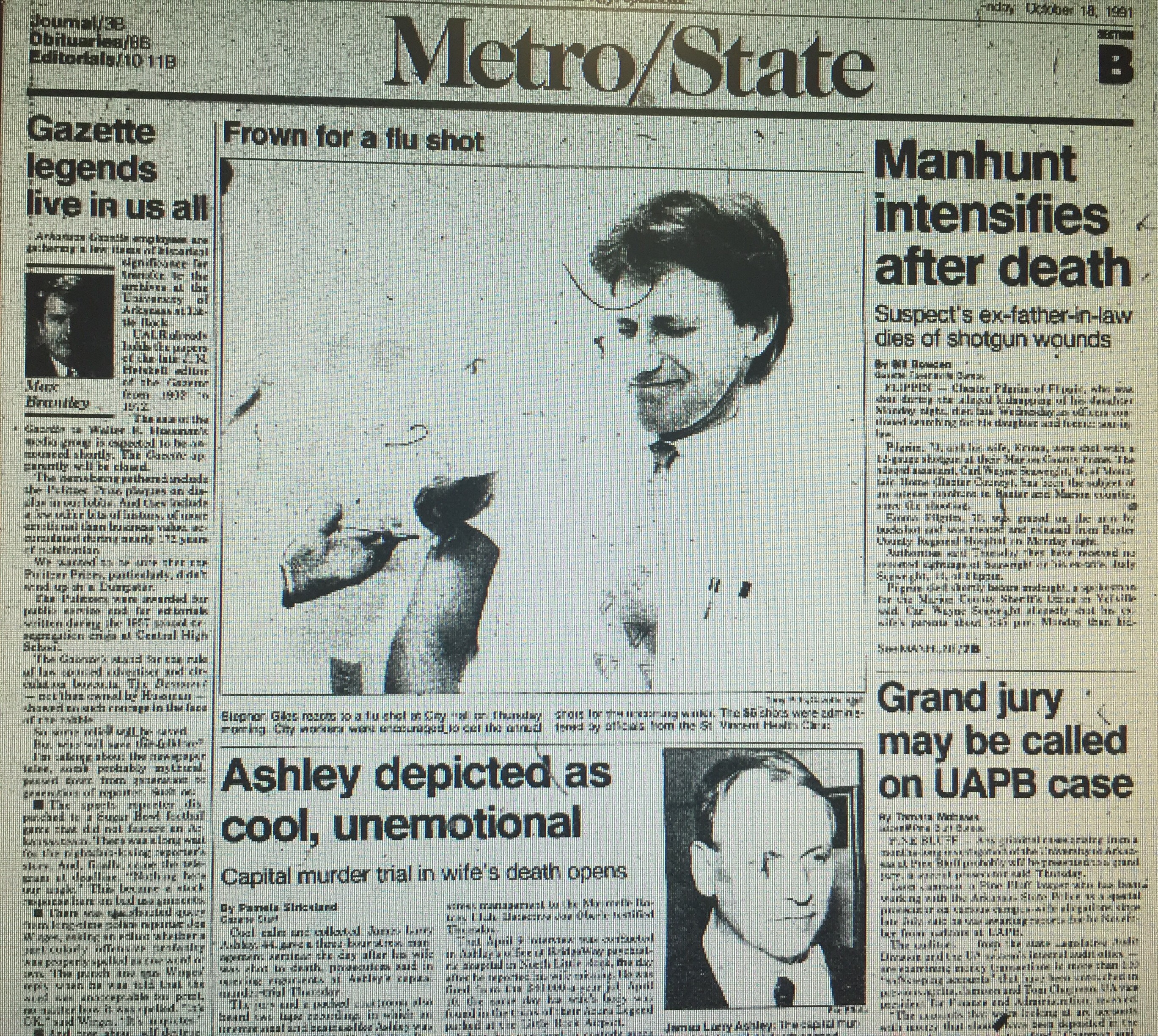
Max Brantley’s column on the front page of the B section also addressed the then-eminent end of the paper. However, as a newspaper all of the sections spent most of their space on the news of the day. While Gazette staffers felt the end was likely near, few felt that the paper on October 18, 1991, would be the final edition.  

The back page of the last section of the Gazette featured an ad for Premiere Pontiac Nissan Audi which was throwing a “Beat Texas” party featuring Craig O’Neill.  The Arkansas Razorbacks were scheduled to play the Texas Longhorns on Saturday, October 19. 

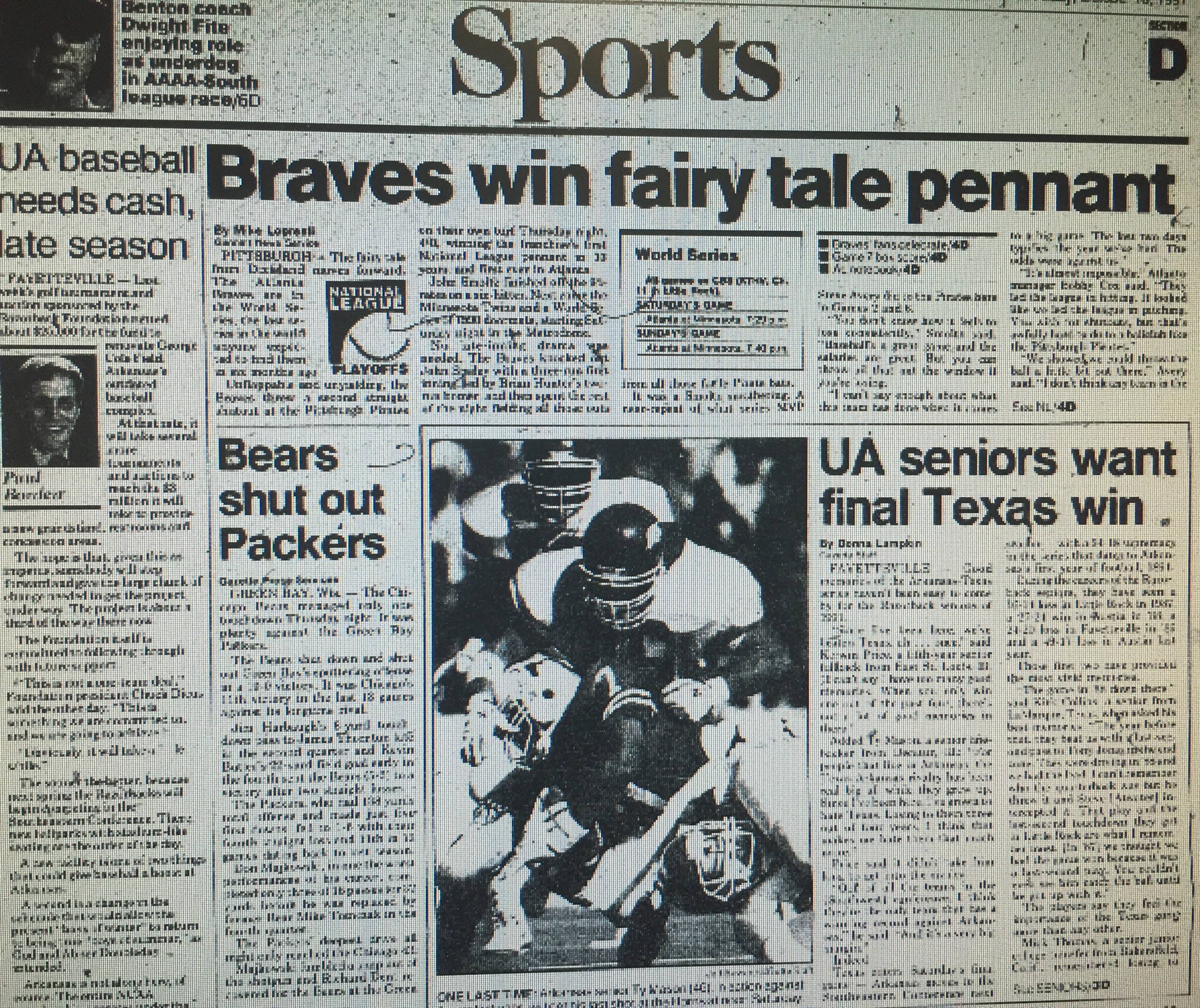
Here are the top halves of the front pages of sections B, C, D, and E for the final Atkansas Gazette.  They tell the storie of trials, football games, corporate earnings, and cultural events. 


100 Years of the Pulitzer celebrated tonight by Arkansas Humanities Council lecture with Ray Moseley

Tonight, ahc-pulitzer-100-moseleyTuesday, October 4 at 7PM, at Ron Robinson Theater,  the Arkansas Humanities Council will present the 3rd in a series of lectures honoring the Pulitzer Prize in Arkansas. This lecture will honor the Arkansas Gazette which won two Pulitzer Prizes in 1958 for Meritorious Service and Editorial Writing.

Ray Mosely, who was the lead reporter for the Gazette’s coverage of the Central High integration crisis in 1957, will give the lecture.  This event is free and open to the public.

Moseley was  later was a United Press International foreign correspondent, bureau chief and then editor for Europe, Africa and the Middle East. For many years after that he was chief European correspondent of the Chicago Tribune based in London. In a 59-year career, he covered such stories as the 1967 Six-Day War, the first Indo-Pakistan war, the Greek-Turkish war in Cyprus, the Rhodesian civil war, the Iranian revolution, the fall of the Berlin Wall and the death of Princess Diana.

He was a Pulitzer finalist in 1981 for a series of articles about Africa and in 2003 was awarded an honorary MBE (Member of the British Empire) by Queen Elizabeth II for services to journalism, the first American correspondent in two decades to receive that honor. He is also the author of three books including a journalistic memoir, In Foreign Fields, and of two forthcoming books, one on the war correspondents of World War II and the other on the black American soldiers of that war. Moseley will share reminiscences about coverage of the 57 crisis, his personal experiences afterward, the end of the Gazette and the future of newspapers.

Following Moseley’s remarks Ernie Dumas will moderate a panel discussion featuring former Gazette reporters.

Little Rock Look Back: Central & Hall Football at 2-0

lrchs-lrhhsAfter two weeks of prep gridiron (that is high school football to those who don’t write like a 1950s inky wretch), Little Rock Central and Little Rock Hall are both posting records of 2 wins and 0 losses.  This feat has not been achieved in quite a while.

How long?  37 seasons!  It was 1979, the last time that the Tigers and Warriors were both out of the gate at 2-0.

1979

Jimmy Carter was in the White House. Bill Clinton was in his first term as Governor. First Lady Hillary Rodham was several months pregnant with Chelsea. Hall High and Razorback standout Webb Hubbell was Mayor of Little Rock.  The City’s population was in the 150,000s (it would be 159,151 after the 1980 census).  Little Rock had an area of approximately 80 square miles.  (Today it is approximately 200,000 citizens over 122 square miles.)

Lou Holtz was coaching the Arkansas Razorbacks in the Southwest Conference.  Harry Hall was in his first season as Commissioner of the Arkansas Intercollegiate Conference.  Rex Nelson was a student at Ouachita.  Paul Eells was in his second year with KATV, while Dave Woodman was finishing his first decade at KARK.  Gary Hogan was anchoring sports for KTHV.  Hogs football games were broadcast on KAAY radio.  While Bob Buice and Jim Elder were ruling the airwaves at KARN, Craig O’Neill was dominating mornings at KLAZ.

Orville Henry, Jim Bailey, and Wadie Moore covered college and high school sports for the Arkansas Gazette.  The Arkansas Democrat had switched to morning delivery and hired John Robert Starr as editor.  Both papers carried ads for Kempners, Golds, M.M. Cohn, Skaggs Albertsons, Minute Man, Union National Bank, Commercial National Bank, Worthen National Bank, and First National Bank.

Metrocentre Mall existed with bricked over streets on Main and Capitol. The Grady Manning Hotel and Hotel Marion still stood (though in their twilight days before their February 1980 date with demolition.)

So a lot has changed since Central and Hall previously achieved this.  In the interval, Central has been 2-0 a dozen times and Hall has achieved that a brace. But the schools never managed it during the same season.  Three times the schools both managed 1-1 seasons and seven times they each started at 0-2.

The 1979 Warriors were helmed by C. W. Keopple, who would lead the team from the 1960s into the 1980s winning four conference/state titles. (When your conference is statewide, winning one got you the other.)  Bernie Cox was in his fifth season as the Tigers’ mentor, with two state championships already under his belt, five more would be in his future.

The teams stayed tied through the fourth week. But in the fifth week, while Central won, Hall lost to Parkview by a score of 7-0.  The following week, the Warriors rebounded, while the Tigers settled for a 0 to 0 tie with Ole Main.  Weeks seven through ten saw both teams notching another win each week.  This set up a Thanksgiving Day classic with the state’s top two teams facing off.  Central was slightly favored, but season records seldom carried any weight when the two cross-town rivals played on Thanksgiving afternoon.  In an upset, Hall bested Central by a score of 17 to 0.

From 1987 to 1990, the second game of the season was the Hall-Central matchup, which meant that it would have been impossible to both start with a 2-0 record.  This second week matchup was made necessary by the fact that not only could the two teams no longer face off on Thanksgiving after 1982, but the two schools were not in the same conference from 1983 through 2000. So the faceoff was early in the season, during the non-conference portion.

Due to subsequent restructurings by the Arkansas Activities Association, the two schools have not played a football game since 2005.  The bell from the “Battle of the Bell” which was supposed to replace the pageantry and intense rivalry of the Thanksgiving Day matchups, sat forlornly and largely forgotten in the trophy case at Central following the 2005 edition which Central won by a score of 24 to 7.  (That season Central started at 0-2 on the way to a 5-5 record and Hall started at 1-1 on the way to a 3-7 record.)  UPDATE: As noted in a comment on this piece, the Bell has now been refurbished and sits proudly at Quigley Stadium.  Thank you Belinda Stilwell for the information!

Who knows how the 2016 season will turn out for these two teams?  In the past 2-0 has led both to State Championships and to a 6-4 record.  But for two schools that have struggled in the past few seasons, to start with a 2-0 record is quite an accomplishment. For both to start with that record is remarkable.


While the blog hiatus and a restructuring continue, this was a bit of history that needed mentioning.

Little Rock Look Back: Former LR Mayor Sprick takes on Muhammad Ali and Loses

Ali SprickDan T. Sprick was a Little Rock Mayor for two years in the 1940s after having previously served on the City Council.  From 1961 until 1970, he served as a State Senator from Little Rock and was a reliable ally for Governor Orval Faubus. Once Faubus left office and was replaced by Governor Winthrop Rockefeller, Sprick continued to wave the banner of segregation and agitation.  One of his new focuses was boxer Muhammad Ali.

In 1969, the University of Arkansas announced that Ali would be one of the speakers for its public appearance series.  After refusing to be drafted and go to Vietnam, Ali was barred from earning a living as a professional boxer and so was making a living giving lectures.  His refusal to submit to the draft was based on his religious beliefs as a recent convert to the Nation of Islam.

Opposition to Ali’s appearance rose almost immediately, and from Little Rock not Fayetteville. The Pulaski Businessman’s Association sent a letter to UA president David Mullins asking him to bar Ali from speaking. President Mullins insisted that he had the right to speak on campus. When that didn’t work, Senator Sprick and his cohorts in the state’s upper chamber went to work. A resolution calling for Ali to be barred from speaking failed on a voice vote after much debate.

While there were certainly some racial overtones to Sprick’s opposition, he and others seemed to be more concerned over the former Cassius Clay’s conversion to Islam plus his ensuing refusal to be drafted.  Senator Sprick declared that if President Nixon would draft him now he would go to serve in Vietnam.  (Sprick was in his late 60s at the time.)

Ali’s speech on the campus actually caused some controversy on its own.  One of the things he advocated for segregation. He praised Alabama Governor George Wallace.  The Arkansas Gazette which had been following the saga in both news stories and editorials, noted that remarks like that should have endeared Ali to Dan Sprick and others.

Ali, of course, resumed his boxing career and defined that sport in the 1970s with his talent in the ring and his showmanship.

Based on an editorial, Sprick sued the Gazette for libel. The paper settled with him out of court because his health was poor. Sprick died in 1972.

Little Rock Look Back: Cornice placed on Robinson Auditorium

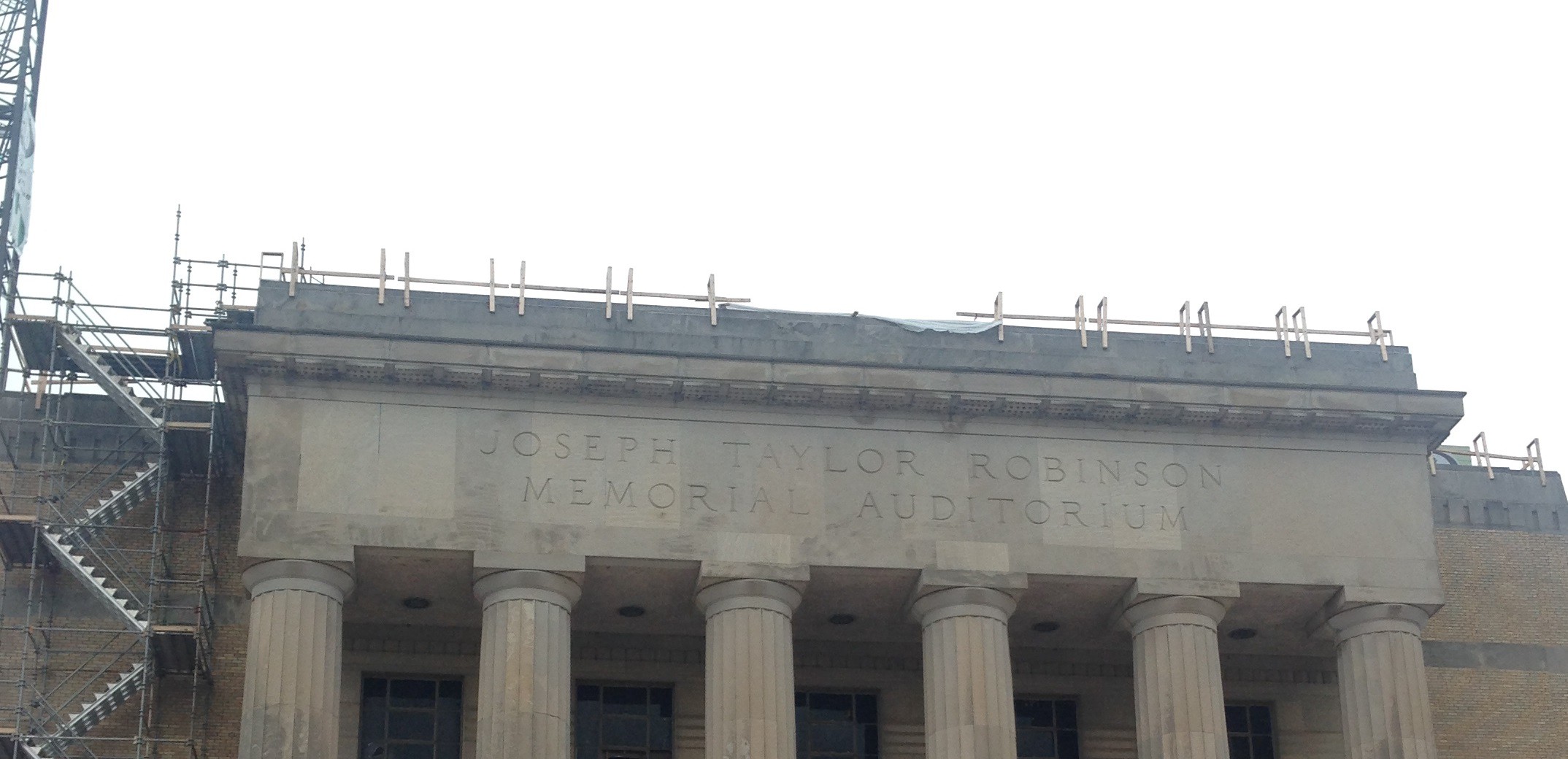
JTR CorniceOn June 1, 1939, the cornice was installed on Robinson Auditorium.  This granite slab noted the name of the building as the Joseph Taylor Robinson Memorial Auditorium.  (It is interesting to note that it used the more modern “u” instead of the classical “v” which was often used in buildings during prior decades – as evidenced by the Pvlaski Covnty Covrt Hovse across the street.)

This was a milestone marking the completion of the front facade of the structure.  Much work would continue on the interior of the structure.  This step in the construction was considered major enough that the Arkansas Gazette mentioned it in a news article.

Today the cornice is again surrounded by construction materials and braces. The front lobby, the cornice and columns are pretty much the only parts of the building not currently under construction as Robinson Center is readied for its second act.  It is scheduled to open in November 2016.

Remembering the Fallen on Memorial Day at Mount Holly Cemetery

MountHolly Memorial DayToday is Memorial Day – a time to pay tribute to the men and women in uniform who died in service to their country.

As a way to give this recognition, today would be a good day to visit a cemetery. One of Little Rock’s most storied cemeteries is Mount Holly Cemetery. There are numerous persons buried there who died while in service to their country.

One of them is 2Lt Carrick W. Heiskell, son of Arkansas Gazette editor J. N. Heiskell.  2Lt Heiskell died while flying for the Air Transport Command in the Himalayas during World War II.  He was posthumously the recipient of the Distinguished Unit Emblem, Purple Heart, and the Air Medal.

Founded in 1843, Mount Holly has been called “The Westminster Abbey of Arkansas.” Thousands of visitors come each year. Those interested in history come to see the resting places of the territorial citizens of the state, including governors, senators, generals, black artisans, and even a Cherokee princess. For others the cemetery is an open air museum of artistic eras: Classical, Victorian, Art Deco, Modern––expressed in gravestone styles from simple to elaborate. Some come to read the epitaphs that range from heartbreaking to humorous to mysterious.

Though a City of Little Rock facility, the cemetery is maintained by the Mount Holly Cemetery Association, a non-profit organization with a volunteer Board of Directors. The cemetery is located at 1200 South Broadway in Little Rock. Gates are open from 8 a.m. until 5 p.m. in the summer and from 8 a.m. until 4 p.m. in the winter.

Interred within the rock walls of Mount Holly are 11 state governors, 15 state Supreme Court justices, four Confederate generals, seven United States senators and 22 Little Rock mayors, two Pulitzer Prize recipients, as well as doctors, attorneys, prominent families and military heroes.