
Little Rock Look Back: Movie Ball sends LR Film Fans into Frenzy

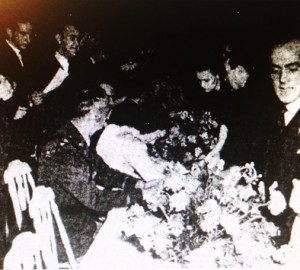
Autograph seekers crowd around the actors at the Movie Ball (photo from Arkansas Gazette)

As final preparations were being made for the opening of the Joseph Taylor Robinson Municipal Auditorium in early 1940, a glamorous evening took place in Robinson’s lower level convention hall on February 1.

In conjunction with a meeting of film executives and movie theatre owners sponsored by Robb and Rowley Theaters (which later became the United Artists theatre chain), several Hollywood actors were in Little Rock and headlined a Movie Ball. While in Little Rock, Maureen O’Hara, Phyllis Brooks, Arleen Whelan, Tim Holt and Gene Autry had also made a variety of public appearances.

Mr. Autrey had to miss the ball because he had to return to Hollywood early to attend to business matters. Actress Ilona Massey had also been scheduled to attend the events but was unable due to illness.

The quartet who did appear at the Movie Ball caused quite a scene. Upon their entrance, so many of the attendees crowded around for autographs that the evening’s grand march could not take place (a newspaper headline in the Democrat innocently used the word “orgy” to describe the crowd). After two attempts, Little Rock Mayor J. V. Satterfield (who was escorting Miss O’Hara) and the other members of the Little Rock host delegation led the Hollywood foursome to their reserved table. For quite a while that evening, the table was besieged by autograph seekers.

Though it is unknown as to whether he sought an autograph, photos from the evening showed a very satisfied Mayor Satterfield with Miss O’Hara on his arm. Satterfield family lore joked that Mrs. Satterfield (who had stayed home that night to tend to a sick son) was not a fan of Miss O’Hara’s films after that evening.

The Movie Ball showed Little Rock citizens the value of Robinson Auditorium even before it had been officially dedicated. The film industry meetings had taken place at the Albert Pike Hotel which did not feature a ballroom large enough to host the ball. Without the auditorium’s availability for the gala, organizers might not have chosen Little Rock for the meeting.

With the auditorium’s convention hall not attached to any hotel, it opened up the chance for Little Rock to host more events. This had been one of the key arguments for an auditorium since Mayor W. E. Lenon’s first proposal back in 1904. Having a glamorous event this early in the auditorium’s life validated that contention. After having endured the challenges to open the building, it was a nice lagniappe for the auditorium’s proponents who were present.
The actor Tim Holt would again be connected to Little Rock. In September 1951, he tried to obtain a divorce in Arkansas and stated that he had been a resident of the state for at least six weeks. He also had someone else testify to that fact. In October 1951, the divorce was granted. Later Mr. Holt was charged with perjury and fined $200 for falsely representing his length of residence in Arkansas. Judicial sanctions for his legal team, which included a State Senator, were eventually reviewed by the Arkansas Supreme Court.

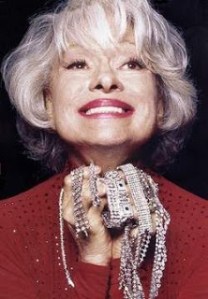
Rock the Oscars 2019: Carol Channing

On January 31, 1921, future “Little Girl from Little Rock” and Oscar nominee Carol Channing was born. Alas it was in Seattle.

After gaining the notice of New York critics and audiences in the musical revue, Lend an Ear, Channing achieved Broadway stardom playing fictional Little Rock native Lorelei Lee (the creation of Anita Loos) in Gentlemen Prefer Blondes.  In this show, which opened in December 1949, she introduced the Leo Robin-Jule Styne songs “Little Girl from Little Rock” and “Diamonds Are a Girl’s Best Friend.”

In 1964, she won the Actress in a Musical Tony for her second signature role playing the title character in Hello, Dolly!  Channing also earned a special Tony in 1968 for Dolly when it became the longest-running Broadway musical.

On November 15, 1966, Carol Channing opened a six day stint in HELLO, DOLLY! at Robinson Auditorium.  She would play 8 sold out shows over those six days.  She had just wrapped filming THOROUGHLY MODERN MILLIE (for which she would receive an Oscar nomination). She had specifically requested that Little Rock be added to the tour.

While in Little Rock, Channing was entertained at the Arkansas Governor’s Mansion and feted at parties.  She was made an honorary citizen of Little Rock, as well.  But she was here to perform. And perform she did. She was rarely known to miss a performance and always gave her utmost.  Bill Lewis, in his review in the ARKANSAS GAZETTE, stated “To hear Channing sing ‘Hello, Dolly!’ Is one of the great experiences of all musical theater to date…”

In 1993, she spent her birthday in Washington DC at a White House dinner for the National Governors’ Association.  This was the Clintons’ first official White House dinner after moving in to the residence eleven days prior.  President Bill Clinton led the crowd in singing “Happy Birthday” to her.  She remarked to the President that she was Christian Scientist and didn’t celebrate birthdays, which meant she didn’t get any older.  He replied that it meant the night was her first birthday (it was her 72nd in actuality).

She died earlier this month just two weeks shy of her 98th birthday.

Little Rock Look Back: A Municipal Auditorium approved by LR Voters in 1937

On January 26, 1937, Little Rock voters went to the polls to vote on three different municipal bond issues.  One of them was the construction of a municipal auditorium.
The bonds for the auditorium would be $468,000 in general obligation bonds which would be paid off between 1940 and 1971. This was toward a total cost of $760,000 for the entire project.

The official campaign for the auditorium was sponsored by the Little Rock Forward Committee which was led by W. H. Williams. In campaign advertisements it showed the value of conventions in New York City which was estimated at $100 per convention attendee. Little Rock organizers were estimating a $10 a day expenditure by visitors, which the committee stressed was very conservative. The campaign committee emphasized the importance of acting at that time due to the federal government money involved.

Various committees and organizations endorsed the auditorium project including the Little Rock Chamber of Commerce, Little Rock Federation of Women’s Clubs, and the Young Business Men’s Association.

The thrust of the campaign focused on the economic benefit to Little Rock as well as the fact that the auditorium would be for all citizens. This message was picked up in editorials by both the Democrat and Gazette. In editorials on January 23 and 25, the Democratopined that the benefits of the auditorium would be distributed among all classes of the citizenry. The next day, both papers ran editorials which touted the economic boon an auditorium would bring through conventions and meetings.

The Democrat’s approach broke down the current value of conventions to Little Rock with, what it termed, the city’s “existing inadequate” facilities. The paper emphasized a conservative estimate of what the added value to Little Rock’s economy would be with the new auditorium.

In expressing support for the auditorium the Gazette stressed the values for local, statewide and national groups. “An auditorium would provide a more convenient and better adapted community center for all kinds of local gathering,” and continued that it would make Little Rock “the logical meeting place for state conventions of every sort.” In discussing the value of state, regional and national meetings the paper stressed that the outside money spent by convention attendees has an impact beyond stores, hotels and restaurants.

Both papers also echoed the importance of the federal government financing to make this possible. The Democrat noted that the Public Works Administration grant and federal low cost loan made this an ideal time.

On January 26, 1937, Little Rock voters approved the auditorium bond by a vote of 1,518 to 519. It passed in each of the city’s 23 precincts. Little Rock Mayor R. E. Overman expressed his pleasure at the outcome of the vote and extended his thanks to the voters.

After the election, a Gazette editorial commented on the low turnout for the special election by commenting that the weather had been nice and there were no other barriers to voting. The editorial writer opined that those not voting in the election must not have been opposed to the endeavor.

Little Rock Look Back: A 1956 attempt at integrating LR schools

Arkansas Democrat photo by staff photographer Mr. Bisgood

Arkansas Democrat photo by staff photographer Mr. Bisgood

On Monday, January 23, 1956, twenty-seven African American students attempted to integrate four Little Rock schools.  By the end of the day, all four school principals had refused entry and some of the students had met with LRSD Superintendent Virgil Blossom.

Eight girls who were students at Horace Mann High School arrived at Central High at 9:30 am accompanied by Daisy Bates and Frank W. Smith both of the NAACP.  One male student attempted to integrate Little Rock Technical High School.  Four students arrived at Forest Heights Junior High (accompanied by three adults) and fourteen students attempted to integrate Forest Park Elementary (accompanied by four adults).  Neither the Arkansas Gazette nor the Arkansas Democrat broke down the age or gender of the junior high and elementary students.

Though all were referred to meet with Mr. Blossom, only the young women from Horace Mann visited with him.  After the conversation both he and Mrs. Bates declared the conversation had been friendly.   Mr. Blossom, in denying the request, noted that the Little Rock School District had a plan for integration. To allow them to integrate immediately would have been going against the plan.  The integration plan was connected to the completion of the new high school.  If it were ready to open in the fall of 1957, then integration at the high schools would start then.  The newspapers noted that there was no timeline for when it would extend down to the junior high and elementary levels.

That evening, Rev. J. C. Crenchaw, the president of the Little Rock NAACP, issued a statement.  In it he expressed frustration that the LRSD was vague on its timeline for integration.  He noted that the students lived near the schools which they tried to integrate and were therefore forced to travel several extra miles each day to attend school.  He also commented that the young man who attempted to enroll at Tech was not afforded the training available there at his current school.

The Arkansas Democrat ran a photo of the meeting with Mr. Blossom.  It identified the seven students who were pictured.  No mention was made as to whether the eighth student was present but not photographed, or if she did not attend the meeting.  As was the practice at the time, the addresses of the students were listed by their names.  Based on those addresses, the students lived between 0.4 and 0.9 miles from Central High School and were between 2.1 and 3.2 miles away from Horace Mann High School.  Of the seven students in the photo, two were seniors, three were juniors, and three were sophomores.  None of the students named became part of the Little Rock Nine who did integrate Central High twenty-one months later.

On January 24, the Gazette editorial writer opined they were glad for the amicable nature of the conversations. They hoped it did not affect the good race relations in Little Rock.  The writer concluded by saying they did not want it to incite extremists (but did not specify if they viewed the extremists as being for or against integration.)

Little Rock Look Back: Opening of 1868 LR City Hall

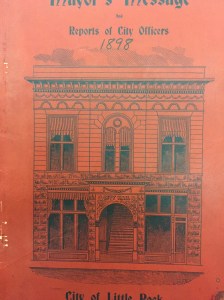
The 1868 City Hall as featured on a city report.

On January 22, 1868, a charity ball (including a supper) was the first special event held in the new Little Rock City Hall located at 120 to 122 West Markham.

The two story building featured city offices downstairs, including an engine house for the volunteer fire department. Upstairs was the council chambers and a special event space. The facility was the width of two storefronts. The upstairs was accessed by a central staircase which went from street level through an archway directly up to the second floor. The first floor had a stone exterior and the second floor was a combination of brick and woodwork.

Records do not indicate when the first city council in the new building took place. At the January 21, 1868, meeting, the body formally accepted the building and cancelled any clauses in the contract about penalties should the contractor not meet the construction deadline. But there is no indication whether that meeting took place in the new building or in the previous city hall. (The location of that prior city hall is a mystery.). The minutes from the council meetings just prior to and just after the January 21 meeting give no indication as to which building was the site for the meeting.

It IS known that March 30, 1908, was the date of the final council meeting in the 1868 City Hall. After that meeting, city offices completed their move to the edifice at Markham and Broadway, which still serves as Little Rock City Hall.

As early as November 1867, the City Council was getting requests for special events to be held in the new city hall. In November and December the council refused to take action on any requests because the building was still under construction.

The January 22, 1868, event was created to help the destitute in Little Rock. The ARKANSAS GAZETTE encouraged people to be generous and purchase tickets. Even the day before the event, the weekly version of the GAZETTE (which at the time had added daily editions in addition to its weekly issue) was assuring people there would be plenty of space in the splendid new building so there was still room for additional ticket purchases. Tickets were $5 to admit a lady and a gentleman.  (That would be the equivalent of $83.71 today. While cheap for two people to attend a Little Rock event in 2018, in the post-Civil War era, it was a definite hit to the pocketbook.)

The unnamed organization which put on the charity event was led by W. W. Wilshire (president), George W. Clark (secretary), Joseph Meyer (treasurer) and a standing committee of Dr. C. M. Taylor, Dr. P. O. Hooper, A. Adams, F. H. Moody, and E. Langley.  Donations could be made to any of the officers.  The arrangements for the event were handled by Joseph Meyer, A. Adams, J. P. Jones, Alexander George, Jr., Joseph W. Bossert, and Daniel Ottenheimer.  The reception committee was W. D. Blocher, H. C. Ashley, A. McDonald, P. W. McWhorter, T. Lafferty, and F. H. Moody.   Tickets could be purchased at the stores of J. E. Reardon, G. H. Gibbs, Joseph Meyer, Lafferty & Raleigh, S. L. Griffith, McAlmont & Stillwell, Beideman & Co., and Dodge & Co as well as at the Anthony and Commercial Houses.  (It is interesting to note how so many people at the time were publicly listed by only their first initial.)

The building stood for 56 years after City Hall vacated it.  It housed a variety of businesses over the years.  The building was torn down in 1964 as part of Urban Renewal.  Today it is the site of part of the Statehouse Convention Center.  It is directly across from the One-Eleven restaurant side of the Capital Hotel.

MLK in Little Rock

Ernest Green, Dr. King and Daisy Bates share a relaxed moment — which was probably rare for the three in 1958

Today is the Martin Luther King Jr. Holiday.  It is an apt time to think about Dr. King and Little Rock.

A friend of L. C. and Daisy Bates, he attended the 1958 Central High School graduation to witness Ernest Green receiving a diploma. Each senior only received eight tickets to the ceremony at Quigley Stadium, and he was one of Green’s. Dr. King was in the state to address the Arkansas AM&N (now UAPB) graduation earlier in the day.

His attendance was briefly mentioned in the local press, but there was no media photo of him at the ceremony.  The Little Rock School District limited the press to one Democrat and one Gazette photographer. Other press were limited to the press box.

There is a photo of Ernest Green with Daisy Bates and Dr. King (pictured on this entry).

In 1968, when Dr. King was assassinated, Little Rock did not see the unrest that many cities did.  Part of that was probably due to quick action by Governor Winthrop Rockefeller. The Governor released a statement fairly quickly expressing his sorrow at the tragedy and calling for a day of mourning. He also made the State Capitol available for the NAACP to have a public memorial, as well as worked with a group of ministers to host an interdenominational service.

Little Rock Mayor Martin Borchert issued a statement as well:

We in Little Rock are disturbed about the incident in Memphis. We are disturbed regardless of where it had happened.  Killing is not the Christian solution to any of our problems today.

In Little Rock, we feel we have come a long way in 10 years toward solving some of our problems of living and working together regardless of race, creed or color.

The city Board of Directors in Little Rock has pledged itself toward continuing efforts to make Little Rock a better place in which to live and work for all our citizens.

We feel the efforts of all thus far have proved we can live in harmony in Little Rock and are confident such an incident as has happened will not occur in Little Rock.  We will continue our most earnest efforts toward the full needs of our citizens.

The day after Dr. King was assassinated, a group of Philander Smith College students undertook a spontaneous walk to the nearby State Capitol, sang “We Shall Overcome” and then walked back to the campus.  President Ernest T. Dixon, Jr., of the college then hosted a 90 minute prayer service in the Wesley Chapel on the campus.

On the Sunday following Dr. King’s assassination, some churches featured messages about Dr. King.  As it was part of Holy Week, the Catholic Bishop for the Diocese of Little Rock had instructed all priests to include messages about Dr. King in their homilies. Some protestant ministers did as well. The Arkansas Gazette noted that Dr. Dale Cowling of Second Baptist Church downtown (who had received many threats because of his pro-integration stance in 1957) had preached about Dr. King and his legacy that morning.

Later that day, Governor Rockefeller participated in a public memorial service on the front steps of the State Capitol. The crowd, which started at 1,000 and grew to 3,000 before it was over, was racially mixed. At the conclusion of the ceremony, Governor and Mrs. Rockefeller joined hands with African American ministers and sang “We Shall Overcome.”

That evening, Trinity Episcopal Cathedral was the site of an interdenominational service which featured Methodist Bishop Rev. Paul V. Galloway, Catholic Bishop Most Rev. Albert L. Fletcher, Episcopal Bishop Rt. Rev. Robert R. Brown, Rabbi E. E. Palnick of Temple B’Nai Israel, Gov. Rockefeller, Philander Smith President Dixon, and Rufus King Young of Bethel AME Church.

Earlier in the day, Mayor Borchert stated:

We are gathered this afternoon to memorialize and pay tribute to a great American….To achieve equality of opportunity for all will require men of compassion and understanding on the one hand and men of reason and desire on the other.

Mayor Borchert pledged City resources to strive for equality.

Another Little Rock Mayor, Sharon Priest, participated in a ceremony 24 years after Dr. King’s assassination to rename High Street for Dr. King in January 1992.  The name change had been approved in March 1991 to take effect in January 1992 in conjunction with activities celebrating Dr. King’s life.  At the ceremony, Daisy Bates and Annie Abrams joined with other civil rights leaders and city officials to commemorate the name change.

Little Rock Look Back: HAIR brings Age of Aquarius to Robinson Center

Ad for the original production of HAIR in Little Rock. Note the ticket prices. And that they could be purchased at Moses Music Shops.

Forty-seven years ago today, on January 18, 1972, the musical Hair settled in for a week-long run at Robinson Auditorium.  The saga to bring the national tour to Little Rock had actually begun eleven months earlier.

In February 1971, a young Little Rock attorney named Phil Kaplan petitioned the Little Rock Board of Censors to see if it would allow a production of Hair to play in the city. He was asking on behalf of a client who was interested in bringing a national tour to Arkansas’ capital city. The show, which had opened on Broadway to great acclaim in April 1968 after an Off Broadway run in 1967, was known for containing a nude scene as well for a script which was fairly liberally sprinkled with four-letter words. The Censors stated they could not offer an opinion without having seen a production.

By July 1971, Kaplan and his client (who by then had been identified as Southwest Productions) were seeking permission for a January 1972 booking of Hair from the City’s Auditorium Commission which was charged with overseeing operations at Robinson Auditorium. At its July meeting, the Commissioners voted against allowing Hair because of its “brief nude scene” and “bawdy language.”

Kaplan decried the decision. He stated that the body couldn’t “sit in censorship of legitimate theatrical productions.” He noted courts had held that Hair  could be produced and that the Auditorium Commission, as an agent for the State, “clearly can’t exercise prior censorship.” He proffered that if the production was obscene it would be a matter for law enforcement not the Auditorium Commission.

The Commission countered that they had an opinion from City Attorney Joseph Kemp stating they had the authority. One of the Commissioners, Mrs. Grady Miller (sister-in-law of the building’s namesake the late Senator Robinson, she had served on the Commission since 1940), expressed her concern that allowing Hair would open the door to other productions such as Oh! Calcutta!

On July 26, 1971, Southwest Productions filed suit against the Auditorium Commission. Four days later there was a hearing before federal Judge G. Thomas Eisele. Judge Eisele offered a ruling on August 11 which compelled the Auditorium Commission to allow Hair to be performed. Prior to the ruling, some of the Auditorium Commissioners had publicly stated that if they had to allow Hair, they would close it after the first performance on the grounds of obscenity. To combat this, Judge Eisele stated that the Commission had to allow Hair to perform the entire six day engagement it sought.

Upon hearing of the Judge’s ruling, Commissioner Emily Miller offered a succinct, two word response. “Oh, Dear!”

In the end, the production of Hair at Robinson would not be the first performance in the state.  The tour came through Fayetteville for two performances in October 1971 at Barnhill Arena.

On January 18, 1972, Hair played the first of its 8 performances over 6 days at Robinson Auditorium.  In his review the next day, the Arkansas Gazette’s Bill Lewis noted that Hair “threw out all it had to offer” and that Little Rock had survived.

The ads promoting the production carried the tagline “Arkansas will never be the same.”  Tickets (from $2 all the way up to $8.50–the equivalent of $12 to $51 in 2019 dollars) could be purchased at Moses Melody Shops both downtown and in “The Mall” (meaning Park Plaza). That business is gone from downtown, but the scion of that family, Jimmy Moses, is actively involved in building downtown through countless projects. His sons are carrying on the family tradition too.

Little Rock was by no means unique in trying to stop productions of Hair.  St. Louis, Birmingham, Los Angeles, Tallahassee, Boston, Atlanta, Charlotte NC, West Palm Beach, Oklahoma City, Mobile and Chattanooga all tried unsuccessfully to stop performances in their public auditoriums.  Despite Judge Eisele’s ruling against the City of Little Rock, members of the Fort Smith City Council also tried to stop a production later in 1972 in that city. This was despite warnings from City staff that there was not legal standing.

Within a few years, the Board of Censors of the City of Little Rock would be dissolved (as similar bodies also were disappearing across the US). Likewise, the Auditorium Commission was discontinued before Hair even opened with its duties being taken over by the Advertising and Promotion Commission and the Convention & Visitors Bureau staff.  This was not connected to the Hair decision; it was, instead, related to expanding convention facilities in Robinson and the new adjacent hotel.  Regardless of the reasons for their demise, both bygone bodies were vestiges of earlier, simpler and differently focused days in Little Rock.