
Black History Month Spotlight – Mosaic Templars Cultural Center

The new Arkansas Civil Rights History Audio Tour was launched in November 2015. Produced by the City of Little Rock and the University of Arkansas at Little Rock allows the many places and stories of the City’s Civil Rights history to come to life an interactive tour.  This month, during Black History Month, the Culture Vulture looks at some of the stops on this tour which focus on African American history.

The Mosaic Templars Cultural Center and Museum collects, preserves, interprets and celebrates Arkansas’s unique African American political, economic, and social achievement from 1865 to 1950. The Center resides in the footprint of the original Mosaic Templars of America National Headquarters and Annex Buildings.

The permanent museum exhibits depict historic West Ninth Street as a thriving commercial and social hub, focusing on the black entrepreneurship, Templars organization, and the legacy of black legislators. Between 1868 and 1893, eighty-five African Americans served in the Arkansas General Assembly. The majority served in the House, with nine in the Senate. Election laws passed in 1891, together with a poll tax in 1832, ended the election of African Americans to the legislature. No black person served again until the General Assembly in 1973.

In addition to community educational programs, the Center offers a genealogy research room, an art collection created by local talent, and a well-stocked store. The Center’s third floor features a replica of the original Headquarters Building auditorium and the Arkansas Black Hall of Fame galleries.

The Center is a museum of the Department of Arkansas Heritage and admission is free.

The app, funded by a generous grant from the Arkansas Humanities Council, was a collaboration among UALR’s Institute on Race and Ethnicity, the City of Little Rock, the Mayor’s Tourism Commission, and KUAR, UALR’s public radio station, with assistance from the Little Rock Convention and Visitors Bureau.
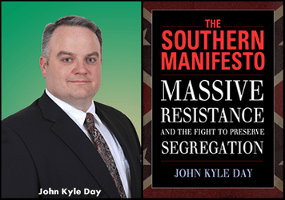
Arkansas and the Southern Manifesto explored at Butler Center’s Legacies & Lunch today

southern_manifestoAt Legacies & Lunch, John Kyle Day, associate professor of history at University of Arkansas at Monticello, will discuss the efforts of the United States Congress to delay desegregation in the 1950s and onward.  The program will take place today (February 3) at 12 noon at the Darragh Center on the CALS campus.

On March 13, 1956, ninety-nine members of the United States Congress promulgated the Declaration of Constitutional Principles, popularly known as the Southern Manifesto. This document formally stated opposition to the landmark United State Supreme Court decision Brown v. Board of Education, and the emergent civil rights movement. This allowed the white South to prevent Brown‘s immediate full-scale implementation and, for nearly two decades, set the slothful timetable and glacial pace of public school desegregation. The Southern Manifesto also provided the Southern Congressional Delegation with the means to stymie federal voting rights legislation, so that the dismantling of Jim Crow could be managed largely on white southern terms.

Day’s book, The Southern Manifesto: Massive Resistance and the Fight to Preserve Segregation, narrates this single worst episode of racial demagoguery in modern American political history and considers the statement’s impact upon both the struggle for black freedom and the larger racial dynamics of postwar America.

Legacies & Lunch is free, open to the public, and supported in part by the Arkansas Humanities Council. Programs are held from noon-1 p.m. on the first Wednesday of each month. Attendees are invited to bring a sack lunch; drinks and dessert are provided. For more information, contact 918-3033.

Black History Month Spotlight – Mosaic Templars of America

The new Arkansas Civil Rights History Audio Tour was launched in November 2015. Produced by the City of Little Rock and the University of Arkansas at Little Rock allows the many places and stories of the City’s Civil Rights history to come to life an interactive tour.  This month, during Black History Month, the Culture Vulture looks at some of the stops on this tour which focus on African American history.
The Mosaic Templars of America was formed as a business in the late 1870s by Arkansas freedmen John E. Bush and Chester W. Keatts to provide insurance and other services to black people, and was incorporated as a fraternal organization in 1882. The Mosaic Templars name was derived from the biblical Moses who led his people out of bondage and relates to black America’s journey out of slavery.

By the 1920s the Templars’ organization extended to 26 states and six Caribbean nations. At the time, as one of the largest black-owned business enterprises in the world, Templars’ holdings included the original insurance company, a building and loan association, a publishing company, a business college, a nursing school and a hospital. For more than 40 years, the Templars Headquarters Building and the adjoining Annex and State Temple buildings on Broadway anchored the city’s black business district on West Ninth Street. Like many businesses, black and white, the Templars did not survive the era of the Great Depression.

Though the original Headquarters building burned in 2005, the Mosaic Templars Cultural Center is modeled on the original design. Exhibits highlight black business and self-achievement from Reconstruction to the 1950s in Arkansas and the nation.

The app, funded by a generous grant from the Arkansas Humanities Council, was a collaboration among UALR’s Institute on Race and Ethnicity, the City of Little Rock, the Mayor’s Tourism Commission, and KUAR, UALR’s public radio station, with assistance from the Little Rock Convention and Visitors Bureau.


Black History Month Spotlight – West Ninth Street

BHM16 W9thThe new Arkansas Civil Rights History Audio Tour was launched in November 2015. Produced by the City of Little Rock and the University of Arkansas at Little Rock allows the many places and stories of the City’s Civil Rights history to come to life an interactive tour.  This month, during Black History Month, the Culture Vulture looks at some of the stops on this tour which focus on African American history.

As early as the 1840s and reaching 1880, the businesses of both black and white races existed in what is now known as Downtown Little Rock. In the last years of the 1800s, a prolific business broker and social center for African Americans dominated West Ninth Street.

In 1898, D. B. Gaines, a local black doctor who also served as pastor of the Mt. Pleasant Baptist Church, wrote a book called Racial Possibilities as Indicated by the Negroes of Arkansas. The last chapter, “Colored Business Directory of Little Rock,” documents the existence of a vibrant commercial center with almost twenty churches and hundreds of dealers of black people.

The black district was home to doctors, dentists, lawyers and entrepreneurs such as restaurant owners, newspaper editors, pharmacists, barbers, tailors, and merchants.

This city within a city, met the needs of the black community since the early 1880 to the 1950s. West Ninth Street saw its peak between 1870 and 1950. Since the 1960s, a number of factors including desegregation, urbanization, urban renewal and the construction of I-630 caused its decline.

The app, funded by a generous grant from the Arkansas Humanities Council, was a collaboration among UALR’s Institute on Race and Ethnicity, the City of Little Rock, the Mayor’s Tourism Commission, and KUAR, UALR’s public radio station, with assistance from the Little Rock Convention and Visitors Bureau.

Senator David Pryor in conversation with Skip Rutherford at today’s Legacies & Lunch

CALS PryorLegacies & Lunch: Senator David Pryor
Senator David Pryor, founding dean of the University of Arkansas Clinton School of Public Service, will be interviewed by Skip Rutherford, current dean of the Clinton School. Topics will include Pryor’s interest in history including his founding of the Pryor Center at the University of Arkansas, his life in politics, and his work at the Kennedy School’s Institute of Politics at Harvard and at the Clinton School.  Senator Pryor will also discuss his late colleague Senator Dale Bumpers.

The conversation will take place today, January 6, at 12 noon at the CALS Ron Robinson Theater.

Pryor is the only person in Arkansas political history to have served in the Arkansas State Legislature, the United States House of Representatives, as governor of Arkansas, and in the U.S. Senate.
As a student at the University of Arkansas, Rutherford supported Pryor in his 1972 U.S. Senate campaign against Senator John McClellan. When Pryor was elected to the U.S. Senate in 1978, Rutherford joined his staff and served there for almost six years. When Pryor stepped down as dean of the Clinton School in 2006, Rutherford succeeded him.
Legacies & Lunch is free, open to the public, and sponsored in part by the Arkansas Humanities Council. Bring a sack lunch; drinks and dessert are provided.
They are expecting a large turnout for Legacies & Lunch . Parking at the CALS Main Library campus, where the Ron Robinson Theater is located, is very limited. Please plan to arrive early to allow ample time for parking and walking to the theater. Attendees may park for $2/hour per vehicle at the River Market Parking Deck, 500 East 2nd Street, which is operated by the City of Little Rock. This is the closest paid parking option. Attendees may also park for free at the Clinton School of Public Service and walk to the theater (approx. 0.5 mile, 10-15 min. walking distance).

Today at noon – Bill Worthen discusses Historic Arkansas Museum for Butler Center Legacies & Lunch

Bill-Worthen_K0A4687-webAt Legacies & Lunch, Bill Worthen, director of the Historic Arkansas Museum, will discuss the museum’s history, placing emphasis on Louise Loughborough, founder of the museum, and Ed Cromwell, who led the museum after Loughborough’s death.

Worthen, a Little Rock native, is a graduate of Hall High School and Washington University, St. Louis. After teaching high school in Pine Bluff for three years, Worthen became director of what was then known as the Arkansas Territorial Restoration in 1972. In 1981, the organization became the first history museum in Arkansas to be accredited by the American Association of Museums. The museum was renamed the Historic Arkansas Museum in 2001 to reflect its expanded facility and mission. Worthen’s current research interests are the bowie knife, sometimes called the Arkansas toothpick, and the Arkansas Traveler, in its many forms.

Legacies & Lunch is free, open to the public, and supported in part by the Arkansas Humanities Council. Programs are held from noon-1 p.m. on the first Wednesday of each month. Attendees are invited to bring a sack lunch; drinks and dessert are provided. For more information, contact 918-3033.

Explore Little Rock’s civil rights history with new app

Little Rock-area residents and visitors have a new way to explore the city’s rich civil rights history.

The University of Arkansas at Little Rock Institute on Race and Ethnicity and Little Rock city officials  have unveiled the Arkansas Civil Rights History Tour app.

The free Apple and Android app guides users on an excursion through some of the city’s most influential historical sites, going back to the 1840s. Each of the 35 stops on the GPS-guided tour includes compelling narratives, historic photos, audio, and links to related content.

Tour stops range from the L.C. and Daisy Bates House to the Trail of Tears. The tour includes a total of three National Historic Landmarks, three National Register Historic Districts, and numerous buildings on the National Register of Historic Places.

Narrated in both English and Spanish, the app also offers information about Jewish history in Little Rock, Hispanic migrations to Arkansas, and Native American tribes.

Organizers recommend app users begin their route at Broadway and West Ninth Street in downtown Little Rock, but the app can help people customize their own path.

A collaboration of the Institute on Race and Ethnicity, the City of Little Rock, the Mayor’s Tourism Commission, and KUAR, UALR’s public radio station, led to the creation of the Arkansas Humanities Council-funded app.

“The institute’s mission is to remember and understand the past, to inform and engage the present, and to shape and define the future in the area of race and ethnicity,” said Dr. John Kirk, director of the Institute on Race and Ethnicity.

“The tour app helps us to do all those things: It powerfully sheds light on the past, it allows people to engage with the past in the present moment, and it helps us to consider how those legacies and lessons can shape and define the future of the city and state.”

The app can be found in the Apple App Store and on Google Play by searching for “Arkansas history.”