Dino Day today at the Museum of Discovery!

No photo description available.DINOSAURS ARE TAKING OVER MUSEUM OF DISCOVERY! What better way to celebrate the opening of “Dinosaurs: Fossils Exposed,” the feature exhibit opening Saturday, January 18, than with a dino party complete with prehistoric activities and demos!  The fun runs from 10am to 3pm.
Here are some of the activities we have planned (subject to change):
-Meet a paleontologist
-Explore fossils
-Make dino tracks
-Create your own Jurassic Park sound effects
-Excavate a chocolate chip cookie
-Dig the layers of the Earth (Sensory play, great for littles)
-Eggs-cavation
-Dinosaur loose parts play (great for littles)
-More

Dino Day at Museum of Discovery is included in regular museum admission or free for museum members.

“Dinosaurs: Fossils Exposed” explores the bones and fossils belonging to the giant creatures that once roamed the Earth. Visitors can view and even touch six full dinosaur skeletal molds including a Triceratops, Tyrannosaurs Rex and Velociraptor. There are additional molds of skulls, arms, legs, eggs, footprints and a 6-foot-1 Apatosaurus femur. Visitors will also enjoy a dig box where they can use paleontology tools to unearth dinosaur bones. The exhibit will remain at the museum until July 18 (date subject to change.)

Pulaski Heights officially became Little Rock’s Ninth Ward on January 13, 1916

On January 13, 1916, the Little Rock City Council formally accepted Pulaski Heights into the City of Little Rock.
The Council had held a regular meeting on Monday, January 10, 1916, which was the same evening as the final meeting of the Pulaski Heights City Council.

Three days later, on Thursday, January 13, 1916, Mayor Charles Taylor again convened the Little Rock City Council to take the steps to officially annex Pulaski Heights into Little Rock.

By Ordinance 2259, the City’s boundaries were increased to include the land which had been Pulaski Heights.  Resolution 918 directed city staff to replat the land, which was necessary to bring the land in accordance with existing city plats and documents.

Resolution 919 set forth January 20 as a special election date to elect the two new members of the Little Rock City Council who would represent the new Ninth Ward of Little Rock.  Those who won would serve until April 1916.  The election would also serve as the primary for the April election.  Back then, winning the Democratic primary for a City race was tantamount to winning the race.  Since there were two seats being created, one would have a two year term, the other would be for only one year.  The candidate receiving the most votes on January 20 would, after April, take up the two year term and be able to run for re-election in April 1918. The candidate with the second highest total of votes would win the one-year term and be up for re-election in April 1917.  At the time, there were three publicly declared candidates for the two seats.  Another had been interested, but dropped out that morning.

Making Pulaski Heights the Ninth Ward was not the only focus of the City Council meeting.  An ordinance was also approved which allocated $438 for the purchase of beds, mattresses, chairs and other furniture for the City hospital.  (That is the equivalent of nearly $10,000 today.)  The Council then reimbursed a doctor the $438, which presumably had been spent on making the purchases.

Flannel Up and Join the Little Rock Zoo as they celebrate Zaara’s 1st Birthday

Image result for zaara the bear

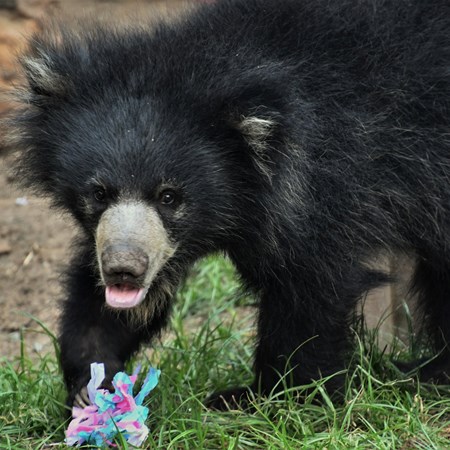
You only turn one once, so don’t miss your chance to wish the Little Rock Zoo’s sloth bear cub, Zaara, a happy first birthday!

All are invited to come to the Zoo on Saturday, January 11, 2020, at 11 a.m. to wish her another great year.  This flannel and bear lodge-themed party, held in indoors in Café Africa, will be great winter fun!  Beginning at 11:30 a.m., guests are invited to enjoy cake and refreshments while supplies last.

This special celebration will include story time by the fireplace, bear keeper chats, craft-making, hot chocolate, and s’mores.  Guests will enjoy a slide show presentation on Zaara’s first year.  Guests will also have a chance to meet the Zoo staff who hand-raised Zaara. Each of these birthday activities are included in admission prices.

Café Africa will feature a specially-priced hearty meal that will include a choice of soup and/or salad and/or a sandwich for $7.

Zaara’s birthday is so important because The Little Rock Zoo was one of only two zoos in North America to have a sloth bear cub birth. Of the 40 sloth bears housed in Association of Zoos and Aquariums (AZA) accredited Zoos in the United States, the Little Rock Zoo has four of them; that’s 10 percent!

Zaara’s birth came as a recommendation of the American Species Survival Plan ® Program, known as SSP.  The SSP Program, developed in 1981 by the Association of Zoos and Aquariums (AZA), helps to ensure the survival of select species in zoos and aquariums, which are either threatened or endangered in the wild. Native to the Indian subcontinent, sloth bears are listed as a vulnerable species, meaning one that is likely to become endangered unless the circumstances that are threatening its survival and reproduction improve.

Learn more about Zaara and other endangered animals at their birthday celebrations throughout 2020.

Pulaski Heights City Council meets for final time on January 10, 1916

104 years ago today, the Pulaski Heights City Council held its final meeting.  Following the January 4 annexation election, Mayor L. H. Bradley convened the Pulaski Height City Council for the final time on January 10, 1916.

Five of the eight aldermen were present for the final meeting.  E. T. Reaves, R. G. Trickett, W.A. Turner, J. B. Webster, and H.C. Locklar.  Absent were J. S. Murphy, J.H. Hicks, and W. H. Keeton.

The City Recorder was A. M. Edwards, while O. E. White was Treasurer and Jonathan P. Streepey was City Attorney.

At the meeting, bills were paid and allowances were made for the transfer of assets and responsibilities to the City of Little Rock.  The minutes do not reflect if there were any valedictory addresses by any of the elected officials, which were often the practice in that era.

Once Mayor Bradley and the Council had worked their way through the agenda, Alderman Reaves made the motion to adjourn the council sine die which was seconded by Alderman Webster. The motion passed unanimously.  With that, the Pulaski Heights City Council, which had first met in 1904, finished its business.

Elvis at 85

Photo by Wayne Cranford

Eighty-five years ago today, Elvis Presley was born in Tupelo, Mississippi. He would, of course, grow up to become a cultural phenomenon.

Elvis performed in Little Rock throughout his career. In April 1972, he played at Barton Coliseum (with tickets on the arena floor going for a whopping $10!). In the 1950s, he played three at Robinson Auditorium. His first appearance was as his career was just starting to take off. The final appearance on that stage, a mere 15 months later, was when he had become a national icon.

His first appearance at Robinson was on February 20, 1955. Billed as the “WSM Grand Ole Opry” show, Elvis Presley was third on the bill behind the Duke of Paducah and Mother Maybelle and the Carter Sisters as he began week long tour of Arkansas and Louisiana. On this date there were a pair of shows, at 3:00 and 8:15 p.m., at Robinson Auditorium. Tickets were 75-cents in advance, $1.00 at the box office and 50-cents for kids. It is believed that Gladys and Vernon Presley attended this performance, invited by Elvis who wanted to introduce them to the Colonel. Gladys was a big fan of the Duke of Paducah. Elvis Presley, Scotty Moore, and Bill Black receive $350 for these two shows instead of their usual $200 per day. In August 1955, he returned and played Robinson as part of the All-Star Jamboree.

His third and final appearance at Robinson Auditorium was on May 16, 1956. This time, the Auditorium was packed. The tickets were $1.50 in advance at Walgreens and $2.00 at the box office. The ads featured 8 great acts in “his” variety show which consisted of the Jordonaires; Rick and Emil Flaim and their orchestra; vocalists Frankie Conners and Jackie Little and comedian-magician Phil Maraquin. A second show was added to accommodate the ticket demand.

About 30 minutes late, due to a missed flight, Elvis appeared on stage in a purple blazer and started singing “Heartbreak Hotel.” The crowd rushed the stage. Little Rock police officers were able to control them eventually and get the teenagers back to their seats. While the crowd was impressed, the police officers were less so. One of the patrolmen told the Arkansas Gazette reporter: “I wouldn’t know him if I saw him. And I wouldn’t be here unless I was being paid.”

Resumption of City of Little Rock government in post-Civil War era

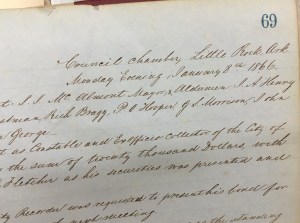
One hundred and fifty four years ago today (on January 8, 1866), Little Rock City Hall resumed functioning after the Civil War.  The City government had disbanded in September 1863 after the Battle of Little Rock.  From September 1863 through the end of the war (on on through part of Reconstruction), Little Rock was under control of Union forces.

Following the April 1865 conclusion of the Civil War, plans were made to restart local government in Little Rock.  Even though Arkansas would not have Congressional representation in Washington until June 1868 (becoming the second Confederate state after Tennessee), the establishment of local government took place in January 1866.  (It was supposed to have started earlier, but the local elections set for November 1865 were cancelled on the day they were originally set to take place.)

The first City Council meeting took place on Monday, January 8, 1866. The council met again on Tuesday, January 9 and Monday, January 15 as they were trying to establish committees and rules for the new government.

The first post-Civil War mayor was Dr. J. J. McAlmont, who was a physician and pharmacist. Following his service as the city’s chief executive, he would later be a co-founder of what is now UAMS.  The initial aldermen were I.A. Henry (who had been on the City Council when it ceased in 1863), Henry Ashley, M. H. Eastman, Rick Bragg, Dr. P. O. Hooper, G. S. Morrison, John Collins and Alexander George.

Their first action was to approve the bond of Thomas C. Scott as Constable and City Collector.  Vouching for him were S. H. Tucker and future LR mayor John Gould Fletcher.  The Recorder was asked to present his bond and the next meeting.

The Mayor then established several committees of the City Council and named his appointments. Among the committees were Finances, Streets, Ordinances, Mount Holly Cemetery, Fire Department and Police.

That meeting and the following two meetings, the City continued to approve motions, resolutions and ordinances to set up the duties and responsibilities of a government.

Ordinance Number 1 established the rates of Licenses for 1866.  Among those were:

  • $100 for the privilege of selling goods at auction
  • $20 for a one-horse wagon, paid quarterly
  • $35 for a two-horse wagon, paid quarterly
  • $50 for a four-horse wagon, paid quarterly
  • $25 to run a cab or bus (which would have been in some horse drawn conveyance), paid quarterly
  • $40 a month to sell liquor, wine, ale, beer, etc., by the glass or bottle to be consumed in a store, tavern, shop or store
  • $25 each quarter for each billiard table
  • $50 each quarter for each ten pin alley
