
Little Rock Look Back: Sermons, TV Shows Dominate Final Day of 1959 Recall Campaign

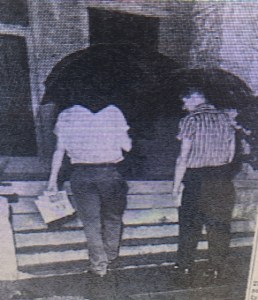
A rainy Sunday afternoon did not stop STOP canvassers on May 24, 1959.

Sunday, May 24, 1959, was election eve for the Recall Campaign.  As such, the election figured into some Sunday morning sermons.  Reverend M. L. Moser Jr. spoke from the pulpit of his church and described the issue of segregation as Biblical. As many had before him, and would after him, he used the story of Noah’s three sons as a way to justify segregation of the races.

(Supposedly one of the sons was the father of the white race, one the father of the African American race, and one the father of the Asian race.  In this narrative, no explanation is given for other variations such as Native Americans and other indigenous people or persons from the sub-continent of India.  Also excluded is the likely race of everyone in the story – those who live in the Middle East.)

At Trinity Episcopal Cathedral, Dean Charles A. Higgins prayed for the schools but did not tell his parishioners how to vote.  Rev. Aubrey G. Walton at First Methodist Church spoke about the schools needing to be free from politics and pressure groups.  (Though Rev. Walton did later appear that evening on a STOP sponsored TV show.)

Embattled School Board president Ed McKinley refused requests from the media and others to divulge his plans for the future of the Little Rock School District.  Earlier he had stated he had an idea on how the schools could be reopened and segregated, but still remain in compliance with the courts.  Across the river, segregationists were planning a rally in North Little Rock to head off any plans for future integration on the north side.  Congressman Alford had already agreed to speak at this rally.

In paid time on TV, Governor Faubus spoke at length in a criticism of the Arkansas Gazette. He called the fired teachers pawns in a larger game.  He noted in his remarks that he did not expect to sway any votes by this point.

Not to be outdone, STOP was on all three TV stations. Sometimes the program was aired on more than one station simultaneously.  In an appearance sponsored by STOP, William S. Mitchell noted that May 24 was coincidentally Children’s Day.  He noted that never before in Little Rock history had so many people volunteered for a cause as those who had worked on STOP and with STOP.  The Women’s Emergency Committee, PTA Council, labor unions, and numerous other organizations had come together to raise money, knock on doors, and otherwise get the word out.

Finally, it was all over but the voting.  Nineteen days of outrage, exasperation, and hyperbole was coming to an end.  When dawn broke, it would be election day.
Little Rock Look Back: End near for 1959 School Board Recall Election

May 23, 1959, was a Saturday. It was also two days before the School Board recall election.  With it being a Saturday, it was the last full day for door knocking as supporters for all sides were busy trying to get out the vote.

Both sides were confident of victory.  Before a crowd of 1,000 in MacArthur Park, segregationists Rep. Dale Alford and Mississippi congressman John Bell Williams berated Harry Ashmore and the Arkansas Gazette.

STOP chair Dr. Drew Agar and campaign chair William Mitchell predicted it would be the largest turnout in Little Rock school election history.  They also stated that Gov. Faubus’ TV appearance criticizing STOP had actually pushed people over to their side.

Echoing Agar and Mitchell, the Pulaski County Election Commission predicted 30,000 of the district’s 42,000 registered voters would cast ballots.  The previous record of 27,000 had been cast in September 1958 when voters decided to keep the high schools closed.  By contrast, 14,300 voted in the December 1958 election which had selected the six school board members now on the ballot for recall.  On May 22, the final day of absentee ballot voting, 205 absentee votes had been cast bringing it to a total of 455 absentee ballots.

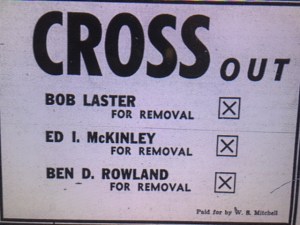
William S. Mitchell, who in addition to being a renowned attorney, apparently had a wicked sense of humor.  He used CROSS’s name against them in ads (placed throughout the newspaper) which urged voters to “Cross” out the names of the three candidates being backed by CROSS.

Scenes from Elizabeth Eckford bench groundbreaking

On May 17, 2018, Elizabeth Eckford joined with representatives of the National Park Service, Little Rock School District, Bullock Temple CME, and many other organizations to break the ground for a commemorative bench.

This bench is a reproduction of the one on which Ms. Eckford sat so famously on the morning of September 4, 1957.

The bench will be built over the summer and installed in September 2018.

Here are some scenes from the ceremony.

Elizabeth Eckford visits with Central High School Principal Nancy Rousseau.

David Kilton of the National Park Service speaks at the ceremony.

Attendees spilled out of the tent and lined the street for the event.

Ms. Eckford speaks to the crowd.

Ms. Eckford is joined by Central High students in breaking ground.


Groundbreaking today for Elizabeth Eckford commemorative bench project

Little Rock Central High School National Historic Site is collaborating with the Central High Memory Project students and additional partners for the groundbreaking ceremony of the Elizabeth Eckford Commemorative Bench on May 17, 2018.  It will take place at 4:30 this afternoon at the corner of Park and 16th Streets.
The date for this groundbreaking was chosen to be on the 64th anniversary of the US Supreme Court’s Brown v. Board decision.  It was that decision which paved the way for Little Rock Central High School to be a pivotal location in the Civil Rights struggle.

September 4, 1957, was supposed to be the first day of school for the African American students who were selected to integrate Little Rock Central High School.  Due to the mobs gathered outside of the school and interference from Governor Orval Faubus, the students would not get in the school that day.

The most famous images from that day are the photos of Elizabeth Eckford walking in front of the school, only to be rebuffed by soldiers and tormented by the crowds. Elizabeth’s decision to walk through the mob of protesting segregationists to enter school, only to be turned away became world news. The story of the desegregation of Central High School was thrust into a defining role within the Civil Rights Movement. Elizabeth’s efforts to overcome the fear and uncertainty that she faced that morning resulted in her seeking refuge at a lonely bus stop bench.

In order to highlight this aspect of the story and create more personal connections with this turning point in history for students and visitors, the National Park Service and the Central High Memory Project Student Team will work with community partners in a new public history project.  The Bench Project includes building a replica of the bus stop bench, creating a mobile app for the students’ audio walking tour of eyewitness accounts of that first day of desegregation, and developing a storycorps recording booth for interviews and student podcasts.

The partnership includes: Bullock Temple C.M.E., Central High School and their EAST LAB, the Little Rock School District, the City of Little Rock, Central Arkansas Library System’s Butler Center for Arkansas Studies, Good Earth Garden Center, Friends of Central High Museum Inc., Home Depot, Little Rock Club 99 and other Rotary International Clubs,  Pam Brown Courtney and Willis Courtney M. D., the Clinton School of Public Service, Unity in the Community, and others.

The groundbreaking ceremony will be held at the corner of Park and 16th Street starting at 4:30 p.m. The program will include remarks by the NPS Superintendent and the directors of some of the partnering organizations regarding the projects that will be completed in connection with this effort. The Central High Memory Project Student Team will be on hand to meet the public and share details about their work.

Little Rock Look Back: Pulitzer Prize to SOUTH PACIFIC

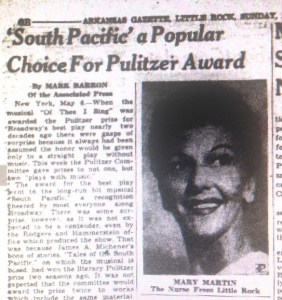
On May 5, 1950, the Rodgers and Hammerstein musical South Pacific captured the Pulitzer Prize in Drama. This would receive special attention in the Arkansas Gazette. The reason this carried such weight in Arkansas was that the musical had a connection to Little Rock.
The 1950 Pulitzer for Drama went to a musical, for only the second time in the history of the awards. The recipient was South Pacific by Richard Rodgers, Oscar Hammerstein II and Joshua Logan. The character was the leading lady of Nellie Forbush. She was an Navy ensign and a nurse stationed on an exotic island during World War II. The musical was based on a Pulitzer Prize winning novel, James Michener’s Tales of the South Pacific.

In the Michener novel, Miss Forbush is not from Little Rock. She is actually from a small town in Alabama. But the book does mention Nellie and her mother visiting Little Rock.  The part was written for Mary Martin from Weatherford, Texas. Rodgers, Hammerstein & Logan did not discuss why they relocated Nellie’s birthplace.

Originally the musical contained a song entitled “My Girl Back Home” in which Nellie sang of being from “Little Rock, A-R-K” while another character sang of being from “Philadelphia, P-A” and “Princeton, N-J.” It is possible the change to Little Rock was made because it offered more lyrical possibilities, but that is only a supposition on the part of the Culture Vulture. That song did appear in the movie version in which Mitzi Gaynor played Nellie Forbush. It was also featured in the 2008 Broadway revival, this time with Kelli O’Hara playing Nellie.

In the musical, Nellie struggles with her own prejudices. This issue of prejudice became an instance of fact meeting fiction. In 1957, a few weeks after Eisenhower sent troops into Little Rock to ensure that Central High would be desegregated, a production of South Pacific on Long Island was temporarily halted when the audience booed and yelled after Nellie mentioned she was from Little Rock. Interestingly, the movie was released in 1958, but retained references to Little Rock. That was either a testament to the expense of re-editing it, or the fact that audience reaction had lessened.

Little Rock Look Back: 2 Pulitzers for the ARKANSAS GAZETTE

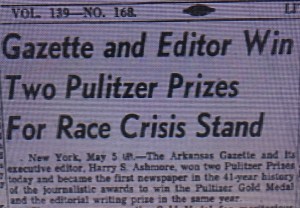
On May 5, 1958, it was announced that the Arkansas Gazette had received two Pulitzer Prizes.  These were for the coverage of the 1957 integration (or lack thereof) at Little Rock Central High School.
The first Pulitzer was for Public Service.  It was awarded to the newspaper.  The citation stated:

For demonstrating the highest qualities of civic leadership, journalistic responsibility and moral courage in the face of great public tension during the school integration crisis of 1957. The newspaper’s fearless and completely objective news coverage, plus its reasoned and moderate policy, did much to restore calmness and order to an overwrought community, reflecting great credit on its editors and its management.

The second Pulitzer was for Editorial Writing.  It was awarded to Harry Ashmore.  The citation read:

For the forcefulness, dispassionate analysis and clarity of his editorials on the school integration conflict in Little Rock.

This was the first time that the Pulitzer for Public Service and Editorial Writing went to the same publication in the same year.

The newspaper coverage in the afternoon Arkansas Democrat and morning Arkansas Gazette was provided by the Associated Press.  The Democrat‘s story ran on the afternoon of the announcement. The front page story had the headline “Pulitzer Honors Go to Gazette.”  The next morning the Gazette ran a longer story under the headline “Gazette and Editor Win Two Pulitzer Prizes for Race Crisis Stand.”  It included a quote from publisher Hugh Patterson, Jr.  He stated, “This recognition belongs to every member of the staff of the Gazette.  I am proud to be associated with these men and women.”

The Pulitzer for National Reporting went to Relman Morin of the Associated Press for his coverage of the events.  His citation noted:
for his dramatic and incisive eyewitness report of mob violence on September 23, 1957, during the integration crisis at the Central High School in Little Rock, Arkansas.

Photographer Will Counts of the Arkansas Democrat was the unanimous choice of the jury to receive the Pulitzer in photography for his photo of the crowd jeering at Elizabeth Eckford.  The board overruled that selection, as was their purview. Speculation was that the board may not have wanted to award four Pulitzers for the same news story.

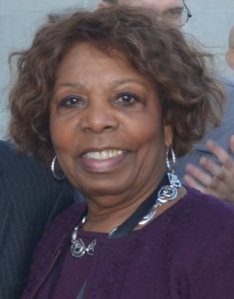
Little Rock Look Back: Lottie Holt Shackelford

Lottie at Civil RightsWhile this headline may say “Little Rock Look Back,” Lottie Shackelford is still very much focused on the present and the future!

On April 30, 1941, future Little Rock Mayor Lottie Shackelford was born. Throughout her career in public service she has been a trailblazer.

Active in community activities and politics, she ran for the City Board in 1974 and lost.  But she was appointed to the Little Rock City Board in September 1978 to fill a vacancy.  This made her the first African American woman to serve on he City Board, and indeed on any governing board for the City (during Reconstruction, there were at least six African Americans on the City Council, but they were all men.) She was subsequently elected to a full-term on the City Board in 1980 winning 55% of the vote over three male candidates.

She was subsequently re-elected in 1984 (unopposed) and in 1988 (with 60% of the vote).

In January 1987, Shackelford became the first female mayor of Little Rock when she was chosen by her colleagues on the City Board to serve in that position. She was Mayor until December 1988.  During that time, Mayor Shackelford invited the Little Rock Nine back to the City to be recognized for the 30th anniversary of their integration of Central High School.

From 1982 until 1992, she served as Executive Director of the Arkansas Regional Minority Purchasing Council.  She left that position to serve as Deputy Campaign Manager of Clinton for President.  She subsequently served on the Clinton/Gore transition team. She later served on the Overseas Private Investment Corporation from 1993 to 2003. She was the first African American to be in that position.

A graduate of Philander Smith College, she has also studied at the Arkansas Institute of Politics at Hendrix College and the Kennedy School of Government at Harvard University.

Mayor Shackelford has also served on numerous boards including the Little Rock Airport Commission, Philander Smith College, Chapman Funds (Maryland) and Medicis Pharmaceutical Corporation (Arizona).  She has the longest tenure of any serving as Vice-Chair of the Democratic National Committee.

Mayor Shackelford was in the first class of inductees for the Arkansas Black Hall of Fame.  In 2015, she was inducted into the Arkansas Civil Rights Heritage Trail.