Arkansas Heritage Month – LR Mayor Satterfield oversees opening of Robinson Auditorium

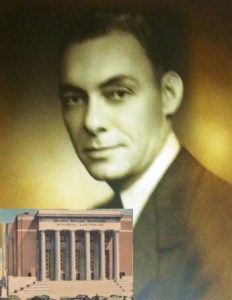
Satterfield AuditUpon taking office as mayor in April 1939, J. V. Satterfield felt he was getting a handle on Little Rock’s precarious financial situation. He would soon discover that it was more unstable than he had imagined.  Included in this was Robinson Auditorium, currently under construction across the street from his office in City Hall.  Mayor Satterfield disclosed that he had voted against the auditorium in 1937 because he felt the finances were not sufficient. But as the mayor, he promised to open the building.

By the summer of 1939, it was becoming apparent that there would not sufficient money to finish the construction.  Even with the issuance of the final round of approved bonds (which had been held back as a reserve), there would not be enough money.  The Mayor and Harvey Couch made plans to go to Washington DC to try to get more money from the federal government.  Mr. Couch was a personal friend of President Roosevelt as well as head of Arkansas Power & Light.  The pair made the trip but returned with no additional money.

At the same time, the Auditorium Commission, which had been appointed by Mayor Overman to oversee the governance of the building, resigned as a group. They said they had been appointed to administer a building, not a construction site. Since it was uncertain as to when the building would open, they stepped down.

Mayor Satterfield was able to negotiate a series of deals to get the necessary work completed for construction of the building to be completed. Part of it involved issuing another round of bonds after the building had been officially opened to finish furnishing the building as well as complete the landscaping.  In January 1940, with a new opening date becoming a stronger possibility, the mayor appointed a new Auditorium Commission.

At the same time, regular events started to take place in the lower level exhibition hall.  There had been a few in November and December, but with a lack of utilities and ongoing construction upstairs in the music hall, those were curtailed.

On February 16, 1940, Joseph Taylor Robinson Memorial Auditorium officially opened. Mayor Satterfield was joined onstage for the ribbon cutting with Senator Robinson’s widow and her sister-in-law, who was a member of the Auditorium Commission.

In April 1940, Little Rock voters approved the final round of bonds which allowed for the building to be finished.

After only two years in office, Mayor Satterfield chose not to seek another term. He left City Hall in April 1941 with finances in order and a new municipal auditorium across the street.
Little Rock Look Back: FDR

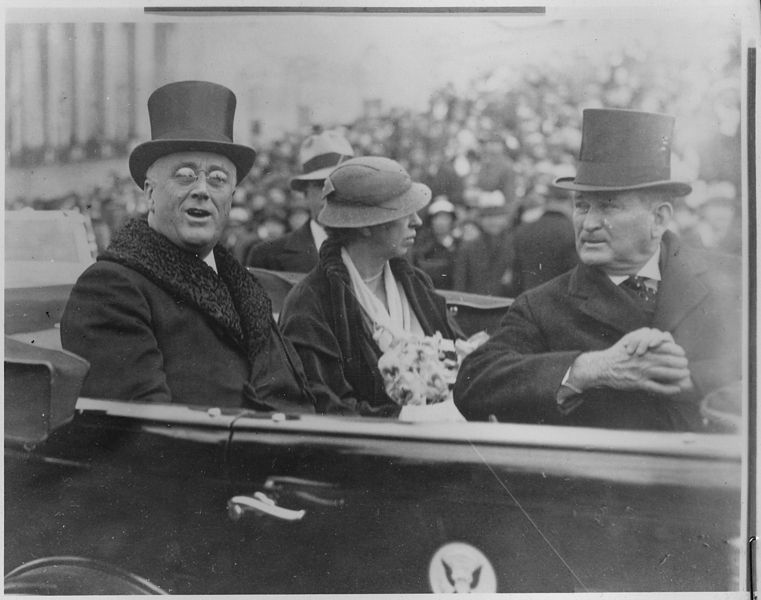
Gov. & Mrs. Roosevelt with Sen. Robinson en route to FDR taking oath as president.

Gov. & Mrs. Roosevelt with Sen. Robinson en route to FDR taking oath as president.

On January 30, 1882, future U.S. President Franklin Delano Roosevelt was born.  In 1936, he visited Little Rock as part of a statewide tour in conjunction with Arkansas’ Centennial celebration.  While in the state he spent time outside of Hot Springs at Couchwood, the vacation home of Arkansas Power & Light founder Harvey Couch, who was the chair of the Centennial activities.

In honor of President Roosevelt’s visit, a portion of Highway 365 in Little Rock was designated Roosevelt Road. He followed part of that road while in the Capital City before making a public appearance.

President Roosevelt’s address on June 10, recounted Arkansas’ territorial and statehood history. At the end he paid tribute to his Senator Joseph Taylor Robinson.  The Senator was a friend and confidant who often led the charge for FDR programs in congress.  Indeed, it would be New Deal programs which would allow for the construction of a municipal auditorium in Little Rock, which would be named in memory of Sen. Robinson after his death in the summer of 1937.  (As the Democratic leader of the Senate, it had been Robinson who accompanied FDR and Eleanor in the motorcade to the 1933 Presidential inauguration ceremony.)

FDR’s visit to Arkansas had political implications as well.  The late Senator Huey Long of neighboring Louisiana had been arguably FDR’s biggest adversary in Washington.  Long was very popular in rural areas of Arkansas and had campaigned for Hattie Caraway when she ran for re-election to the Senate, to the dismay of many of Arkansas’ Democratic establishment.  Harvey Couch had worked to bring about a detente between FDR and Long prior to the latter’s assassination in 1935.  But between a lingering mistrust of FDR by Long supporters and discontent from some sectors based on New Deal programs, it was important for FDR to shore up Democratic support in Arkansas.  At the time the state had nine electoral votes.

Early in World War II, President Roosevelt used a fireside chat to promote the heroism of Little Rock native Corydon Wassell, who had saved several troops in the South Pacific.  FDR would return to Central Arkansas in 1943 to review troops at the military facility named for Sen. Robinson.  That would be his final visit to Arkansas before his death in April 1945.

Little Rock Look Back: Senator Joseph T. Robinson Funeral at Little Rock First Methodist

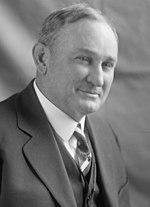
Senator Joseph Taylor Robinson

Today, Arkansas political icon and longtime United States Senator Dale Bumpers is being remembered in a memorial service at Little Rock’s First United Methodist Church.

On another Sunday afternoon, this time in July 1937, another United States Senator and former Arkansas Governor was also remembered in a service in the same church.  That man was Joseph Taylor Robinson.

Unlike Senator Bumpers, Senator Robinson died in office. Both men, however, shared many of the same qualities. Both were recognized as leaders within their parties and within the Senate. Both were counselors to Presidents. Senator Robinson was usually President Franklin Roosevelt’s point person to shepherd legislation on Capitol Hill.  Senator Bumpers worked closely with Presidents Carter and Clinton.  Both men flirted with national politics. Robinson was the Vice Presidential nominee of the Democratic Party in 1928. Bumpers seriously contemplated a run for the White House on more than one occasion.

It seems fitting that Senator Bumpers would be memorialized at a place of worship which had also been the site of the final rites for another Arkansas lion of the Senate.

Senator Robinson died in Washington D.C. on July 14, 1937.  His wife was in Little Rock making preparations for a trip the couple was to take. Following his demise, Mrs. Robinson went to Washington to accompany her husband’s body back to Arkansas.

The Senator was honored with a memorial service in the Senate chambers on Friday, July 17.  President Roosevelt and the cabinet joined members of the senate on the floor in what was described as a state funeral without pomp.  Mrs. Robinson sat with her brothers and two nephews as well as Bernard Baruch and Arkansas Power & Light’s Harvey Couch, who were Senator Robinson’s closest friends.  Eleanor Roosevelt was one of the many crowded in the senate galleries observing the service.  Following the service his body remained in the chambers until it was transferred to a train to make the journey to Little Rock.

The funeral train bore his body, his family, 50 senators and over twenty congressmen. It reached Little Rock around 8am on Sunday the 19th.  From there, Senator Robinson’s body was taken to his house on Broadway Street until noon.  It subsequently lay in state at the Arkansas State Capitol until being escorted by military to First Methodist Church.

1,500 people packed the church a half hour before the service began. The sun shone through the windows onto the flag-draped coffin as Rev. H. Bascom Watts led the service. Among the pallbearers was former Vice President Charles G. Dawes. Governor Carl Bailey of Arkansas was joined by Governors Richard Leche of Louisiana and E.W. Marland of Oklahoma.

As the funeral procession reached Roselawn Cemetery, thunder echoed. The skies which had alternated between sun and rain that day, returned to rain. A deluge greeted the end of the service and sent visitors hurrying for shelter at the end.


Little Rock Look Back: Frank Sinatra at 100

FAS 100Frank Sinatra never made a public appearance in Little Rock, or even Arkansas. But his musical genius continues to be felt throughout the state.

100 years ago today he was born in Hoboken, New Jersey.  Over the years he went from idol of the bobby-soxers to major Hollywood heavyweight and then to musical mentor.  He was also a businessman and record executive. Though sometimes in headlines because of his personal life, his talent was so overwhelming that any personal failings seemed to be quickly overlooked.

He came up as an admirer of FDR and was a close friend of JFK. In later years, he tended to be associated with GOP candidates, but usually befriended whoever was in the Oval Office.

Upon his death in May 1998, former Little Rock resident President Bill Clinton issued a statement.

Hillary and I were deeply saddened to hear of the death of a musical legend and an American icon, Frank Sinatra. Early in his long career, fans dubbed him ‘The Voice.’ And that was the first thing America noticed about Frank Sinatra: that miraculous voice, strong and subtle, wisecracking and wistful, streetwise but defiantly sweet. In time he became so much more. Sinatra was a spellbinding performer, on stage or on screen, in musicals, comedies and dramas. He built one of the world’s most important record companies. He won countless awards, from the Grammy — nine times — to the Academy Award, to the Presidential Medal of Freedom. And he dedicated himself to humanitarian causes.

“When I became president, I had never met Frank Sinatra, although I was an enormous admirer of his. I had the opportunity after I became president to get to know him a little, to have dinner with him, to appreciate on a personal level what fans around the world, including me, appreciated from afar.

“Frank Sinatra will be missed profoundly by millions around the world. But his music and movies will ensure that ‘Ol’ Blue Eyes’ is never forgotten. Today, I think every American would have to smile and say he really did do it his way.

FAS tieIn 2013, as part of an exhibit of photography and artifacts of jazz musicians, the Clinton Presidential Center featured one of Sinatra’s bowties. It is pictured here.

PIGSKIN TURKEY DAY IN THE ROCK, Part 3 – Little Rock vs. NLR


Turkey Bowl LRHS NLRHSAfter 20 years of playing a variety of schools on Thanksgiving, in 1934 Little Rock High School had started the new tradition of playing the North Little Rock High School Wildcats.  These cross-river rivals had played a few games previously in the 1910s and early 1920s. The competition was resumed in 1931, but was not on Thanksgiving Day until 1934.  With that game, the Tigers of Little Rock would begin a 49-year tradition of taking on their biggest rival on Turkey Day.

For much of the 1920s and 1930s, a Thanksgiving Day game for Little Rock High School meant rain.  That was the case in the 1934 meeting at Kavanaugh Field. (Located at the current spot of Quigley Stadium, it was a baseball field on which football games could also be played.  In 1936, the current stadium opened.)  The Tigers and Wildcats played to a 2-0 win achieved by the southside Bengals of Earl Quigley.

Another notable matchup was the 1938 game.  Little Rock won 12 to 7. With that win, it captured its first official state football championship. (Though the Arkansas Activities Association does now credit LRHS with several prior championships.)

The 1939 edition took place on Arkansas Thanksgiving.  That November featured five Thursdays.  President Roosevelt issued a proclamation that Thanksgiving would be the fourth Thursday, as it traditionally was. However Arkansas and a few other states chose to observe it on the final Thursday.  Little Rock won 6 to 0, but it was a messy game. Some sports fans joked that the game was FDR’s revenge on Arkansas for ignoring him regarding Thanksgiving.

In 1941, only a few days before the US would be plunged into World War II, North Little Rock achieved its first Turkey Day win over Little Rock.  The score was 26 for the Wildcats and 0 for the Tigers.  This was only the third ever loss for the Tigers on a Thanksgiving Day.  The Tigers were so dominant on Turkey Day games, a student had once remarked to a Gazette reporter that the matchup against Pine Bluff should be moved to Thanksgiving since the Tigers always seemed to win on that day.  (Pine Bluff was the state’s other football powerhouse at the time and often gave the Tigers fits in games.)

North Little Rock repeated as winner in the 1942 game, this time with a 31 to 12 score.  Writing for the Gazette, Orville Henry wondered if this would be the final meeting for the duration of the war.  He opined that many of the players might be in a different type of uniform for future games and that rubber might be needed for the war effort instead of athletic equipment.  While some colleges and high schools did drop football during the war, neither LR nor NLR did.

The Tigers were back on top in 1943 by a 13-7 score.  (It would be the last football game for the NLR coach who had been drafted.)  The 1944 game also featured a 13-7 score, but this time it was flipped and the Wildcats were winners.  The 1945 edition ground to a 13-13 tie.

In 1947, both teams were undefeated heading into the Turkey Day classic.  The inky wretches and scribes were predicting another evenly matched slugfest.  Instead Little Rock owned the game and came out with a 13-0 win.

The teams met eight times in the 1950s on Thanksgiving.  Little Rock won seven of the eight, losing the 1951 game by one point (13 to 14).

With the anticipation of a second Little Rock high school to be opened in a few years, Little Rock High School was rechristened as Little Rock Central High in 1954. The new school, named Hall High opened in 1957 but played much smaller schools for its first year on the gridiron.  Plans were underway for Hall and Central to meet on Turkey Day in 1958, so the 1957 meeting of Little Rock and North Little Rock would be the final time the two teams would meet on Thanksgiving Day.

Little Rock Central High had dominated world headlines in September and October 1957 with the desegregation of the school.  The sports coverage of this game however belied all the drama off the field. News reports focused on Turkey Day as the final game between the longtime rivals and on the fact that it had a morning start time instead of the traditional afternoon start time.  In the end, the Tigers had the same result as they did in the first Turkey Day meeting: a win.

After 24 meetings on Thanksgiving Day, Little Rock had 19 wins, 4 losses, and one tie.  Seven times they shut out the Wildcats, and one time the northern team blanked them.  The fewest total points scored were 2 in the 1934 game, while the 1950 game produced a cumulative total of 71 points (LR 64, NLR 7).  The Tigers scored a total of 517 points over 24 games and gave up only 203.

Four Elections which shaped 20th Century focus of Clinton School lecture tonight

Pivotal Tuesdays: Four Elections that Shaped the Twentieth Century

6pm, November 16 – Clinton School Sturgis Hall

In her book, “Pivotal Tuesdays,” Margaret O’Mara looks back at four pivotal presidential elections of the past 100 years to show how they shaped the twentieth century. Exploring personalities, critical moments, and surprises of the elections of 1912, 1932, 1968, and 1992, this book shows how elections are windows into changing economic times and how history is made when ordinary people cast their ballots. A book signing will follow.

Margaret O’Mara is an associate professor of History at the University of Washington in Seattle, specializing in the political and economic history of the twentieth century United States. Her research and writing focuses on the history of the high-tech industry, the history of American politics, and the connections between the two. In addition to her academic work, she has collaborated with government, business, and civic organizations on a range of projects exploring how innovation drives growth and change.

Little Rock Look Back: TR in the LR

TheodoreRooseveltOn October 25, 1905, President Teddy Roosevelt, recently elected to a four year term in his own right, made an appearance in Little Rock.

He was greeted at the train station by Governor Jeff Davis and was the guest of honor in a parade up Main Street to City Park (now MacArthur Park) in where a public meeting was held featuring remarks by the President.  During this remarks, speaking to a largely Democratic crowd, the Republican Roosevelt noted: “The candidate is the candidate of a party; but if the president is worth his salt he is the president of the whole people.”

According to media reports at the time, Main Street from Markham to Tenth was a solid mass of cheering spectators for the parade.  This was the first time a sitting President had spent time in Little Rock away from a train station. The only other incumbent President to visit Little Rock had been Benjamin Harrison, who had made only a brief layover.

Roosevelt would make three more visits to Arkansas.  In 1910, he spoke at the Arkansas State Fair in Hot Springs.  In April and September 1912, he made several campaign stops in the state as he was running to reclaim the presidency, this time heading the Progressive (or Bull Moose) ticket.  Though Roosevelt’s successor, William Howard Taft, would visit briefly once in office and once after leaving office, it would not be until Roosevelt’s cousin Franklin Delano Roosevelt visited in 1936, that another sitting President spent much time in the state after TR’s 1905 visit.