
Little Rock Look Back: Ground Broken for Robinson Auditorium

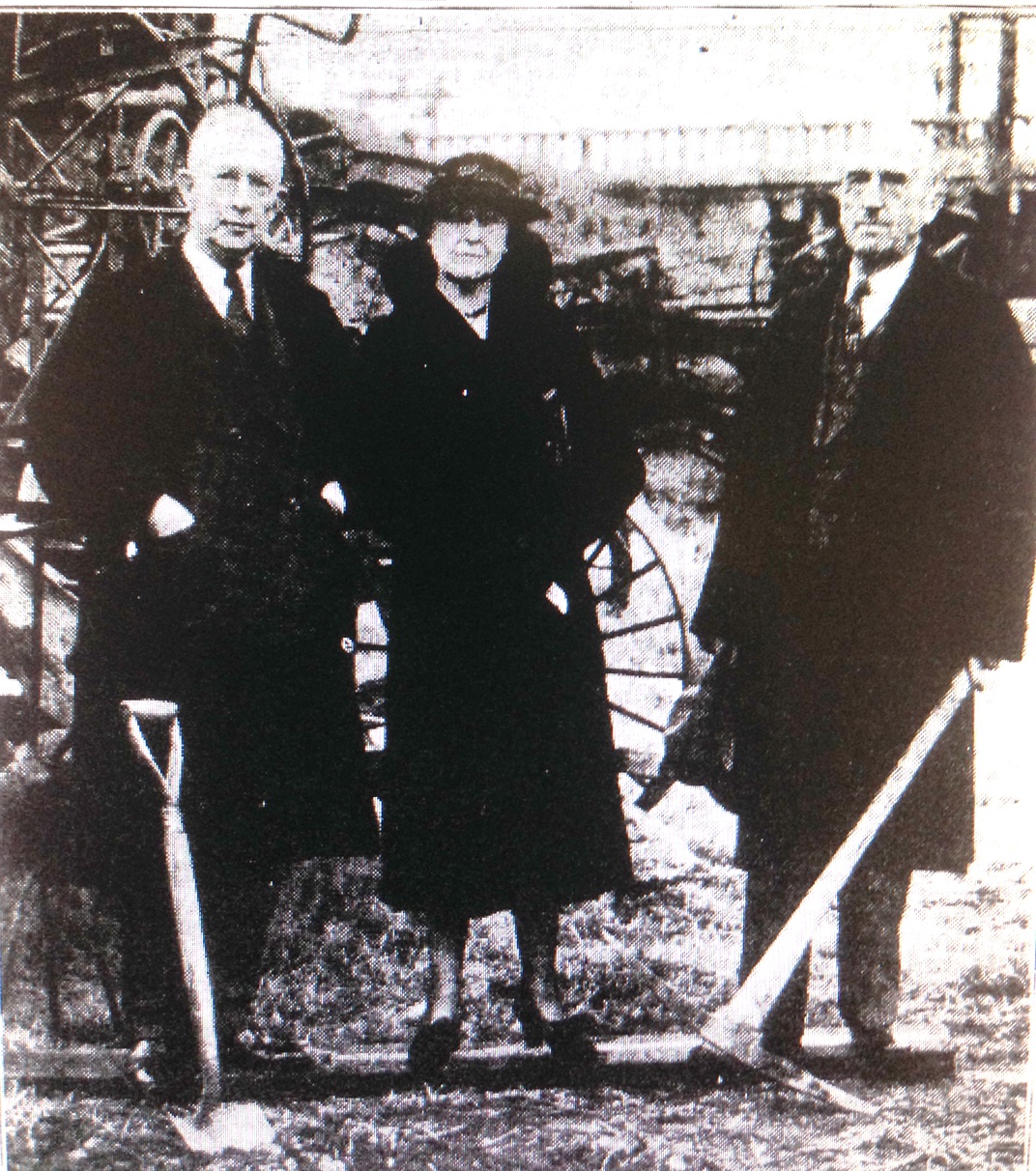
    ARKANSAS DEMOCRAT photo of Mayor Overman, Mrs. Robinson and Mr. Allaire at the groundbreaking. The Broadway Bridge balustrades are visible in the background.

ARKANSAS DEMOCRAT photo of Mayor Overman, Mrs. Robinson and Mr. Allaire at the groundbreaking. The Broadway Bridge balustrades are visible in the background.

On December 24, 1937, at 11:30 a.m., Little Rock Mayor R. E. Overman, Ewilda Gertrude Miller Robinson (the widow of Senator Joseph Taylor Robinson) and  Alexander Allaire of the PWA turned dirt to participate in the brief groundbreaking ceremony for Little Rock’s municipal auditorium.  That morning, the Arkansas Gazette ran a brief story on the upcoming groundbreaking.  The story mentioned that the building would be named in memory of the late beloved Arkansas politician.  This appears to be the first public pronouncement of the Robinson name for this civic structure.

Among others in attendance at the groundbreaking were Mrs. Charles Miller (sister-in-law of Mrs. Robinson), Mr. and Mrs. Grady Miller (brother and sister-in-law of Mrs. Robinson), the mayor’s wife, the three architects (George Wittenberg, Lawson Delony and Eugene John Stern), and D. H. Daugherty and Will Terry of the City’s Board of Public Affairs.

Construction had to start by January 1, 1938, in order to receive PWA funds.  By breaking ground on December 24, there was over a week to spare.  The site had been selected in late October 1937, and the purchase had not been finalized.  But the PWA did give permission for the City to let a contract for excavation, demolition and filling on the site.

The groundbreaking took place at the corner of Garland and Spring Streets which was on the northeast corner of the block set aside for the auditorium.  Today, Spring Street does not extend north of Markham; the street was closed to make way for the parking structure and what is now the Doubletree Hotel.  Garland Street is basically an alley that runs parallel to Markham north of City Hall, Robinson Auditorium and the Doubletree Hotel.

Approximate site of the 1937 groundbreaking. Once again it is a construction site as the Robinson renovation is underway.

Approximate site of the 1937 groundbreaking. Once again it is a construction site as the Robinson renovation is underway.

Book on LR Architects celebrated tonight

Architects of LR bookTonight, the Historic Arkansas Museum will be hosting a lecture and book signing for the recently released Architects of Little Rock: 1833–1950, penned by Little Rock architects, Charles Witsell and Gordon Wittenberg.

The evening will begin at 5:30 with a special presentation and lecture discussing the book. Speakers will include Bill Worthen, Historic Arkansas Museum; Tom Adams, WD&D; John Greer, WER Architects/Planners; Bobby Roberts, Central Arkansas Library and a special presentation will be given by Wesley Walls, President AIA Arkansas.

A reception and book signing will begin immediately following the lecture. All are invited to attend this special evening. “There are many ways of knowing the built environment. In their Architects of Little Rock, Mr. Witsell and Mr. Wittenberg explore the always complex relationship between buildings and the visionary thinkers—sometimes ordinary craftsman— who produced them. In so doing, they not only have uncovered the design rationales and circumstances of production that influenced a wide spectrum of Little Rock architecture but moreover have written a significant work of architectural scholarship that addresses the history of the architect’s profession,” Ethel Goodstein-Murphree, architectural historian and professor of architecture, University of Arkansas.

Architects of Little Rock: 1833–1950, is being released this month. The book is co-written by Little Rock architects, Charles Witsell and Gordon Wittenberg and edited by Marylyn Jackson Parins. Architects of Little Rock provides biographical and historical sketches of the architects at work in Little Rock from 1833 to 1950. It is the story of the people behind the city’s most important buildings. Thirty-five architects are profiled, including George R. Mann, Thomas Harding, Charles L. Thompson, Max F. Mayer, Edwin B. Cromwell, George H. Wittenberg, Lawson L. Delony, and others. Famous buildings, including the Historic Arkansas Museum, the Old State House, the Arkansas State Capitol, St. Andrews Cathedral, Little Rock City Hall, the Pulaski County Court House, Little Rock Central High School and Robinson Auditorium are showcased, bringing attention to and encouraging appreciation of the city’s historic buildings.

Charles Witsell and Gordon Wittenberg are retired principals of the Little Rock architecture firms WER Architects/Planners (Witsell, Evans and Rasco) and WD&D (Wittenberg, Delony and Davidson), respectively.

Little Rock Look Back: Groundbreaking for Robinson Auditorium

    ARKANSAS DEMOCRAT photo of Mayor Overman, Mrs. Robinson and Mr. Allaire at the groundbreaking. The Broadway Bridge balustrades are visible in the background.

ARKANSAS DEMOCRAT photo of Mayor Overman, Mrs. Robinson and Mr. Allaire at the groundbreaking. The Broadway Bridge balustrades are visible in the background.

On December 24, 1937, at 11:30 a.m., Little Rock Mayor R. E. Overman, Ewilda Gertrude Miller Robinson (the widow of Senator Joseph Taylor Robinson) and  Alexander Allaire of the PWA turned dirt to participate in the brief groundbreaking ceremony for Little Rock’s municipal auditorium.  That morning, the Arkansas Gazette ran a brief story on the upcoming groundbreaking.  The story mentioned that the building would be named in memory of the late beloved Arkansas politician.  This appears to be the first public pronouncement of the Robinson name for this civic structure.

Among others in attendance at the groundbreaking were Mrs. Charles Miller (sister-in-law of Mrs. Robinson), Mr. and Mrs. Grady Miller (brother and sister-in-law of Mrs. Robinson), the mayor’s wife, the three architects (George Wittenberg, Lawson Delony and Eugene John Stern), and D. H. Daugherty and Will Terry of the City’s Board of Public Affairs. 

Construction had to start by January 1, 1938, in order to receive PWA funds.  By breaking ground on December 24, there was over a week to spare.  The site had been selected in late October 1937, and the purchase had not been finalized.  But the PWA did give permission for the City to let a contract for excavation, demolition and filling on the site.

The groundbreaking took place at the corner of Garland and Spring Streets which was on the northeast corner of the block set aside for the auditorium.  Today, Spring Street does not extend north of Markham; the street was closed to make way for the parking structure and what is now the Doubletree Hotel.  Garland Street is basically an alley that runs parallel to Markham north of City Hall, Robinson Auditorium and the Doubletree Hotel.

Approximation of site of Robinson Auditorium groundbreaking

Approximation of site of Robinson Auditorium groundbreaking

Architeaser – June 3

Yesterday’s Architeaser was one of the masks on the side of Robinson Center Music Hall.  Built from 1937 to 1939, it was designed by George Wittenberg and Lawson Delony, as well as associate architect Eugene Stern in a modified art deco style with neo-classical elements.

Today’s Architeaser is below.