
Tonight at the Clinton School – Devery Anderson discusses the 1955 murder of Emmett Till

Emmett Till bookThis evening at 6pm at the Clinton School, Devery Anderson discusses his book on the murder of Emmett Till. A book signing will follow.

Emmett Till: The Murder That Shocked the World and Propelled the Civil Rights Movement offers the first truly comprehensive account of the 1955 murder and its aftermath. It tells the story of Emmett Till, the fourteen-year-old African American boy from Chicago brutally lynched for a harmless flirtation at a country store in the Mississippi Delta. His death and the acquittal of his killers by an all-white jury set off a firestorm of protests that reverberated all over the world and spurred on the civil rights movement. Like no other event in modern history, the death of Emmett Till provoked people all over the United States to seek social change.

For six decades the Till story has continued to haunt the South as the lingering injustice of Till’s murder and the aftermath altered many lives. Fifty years after the murder, renewed interest in the case led the Justice Department to open an investigation into identifying and possibly prosecuting accomplices of the two men originally tried. Between 2004 and 2005, the Federal Bureau of Investigation conducted the first real probe into the killing and turned up important information that had been lost for decades.

This book will stand as the definitive work on Emmett Till for years to come. Incorporating much new information, the book demonstrates how the Emmett Till murder exemplifies the Jim Crow South at its nadir. The author accessed a wealth of new evidence. Anderson has made a dozen trips to Mississippi and Chicago to conduct research and interview witnesses and reporters who covered the trial. In Emmett Till Anderson corrects the historical record and presents this critical saga in its entirety.

Black History Month Spotlight – Arkansas Baptist College

The new Arkansas Civil Rights History Audio Tour was launched in November 2015. Produced by the City of Little Rock and the University of Arkansas at Little Rock allows the many places and stories of the City’s Civil Rights history to come to life an interactive tour.  This month, during Black History Month, the Culture Vulture looks at some of the stops on this tour which focus on African American history.
 

Arkansas Baptist College, established in 1884 by Rev. E. C. Morris and the National Baptist Convention, trained black students to become ministers and teachers. One of the earliest historically black colleges in the state, Arkansas Baptist College was first hosted by neighborhood churches, including Mt. Zion Baptist. In 1885, the College finally settled at what is now 16th and Dr. Martin Luther King, Jr., Drive.

Reverend Joseph A. Booker was appointed president of Arkansas Baptist College in 1887 and served for nearly forty years. Born into slavery, Booker was later educated at Nashville Institute in Tennessee. He not only scored early success for the college but also won acclaim as editor of Baptist Vanguard, a weekly publication produced on campus. Noted as a staunch opponent of Jim Crow segregation laws in Little Rock, Booker fought the Separate Coach Law of 1891.

In 2006, the College launched the African American Leadership Institute and in 2015 the Scott Ford Center for Entrepreneurship and Community Development. Dr. Fitzgerald Hill has directed the resurgence of Arkansas Baptist College, securing federal grants and recruiting more students.

The app, funded by a generous grant from the Arkansas Humanities Council, was a collaboration among UALR’s Institute on Race and Ethnicity, the City of Little Rock, the Mayor’s Tourism Commission, and KUAR, UALR’s public radio station, with assistance from the Little Rock Convention and Visitors Bureau

Black History Month Spotlight – Lynching of John Carter

John Carter lynch victimThe new Arkansas Civil Rights History Audio Tour was launched in November 2015. Produced by the City of Little Rock and the University of Arkansas at Little Rock allows the many places and stories of the City’s Civil Rights history to come to life an interactive tour.  This month, during Black History Month, the Culture Vulture looks at some of the stops on this tour which focus on African American history.

On May 4, 1927, Little Rock witnessed its worst episode of racial violence in the twentieth century. Thirty-eight year old African American John Carter allegedly “assaulted” two white women on the outskirts of the city. A white mob hunted Carter down, hung him from a telegraph pole, and riddled his dead body with hundreds of bullets. The mob transported Carter’s body downtown and then dragged it through the streets tied to the back of an automobile.

Thousands of white onlookers gathered at West Ninth Street and Broadway, the heart of the black business district. There the mob tore pews from Bethel AME Church, one of the city’s largest and oldest black churches, and threw Carter’s body onto a makeshift funeral pyre. The mob only dispersed when Gov. John E. Martineau sent in Arkansas National Guardsmen because Mayor Charles Moyer, the Chief of Police, and Sheriff “could not be reached.” No charges were ever brought against any of the perpetrators.

During the Jim Crow era, white lynch mobs murdered at least 284 black people in Arkansas, the second highest per capita number of lynchings in any state outside of Mississippi.

The app, funded by a generous grant from the Arkansas Humanities Council, was a collaboration among UALR’s Institute on Race and Ethnicity, the City of Little Rock, the Mayor’s Tourism Commission, and KUAR, UALR’s public radio station, with assistance from the Little Rock Convention and Visitors Bureau.

Marines of Montford Park focus of film at MacArthur Museum tonight 

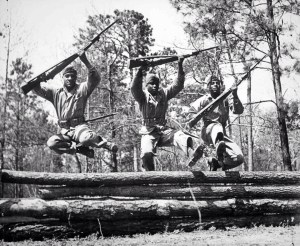
The winter weather delayed this event twice, but tonight the MacArthur Museum of Arkansas Military History will show the film The Marines of Montford Point: Fighting for Freedom.  the movie will start at 6:30 at the museum in MacArthur Park.

Hosted and narrated by Oscar winner Louis Gossett Jr., this movie profiles the first African Americans recruits in the United States Marine Corps. It begins with their experiences at Montford Point Base, a segregated boot camp in the heart of the Jim Crow South.

All-black battalions from Montford Point loyally served their country (some as officers) in three major conflicts: World War II, Korea and Vietnam.  All the while they were fighting for their country, they were also fighting for their own civil rights back home.

During the film, Montford Point veterans recount the racism they encountered both within and outside the military. They also reminisce about the rigors of basic training, the harsh conditions of the barracks, and the perils of combat.

There is no admission cost.  Light refreshments will be available.

The MacArthur Museum of Arkansas Military History is a program of the City of Little Rock Parks & Recreation Department.