Little Rock Look Back: Robinson Auditorium opens in 1940

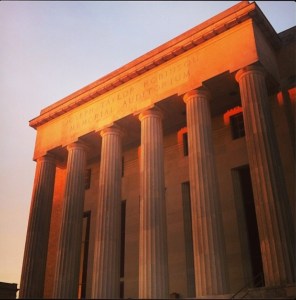
auditoriumduskOn February 16, 1940, after three years of planning and construction including several delays due to lack of funding, the Joseph Taylor Robinson Memorial Auditorium officially opened. It was a cold, rainy night, but those in attendance did not care.

Searchlights painting arcs in the sky greeted attendees. They were borrowed from the Arkansas National Guard. Newspaper accounts noted that only a few of the men who attended were in tuxedos, most were simply in suits. The work to get the building opened had been so harried, that it was discovered there was not an Arkansas Flag to fly in front of the building. Mayor Satterfield found one at the last minute courtesy of the Arkansas Department of the Spanish War Veterans.

The weather delayed arrivals, so the program started fifteen minutes late. Following a performance of Sibelius’ Finlandia by the fledgling Arkansas State Symphony Orchestra, Mayor J. V. Satterfield, Mrs. Joseph T. Robinson, Mrs. Grady Miller (the Senator’s sister-in-law and a member of the Auditorium Commission) and D. Hodson Lewis of the Chamber of Commerce participated in a brief ribbon cutting ceremony. Mrs Robinson cut the ribbon on her second attempt (once again proving that nothing connected with getting the building open was easy).

The ceremony was originally set to be outside of the building but was moved indoors due to the inclement weather. The ribbon cutting took place on the stage with the ribbon stretched out in front of the curtain. The opening remarks were broadcast on radio station KGHI.

Mr. Lewis, Mrs. Miller and Mayor Satterfield look on as Mrs. Robinson cuts the ribbon

Mr. Lewis, Mrs. Miller and Mayor Satterfield look on as Mrs. Robinson cuts the ribbon

Though he had previously discussed how he had voted against the auditorium in 1937 before entering public life, the mayor’s remarks that evening were appropriately gracious, statesmanlike and a testament to the effort he had invested to get it open upon becoming mayor. “We hope you have a very pleasant evening and hope further that it will be the first in a long series which you will enjoy in this, your auditorium.”

Tickets for the event, advertised as being tax exempt, were at four different pricing levels: $2.50, $2.00, $1.50 and $1.00.

The estimated attendance was 1700. Following the ribbon cutting, the main performance took place. The headliner for the grand opening was the San Francisco Opera Ballet accompanied by the new Arkansas State Symphony Orchestra (not related to the current Arkansas Symphony Orchestra). The featured soloist with the ballet was Zoe Dell Lantis who was billed as “The Most Photographed Miss at the San Francisco World’s Fair.”

At the same time that the gala was going on upstairs in the music hall, a high school basketball double-header was taking place in the downstairs convention hall. North Little Rock lost to Beebe in the first game, while the Little Rock High School Tigers upset Pine Bluff in the marquee game.

Black History Month Spotlight – L.C. and Daisy Bates House

Bates HouseThe new Arkansas Civil Rights History Audio Tour was launched in November 2015. Produced by the City of Little Rock and the University of Arkansas at Little Rock allows the many places and stories of the City’s Civil Rights history to come to life an interactive tour.  This month, during Black History Month, the Culture Vulture looks at some of the stops on this tour which focus on African American history.

L.C. and Daisy Bates were civil rights activists and co-owners and publishers of the Arkansas State Press newspaper. During the 1957 school desegregation crisis of Central High School, their home functioned as headquarters for the “Little Rock Nine,” the first black students to attend the school. The Bateses’ home provided a safe-haven for “the Nine.” It was a refuge, a place to study and receive counseling to contend with frequent harassment by white students and other staunch segregationists who demonstrated outside the school.

“The Nine” also visited with the NAACP legal team of Thurgood Marshall and Wiley Branton, who worked on the school desegregation case of Aaron v. Cooper. Daisy Bates, a mentor to the Nine, was president of the Arkansas State Conference of the National Association for the Advancement of Colored People (NAACP.) For taking a stand against segregated schools, L.C. and Daisy Bates had numerous missiles hurled at their home during the school crisis and had several fiery crosses—an emblem of the white terror organization the Ku Klux Klan— burned on their lawn. Segregationists mounted a boycott of the Arkansas State Press newspaper, putting it out of business in 1959.

In 2001, it was declared a National Historic Landmark.  The house is now being restored and turned into a museum.

The app, funded by a generous grant from the Arkansas Humanities Council, was a collaboration among UALR’s Institute on Race and Ethnicity, the City of Little Rock, the Mayor’s Tourism Commission, and KUAR, UALR’s public radio station, with assistance from the Little Rock Convention and Visitors Bureau.

Super Bowl Sunday Little Rock Look Back: Copper Bowl

Copper Bowl

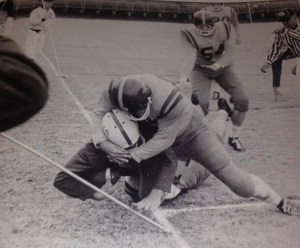
A Little Rock police officer tackles a NLR player in one of the Copper Bowls.

Today is Super Bowl Sunday, so it seems to be a good time to remember the five year series of football games in Little Rock known as the Copper Bowl.

From December 1959 through December 1963, the Little Rock Police Department played the North Little Rock Police Department in a series of football games.  The Copper Bowl games were fundraisers to help the LRPD provide food and presents for needy families during the Christmas season.

The agreement was that the teams would play for five years. The team with the most wins would permanently receive the Copper Bowl trophy.  The LRPD was outfitted with uniforms from Little Rock University and Louisiana State University (thanks to the efforts of Sgt. Harold Zook).  The games were played at Quigley Stadium.

Before the final game on December 1, 1963, the series was tied at 2-2.  The LRPD team won the game and permanently captured the trophy.  Over the five year period several thousand dollars were raised.

National Park Service Director, Local Leaders to Speak at Black History Month Town Hall Meeting

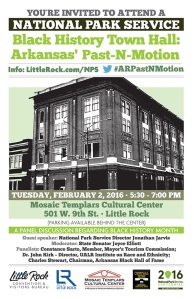
Feb 2 NPS eventLittle Rock Central High School National Historic Site in partnership with Little Rock Convention & Visitors Bureau, Mosaic Templars Cultural Center and the City of Little Rock, invite the public to join them for a Black History Month Town Hall Meeting entitled Arkansas’s Past-N-Motion to be held at Mosaic Templars Cultural Center at 5:30pm on February 2, 2016.

National Park Service Agency Director Jonathan Jarvis will serve as the guest speaker, and will discuss the National Parks Centennial Celebration, his tour to several of our nation’s civil rights-related historic sites and parks, and the importance of the National Park Service’s role in preserving and sharing our country’s history for future generations.  After his remarks, a panel discussion with local individuals will discuss several local institutions, and their roles and recent initiatives in preserving and sharing our city’s African American history, and its unique place in our nation’s civil rights movement.  This discussion will feature State Senator Joyce Elliott as moderator, and feature local panelists: Constance Sarto, Member, Mayor’s Tourism Commission; Dr. John Kirk – Director, UALR Institute on Race and Ethnicity; and Charles Stewart, Chairman, Arkansas Black Hall of Fame.

This Town Hall Meeting will highlight the resources of Civil Right institutions both from a national and local perspective, and the role of the National Park Service as the nation’s storyteller as it prepares to embark upon its Centennial 100th Birthday celebration on August 25, 2016.

During Director Jarvis’ time in Arkansas, he plans to visit Little Rock Central High School National Historic Site, engage Youth Leadership Academy members from Central High School as well as elementary students around the new White House youth initiative to get all 4th graders and their families to experience the places that are home to our country’s natural treasures, rich history, and vibrant culture FREE OF CHARGE! His visit to Arkansas will mark the start of Director Jarvis’ month-long endeavor to promote Civil Rights Sites during Black History Month.

They have also created the hashtag #ARPastNMotion to encourage local community groups to share information regarding any upcoming events relating to Black History Month.

For more information, please contact Enimini Ekong at (501) 396-3006 or Enimini_Ekong@nps.gov, or visit www.LittleRock.com/NPS.

Little Rock Central High School National Historic Site is located at 2120 Daisy L. Gatson Bates Drive, diagonally across the street from Central High School. The visitor center is open from 9:00 a.m. – 4:30 p.m. Monday through Sunday.  Admission is free. For more information call (501) 374-1957 or email chsc_visitor_center@nps.gov.

Little Rock Look Back: Rev. Dr. Martin Luther King, Jr.

Ernest Green, Dr. King and Daisy Bates share a relaxed moment -- which was probably rare for the three in 1958

Ernest Green, Dr. King and Daisy Bates share a relaxed moment — which was probably rare for the three in 1958

Today is the Martin Luther King Jr. Holiday.  It is an apt time to think about Dr. King and Little Rock.  A friend of L. C. and Daisy Bates, he attended the 1958 Central High School graduation to witness Ernest Green receiving a diploma. Each senior only received eight tickets to the ceremony at Quigley Stadium. Dr. King was in the state to address the Arkansas AM&N (now UAPB) graduation.

His attendance was briefly mentioned in the local press, but there was no media photo of him at the ceremony.  The Little Rock School District limited the press to one Democrat and one Gazette photographer. Other press were limited to the press box.

Ernest Green has a photo of him with Daisy Bates and Dr. King (pictured on this entry).

In 1968, when Dr. King was assassinated, Little Rock did not see the unrest that many cities did.  Part of that was probably due to quick action by Governor Winthrop Rockefeller. The Governor released a statement fairly quickly expressing his sorrow at the tragedy and calling for a day of mourning. He also made the State Capitol available for the NAACP to have a public memorial, as well as worked with a group of ministers to host an interdenominational service.

Little Rock Mayor Martin Borchert issued a statement as well:

We in Little Rock are disturbed about the incident in Memphis. We are disturbed regardless of where it had happened.  Killing is not the Christian solution to any of our problems today.

In Little Rock, we feel we have come a long way in 10 years toward solving some of our problems of living and working together regardless of race, creed or color.

The city Board of Directors in Little Rock has pledged itself toward continuing efforts to make Little Rock a better place in which to live and work for all our citizens.

We feel the efforts of all thus far have proved we can live in harmony in Little Rock and are confident such an incident as has happened will not occur in Little Rock.  We will continue our most earnest efforts toward the full needs of our citizens.

The day after Dr. King was assassinated, a group of Philander Smith College students undertook a spontaneous walk to the nearby State Capitol, sang “We Shall Overcome” and then walked back to the campus.  President Ernest T. Dixon, Jr., of the college then hosted a 90 minute prayer service in the Wesley Chapel on the campus.

On the Sunday following Dr. King’s assassination, some churches featured messages about Dr. King.  As it was part of Holy Week, the Catholic Bishop for the Diocese of Little Rock had instructed all priests to include messages about Dr. King in their homilies. Some protestant ministers did as well. The Arkansas Gazette noted that Dr. Dale Cowling of Second Baptist Church downtown (who had received many threats because of his pro-integration stance in 1957) had preached about Dr. King and his legacy that morning.

Later that day, Governor Rockefeller participated in a public memorial service on the front steps of the State Capitol. The crowd, which started at 1,000 and grew to 3,000 before it was over, was racially mixed. At the conclusion of the ceremony, Governor and Mrs. Rockefeller joined hands with African American ministers and sang “We Shall Overcome.”

That evening, Trinity Episcopal Cathedral was the site of an interdenominational service which featured Methodist Bishop Rev. Paul V. Galloway, Catholic Bishop Most Rev. Albert L. Fletcher, Episcopal Bishop Rt. Rev. Robert R. Brown, Rabbi E. E. Palnick of Temple B’Nai Israel, Gov. Rockefeller, Philander Smith President Dixon, and Rufus King Young of Bethel AME Church.

Earlier in the day, Mayor Borchert stated:

We are gathered this afternoon to memorialize and pay tribute to a great American….To achieve equality of opportunity for all will require men of compassion and understanding on the one hand and men of reason and desire on the other.

Mayor Borchert pledged City resources to strive for equality.

Another Little Rock Mayor, Sharon Priest, participated in a ceremony 24 years after Dr. King’s assassination to rename High Street for Dr. King in January 1992.  The name change had been approved in March 1991 to take effect in January 1992 in conjunction with activities celebrating Dr. King’s life.  At the ceremony, Daisy Bates and Annie Abrams joined with other civil rights leaders and city officials to commemorate the name change.

Documentary on MLK in Arkansas shown at Clinton School

mlk filmToday (January 15) at 12 noon, the Clinton School of Public Service is hosting a screening of the documentary “Dr. Martin Luther King Jr. in Arkansas.”

It originally aired on KATV-7 on January 19, 1987, as a 30-minute television special. Narrated by Arkansas native Deborah Mathis, it includes Dr. King’s attendance at Ernest Green’s Little Rock Central High School graduation and his commencement address at the University of Arkansas Pine Bluff.

It will be shown at the Clinton School.


Little Rock Look Back: Robinson Baskeball Arena

Former entrance to Robinson off Garland Street. Used to attend basketball games.

Former entrance to Robinson off Garland Street. Used to attend basketball games.

While Joseph Taylor Robinson Memorial Auditorium is known today as a performance and meeting venue, in its early days it was also the home to sports. Seventy-six years ago tonight the first basketball game was played at Robinson.

One of the first regular activities which took place in the lower level exhibition hall was a series of boxing and wrestling matches.  Building on the success of this, basketball came to the convention hall in January 1940.

A series of games featuring Little Rock High School and North Little Rock High School were announced by Coach Earl Quigley to take place from January 11 through February 16, the official opening day for the facility.

At that time, neither high school had a gymnasium; therefore both schools played their basketball games on their school auditorium stages with fans seated in the audience. The convention hall offered a regulation size floor (made of pecan block parquet) with seating for over 1,300 people along the sidelines and in the balcony.  The first men’s basketball game in Robinson Auditorium took place between the Little Rock High School Tigers and the North Little Rock High School Wildcats on January 11, 1940.

The Tigers lost the game before a crowd estimated to be 1,300.  Earlier in the evening there had been an exhibition between two women’s basketball teams.  The cost for admission to the games was 35 cents for the reserved seating and 25 cents for general admission.