Sculpture at the River Market Show seeking artists; 2016 Monument Sculpture Competition winner will be placed at Central High

Sculpture at the River MarketThere is a very rare opportunity for an artist to have their work permanently displayed on the grounds of historic Central High School.  The recipient of the Sculpture at the River Market 2016 Monument Sculpture Commission Competition will have just that chance.  The installation will take place in 2017 to commemorate the 60th anniversary of the integration of Central High School.
This will be a $60,000 to $80,000 Award.  Artists selected into the 2016 Sculpture at the River Market Show & Sale in Little Rock, Arkansas will be eligible for the Central High School Monument Commission Competition. Only 50 artists will be selected to participate in the Show and Sale.

The River Market Sculpture Show and Sale dates are April 22-24, 2016.
Click here for a SHOW application.     Deadline to submit an application to the show is January 14.
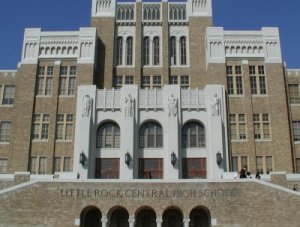
centralentranceThe site for this year’s contest will be a space where two sidewalks converge to start the curved ramp that will lead to the front doors of Central High School. The site is street level, so the sculpture can be seen from both sides of the street and will be a focal point as you start ascending to the porch and the front doors.
The design should not be restrained by the historical events that occurred at Central High School. The entry can convey some aspect of the events of 1957, but can represent many other feelings such as hope, togetherness, the importance of education, opportunity, or any other positive feeling that would impact students and visitors to this important landmark. It can be solemn or whimsical, or it can be figurative, abstract or interactive.

About Central High School:  In 1957, the nation watched the Little Rock Nine story unfold as nine black students attempted to enter the previously all-white school. With the help of television news, then in its infancy, the events commanded worldwide attention. Little Rock came to symbolize the federal government’s commitment to eliminating separate systems of education for blacks and whites. When Little Rock Central High School was built in 1927, the American Institute of Architects named Central High School, “The Most Beautiful High School in America”. The high school is still operating today and is the only functioning high school to be located within the boundary of a national historic site.

Click here for a drawing of the COMPETITION site and more information about the COMPETITION.

For Show information visit www.sculptureattherivermarket.com or email SculptureAtTheRiverMarket@ymail.com.

15 Highlights of 2015 – Recital featuring restored 1927 Steinway at Central High

 In September, the LRCH Tiger Foundation and Little Rock Central High School hosted a recital to celebrate the successful completion of the renovation of the 1927 Steinway & Sons grand piano.
It took place in the Roosevelt Thompson Auditorium at the school. The concert was free and open to the public and all were welcome.

The recital showcased the variety of music that has been played on the Model A III Steinway over the past 88 years. The piano was purchased for the school when it opened in September 1927. Over the years, it had fallen into disrepair and been improperly maintained. 

Due to the efforts of the Tiger Foundation (led by project chair Julie Keller), LRCHS Principal Nancy Rousseau and choral director Scott Whitfield, money was raised to restore the piano. A new onsite storage facility was also completed, paid for by donations.  

At the concert, it was announced that the piano would now be named “Scott” in honor of Mr. Whitfield. 

The $38,000 restoration project was undertaken by Mike Anderson of Anderson’s Piano Clinic who assembled a team of experts from Arkansas and Texas.

The Tiger Foundation is led by a 21-member board of dedicated volunteers, many of whom are Central alumni, who are passionate about the continued growth and success of Little Rock Central High School.

2015 In Memoriam – Ozell Sutton

1515 Sutton

In these final days of 2015, we pause to look back at 15 who influenced Little Rock’s cultural scene who left us in 2015.

Ozell Sutton was a writer and eyewitness to history, while making some of his own too.

Born in Gould, he moved with his family to Little Rock and graduate from Dunbar High School and Philander Smith College. In 1950, he became the Arkansas Democrat‘s first African American reporter.

He was at Central High when the Little a Rock Nine integrated, marched with Dr Martin Luther King Jr. in Washington in 1963 and was with Dr King when he was assassinated in 1968.

He served as an aide to Gov. Winthrop Rockefeller from 1968 to 1970. From 1972 to 2003 he work for the U.S. Department of Justice Community Relations Service in Atlanta. In that capacity he was often on the forefront in efforts to diffuse racially tense situations.

In 1962, he received an honorary doctorate from Philander Smith in recognition of his political activism in the civil rights movement. He was awarded the Distinguished Service Award by the Department of Justice in 1994.  He also was awarded the Medallion of Freedom by the National Association for the Advancement of Colored People (NAACP).

In 2012, he was presented with the Congressional Gold Medal in recognition for his being one of the first African Americans to serve in the Marine Corps. His book “From Yonder to Here:” A Memoir of Dr. Ozell Sutton was published in 2009.  In 2013, he was honored by inclusion on the Arkansas Civil Rights Heritage This designation came for his work in 1963 to desegregate downtown Little Rock’s businesses.

Ozell Sutton was inducted into the Arkansas Black Hall of Fame in 2001.

Little Rock Look Back: School Children Sing Christmas Carols at Robinson Auditorium

Christmas Carols

Photo from Arkansas Gazette

Right now, music is silenced at Robinson Center.  During the renovation, violins and tubas have been replaced by saws and heavy equipment.

Similarly, 76 years ago, the halls of that building were alive with only the sounds of construction.  But out front, on December 18, 1939, the sounds of Christmas carols filled the air.

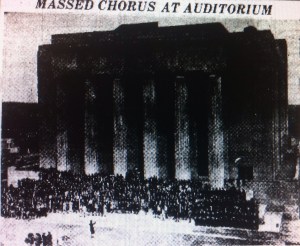
That afternoon, 500 school children from elementary schools were joined by the A Capella Choir of Little Rock High School as they sang Christmas carols on the front steps of the auditorium on a weekday afternoon.  The singers were accompanied by the Little Rock High School Brass Sextet.  The invocation for the event, which was sponsored by the Little Rock Council of Parents and Teachers, was delivered by the Right Reverend Richard Bland Mitchell, the Episcopal Bishop of Arkansas.

A Christmas tree in front of City Hall was lit up as part of the ceremony as well.  Media coverage noted that the audience witnessing the program stood on the front steps of the Pulaski County Courthouse, the side lawn of City Hall and in front of the steps of Robinson Auditorium.  It was also noted that most windows in the nearby government buildings were filled with people watching the ceremony.

Explore Little Rock’s civil rights history with new app

Little Rock-area residents and visitors have a new way to explore the city’s rich civil rights history.
The University of Arkansas at Little Rock Institute on Race and Ethnicity and Little Rock city officials  have unveiled the Arkansas Civil Rights History Tour app.

The free Apple and Android app guides users on an excursion through some of the city’s most influential historical sites, going back to the 1840s. Each of the 35 stops on the GPS-guided tour includes compelling narratives, historic photos, audio, and links to related content.

Tour stops range from the L.C. and Daisy Bates House to the Trail of Tears. The tour includes a total of three National Historic Landmarks, three National Register Historic Districts, and numerous buildings on the National Register of Historic Places.

Narrated in both English and Spanish, the app also offers information about Jewish history in Little Rock, Hispanic migrations to Arkansas, and Native American tribes.

Organizers recommend app users begin their route at Broadway and West Ninth Street in downtown Little Rock, but the app can help people customize their own path.

A collaboration of the Institute on Race and Ethnicity, the City of Little Rock, the Mayor’s Tourism Commission, and KUAR, UALR’s public radio station, led to the creation of the Arkansas Humanities Council-funded app.

“The institute’s mission is to remember and understand the past, to inform and engage the present, and to shape and define the future in the area of race and ethnicity,” said Dr. John Kirk, director of the Institute on Race and Ethnicity.

“The tour app helps us to do all those things: It powerfully sheds light on the past, it allows people to engage with the past in the present moment, and it helps us to consider how those legacies and lessons can shape and define the future of the city and state.”

The app can be found in the Apple App Store and on Google Play by searching for “Arkansas history.”

PIGSKIN TURKEY DAY IN THE ROCK, Part 6 – A Variety of Foes

Turkey Day 1921From the first Thanksgiving football game for Little Rock High School in 1914 until 1933, the Tigers played a variety of opponents.  They faced off against other Arkansas high schools, out of state high schools, a college and a team of soldiers.  Their record in these twenty games was 18 wins and 2 losses.  While the opponent may have varied, each year the Tiger eleven lined up against their foes at home in Little Rock. The team had enough of a reputation that they could invite opponents and never had to travel.

Playing games on Thanksgiving had become a tradition by the time Little Rock joined in the fray in 1914. Their first Thanksgiving Day opponent was Texarkana High School.  The Tigers won by a score of 20 to 0. The crowd of 1,500 at West End Park (now the site of Quigley Stadium) not only witnessed the high school game, but also saw Arkansas College (now Lyon College) defeat Little Rock College (no association with UALR) by a score of 40 to 0.  With their win, Little Rock captured the state championship – their fourth since 1907.

By the next Thanksgiving Day, the field at West End Park was known as Kavanaugh Field. It would have that name until it was replaced by Quigley Stadium in 1936.  From 1915 until 1933, Little Rock would defeat three Arkansas high schools Van Buren, Benton and Hot Springs as well as high schools from Oklahoma, Mississippi, Louisiana, Texas, Alabama, Kansas, Illinois and Missouri.  Three of their out of state opponents returned for a second time, so even though these schools were generally overwhelmed by Little Rock High, it was obviously viewed as a positive experience.  Playing out of state teams garnered other benefits. In 1920, they played Tupelo Military Institute, which held the Mississippi-Alabama championship. By defeating them, Little Rock High School claimed the state championship of four states: Arkansas, Alabama, Tennessee and Mississippi.

In 1917, they beat the college team of Arkansas State Normal School (now UCA) by a score of 45 to 0. (The Tigers so overpowered State Normal that the Gazette mused that the extremely muddy field was all that kept LR from scoring more than 45 points.)

The Tigers’ only two defeats came in 1918 and 1924.  The first Thanksgiving Day defeat came in 1918 when Little Rock played a team of soldiers from Camp Pike. The soldiers were an average of 20 pounds heavier than the Tigers. They used that weight to their advantage to defeat the high schoolers by a score of 42 to 0.  This was at the height of the US involvement in The Great War. So this game was certainly part of Little Rock’s war effort as the City worked to extend hospitality to soldiers. The Tigers’ 1924 defeat was at the hands of Atlanta Tech High School by a score of 35 to 7.

While the Thanksgiving games were serious business for the Tigers and their fans, they also provided for moments of entertainment.  In 1923, the Gazette reported that the Tigers had hosted a dance at the Capital Hotel for the visiting Ensley High football team from Birmingham, Alabama.  One wonders if there were a motive to their hospitality considering that the next day the Tigers won by a score of 20-7. Perhaps distracting the opposing players the night before the game was all part of Coach Earl Quigley’s strategy.  On Thanksgiving 1929, Little Rock hosted previously undefeated Soldan High from Saint Louis. At halftime of the game (which would end with LR scoring 26 to their opponent’s 6), there was a performance by the Little Rock High School band as well as a group of girls called Quigley’s Quackers.

Based on their reputation as a powerhouse, Little Rock would continue to play teams from other states. But after 1933, Little Rock would play a close rival: first North Little Rock (1934-1957) and then Hall High (1958-1982).  During the two decades of playing various teams, the Little Rock Tigers achieved ten shutouts and suffered one shut out.  The Tigers scored 492 points and gave up 133 points.

1914 Little Rock 20 Texarkana 12
1915 Little Rock 40 Muskogee Central High 0
1916 Little Rock 46 Van Buren 0
1917 Little Rock 45 Arkansas State Normal 0
1918 Little Rock 0 Camp Pike 42
1919 Little Rock 52 Benton 0
1920 Little Rock 6 Tupelo Military Institute 3
1921 Little Rock 21 New Orleans Warren Easton High 3
1922 Little Rock 7 Bryan (TX) High 0
1923 Little Rock 20 Birmingham Ensley High 7
1924 Little Rock 7 Atlanta Technical High 35
1925 Little Rock 6 New Orleans Warren Easton High 0
1926 Little Rock 18 Birmingham Ensley High 6
1927 Little Rock 37 Wichita Central High 0
1928 Little Rock 18 Chicago Lindblom High 0
1929 Little Rock 26 Saint Louis Soldan High 6
1930 Little Rock 33 Chicago Lindblom High 13
1931 Little Rock 31 Dallas Woodrow Wilson High 0
1932 Little Rock 6 Saint Louis Cleveland High 0
1933 Little Rock 13 Hot Springs 6


  • Muskogee Central High has been known as Muskogee High since the 1970 integration of the formerly all-white school with an African American high school.
  • Tupelo Military Institute existed from 1913 to 1937.
  • Warren Easton High is Louisiana’s oldest high school. After Hurricane Katrina it is now a charter high school.
  • Bryan High School was replaced by Stephen F. Austin High School, which was replaced by a new Bryan High School.
  • Ensley High in Birmingham closed in 2006.
  • Atlanta Technical High closed in 1947. A charter school with the same name operated from 2004 to 2012.
  • Wichita Central High has been known as Wichita East High since 1929. It is the largest high school in Kansas.
  • Chicago Lindblom High now educates under the name Lindblom Math and Science Academy.
  • Saint Louis Soldan High now educates as Soldan International Studies High School
  • Woodrow Wilson High School continues to operate in the Lakewood neighborhood of East Dallas.
  • Saint Louis Cleveland High now educates as Cleveland Junior Naval Academy and is no longer in the longtime Grover Cleveland High School building.


PIGSKIN TURKEY DAY IN THE ROCK, Part 3 – Little Rock vs. NLR


Turkey Bowl LRHS NLRHSAfter 20 years of playing a variety of schools on Thanksgiving, in 1934 Little Rock High School had started the new tradition of playing the North Little Rock High School Wildcats.  These cross-river rivals had played a few games previously in the 1910s and early 1920s. The competition was resumed in 1931, but was not on Thanksgiving Day until 1934.  With that game, the Tigers of Little Rock would begin a 49-year tradition of taking on their biggest rival on Turkey Day.

For much of the 1920s and 1930s, a Thanksgiving Day game for Little Rock High School meant rain.  That was the case in the 1934 meeting at Kavanaugh Field. (Located at the current spot of Quigley Stadium, it was a baseball field on which football games could also be played.  In 1936, the current stadium opened.)  The Tigers and Wildcats played to a 2-0 win achieved by the southside Bengals of Earl Quigley.

Another notable matchup was the 1938 game.  Little Rock won 12 to 7. With that win, it captured its first official state football championship. (Though the Arkansas Activities Association does now credit LRHS with several prior championships.)

The 1939 edition took place on Arkansas Thanksgiving.  That November featured five Thursdays.  President Roosevelt issued a proclamation that Thanksgiving would be the fourth Thursday, as it traditionally was. However Arkansas and a few other states chose to observe it on the final Thursday.  Little Rock won 6 to 0, but it was a messy game. Some sports fans joked that the game was FDR’s revenge on Arkansas for ignoring him regarding Thanksgiving.

In 1941, only a few days before the US would be plunged into World War II, North Little Rock achieved its first Turkey Day win over Little Rock.  The score was 26 for the Wildcats and 0 for the Tigers.  This was only the third ever loss for the Tigers on a Thanksgiving Day.  The Tigers were so dominant on Turkey Day games, a student had once remarked to a Gazette reporter that the matchup against Pine Bluff should be moved to Thanksgiving since the Tigers always seemed to win on that day.  (Pine Bluff was the state’s other football powerhouse at the time and often gave the Tigers fits in games.)

North Little Rock repeated as winner in the 1942 game, this time with a 31 to 12 score.  Writing for the Gazette, Orville Henry wondered if this would be the final meeting for the duration of the war.  He opined that many of the players might be in a different type of uniform for future games and that rubber might be needed for the war effort instead of athletic equipment.  While some colleges and high schools did drop football during the war, neither LR nor NLR did.

The Tigers were back on top in 1943 by a 13-7 score.  (It would be the last football game for the NLR coach who had been drafted.)  The 1944 game also featured a 13-7 score, but this time it was flipped and the Wildcats were winners.  The 1945 edition ground to a 13-13 tie.

In 1947, both teams were undefeated heading into the Turkey Day classic.  The inky wretches and scribes were predicting another evenly matched slugfest.  Instead Little Rock owned the game and came out with a 13-0 win.

The teams met eight times in the 1950s on Thanksgiving.  Little Rock won seven of the eight, losing the 1951 game by one point (13 to 14).

With the anticipation of a second Little Rock high school to be opened in a few years, Little Rock High School was rechristened as Little Rock Central High in 1954. The new school, named Hall High opened in 1957 but played much smaller schools for its first year on the gridiron.  Plans were underway for Hall and Central to meet on Turkey Day in 1958, so the 1957 meeting of Little Rock and North Little Rock would be the final time the two teams would meet on Thanksgiving Day.

Little Rock Central High had dominated world headlines in September and October 1957 with the desegregation of the school.  The sports coverage of this game however belied all the drama off the field. News reports focused on Turkey Day as the final game between the longtime rivals and on the fact that it had a morning start time instead of the traditional afternoon start time.  In the end, the Tigers had the same result as they did in the first Turkey Day meeting: a win.

After 24 meetings on Thanksgiving Day, Little Rock had 19 wins, 4 losses, and one tie.  Seven times they shut out the Wildcats, and one time the northern team blanked them.  The fewest total points scored were 2 in the 1934 game, while the 1950 game produced a cumulative total of 71 points (LR 64, NLR 7).  The Tigers scored a total of 517 points over 24 games and gave up only 203.