April 19 Architeaser

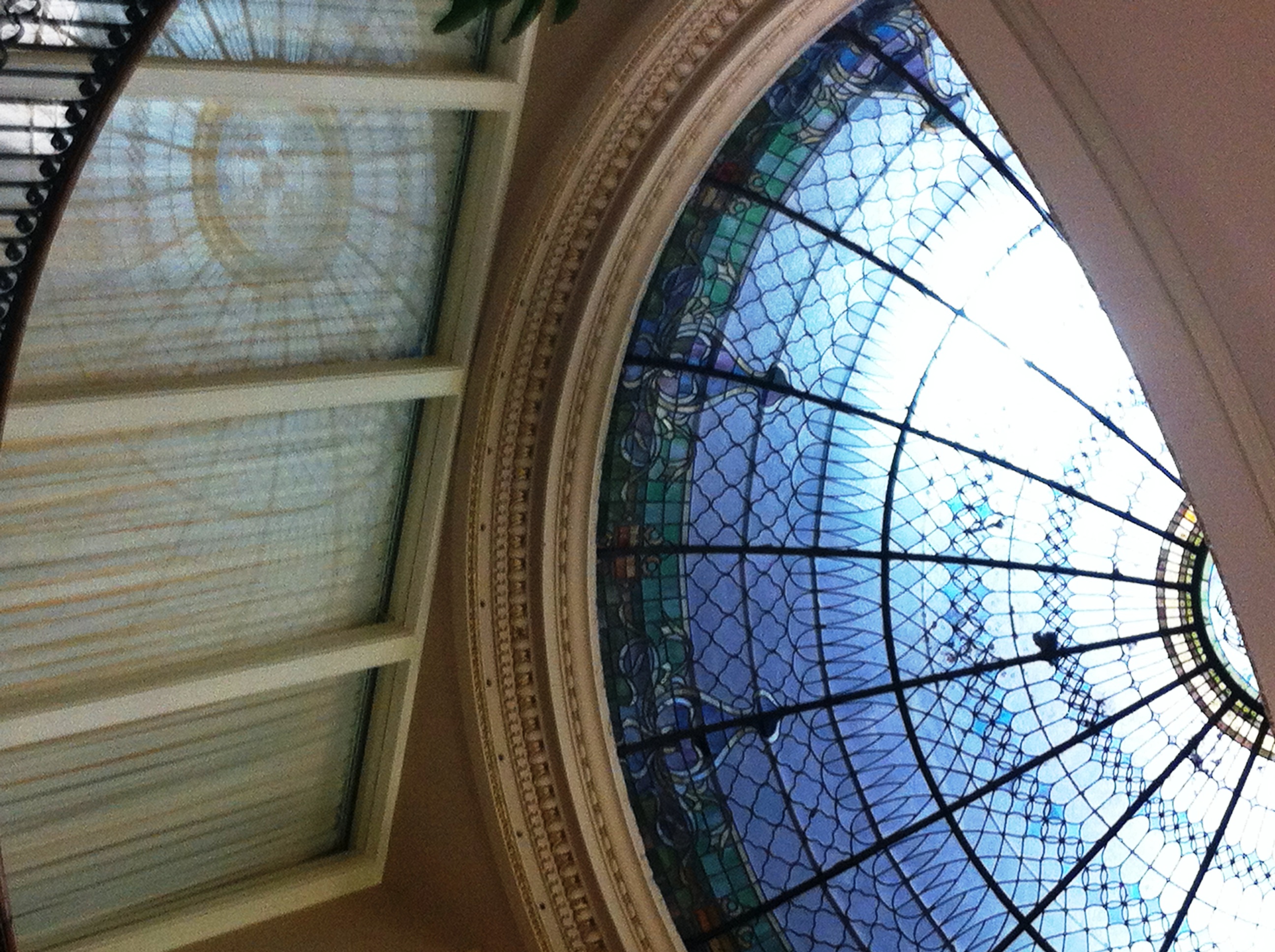
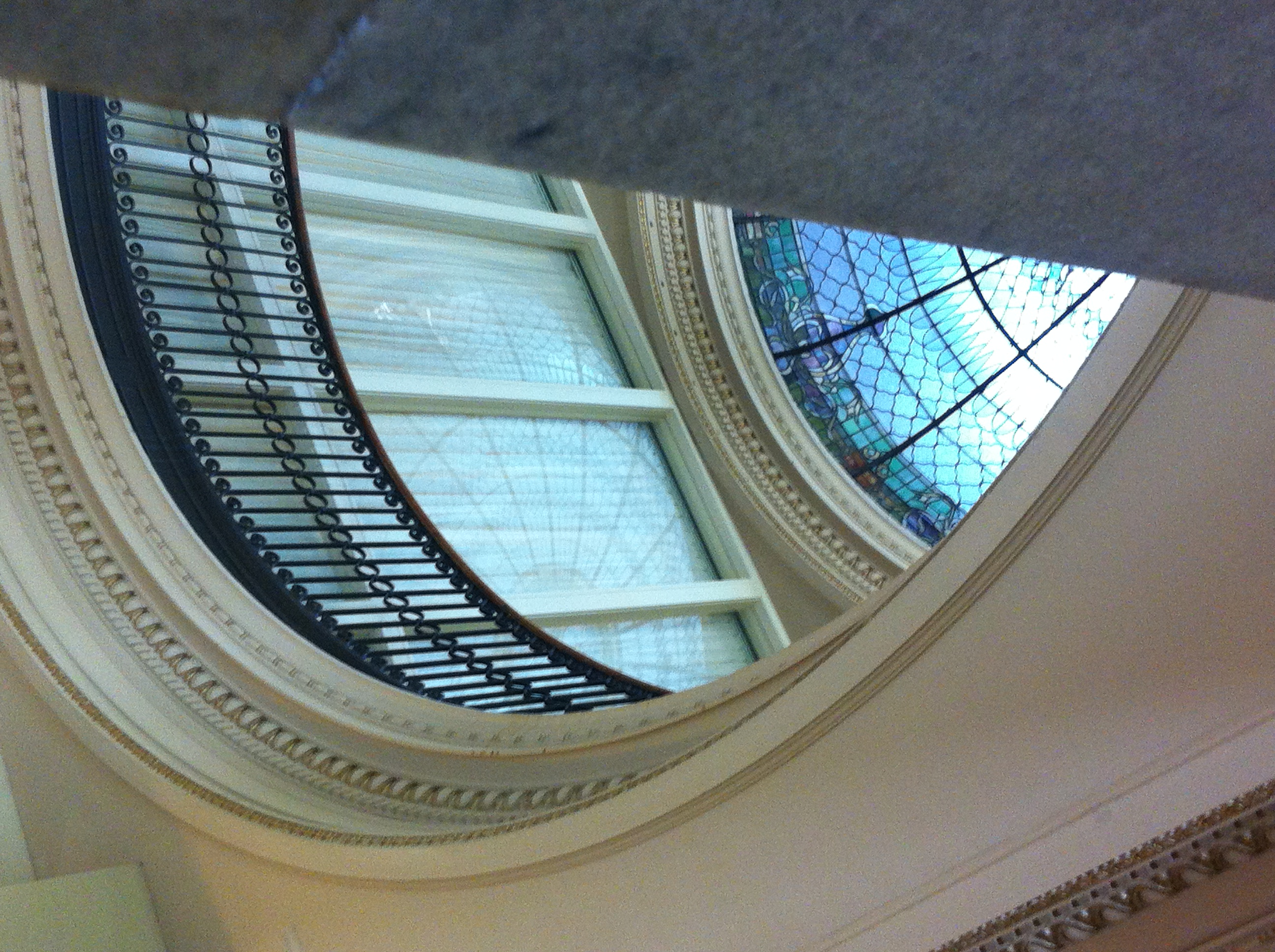
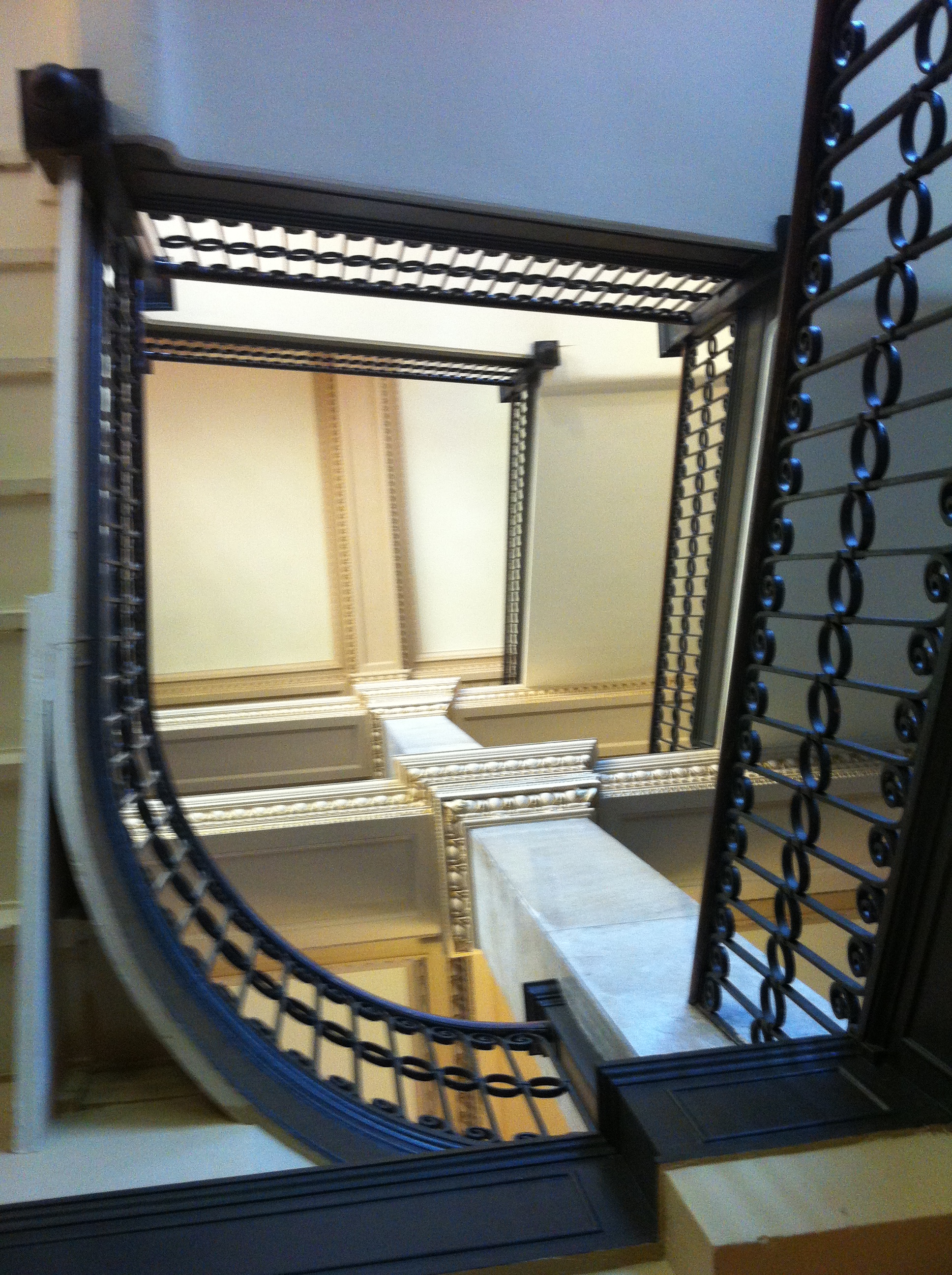
IMG_4907The City Hall 105 week of the Architeaser wraps up with this unique perspective of City Hall.  Though there are offices on four levels of City Hall, there is only one spot where one can see all four levels.  The western edge of the central staircase affords the only view from the basement to the third floor.  The central staircase is symmetrical from the first floor up to the third floor. But from the first floor to the basement, there is only one flight of stairs going down (on the west side).

Today’s Architeaser goes from the basement up to the third floor of Charles Thompson’s edifice.  When the building opened, the basement was used but most of the third floor was unfinished.  The ceramic tile pattern on the third floor is different from the other floors.  The eastern stairwell went to the third floor balcony which overlooked the City Council chambers.

Over time a few offices started migrating up there.  In 1929, when the Museum of Antiquities and Natural History (now Museum of Discovery) was “given” to the City and moved into City Hall, the museum had to finish out its own space.  It was not until New Deal programs needed local offices and took up residence on the third floor that all of City Hall was occupied.  At that point the building was over 25 years old.

The balcony in the City Council chambers was removed in the 1960s when additional office space was needed.  At that point in time, the high ceiling in the chambers was lowered and more offices were installed on what had been the balcony level.

Unfortunately photos of the old Council chambers do not seem to exist.

April 18 Architeaser

IMG_4577There have been many building modifications at Little Rock City Hall over the past 105 years.  One thing has not changed: the Tiffany stained glass window in the rotunda.

Though City Hall once had a dome, the stained glass window has always looked down on the rotunda from the third floor ceiling.  Here are some views of the stained glass in the rotunda.

There was a second, smaller stained glass skylight in the stairwell adjacent to the City Board chamber.  In the 1960s, it was removed.  Records do not indicate what happened to it.

IMG_4897 IMG_4899

April 17 Architeaser

IMG_4825In the early 1960s, the windows at City Hall were bricked in.  The rational at the time dealt with energy efficiency and the installation of air conditioning in the building.  At the same time, there were other renovations undertaken.  Some of these were undertaken because of growth at City Hall, others were due to the 1957 change to the City Manager form of government (which created some new positions and eliminated others).  The City Clerk’s office was moved and the vault was relocated.

In conjunction with the mid-1980s restoration of the building, all but a few of the windows were finally unbricked.  Most of the remaining bricked-in windows were left intact because of mechanical equipment now located behind them.  Three other windows remained enclosed.  Two were in the City Board Chambers (which had to remain enclosed to enable for clearer broadcasting of meetings) and the third was in the City Clerk’s office (because of the “new” 1960s location of the Clerk’s vault).

Today’s Architeaser shows the  bricked-in window on the second floor western elevation in the City Clerk’s office.  Next to it is the top half of the exposed window.

April 16 Architeaser

IMG_4837


When Little Rock City Hall opened in April 1908, the eastern facade had a porch with two sets of double staircases going from the building to the street level.

Capping each staircase was a portico with a balcony atop.  Though these balconies were structurally sound for standing atop, they were not accessed through doorways. The only way to access them is to climb through a window.

By the 1930s, with development behind the building.  A driveway had been constructed around City Hall and going up alongside the building.  As part of this, the northern staircases were removed and the doorway changed into a window.  The southern stairways remain on the Broadway side of the building to this day.

April 15 Architeaser

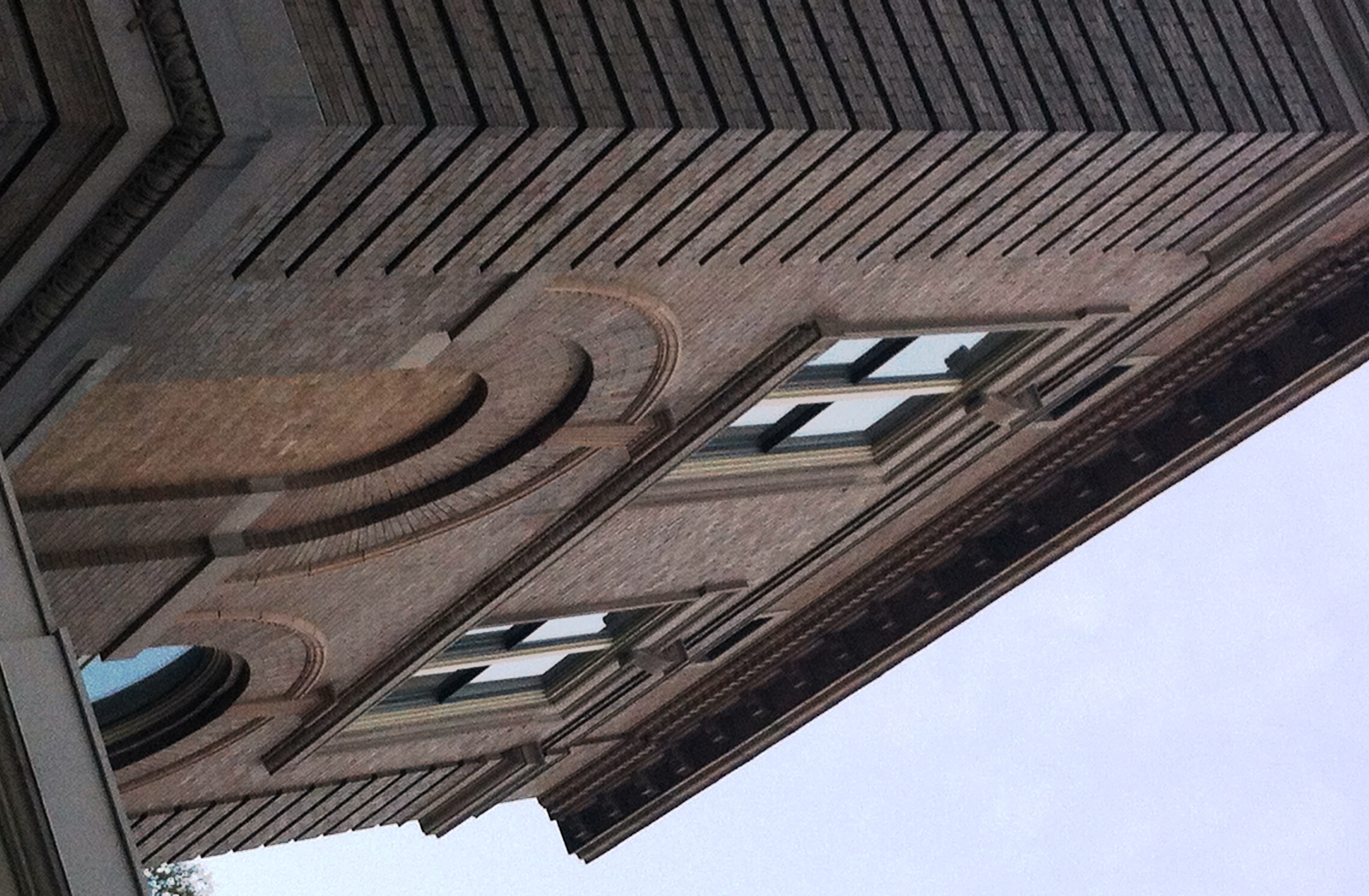
IMG_4853This week’s Architeasers will examine elements of Little Rock City Hall, which officially opened to the public on April 15, 1908.  Today’s features the front doors and wrought iron mini-balcony off the second floor.  These are covered by the portico which extends from the third floor facade.

It is doubtful the wrought iron balcony ever functioned as a place for people to stand. It is not a heavy structure and is secured very simply.  In addition, to reach it, one would have to climb over the 2nd story windows and crawl out onto it.  It appears to have always been for decorative purposes.

The glass doors are not original to City Hall.  They were installed as late as the 1980s renovation.  There also was once a porchlight which hung in the area.  The ceramic tile is original as is the masonry.

The architect for City Hall was Charles L. Thompson.  The building was championed by Mayor W. E. Lenon.  He served as Mayor from 1903 to 1908.  At the first meeting in the new building, he resigned because his work was needing his full attention.  At the time the position of Mayor was part-time.

Little Rock Look Back: City Hall turns 105

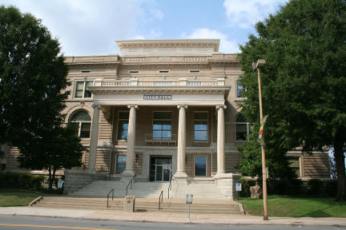
CityHa78105 years ago today, Little Rock City Hall officially opened at the corner of Markham and Broadway.

On April 15, 1908, the Italian Renaissance Revival style building, which had been designed by local architect Charles Thompson, played host to an open house. Staff had started moving into the building in March of that year.   This was, as often is the case, behind schedule.  The date in the cornice toward the top of the building is 1907, but the building was not completed until 1908.

In 1903, W. E. Lenon became Mayor of Little Rock. Back then, the terms were two-year terms.  By the start of his second term in 1905, he realized that the City was outgrowing City Hall, which was, at the time, on the northeast corner of Markham and Louisiana – where part of the Statehouse Convention Center sits today.

In February 1906, Mayor Lenon appointed a committee of five aldermen to over see the planning for the building of a new City Hall. In July 1906, the City Council approved plans, which called for a City Hall with an municipal auditorium wing. There was some hue and cry about wasteful spending, so, in September 1906, those plans were scrapped and a simpler City Hall was approved for the cost of $175,000.

The last resolution in the old City Hall called for the banning of smoking in the new Council Chambers – while the Council was in session. This may well have been the first smoking ban in a public government building in the history of Arkansas.

When the building opened, the third floor was not finished out. The space was not needed. When the Museum of Natural History and Antiquities (now the Museum of Discovery) moved into City Hall in 1929, they had to finish out their space.

In 1913, the new Central Fire Station, designed in the Beaux Arts style, was constructed adjacent to City Hall. During the 1930s, as the City grew, more space was needed. A garage, designed in the “austere, utilitarian” style was built in 1936 and a City Jail Annex, built by the WPA in the modified Art Deco style was built in 1938.
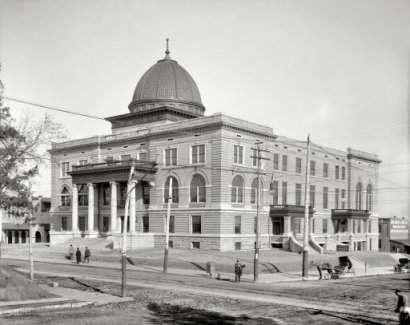
City Hall prior to 1912

City Hall prior to 1912

By 1955, the copper-clad dome which sat on top of City Hall needed severe repairs. The wooden supports and the copper cladding were both in dire shape. Mayor Pratt Remmel set aside money for the dome to be repaired. After defeating Remmel in his bid for a third term, Mayor Woodrow Mann scrapped plans for the repair and, indeed, scrapped the dome.

Following the lead of County Judge Arch Campbell who had removed the tower at the County Courthouse, Mann proposed removal of the dome. He had an informal survey which had three options: repair the dome, replace the dome with an aluminum one, or remove it. This was open to anyone to respond – voting eligibility or Little Rock residency did not matter. By a slim margin, remove the dome won – so the dome was removed.

In 1960, as air conditioning was installed, windows were bricked in to promote energy efficiency. At the time, the feeling was that a new City Hall would be constructed in the 1970s somewhere more central to the growing city. Relocation talk persisted throughout the 1970s and early 1980s. By that time, City Hall had been modified a great deal – with no thought about historic preservation. When the Police and Fire Department had moved out into their new facilities, their old spaces had become storage.

By 1984, the decision was made to stay at Markham and Broadway. An extensive renovation and restoration effort was undertaken. In 1988, the building reopened, and the interior had been restored to its 1908 appearance.

25th Arkansas Business of the Year finalists include cultural institutions

Arkansas Business earlier this week announced the finalists for the 25th Arkansas Business of the Year.  The winners will be announced at a ceremony presented by Centennial Bank and Arkansas Business on Tuesday, February 26 at the Statehouse Convention Center.

As is often the case several of the finalists in the business and business leader categories are supporters of cultural life in their communities.  In addition, two of the finalists in the Non-Profit categories are connected to Little Rock’s cultural scene.

christinalittlejohnChristina Littlejohn is a finalist for Non-Profit Executive of the Year.  Since 2009 she has been Executive Director of the Arkansas Symphony Orchestra.  Since coming to the ASO, she has not only led it through the current recession, she also worked with the selection of Philip Mann as the Music Director.  Whereas many symphony orchestras are cutting musicians, concerts and series, the ASO has been embarking on new outreach concerts including the new Intimate Neighborhood Concert series..

Prior to joining ASO, she served as Executive Director of the Pensacola Symphony Orchestra, Director of Residencies for the Cleveland Orchestra, and Executive Director of the Mobile Symphony.  She is also a cellist.

The Museum of Discovery is a finalist for Non-Profit of the Year. Established in 1927 as the Museum of Natural History and Antiquities, the Museum of Discovery is the oldest museum in Little Rock.  It has been housed in a storefront, the third floor of Little Rock City Hall, the Arsenal Tower in MacArthur Park, and since 1998 has called the Museum Center in the River Market its home.

The new facility provided more hands-on, interactive exhibits and programs, and the museum began to focus more intensely on science, technology, engineering and math. In 2003, the museum merged with the Children’s Museum of Arkansas and assumed responsibility for addressing the needs of preschool children. Also in 2003, the museum became a Smithsonian Affiliate.

In 2011, the museum closed for nine months in order to add a new entrance and undergo a total renovation. This project, funded by a grant from the Donald W. Reynolds Foundation, also provided funding for new, interactive science exhibits, completing the museum’s transformation from a collecting museum to a science center.  Nan Selz led the Museum as Executive Director from 2004 through 2012.  Kelley Bass, a former member of the museum’s board, became the Museum’s CEO earlier this month.