Tonight at the MacArthur Museum of Arkansas Military History, a FREE film: LAST DAYS IN VIETNAM

IMG_5596

In partnership with AETN, the MacArthur Museum of Arkansas Military History will host a preview screening of the “American Experience: Last Days in Vietnam.”  The screening starts at 6:30pm tonight at the museum in MacArthur Park.

Free admission. Free popcorn and beverages provided.

During the chaotic final days of the Vietnam War, the North Vietnamese Army closes in on Saigon as South Vietnamese resistance crumbles. The United States has only a skeleton crew of diplomats and military operatives still in the country. As Communist victory becomes inevitable and the U.S. readies to withdraw, some Americans begin to consider the certain imprisonment and possible death of their South Vietnamese allies, co-workers, and friends.

Meanwhile, the prospect of an official evacuation of South Vietnamese becomes terminally delayed by Congressional gridlock and the inexplicably optimistic U.S. Ambassador. With the clock ticking and the city under fire, a number of heroic Americans take matters into their own hands, engaging in unsanctioned and often makeshift operations in a desperate effort to save as many South Vietnamese lives as possible.

Last Days in Vietnam was produced and directed by Rory Kennedy, an Emmy Award-winning independent documentary filmmaker and co-founder and president of Moxie Firecracker Films. Her work has been shown on PBS, HBO, A&E, MTV, and Lifetime.

The MacArthur Museum of Arkansas Military History is a program of the City of Little Rock’s Parks and Recreation Department.


Little Rock Look Back: MacArthur Returns….to Little Rock

General MacArthur and Mayor Remmel

General MacArthur and Mayor Remmel

On Sunday, March 23, 1952, General Douglas MacArthur made his only post-infancy visit to Little Rock. He had previously been scheduled to visit Mississippi, and Little Rock Mayor Pratt Remmel had persuaded him to add a visit to Little Rock to the agenda. The fact that Little Rock now had a Republican mayor had apparently piqued the General’s interest.

General MacArthur, accompanied by his wife and son as well as several journalists and members of his military retinue, arrived at Little Rock Airport at 10:40 am. He was met by a delegation of civic leaders including Mayor Remmel. Alderman James Griffey made welcoming remarks on behalf of the city. Then the General and Mayor boarded an open car and led a motorcade from the airport to downtown.

The motorcade’s destination was Christ Episcopal Church at Capitol and Scott streets. It was at this church that MacArthur had been baptized as an infant. The delegation was greeted by the Episcopal Bishop R. Bland Mitchell, Rector J. Hodge Alves, and Rector Emeritus W. P. Witsell. (While he had been Rector, Dr. Witsell had garnered national attention by issuing an Easter blessing to Gen. MacArthur as he had been evacuating the Philippines at the height of World War II.) In order to gain admittance to the church that morning, church members and guests had to have tickets.

Following the worship service, the General and his party went to three events in the park named in his honor. The first was a tour of the Museum of Natural History (now the Museum of Discovery and located in the River Market; the current tenant of the building is the MacArthur Museum of Arkansas Military History), which was located in the building in which the General had been born. After the tour, he spoke at a dedication of a small rose garden adjacent to the museum. It was sponsored by the Little Rock City Beautiful Commission and the Garden Clubs of Greater Little Rock.

Though every stop of the General’s visit had featured crowds, the largest was at the third location in MacArthur Park. A crowd of several thousand greeted the General as he spoke from the Foster Bandshell in the park’s southwest corner. Chamber of Commerce president Richard C. Butler (brother-in-law of Mayor Remmel) was the master of ceremonies. Following an invocation by Methodist Bishop Paul Martin, the only other speaker was the General. In his remarks he spoke of his Southern heritage and of his appreciation for the support of the citizens of Little Rock over the years.

Several gifts were bestowed upon the MacArthurs at the ceremony. The City of Little Rock presented Mrs. MacArthur with an engraved silver serving tray.

Following the events in MacArthur Park, the family retired for a brief respite to the Hotel Marion. They then attended a luncheon buffet in their honor at the home of Howard and Elsie Stebbins on Edgehill Road. The General and Mrs. MacArthur circulated through the house greeting guests and then eschewed a special table in favor of balancing their plates on their laps and sitting in wingback chairs. Meanwhile Arthur MacArthur stayed upstairs and discussed stamp collecting and other hobbies with the Stebbins’ two teenage sons.

Following the luncheon, the MacArthur party went back to the airport and by 4:00pm, the plane was in the air.

Though this visit was coming at the end of a whirlwind of activities, by all accounts, the General and Mrs. MacArthur were very gracious and accommodating. The General was being mentioned as a potential GOP candidate for President, but purposefully steered clear of any political comments in his remarks. He and Mrs. MacArthur dutifully posed for photos not only for the media but also for amateur photographers. At lunch, the General even asked a Gazettephotographer to take a photo of him with his Little Rock Police motorcycle escorts so that they could have a souvenir of the visit.

Women’s History Month Throwback Thursday: The Fine Arts Club

In 1914, a group of women interested in visual art came together in Little Rock and formed The Fine Arts Club of Arkansas. 

In the early years, they gathered for regular discussions and taught art classes. 

Over time, the Fine Arts Club started acquiring artworks through donations. Originally they displayed these in the Pulaski County Courthouse in a room loaned to them for that purpose. 

Eventually, the County needed the space and the Fine Arts Club needed more room.  In the early 1930s, members approached Mayor Horace Knowlton with the suggestion of the City constructing a fine art museum. 

After securing funding for construction from the WPA, ground was broken and the Museum of Fine Arts opened in 1937 in City Park (now MacArthur Park).

Members of the Fine Arts Club staffed the museum as volunteers and docents as well as arranged for traveling exhibits. From the museum, the club continued to offer classes and guest lectures

By the mid-1950s, there was a desire for larger exhibit space, and the Fine Arts Club joined with the Junior League and the City of Little Rock in creating a new art museum.  

In 1963, the Arkansas Arts Center opened in MacArthur Park. This new facility encompassed the previous museum as well as additional spaces. With the hiring of professional staff to curate exhibits and teach classes, the Fine Arts Club transitioned to a volunteer corps and continued special monthly programming. 

Today, the purpose of the Fine Arts Club is to promote and extend the activities, usefulness and enjoyment of the Arkansas Arts Center.  The Fine Arts Club supports the Arkansas Arts Center by hosting programs featuring knowledgeable and dynamic speakers, and providing volunteers.  

Marines of Montford Park focus of film at MacArthur Museum tonight 

The winter weather delayed this event twice, but tonight the MacArthur Museum of Arkansas Military History will show the film The Marines of Montford Point: Fighting for Freedom.  the movie will start at 6:30 at the museum in MacArthur Park.

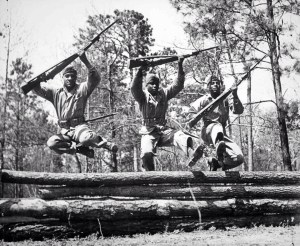
Hosted and narrated by Oscar winner Louis Gossett Jr., this movie profiles the first African Americans recruits in the United States Marine Corps. It begins with their experiences at Montford Point Base, a segregated boot camp in the heart of the Jim Crow South.

All-black battalions from Montford Point loyally served their country (some as officers) in three major conflicts: World War II, Korea and Vietnam.  All the while they were fighting for their country, they were also fighting for their own civil rights back home.

During the film, Montford Point veterans recount the racism they encountered both within and outside the military. They also reminisce about the rigors of basic training, the harsh conditions of the barracks, and the perils of combat.

There is no admission cost.  Light refreshments will be available.

The MacArthur Museum of Arkansas Military History is a program of the City of Little Rock Parks & Recreation Department.

Little Rock Look Back: City Park becomes MacArthur Park

GOn March 9, 1942, Little Rock’s first public park was renamed by the Little Rock City Council.  By a vote of fourteen ayes, zero nays and four absent, the alderman approved Ordinance 6,388 which renamed the park in honor of General Douglas MacArthur. 

The text of the ordinance says that “it is fitting and proper that the bravery and glorious deeds of General Douglas MacArthur, a native son of Little Rock, should be commemorated.”  This was passed a few months after the United States’ entry into World War II. 

Though he was already a well-established military figure, most of the MacArthur legend during the war would take place after this naming. 

The park land had originally served as a horse racetrack in the early days of Little Rock.  By 1836, the federal government purchased the land for construction of a military arsenal.  The flagship building, the Arsenal Tower building, is the only remaining structure from that time period.  

The land served as a military outpost until 1892.  On April 23, 1892, a land swap took place where in the City of Little Rock was given the property with the stipulation that it would be “forever exclusively devoted to the uses and purposes of a public park.” (Never mind that the federal government took part of the land back for the construction of the Wilbur Mills Freeway.)  

In return for giving the City this land, the federal government took possession of land on the north side of the Arkansas River (then part of Little Rock) – that 1,000 acres became Fort Logan H. Roots. The park opened on July 4, 1893, with the name Arsenal Park. Since it was the City’s first and only park at the time, residents started referring to it as City Park. In time, the designation Arsenal Park fell from use.  In fact, it is referred to as City Park exclusively and officially in City documents throughout the first 42 years of the 20th Century. 

The action of the City Council in March 1942, was accompanied by petitions encouraging the action which were submitted by the Arkansas Authors and Composers Society, the Arkansas Engineers Club and the Pulaski County Republican Central Committee.  

City records do not indicate if anyone registered opposition to the name change. It would be another decade before General MacArthur would return to the site of his birth, a place he had not visited since his infancy.MacPark ordinance

Women’s History Month Throw Back Thursday: The Aesthetic Club


One of the founders of the Aesthetic Club.

Since March is Women’s History Month, this month there will be a special “Throw Back Thursday” feature on a women’s organization which has shaped Little Rock’s cultural landscape. Up first is The Aesthetic Club

Founded in 1883, the Aesthetic Club is one of the oldest women’s clubs west of the Mississippi River.  The club first met on January 15, 1883 with founders Cynthia Polk, Sallie Martin, Ida Martin, Fannie Jabine, Jane Georgine Woodruff, Mary Knapp, Gertrude Hempstead, Harriet Jabine, and Virginia Hamilton.

Their purpose was “to present programs of a literary, artistic, musical, and timely trend” in order to “assist in educational uplift, and to bring its members together for social enjoyment.”

By 1894, the membership had increased to 100, and the group could no longer meet in members’ homes.  a new meeting place had become necessary. In 1893, the group started meeting in the Arsenal Tower Building, where they continue today. For several years they were the only tenant of the building and paid the utility bills for the structure when no other entity would.

The Aesthetic Club worked with the Arkansas Federation of Women’s Clubs to secure library legislation from the state of Arkansas in 1902. This allowed for cities to create municipal libraries.

The Aesthetic Club’s objective is “to present programs at various meetings of a literary, artistic, musical, and timely trend; to assist in educational uplift; and to bring its members together for social enjoyment.” A member of the Aesthetic Club may read a paper, play a musical instrument, sing, or be appointed chairman of the day and be responsible for introducing speakers and musicians or greeting members. Membership of the Aesthetic Club is still limited so that its active members total no more than 100, not including inactive and associate members.

Amelia Smith, an active Aesthetic Club member between 1940 and 1960, summed up the club’s strength: “It has always been a body of women who stood for and lived up to its motto, ‘The Good, the True, and the Beautiful.’ Never once, whether there were good times, wars, a Great Depression, or social changes, has it departed from remarkable standards.”

Over the years many of the members were wives, daughters and mothers of Luttle Rock leaders. As the role of women has changed, now he leaders are actual members–not relatives of leaders.

Little Rock Look Back: President William McKinley

William_McKinley_by_Courtney_Art_Studio,_1896It doesn’t appear that William McKinley ever visited Little Rock.  He does, however, have a street named after him.  In the list of Presidential streets, he is the last President to be the namesake of a street.  It would not be until Roosevelt was named for FDR in the 1930s and Clinton Avenue was named in the 1990s that more Little Rock streets would be named for the Commander in Chief.

William McKinley, Jr., was born on January 29, 1843. He would be the last US President to have served in the Civil War, entering as a private and exiting as a major.  After the war, he returned to his native Ohio, was married and became an attorney.  From 1877 until 1883 and again from 1885 until 1891, he served in Congress.  Defeated for re-election in 1890, he ran for Governor of Ohio in 1891 and was elected. He was re-elected in 1895 but by the next year would be on the ballot for President. Famous for campaigning from his front porch, he was elected in 1896 over William Jennings Bryan.  In 1900, he was re-elected again over Bryan.  On September 6, 1901, in the Temple of Music at the Pan-American Exposition in Buffalo, NY, he was shot.  He died on September 14.

President McKinley is responsible for the name Fort Logan H. Roots for the federal military installation located in Little Rock on the north side of the Arkansas River (now part of NLR). It was named for a former GOP Congressman from Arkansas.  As a civic leader, Roots had been involved in the negotiations for the land swap which led to the establishment of the military installation north of the river and the creation of City Park (now MacArthur Park) on the site of the former military outpost. He died in 1893 shortly after the deal had been executed.

Arkansas voters never gave McKinley their electoral votes. But when he was assassinated in September 1901, there was a public memorial service held for him at the Kempner Theatre in downtown Little Rock.  At the time, it was the largest indoor structure in the City for events.