7th Annual Vintage Military Vehicle Show today at MacArthur Museum of Arkansas Military History

The MacArthur Museum of Arkansas Military History will host its seventh annual vintage military vehicle show on Saturday, October 12, from 9:00 a.m. to 2:00 p.m.

Two dozen military vehicles from World War II through Desert Storm will be on display in front of the museum, located at 503 E. 9th Street in downtown Little Rock’s MacArthur Park.  The vehicle show will feature Jeeps and other vehicles from the Arkansas Military Vehicle Preservation Association and the West Tennessee Military Vehicle Collectors Club.

The event features living history performances by World War II Reenactors of Arkansas.  Refreshments are provided by Woodmen Life, Bluebell Ice Cream, and Premium Refreshment Services.

The show appeals to those who have an interest in military history, as well as in vintage cars and trucks.    It is free to the public.

Artober – Past, Present, Future

October is Arts and Humanities Month nationally and in Little Rock. Americans for the Arts has identified a different arts topic to be posted for each day in the month. Today looks at “Past, Present, Future.”

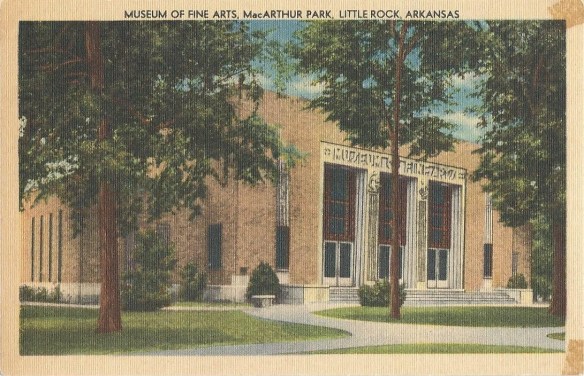
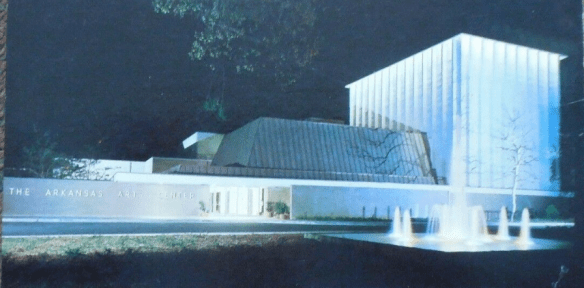
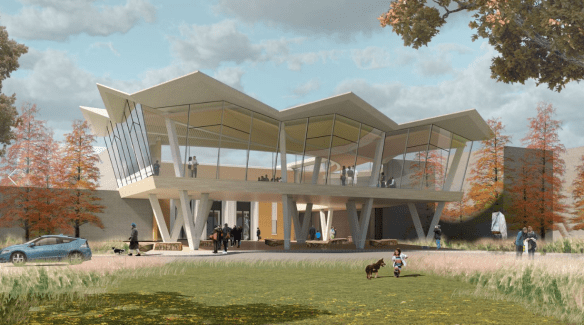
In keeping with that, today features images of the original 1937 Museum of Fine Arts, the 1963 version of the Arkansas Arts Center (the successor to the previous museum), the 2000 edition of the AAC, and the 2022 future look of the building.

The first building faced north onto 9th street.

The second building shifted the focus of the building. It faced south into MacArthur Park with the original entrance now being covered and part of the back of the building.

By 2000, the entrance had shifted to the west facing Commerce Street (though the 1963 entrance remained as a convenient entry for the Children’s Theatre and Museum School.

Finally, in 2022, the main entrance will return to the newly uncovered 1937 facade on the north.  It will be situated inside a courtyard framed by the new two story cultural living room at the historic crescent drive inside MacArthur Park. Standing in the center of the courtyard, in front of the historic facade will be Henry Moore’s Standing Figure Knife Edge (Large).  Studio Gang is the lead architect for this project with SCAPE serving as landscape architect.  Polk Stanley Wilcox is the associate architect.

The Arkansas Arts Center was formally established on Sept 6, 1960

Architectural model of the original Arkansas Arts Center which would open in 1963.

On Tuesday, September 6, 1960, the City of Little Rock Board of Directors adopted ordinance 11,111 which formally established the Arkansas Arts Center.

In July 1957, the City Council of Little Rock granted the Museum of Fine Arts the authority to solicit and receive funds for expanding that museum’s physical plant.  During that process, it had been decided that the museum needed an expanded mission and a new name.  By the summer of 1960, the museum supporters had raised sufficient funds to proceed with constructing the new facility.  Therefor the new ordinance was prepared and submitted to the City Board.  (In November 1957, the City Council had been replaced by a City Board.)

Ordinance 11,111 set forth that the Museum of Fine Arts would be known as the Arkansas Arts Center and that the previous museum’s board would serve as the board for the new museum.  The Board of the Arkansas Arts Center was given the authority to have the new building constructed in MacArthur Park and the existing building modified.  As a part of the planning for the new museum, the City committed $75,000 for the capital campaign.

The groundbreaking for the new museum would take place in August 1961.  Mayor Werner Knoop, who signed Ordinance 11,111, took part in the groundbreaking.

Media attending the September 6, 1960, City Board meeting were more interested in discussion about a potential leash law for dogs within the City limits.

201 years of the Quapaw Line

Stones placed in Riverfront Park denote where there Quapaw Line started from La Petite Roche

On August 24, 1818, the Quapaw Line was drawn.  Starting at La Petite Roche and heading due south, this line formed the boundary between the Quapaw tribal lands and public lands available for settlement.  (In the 1810s and 1820s, the Quapaw alternated between Central Arkansas and Northwest Louisiana depending on preferences of the tribal leadership.)

Though by 1824, the Quapaw were forced by the federal government to give up all of their lands in the area, the line continued serve as an important marker.   In the ensuing six years, the first permanent settlement of Little Rock took place and streets were planned.

The 1818 treaty referred to La Petite Roche as the Little Rock.  Some have speculated that this is the first official use of “Little Rock” to designate the outcropping and to name the area.  When the U.S. Post Office was established in March 1820, it was given the name Little Rock.

There is a marker commemorating the beginning of the Quapaw Line located at La Petite Roche in Riverfront Park.  The first segment of the line is also noted in the park.  There are also sunken markers place along the line at various points.  In MacArthur Park, at the corner of 9th and Commerce Streets, there is a marker noting that the line passed through at that location.  A few years ago, engineers from Garver retraced the line using modern technology. They found the original surveyors’ work to be extremely accurate.

A good account of walking the Quapaw Line through downtown Little Rock can be found on this website.

Most of what is now called the Quapaw Quarter was located to the west of the Quapaw Line.  However, it did take its name from the fact that the tribe had once lived in that area and was later sequestered to lands near it.  The name for the area was chosen by a committee composed of David D. Terry, Peg Newton Smith, Mrs. Walter Riddick Sr., Dr. John L. Ferguson, and James Hatcher. They had been appointed to a Significant Structures Technical Advisory Committee to advocate for preservation of important structures as a component of the City of Little Rock’s urban renewal efforts.

Farewell Party at the Arkansas Arts Center today

No photo description available.

The Arkansas Arts Center is celebrating the end of an era!

After 56 years, it is time to say goodbye to the current MacArthur Park space with a party that takes over the whole building.

They have filled the galleries with a carnival of activities – karaoke, giant yard games, a beach party, photo booth, and inflatable fun zone. Don’t miss music, dancing, food, drinks and much more!

Join the AAC for family-focused fun and activities for all ages from 2–5 p.m. Starting at 5 p.m., the Farewell Festival will be 21+.

The Farewell Festival is free for Arkansas Arts Center members, with special perks available for members of ’22&You.

Membership Card Required for Entry

PS – Stay tuned for announcements of upcoming events! Just because the facility in MacArthur Park will be closed for reconstruction does not mean the AAC is ceasing having events.