
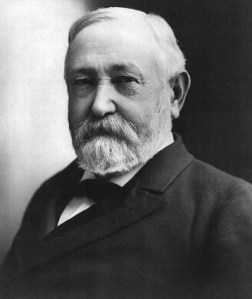
Benjamin Harrison becomes first sitting president to visit Little Rock

On April 17, 1891, Benjamin Harrison became the first sitting president to visit Arkansas.  He was on a cross-country railroad trip having left DC on April 13.

The morning of the 17th he spoke in Memphis and then took the train to Little Rock.  Accompanying him from Memphis to Little Rock were a delegation which included Governor and Mrs. James P. Eagle, Mayor H. L. Fletcher and Col. Logan H. Roots.  Also in the party was Mrs. W. G. Whipple, a former first lady of Little Rock.

They arrived in Little Rock in the afternoon.  A parade took them from the train station to the State House (now the Old State House Museum) where the Governor formally welcomed the President and his party.

In his brief remarks, President Harrison spoke of the hospitality and the natural resources available in Arkansas.  He also touched on the Civil War, which at the time was less than 30 years in the past. He noted “The commonwealth rests upon the free suffrage of its citizens and their devotion to the Constitution and the flag is the bulwark of its life.  We have agreed, I am sure, that we will do no more fighting among ourselves.” These remarks were met enthusiastically by the crowd assembled.

The President concluded is brief remarks thanking the State officials and the citizenry.  He then took the train to Texarkana where he made his third set of remarks of the day.

Benjamin Harrison was on the Presidential ticket two times. The first time he lost the popular vote but won the Electoral College defeating incumbent Grover Cleveland. The second time he lost both the popular and electoral votes to Cleveland.  He did not carry Arkansas in either election. Though he was the first sitting president to visit Little Rock, there is nothing here named for him.  Since there was already a Harrison Street named after his grandfather, he is skipped between Cleveland and McKinley in the presidential streets.

Little Rock Look Back: Brooks-Baxter War Starts

Brooks BaxterOn April 15, 1874, Joseph Brooks, accompanied by armed men, including the Pulaski County Sheriff, went into the office of Governor Elisha Baxter demanding he vacate the office.  Alone, save a young son, Governor Baxter departed the Arkansas State Capitol (now the Old State House), and met up with a group of supporters to plan their response.

Thus, the Brooks-Baxter War in Arkansas had begun.

Brooks had faced off against Baxter in the 1872 gubernatorial election.  Both were Republicans, but represented different factions of the party.  Brooks led the Brindletails, which were more aligned with efforts to gradually re-enfranchise former Confederates as well as have a smaller government with limited gubernatorial powers.  Baxter led the Minstrels.  This group was focused on retaining power and control of state government by limiting re-enfranchisement of former Confederates.

Many historians believe that Brooks may have actually won the election, but Baxter’s faction’s control of the state machinery resulted in him being declared the winner.  Brooks’ appeal to the Arkansas General Assembly was unsuccessful.  He took it to the state courts, which was likewise going nowhere.  EXCEPT….

Baxter had changed course on his views toward Democrats and members of his own party. This resulted in him losing support of many Republicans.  He also fought with fellow Republicans regarding a railroad issue.  This led to a meeting of many leading Republicans including Arkansas’ two US Senators.  Not long after that, Pulaski County Circuit Judge John Whytock heard Brooks’ case.  On April 15, 1874, Judge Whytock ruled in favor of Brooks.

Following his ouster from the governor’s office, Baxter telegraphed President Grant, asking for assistance.  In the meantime, both sides recruited supporters.  Baxter and 200 men set up headquarters in the Anthony House, which was near the State Capitol.  Brooks and his supporters used furniture to barricade the capitol building.  Robert Catterson, a former Little Rock mayor, set up artillery pieces on the capitol lawn to defend Brooks.

For the next month, there would be many rumors and skirmishes.  Little Rock, like the rest of the state, was divided. And the conflict was just beginning.

LR Women Making History – Louise Loughborough

Louise Loughborough was the first woman to serve on the Little Rock Planning Commission.  Not only was the she first woman to serve on this body, she was the first to serve on any City commission other than the Board of Censors or Library Board.  Born Louisa Watkins Wright in Little Rock 1881, her ancestors included many early Arkansas leaders including Little Rock Mayor David Fulton.

In 1935, Loughborough was appointed to the Little Rock Planning Commission, and it was in this role that she first heard about the plan to condemn the half-block of houses that she had grown up admiring on Cumberland and East Third streets. Although the neighborhood had fallen on hard times, becoming a red-light district and slum, Loughborough feared the loss of several historic structures, including the Hinderliter House, the oldest building in Little Rock and thought to be Arkansas’s last territorial capitol. She mobilized a group of civic leaders to save these buildings. She enlisted the aid of prominent architect Max Mayer and coined the term “town of three capitols” to try to capture the imagination of potential supporters, grouping the “Territorial Capitol” with the Old State House and the State Capitol.

The Arkansas Territorial Restoration opened on July 19, 1941. The project was the first Arkansas agency committed to both the restoration of structures and the interpretation of their history, and it served as a model and inspiration for historic preservation in the state. Around the same time, she was a moving force behind the creation of a museum at the Old State House as well.  Today both Historic Arkansas Museum (as the Territorial Restoration is now known) and the Old State House Museum are agencies of the Department of Arkansas Heritage.

As founding Chairman of the Arkansas Territorial Restoration Commission, Louise Loughborough provided daily direction for the museum house complex through the first twenty years of its existence. She died in Little Rock on December 10, 1962 and was buried at Mount Holly Cemetery.

LR Women Making History – Mary Fletcher Worthen

Mary Fletcher Worthen cultivated history and music with the same grace and skill as she cultivated gardens.
Born outside of Scott, she attended Vassar and Little Rock Junior College. After marrying banker Booker Worthen, she has devoted her life to improving Little Rock. Together with Stella Boyle and George Smith, she and Booker helped found the precursor to the Arkansas Symphony Orchestra.  Through its many iterations, she has been a steadfast supporter and is now a life member of the ASO Board.  She has also been a supporter of many other music organizations in Little Rock including the Chamber Music Society of Little Rock, of which she was a founder.

Another hallmark of her involvement is Mount Holly Cemetery Association.  For over 50 years she has served on the board of this body.  Without notes, she can recite the history of practically every resident buried there.  The tours she would lead with Peg Newton Smith were hot commodities when auctioned at fundraisers.  These two loving and lifelong friends would sometimes remember things differently. They playfully prodded and needled each other as they wended and winded their way through the headstones and history regaling rapt audiences with yarns of yore, quips and quotes, plus an anecdote or two.

She has also served on the Old State House Museum Board and the Pulaski County Historical Society Board.  As a historian, she literally wrote the book on Trinity Episcopal Cathedral.  She combined her interest in herb gardening and history with the creation of the Medicinal Garden at Historic Arkansas Museum, which is now named in her honor.

Born in 1917, up until her final days in 2015 Mary Worthen continued to learn new facts, share her love of history and music, and work to cultivate the next generations of cultural enthusiasts.

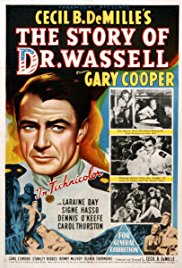
Rock the Oscars: THE STORY OF DR. WASSELL

Dr WassellFrom April 24 to 26, 1944, future Oscar winner Cecil B. DeMille was in Little Rock for the world premiere screening of The Story of Dr. Wassell.  This 1944 Paramount Pictures Technicolor release told the story of wartime hero Dr. Corydon Wassell.  It would be nominated for the Oscar for Best Special Effects.

Why was Little Rock chosen?  It was the hometown of Dr. Wassell.  His paternal grandfather, John Wassell, was Little Rock’s 27th mayor.  His first cousin, Sam Wassell, was serving on the City Council at the time of the film’s release and would become Little Rock’s 51st mayor.

Based on a book by James Hilton, it was inspired by the heroic efforts of Dr. Wassell, a naval officer, as he led the evacuation of several sailors (and treated their wounds) in Java in February 1942.  President Roosevelt highlighted Dr. Wassell in his May 26, 1942, fireside chat.

Little Rock rolled out the red carpet (literally and figuratively) for DeMille and a contingency from Hollywood.  Dr. and Mrs. Wassell also returned to Little Rock for the festivities.  Unfortunately, Gary Cooper (who played Wassell in the film) was unable to attend due to illness.  His costar, Laraine Day, was making another film and could not attend either.    Those in attendance with DeMille (and Mrs. DeMille) included actresses Signe Hasso and Carol Thurston, and actor Melvin Francis.  The latter played himself; he had actually been one of the sailors saved by Dr. Wassell.

On April 24, 1944, DeMille and Dr. Wassell appeared on a radio program broadcast live from the music hall of Robinson Auditorium.  The next day, the troupe toured Camp Robinson and spoke to the soldiers there.  Later that day, Miss Hasso and Miss Thurston sold war bonds at Pfeiffers and M.M. Cohn’s.

April 26, 1944, was a full day for the DeMilles, the Wassells, and the others.  It started with a luncheon at the Hotel Marion, hosted by the Lions Club and Little Rock Chamber of Commerce.  Governor Homer Adkins presented DeMille with an Arkansas Traveler certificate.  DeMille, in return, presented Governor Adkins with a copy of the script.

When it was Dr. Wassell’s time to speak, he praised Little Rock’s efforts on the home front.  He also asked for a standing tribute to longtime Little Rock school superintendent R.C. Hall, who had died the day before.  Dr. Wassell had taught with Mr. Hall decades earlier.

Following the lunch, there was a parade on Main Street.  It started at 10th and Main and proceeded to Markham before ending at the War Memorial Building (now the Old State House Museum).  Newspaper accounts said that it was four miles long and featured many military units and marching bands.

Dinner that evening was at the Lafayette Hotel before screenings of the movie at the Capitol and Arkansas Theatres. Both screenings were sold out.  On April 27, 1944, a regular run of the movie started at the Capitol Theatre.  It would be released nationally on July 4, 1944, which also happened to be Dr. Wassell’s birthday.

Little Rock Look Back: Clinton Center opens in 2004

wjc library openingIt has been thirteen years since the Clinton Presidential Center opened on a wet, cold Thursday.

The days leading up to it has been glorious.  And while the weather may have literally dampened spirits a bit, it was still an important day for Little Rock and Arkansas.

The events leading up to the opening included a concert by Aretha Franklin with the Arkansas Symphony Orchestra and an appearance by Senator John Glenn at the Museum of Discovery.  Events were hosted by the Arkansas Arts Center, Arkansas Repertory Theatre, Historic Arkansas Museum, and Old State House Museum.  There were scores of receptions and parties as Hollywood, New York, and DC descended on Little Rock.

November 18 dawned rainy and cool.  As the day continued on the precipitation continued while the temperature did not warm up.  Years of planning for a grand opening ceremony came down to this.  But at the appointed time, festivities began.

On the site of an abandoned warehouse district and unofficial dump which had previously been a train station, many leaders of the free world were gathered.  They rubbed shoulders with thousands of Arkansans from probably every county in the state.

It had been seven years and eleven days since Bill Clinton had announced the site of his presidential library.  It had been five years since artifacts and articles started arriving from Washington DC in Little Rock.  There had been lawsuits, threats of lawsuits, the threat of a Counter-Clinton Library, and countless meetings.

After speeches from Presidents Carter, Bush 41 and Bush 43, remarks from President Clinton and then-Senator Clinton (who was made even wetter by water pouring off an ill-placed umbrella), and even a musical performance by Bono and The Edge, Chelsea Clinton turned over the ceremonial key from the Clinton Foundation to the National Archives to officially open the Clinton Presidential Center.

In his capacity leading the Clinton Foundation, Skip Rutherford oversaw the planning for the Clinton Library and the grand opening festivities.  He, along with the foundation’s Executive Director Stephanie Streett, oversaw a phalanx of volunteers and staff to anticipate every detail.  The 1,000 days countdown sign that had been on the construction site (the brainchild of Tyler Denton) finally reached 0.

Isabelle Rodriguez, Shannon Butler, Mariah Hatta, Jordan Johnson, Lucas Hargraves, and Ben Beaumont — among others — had been putting in twelve plus hour days for months on end to get ready for the opening.  City Manager Bruce T. Moore led a team of City officials who had assisted on the planning and execution of the site preparation and making sure Little Rock was ready to welcome the world.  Moore and City Director Dean Kumpuris had been appointed by Little Rock Mayor Jim Dailey to lead Little Rock’s efforts to land the library.  After Clinton’s announcement of the site, Dailey, Kumpuris and Moore continued to work together to ensure the library would be successful.

While the weather on November 18, 2004, may have been a disappointment, the people who were gathered knew they were witnesses to history.  And thirteen years later, is a day people still talk about.

Little Rock Look Back: Hollywood in Little Rock

All right Mr. DeMille, Little Rock was ready for its close up.

From April 24 to 26, 1944, Cecil B. DeMille was in Little Rock for the world premiere screening of The Story of Dr. Wassell.  This 1944 Paramount Pictures Technicolor release told the story of wartime hero Dr. Corydon Wassell.

Why was Little Rock chosen?  It was the hometown of Dr. Wassell.  His paternal grandfather, John Wassell, was Little Rock’s 27th mayor.  His first cousin, Sam Wassell, was serving on the City Council at the time of the film’s release and would become Little Rock’s 51st mayor.

Based on a book by James Hilton, it was inspired by the heroic efforts of Dr. Wassell, a naval officer, as he led the evacuation of several sailors (and treated their wounds) in Java in February 1942.  President Roosevelt highlighted Dr. Wassell in his May 26, 1942, fireside chat.

Little Rock rolled out the red carpet (literally and figuratively) for DeMille and a contingency from Hollywood.  Dr. and Mrs. Wassell also returned to Little Rock for the festivities.  Unfortunately, Gary Cooper (who played Wassell in the film) was unable to attend due to illness.  His costar, Laraine Day, was making another film and could not attend either.    Those in attendance with DeMille (and Mrs. DeMille) included actresses Signe Hasso and Carol Thurston, and actor Melvin Francis.  The latter played himself; he had actually been one of the sailors saved by Dr. Wassell.

On April 24, 1944, DeMille and Dr. Wassell appeared on a radio program broadcast live from the music hall of Robinson Auditorium.  The next day, the troupe toured Camp Robinson and spoke to the soldiers there.  Later that day, Miss Hasso and Miss Thurston sold war bonds at Pfeiffers and M.M. Cohn’s.

April 26, 1944, was a full day for the DeMilles, the Wassells, and the others.  It started with a luncheon at the Hotel Marion, hosted by the Lions Club and Little Rock Chamber of Commerce.  Governor Homer Adkins presented DeMille with an Arkansas Traveler certificate.  DeMille, in return, presented Governor Adkins with a copy of the script.

When it was Dr. Wassell’s time to speak, he praised Little Rock’s efforts on the home front.  He also asked for a standing tribute to longtime Little Rock school superintendent R.C. Hall, who had died the day before.  Dr. Wassell had taught with Mr. Hall decades earlier.

Following the lunch, there was a parade on Main Street.  It started at 10th and Main and proceeded to Markham before ending at the War Memorial Building (now the Old State House Museum).  Newspaper accounts said that it was four miles long and featured many military units and marching bands.

Dinner that evening was at the Lafayette Hotel before screenings of the movie at the Capitol and Arkansas Theatres. Both screenings were sold out.  On April 27, 1944, a regular run of the movie started at the Capitol Theatre.  It would be released nationally on July 4, 1944, which also happened to be Dr. Wassell’s birthday.