Black History Month – Florence Price and Robinson Center

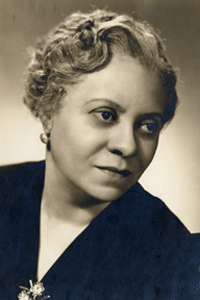
Florence-PriceOutside the William Grant Still Ballroom at Robinson Center is an atrium named for Florence Price.  It is fitting that these two childhood friends should be memorialized in adjoining spaces.

Florence Price was the first African-American female composer to have a symphonic composition performed by a major American symphony orchestra. She was born in Little Rock on April 9, 1887, to James H. Smith and Florence Gulliver Smith. Her father was a dentist in Little Rock, while her mother taught piano and worked as a schoolteacher and a businesswoman.

As a child, Smith received musical instruction from her mother, and she published musical pieces while in high school. She attended Capitol Hill School in Little Rock, graduating as valedictorian in 1903. Smith then studied at the New England Conservatory of Music in Boston, Massachusetts, In 1907, she received degrees as an organist and as a piano teacher.

After graduation, Smith returned to Arkansas to teach music. After stints in Cotton Plant, North Little Rock and Atlanta, GA, Smith returned to Little Rock in 1912 to marry attorney Thomas Jewell Price on September 25, 1912. Her husband worked with Scipio Jones.

While in Little Rock, Price established a music studio, taught piano lessons, and wrote short pieces for piano. Despite her credentials, she was denied membership into the Arkansas State Music Teachers Association because of her race.

The Prices moved to Chicago, Illinois, in 1927. There, Price seemed to have more professional opportunity for growth despite the breakdown and eventual dissolution of her marriage. She pursued further musical studies at the American Conservatory of Music and Chicago Musical College and established herself in the Chicago area as a teacher, pianist, and organist. In 1928, G. Schirmer, a major publishing firm, accepted for publication Price’s “At the Cotton Gin.” In 1932, Price won multiple awards in competitions sponsored by the Rodman Wanamaker Foundation for her Piano Sonata in E Minor, a large-scale work in four movements, and her more important work, Symphony in E Minor.

The latter work premiered with the Chicago Symphony Orchestra on June 15, 1933, and the orchestras of Detroit, Michigan; Pittsburgh, Pennsylvania; and Brooklyn, New York, performed subsequent symphonic works by Price. This was the first time a black woman had presented her work on such a stage. In this regard,

Price’s art songs and spiritual arrangements were frequently performed by well-known artists of the day. For example, contralto Marian Anderson featured Price’s spiritual arrangement “My Soul’s Been Anchored in the Lord” in her famous performance on the steps of the Lincoln Memorial in Washington DC on Easter Sunday, April 9, 1939. European orchestras later played Price’s works.

This national and international recognition made her more popular back home, and in 1935, the Alumni Association of Philander Smith College in Little Rock sponsored Price’s return to Arkansas, billing her as “noted musician of Chicago” and presenting her in a concert of her own compositions at Dunbar High School.

In her lifetime, Price composed more than 300 works, ranging from small teaching pieces for piano to large-scale compositions such as symphonies and concertos, as well as instrumental chamber music, vocal compositions, and music for radio. Price died in Chicago on June 3, 1953, while planning a trip to Europe.

RobinsoNovember: Florence Price

Florence-PriceOutside the William Grant Still Ballroom at Robinson Center is an atrium named for Florence Price.  It is fitting that these two childhood friends should be memorialized in adjoining spaces.

Florence Price was the first African-American female composer to have a symphonic composition performed by a major American symphony orchestra. She was born in Little Rock on April 9, 1887, to James H. Smith and Florence Gulliver Smith. Her father was a dentist in Little Rock, while her mother taught piano and worked as a schoolteacher and a businesswoman.

As a child, Smith received musical instruction from her mother, and she published musical pieces while in high school. She attended Capitol Hill School in Little Rock, graduating as valedictorian in 1903. Smith then studied at the New England Conservatory of Music in Boston, Massachusetts, In 1907, she received degrees as an organist and as a piano teacher.

After graduation, Smith returned to Arkansas to teach music. After stints in Cotton Plant, North Little Rock and Atlanta, GA, Smith returned to Little Rock in 1912 to marry attorney Thomas Jewell Price on September 25, 1912. Her husband worked with Scipio Jones.

While in Little Rock, Price established a music studio, taught piano lessons, and wrote short pieces for piano. Despite her credentials, she was denied membership into the Arkansas State Music Teachers Association because of her race.

The Prices moved to Chicago, Illinois, in 1927. There, Price seemed to have more professional opportunity for growth despite the breakdown and eventual dissolution of her marriage. She pursued further musical studies at the American Conservatory of Music and Chicago Musical College and established herself in the Chicago area as a teacher, pianist, and organist. In 1928, G. Schirmer, a major publishing firm, accepted for publication Price’s “At the Cotton Gin.” In 1932, Price won multiple awards in competitions sponsored by the Rodman Wanamaker Foundation for her Piano Sonata in E Minor, a large-scale work in four movements, and her more important work, Symphony in E Minor.

The latter work premiered with the Chicago Symphony Orchestra on June 15, 1933, and the orchestras of Detroit, Michigan; Pittsburgh, Pennsylvania; and Brooklyn, New York, performed subsequent symphonic works by Price. This was the first time a black woman had presented her work on such a stage. In this regard,

Price’s art songs and spiritual arrangements were frequently performed by well-known artists of the day. For example, contralto Marian Anderson featured Price’s spiritual arrangement “My Soul’s Been Anchored in the Lord” in her famous performance on the steps of the Lincoln Memorial in Washington DC on Easter Sunday, April 9, 1939. European orchestras later played Price’s works.

This national and international recognition made her more popular back home, and in 1935, the Alumni Association of Philander Smith College in Little Rock sponsored Price’s return to Arkansas, billing her as “noted musician of Chicago” and presenting her in a concert of her own compositions at Dunbar High School.

In her lifetime, Price composed more than 300 works, ranging from small teaching pieces for piano to large-scale compositions such as symphonies and concertos, as well as instrumental chamber music, vocal compositions, and music for radio. Price died in Chicago on June 3, 1953, while planning a trip to Europe.

RobinsoNovember: Lawrence Hamilton

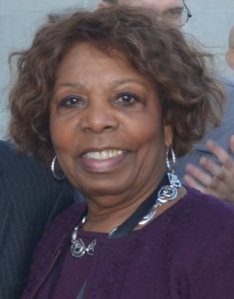
LawrenceHamiltonAnother notable former Little Rock performing artist who is memorialized at Robinson Center is Lawrence Hamilton.

The son of the Dr. Oscar and Mae Dell Hamilton, he was born in the small southwest Arkansas town of Foreman With an interest in music stemming from childhood, Hamilton earned a music scholarship to attend Henderson State University in Arkadelphia where he studied piano and voice He graduated in 1976 with a bachelor’s degree in music education.

From Arkansas, Hamilton traveled to Florida to work as a performer at Walt Disney World in Orlando, Florida where he would meet talent manager, Tommy Molinaro. This fateful meeting would prove to be a life-changing encounter, as Molinaro would invite Hamilton to come to New York to audition for the famed actor/director Geoffrey Holder. This marked the beginning of Hamilton’s bold and creative career in the performing arts, leading to performances on Broadway and on tours in Sophisticated Ladies, The Wiz,Uptown – Its Hot, Porgy and Bess, Big River, Play On!, and Jelly’s Last Jam among others. Perhaps his crowning achievement was starring in Ragtime.

Hamilton has been a member of the Southern Ballet Theater, Brooklyn Dance Theater, Ballet Tap USA, and the Arkansas Opera Theater He has performed in concert with the legendary Lena Horne at the White House for President and Mrs. Ronald Reagan, and at the Vatican for Pope John Paul II. Hamilton’s career also led to a stint as musical director for the renowned opera legend Jessye Norman, as well as vocal coach/arranger for the pop group New Kids on the Block

Upon his return to Arkansas, Hamilton served for several years as director of choral music at Philander Smith College. He also appeared in several plays at the Arkansas Repertory Theatre.  In addition, he performed at countless concerts, benefits and galas throughout Arkansas.  In 2003, he was inducted into the Arkansas Black Hall of Fame.  In 2008, he was appointed to the Little Rock Mayor’s Task Force on Tourism.

Hamilton died in New York in April 2014 due to complications from surgery.  Just weeks prior to the surgery, he had appeared in August Wilson’s The Piano Lesson in Cape Fear, North Carolina.  He had also starred in that play at Arkansas Rep a few years earlier.

Little Rock Look Back: Lottie Shackelford

Lottie at Civil RightsWhile this headline may say “Little Rock Look Back,” Lottie Shackelford is still very much focused on the present and the future!

On April 30, 1941, future Little Rock Mayor Lottie Shackelford was born. Throughout her career in public service she has been a trailblazer.

Active in community activities and politics, she ran for the City Board in 1974 and lost.  But she was appointed to the Little Rock City Board in September 1978 to fill a vacancy.  This made her the first African American woman to serve on he City Board, and indeed on any governing board for the City (during Reconstruction, there were at least three African Americans on the City Council, but they were all men.) She was subsequently elected to a full-term on the City Board in 1980 winning 55% of the vote over three male candidates.

She was subsequently re-elected in 1984 (unopposed) and in 1988 (with 60% of the vote).

In January 1987, Shackelford became the first female mayor of Little Rock when she was chosen by her colleagues on the City Board to serve in that position. She was Mayor until December 1988.

From 1982 until 1992, she served as Executive Director of the Arkansas Regional Minority Purchasing Council.  She left that position to serve as Deputy Campaign Manager of Clinton for President.  She subsequently served on the Clinton/Gore transition team. She later served on the Overseas Private Investment Corporation from 1993 to 2003. She was the first African American to be in that position.

A graduate of Philander Smith College, she has also studied at the Arkansas Institute of Politics at Hendrix College and the Kennedy School of Government at Harvard University.

Mayor Shackelford has also served on numerous boards including the Little Rock Airport Commission, Philander Smith College, Chapman Funds (Maryland) and Medicis Pharmaceutical Corporation (Arizona).  She has been the longest serving Vice-Chair of the Democratic National Committee.

Mayor Shackelford was in the first class of inductees for the Arkansas Black Hall of Fame.  In 2015, she was inducted into the Arkansas Civil Rights Heritage Trail.

Little Rock Look Back: St. Patrick’s Day with Mayor Pat L. Robinson

IMG_4517On this date in 1900, future Little Rock Mayor Pat L. Robinson was born.  While I cannot verify that he was indeed named after St. Patrick, it would be fairly reasonable to assume there might be a connection.

Robinson was a rising star of Little Rock Democratic politics.  In April 1929, just weeks after his 29th birthday, he was elected Mayor.  He had twice been elected as City Attorney (1926 and 1928) and was one of the youngest to serve in that position.

During Mayor Robinson’s tenure, he announced plans to construct a new airport.  That project led to the creation of what is now the Bill and Hillary Clinton National Airport.  Mayor Robinson was also involved in helping Philander Smith College secure the property where it is now located.  In addition, during his tenure, what is now the Museum of Discovery was folded into the City of Little Rock.  Shortly after taking office, he championed several projects for approval by Little Rock voters. The projects he supported were approved; the ones he did not support did not pass.

Single at the time he was in office and generally considered good looking, Mayor Robinson was sometimes referred to as the “Jimmy Walker of the Southwest.” Walker was the handsome and charming Mayor of New York City at the time.

Mayor Robinson ran afoul of some of the Democratic party leaders. Records don’t seem to indicate exactly what actions he took or did not take.  One thing that is brought up is that the City went into financial distress during his tenure.  Considering the Wall Street crash happened shortly after he took office, that financial state was not unique to Little Rock.

IMG_4532During this era in Little Rock, it was customary for an incumbent mayor to be given a second term. But City Clerk Horace Knowlton challenged Robinson in the primary.  It was a bitter campaign with Robinson linking Knowlton to disreputable denizens and Knowlton charging Robinson with “an orgy of spending.”  Robinson initially came out 17 votes ahead. But after a review and a lawsuit, it was found that Knowlton ended up with 10 more votes and became the nominee.  At the time, being the Democratic nominee was tantamount to election.

After he left office, Robinson practiced law for a few years in Little Rock and then left the city.  Records do not indicate where he went but he no longer appeared in the City of Little Rock directory by the early 1940s.  In the 1940 census he is listed as divorced and a lodger living with a couple.

Black History Month Spotlight – Arkansas State Capitol

Arkansas birthdayThe new Arkansas Civil Rights History Audio Tour was launched in November 2015. Produced by the City of Little Rock and the University of Arkansas at Little Rock allows the many places and stories of the City’s Civil Rights history to come to life an interactive tour.  This month, during Black History Month, the Culture Vulture looks at some of the stops on this tour which focus on African American history.

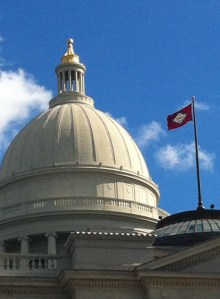
The Arkansas state capitol has been the site of a number of civil rights events over the years. In 1964, Ozell Sutton, a local African American leader, was denied service at the capitol’s basement cafeteria because of his race. The cafeteria then reincorporated as a private members-only club to avoid integration. A number of conflicts occurred when local black students from Philander Smith College and an interracial group of Arkansas Student Nonviolent Coordinating Committee members tried, on several occasions, to desegregate the cafeteria. In 1965, the courts finally ordered the cafeteria to open its doors to blacks and whites on an equal basis.

In 1968, after the assassination of Martin Luther King, Jr., Arkansas governor Winthrop Rockefeller held a memorial service on the capitol steps for the slain civil rights leader—the only southern governor to make such a gesture of reconciliation. His actions are credited with limiting the impact of the violence that rocked other cities in the wake of the King assassination. In 2005, John and Cathy Deering’s “Testament” bronze sculpture of the Little Rock Nine was dedicated on the north side of the building. It was the first civil rights monument erected on the grounds of a southern state capitol.

The app, funded by a generous grant from the Arkansas Humanities Council, was a collaboration among UALR’s Institute on Race and Ethnicity, the City of Little Rock, the Mayor’s Tourism Commission, and KUAR, UALR’s public radio station, with assistance from the Little Rock Convention and Visitors Bureau.

Black History Spotlight – Dunbar Historic Neighborhood

DunbarNeighborhoodThe new Arkansas Civil Rights History Audio Tour was launched in November 2015. Produced by the City of Little Rock and the University of Arkansas at Little Rock allows the many places and stories of the City’s Civil Rights history to come to life an interactive tour.  This month, during Black History Month, the Culture Vulture looks at some of the stops on this tour which focus on African American history.

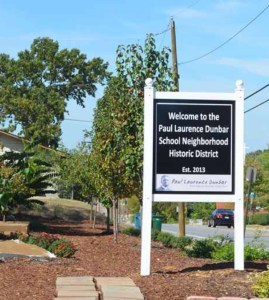
The Paul Laurence Dunbar School Historic District played an important role as the center of Little Rock’s African American community from the mid-1800s to the mid-1900s.  Development began around Wesley Chapel, organized in 1853.

The neighborhood expanded after the Civil War to become home to many African Americans noted for their success in a number of fields, including business, politics, religion, education, law, music, and medicine. Among the historically black institutions that were founded in the neighborhood and remain there today are several churches, including Wesley Chapel United Methodist, Bethel A.M.E., Mount Pleasant Baptist, Mount Zion Baptist, and Union A.M.E.; and two colleges, Arkansas Baptist and Philander Smith.

The existing Dunbar School replaced an older high school that was named for Mifflin Gibbs, a prominent African American lawyer and political leader who lived in the neighborhood.  Today, Gibbs Elementary School continues the recognition of Gibbs.

The app, funded by a generous grant from the Arkansas Humanities Council, was a collaboration among UALR’s Institute on Race and Ethnicity, the City of Little Rock, the Mayor’s Tourism Commission, and KUAR, UALR’s public radio station, with assistance from the Little Rock Convention and Visitors Bureau.