Arkansas Heritage Month – The architecture of AIA/ALA award winning CALS libraries by Polk Stanley Wilcox

To encourage excellence in the architectural design and planning of libraries, the AIA and the American Library Association/Library Administration and Management Association created this award to distinguish accomplishments in library architecture.  In 2011 and again in 2015, Polk Stanley Wilcox won the award for projects designed for the Central Arkansas Library System.

AIA ALA PSW ASIThe 2011 award went to for work on the Arkansas Studies Institute.  This actually combines three buildings of three different centuries and construction types into one architectural timeline, evoking imagery of pages of an opening book.

The Arkansas Studies Institute is a repository for 10 million historic documents and the papers of seven Arkansas Governors, including President Bill Clinton. Located in a thriving entertainment district comprised of rejuvenated warehouses near the Arkansas River, the design combines significant, but neglected buildings from the 1880’s and 1910’s with a new technologically expressive archive addition. This creates a pedestrian focused, iconic gateway to the public library campus – and the public face of Arkansas history.

The design philosophy is based literally on the book – a physical container of information, with pages flowing into a site-sensitive narrative of the building’s function. Taking cues from the medium for which the Institute was created, the entrance acts as an abstract book cover, pulled away from the building as a double wall, defusing western sunlight and heat in the atrium beyond.

Public Spaces – galleries, a café, museum, and meeting rooms – enliven streetscape storefronts, while the great library research hall encompasses the entire second floor of the 1914 warehouse building. A thin atrium pulls the new structure away to protect the old, stretching the building’s length and flooding all levels with light – a key sustainable strategy. 100 historic images in glass handrails signify that architecture can and should actively engage in storytelling. Suspended bridges span the gap between new and old, open and secure, today and yesterday.

The Arkansas Studies Institute weaves history, research, pedestrians, and a restored streetscape together, healing a gaping wound in the urban fabric, while expanding environmental stewardship into the public realm and serving as a beacon of knowledge.

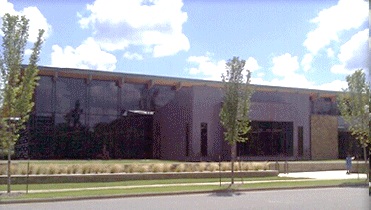
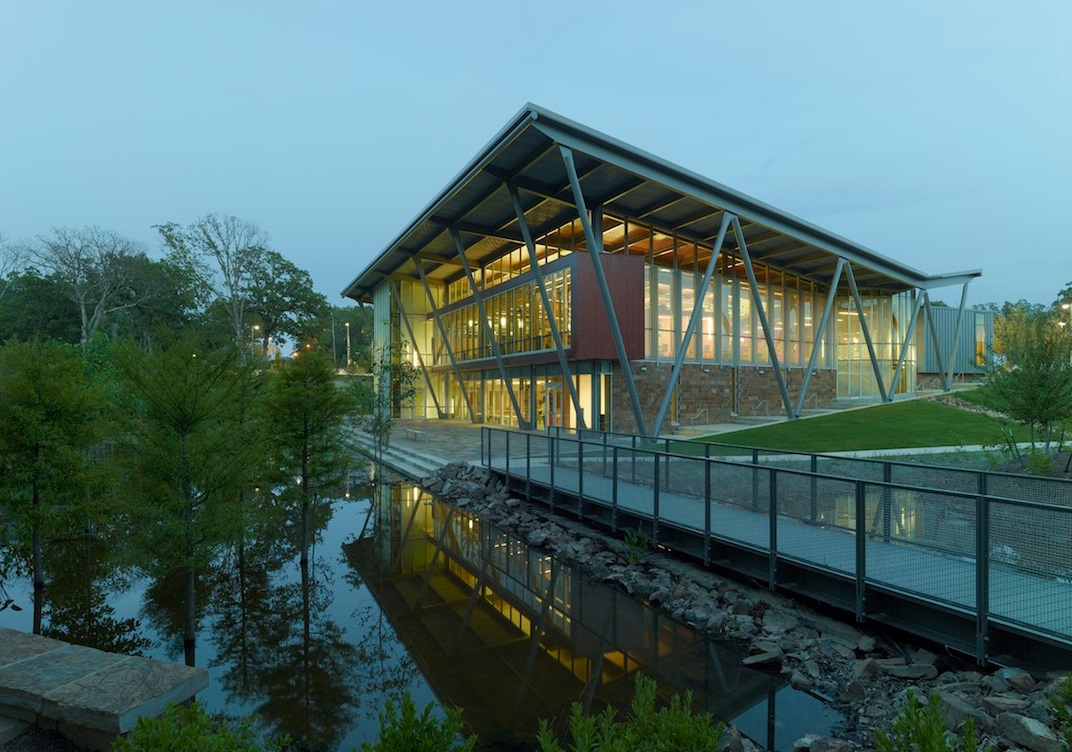
AIA ALA PSW HRCCLCIn 2015, the award went to PSW for their work on the Hillary Rodham Clinton Children’s Library and Learning Center.

Based on experiential learning where hands-on education teaches life skills needed to become responsible adults, a new Children’s Library and Learning Center boosts hopes for a neglected neighborhood, serves as an exemplary tale of urban renewal, and acts as a beacon of hope for an entire city.

This “community embedded, supportive learning center” offers not only books, but also a performance space, teaching kitchen, greenhouse, vegetable garden, and an arboretum. It is the state’s first library holistically imagined as a children’s education destination. The Library Director’s challenge was to create a “playground without equipment” where nature and imagination create grand adventures on an abandoned six acre site in the heart of the capital city. A charrette with youth uncovered a surprising and heartbreaking result: their top desire wasn’t for the latest video game technologies… it was food security. They wanted to learn how to feed themselves. Children also desired a place that was uplifting, inspirational and full of natural light, while in contrast feeling safe, secure, and sheltered. They wanted a place that “lifted expectations”.

An interstate highway—the railroad tracks of our generation—split Little Rock 40 years ago and destroyed a unified city grid, contributing to racial and socioeconomic divisions that separated citizens physically and emotionally. The site’s border condition became a national symbol for gang violence when featured in a 1990’s HBO documentary. Its opposite side, however, continued to be the city’s version of New York City’s Central Park—the place to live, work, and play. The design team’s overarching idea was centered on three moves: bridge the gap by stretching the park across the highway, create a library that is “the place to be” for all children, and develop civic pride in an underserved neighborhood, helping to mend partitions that have plagued the city for so long.

Landscape ecology and urban connectivity themes provide experiential education. Children see natural vegetation representing the state’s varied ecological regions from the Ozark Highlands to the Mississippi Delta. Two bus lines within a quarter mile assure access from distances, while the hundreds of children living within a half mile can walk or bike. An instructional greenhouse, gardens, and teaching kitchen allow children to cultivate, harvest, prepare meals, and sell produce in a planned farmer’s market. A full time ‘Environmental Educator’ oversees programs, teaching proper use of water, energy, and resources, and how we keep healthy through decisions made within the built environment. The lobby’s smart monitors can display real time water and energy consumption. Mechanical and structural systems are purposefully exposed so operations and construction methods can be discussed.

While this Library exceeded expectations by achieving LEED Gold, the true measure of success beyond points is the neighborhood’s feel, which shifted from dangerous to full of life and pride. The library is a safe zone and home to a sustainable-minded community.

New Rooftop Terrace planned for Robinson Center

RCMH EXT-01_Aerial1The Little Rock Convention & Visitors Bureau (LRCVB) is now booking events for the all-new Robinson Conference Center, set to reopen in November of this year.  Located on the north side of the building, the Grand Ballroom and adjoining meeting rooms offer magnificent views of the Arkansas River.  With seamless connectivity to the DoubleTree Hotel’s meeting space, the center offers flexibility for convention activities, meetings, and banquets.  For booking information, please call 501-255-3323.

Earlier this week, the Little Rock Advertising and Promotion Commission (LRA&P) also approved the addition of a 5,800 sq. ft. outdoor terrace.  The terrace was part of the original project plans, however, but it was removed from the plans in 2014 during contract negotiations due to budget constraints.  Now, less than eight months from completion, LRCVB and LR A&P are able to add the finished outdoor space back into the project.  The space will offer amazing views of the Arkansas River and sits on the highest level of the new conference center, and its addition will not impact the project’s completion date.

“We are so pleased with the progress of this complex project.  Our project team, including architects Polk Stanley Wilcox and Ennead, construction manager CDI/Hunt joint venture, owner’s representatives Mike Steelman of SCM architects, and a host of sub-contractors, have continued to provide meticulous attention to detail and countless effort to this project.  The all-new Robinson Center is going to be a show-piece for Little Rock and all of Central Arkansas,” said Gretchen Hall, President & CEO of LRCVB.

For more information on the Robinson Center Second Act renovation and expansion project, visit www.RobinsonCenterSecondAct.com and follow us on https://www.facebook.com/pages/Robinson-Center/276515585880 and https://twitter.com/RobinsonCenter.

Robinson Construction Facts to Date:

  • Over 10,878 tons of material have been recycled, representing 90% of the waste material diverted
  • 1,800 tons of steel has been erected
  • 3,000 cubic yards of concrete has been placed
  • 1,104 individuals have gone through CDI/Hunt Safety Orientation
  • 75% of the project subcontractors are local
  • 250,000 +/- man hours have been utilized to date

Robinson History

The historic Robinson Auditorium has long been a landmark in Central Arkansas.  Construction of the Joseph T. Robinson Memorial Auditorium began in 1937 and officially opened in February 1940.  The structure was a WPA (Works Progress Administration) project, and is an excellent example of the Art Deco style architecture of the time.  The building was added to the National Register of Historic Places in 2007.  The facility is owned by the City of Little Rock and managed by the Little Rock Convention & Visitors Bureau.

15 Highlights of 2015 – Polk Stanley Wilcox wins AIA/ALA Library Building Award for CALS Children’s Library

Childrens Library 2For the final fifteen days of 2015, a look back at some of the cultural highlights of 2015.
Up first –

Polk Stanley Wilcox Architects and the Central Arkansas Library System were honored with Library Architecture’s highest and most prestigious achievement: A 2015 AIA/ALA Library Building Award. 

Of all libraries submitted, the 2015 AIA/ALA Library Building Awards honor only six separate projects. The Hillary Rodham Clinton Children’s Library and Learning Center joins prestigious projects from as far away as Vancouver, Washington, Dartmouth, Mass., Norfolk, Virginia, San Antonio, Texas, and Des Moines, Iowa. The projects was honored at the National ALA Conference in San Francisco on June 25-30th.

To encourage excellence in the architectural design and planning of libraries, the National American Institute of Architects (AIA) in Washington DC and the American Library Association (ALA) created this award to distinguish accomplishments in library architecture. Biennially, representatives of each organization celebrate the finest examples of library design from around the world designed by American Architects.

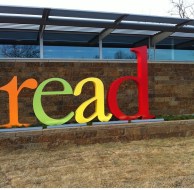
READThe new Children’s Library and Learning Center is based on experiential learning, where children are educated through hands on activities that teach life skills needed to become responsible adults. Referred to as a “community-embedded, supportive learning center,” this library offers not only books, but also a performance space, a teaching kitchen, a greenhouse and vegetable garden, and an arboretum.

The award is given every two years.  It is the second time that Polk Stanley Wilcox has received the award for a CALS project.  In 2011 the firm won it for the Arkansas Studies Institute building.  Not only is it rare for a firm to receive this award, it is even more rare for the same firm to receive it twice for working with the same client.  These honors are a testament to the leadership at both Polk Stanley Wilcox and the Central Arkansas Library System.

Creative Class of 2015: Reese Rowland

reeserArchitect Reese Rowland has literally changed the landscape of Little Rock.  He has designed some of Little Rock’s most recognized buildings, including Acxiom’s River Market Tower Headquarters, Bank of the Ozarks Headquarters, Heifer International’s Education Center, the Little Rock Regional Chamber of Commerce, the Arkansas Studies Institute and Hillary Rodham Clinton Children’s Library.

Reese has been rewarded with over 60 National, Regional and State Design Awards in the last twelve years. His Heifer International World Headquarters design received the Nation’s highest honor for architecture, the 2008 AIA National Institute Honor Award, one of 13 awarded. The South’s first LEED Platinum building was also named a National AIA/COTE Top 10 Green Building in 2007. In 2011, his Arkansas Studies Institute design received a National AIA/ALA (American Library Association) Award of Excellence, one of five awarded in the biennial competition, honoring the best in library architecture worldwide. In 2015, his Hillary Rodham Clinton Children’s Library won the same Award.

Arkansas Business named Reese to its prestigious list of “25 Entrepreneurs & Innovators of the last 25 years”, crediting his work with helping to transform downtown Little Rock through modern architecture. His work has been published in 25 national and international periodicals, as well as 13 books. AY Magazine named Reese to its list of “12 Powerful Men in Arkansas” for having influence, making a difference, and serving others. Additionally, Arkansas Times Magazine named him as one of “50 Influential Arkansans” as well in 2012.

In recognition of his commitment to design and the architectural profession, Reese was selected as a Fellow of the American Institute of Architects in 2014.  This designation goes to fewer than 4% of all architects.

Movies in the Park tonight features THE INCREDIBLE HULK

MITP072915The eleventh season of Movies in the Park ends in a big way – a big green, hulking way.  The 2008 adventure film The Incredible Hulk starts tonight at sundown at the First Security Amphitheatre in Riverfront Park. Tonight’s sponsor is Polk Stanley Wilcox architects.

Little Rock’s own Movies in the Park, brought to you by the Little Rock Convention and Visitors Bureau and the City of Little Rock, finishes its 11th annual season tonight, Wednesday, July 29 at the First Security Amphitheatre.  Movies are shown every Wednesday during the season and begin at sundown.

Based on the comic book and mindful of the 1970s TV series, The Incredible Hulk was directed by Louis Laterrier.  Bruce Banner, a scientist on the run from the U.S. Government must find a cure for the monster he emerges whenever he loses his temper. However, Banner then must fight a soldier whom unleashes himself as a threat stronger than he.

Edward Norton plays the title character. Liv Tyler, Tim Roth, William Hurt and Tim Blake Nelson also star.  Others in the cast include Ty Burrell, Christina Cabot and Lou Ferrigno (who played the Hulk in the aforementioned TV series).

Families, picnics and pets are invited to the park to enjoy movies under the stars, no glass containers please. A parent or adult guardian must accompany all children and youth under the age of 18 and an ID is required. The amphitheater will open an hour before film showings and movies will start at sundown each week. For more information please visit http://moviesintheparklr.net.

Read and LEED – Two CALS library branches have received LEED Green Building Certification

Two Central Arkansas Library System (CALS) branches have been awarded prestigious LEED® (Leadership in Energy and Environmental Design) Green Building Certification by the U.S. Green Building Council and verified by the Green Building Certification Institute (CBGI). The first LEED certified project for CALS, Oley E. Rooker Library has been certified LEED Silver, and Hillary Rodham Clinton Children’s Library & Learning Center has been certified LEED Gold.

LEED is the nation’s preeminent program for the design, construction, and operation of high performance green buildings. In the central Arkansas area, Rooker Library is one of only nine LEED Silver projects, and the Hillary Rodham Clinton Children’s Library & Learning Center is one of only ten LEED Gold projects.

OLEY ROOKER LIBRARY (photo courtesy of CALS)

OLEY ROOKER LIBRARY (photo courtesy of CALS)

A building’s structure, access, and personality reflect the materials and design that went into its construction. CALS strives to show its respect for the history of our community and for its natural resources in its building design and choice of materials. With CALS’ commitment to sustainable building techniques or adaptable reuse of existing facilities in mind, Allison Architects designed the Rooker Library and James H. Cone, Inc. served as general contractor. Polk Stanley Wilcox Architects managed the Hillary Rodham Clinton Children’s Library & Learning Center design and East-Harding Construction provided construction services.

The Rooker Library and Hillary Rodham Clinton Children’s Library & Learning Center achieved LEED certification for energy use, lights, water, and material use as well as incorporating a variety of other sustainable strategies. By using less energy and water, LEED certified buildings save money for families, businesses, and taxpayers; reduce greenhouse gas emissions; and contribute to a healthier environment for residents, workers, and the larger community.

LEED certification of the libraries was based on a number of green design and construction features including:

  • Geothermal heating and cooling systems and high performance building envelopes which reduce the energy needed to maintain the buildings
  • High performance glazing with sunscreens which allow for abundant daylight
  • Deep roof overhang with fritted glass filtering system
  • Maximizing open space on the site
  • Use of local materials, rapidly renewable materials, and materials with recycled content
  • Bioswale and open-grid paving
  • Use of mature tree to provide natural shade
  • Water management system including a butterfly roof and wetland for water efficient landscaping, with native plants to help break down pollutants
  • Bicycle storage on site
  • Low flow water fixtures
  • Construction practices which include reducing construction site waste, preventing pollution from erosion, and managing the building to limit air contamination


Oley E. Rooker Library

The $5 million, 13,450 square-foot Rooker Library includes sustainable features such as a geothermal HVAC system and cork or linoleum flooring throughout, and building materials include copper and Arkansas sandstone. Amenities at the library include public meeting rooms, smaller study rooms, and public access computers. Exterior features include a reflecting pool with three sculpture otters and a pavilion that can be used for library and community functions.

Funding for the Rooker Library was made available by Little Rock voters’ approval of a bond issue in 2004.


Hillary Clinton Children' s Library and Learning Center (photo courtesy of Polk Stanley Wilcox)

Hillary Clinton Children’ s Library and Learning Center (photo courtesy of Polk Stanley Wilcox)

Hillary Rodham Clinton Children’s Library & Learning Center

Set on a six-acre site, the $12 million, 30,000 square foot Children’s Library includes a computer lab with fourteen computers, teaching kitchen, large activity area, individual and group study rooms, theater, and community room in addition to a collection of more than 21,000 books, DVDs, and CDs.

In 2007, Little Rock voters approved a bond issue to provide funding for the Children’s Library.

The Children’s Library’s grounds are integral to the entire facility’s program. A greenhouse and teaching garden help children learn about growing healthy foods as well as provide produce that will be used in the teaching kitchen programs. The grounds reflect the topography of Arkansas’s ecosystems, from the native hardwood trees in the highlands to vegetation of the wetland areas, which are both planted and original to the site. Walking paths offer families an attractive place for exercise while learning the names of the trees and plants, and an amphitheater has seating for outdoor programs or nature watching.

Architecture of new LR library focus of talk tomorrow night

READThe Architecture and Design Network presents architect Reese Rowland and Dr. Bobby Roberts in a conversation tomorrow night. (Tuesday, May 14)
Entitled “CALS Children’s Library and Learning Center: a New Paradigm,” Rowland and Roberts will discuss the process to design and build this innovative facility. The program begins at 6pm following a 5:30pm reception.  It will take place at the new Children’s Library and Learning Center located at 4800 West 10th Street.
Five years in the making, Little Rock’s new children’s library and learning center offers a range of participatory experiences designed to encourage the growth, development and well-being of its young patrons.
Situated on a six acre, landscaped tract that borders a  residential neighborhood just south of Highway 630, the 30,000 square foot facility is like no other in the region. Designed by award-winning  architect Reese Rowland, the twelve million dollar glass, steel and stone structure houses a collection of more than 21,000 books, CDs and DVDs. Among its special features are a computer lab; a spacious meeting room; a teaching kitchen; a series of study rooms and a multi-use,165-seat  theater. A greenhouse and teaching garden, set apart from the main structure, are  part of the complex which also includes an outdoor amphitheater.
Roberts will talk about how the idea for building a combined   children’s library  and learning center came about. He will also tell  how its  location was selected.  He and Rowland will discuss their roles, as client and architect, in the project’s design. They will talk about the kinds of programming  envisioned for the  facility and discuss  ways in which it plans to  engage with other  institutions and organizations in the community to serve children and their  families.
The event, part of  ADN’s Art of Architecture lecture series,  is free and open to the public. Series’  supporters include the Central Arkansas Chapter of the AIA, the Arkansas Arts Center,  UA’s Fay Jones School of Architecture and CALS. For additional information contact ardenetwork@icloud.com