100 Years of the Pulitzer celebrated tonight by Arkansas Humanities Council lecture with Ray Moseley

Tonight, ahc-pulitzer-100-moseleyTuesday, October 4 at 7PM, at Ron Robinson Theater,  the Arkansas Humanities Council will present the 3rd in a series of lectures honoring the Pulitzer Prize in Arkansas. This lecture will honor the Arkansas Gazette which won two Pulitzer Prizes in 1958 for Meritorious Service and Editorial Writing.

Ray Mosely, who was the lead reporter for the Gazette’s coverage of the Central High integration crisis in 1957, will give the lecture.  This event is free and open to the public.

Moseley was  later was a United Press International foreign correspondent, bureau chief and then editor for Europe, Africa and the Middle East. For many years after that he was chief European correspondent of the Chicago Tribune based in London. In a 59-year career, he covered such stories as the 1967 Six-Day War, the first Indo-Pakistan war, the Greek-Turkish war in Cyprus, the Rhodesian civil war, the Iranian revolution, the fall of the Berlin Wall and the death of Princess Diana.

He was a Pulitzer finalist in 1981 for a series of articles about Africa and in 2003 was awarded an honorary MBE (Member of the British Empire) by Queen Elizabeth II for services to journalism, the first American correspondent in two decades to receive that honor. He is also the author of three books including a journalistic memoir, In Foreign Fields, and of two forthcoming books, one on the war correspondents of World War II and the other on the black American soldiers of that war. Moseley will share reminiscences about coverage of the 57 crisis, his personal experiences afterward, the end of the Gazette and the future of newspapers.

Following Moseley’s remarks Ernie Dumas will moderate a panel discussion featuring former Gazette reporters.

Remembering the Fallen on Memorial Day at Mount Holly Cemetery

MountHolly Memorial DayToday is Memorial Day – a time to pay tribute to the men and women in uniform who died in service to their country.

As a way to give this recognition, today would be a good day to visit a cemetery. One of Little Rock’s most storied cemeteries is Mount Holly Cemetery. There are numerous persons buried there who died while in service to their country.

One of them is 2Lt Carrick W. Heiskell, son of Arkansas Gazette editor J. N. Heiskell.  2Lt Heiskell died while flying for the Air Transport Command in the Himalayas during World War II.  He was posthumously the recipient of the Distinguished Unit Emblem, Purple Heart, and the Air Medal.

Founded in 1843, Mount Holly has been called “The Westminster Abbey of Arkansas.” Thousands of visitors come each year. Those interested in history come to see the resting places of the territorial citizens of the state, including governors, senators, generals, black artisans, and even a Cherokee princess. For others the cemetery is an open air museum of artistic eras: Classical, Victorian, Art Deco, Modern––expressed in gravestone styles from simple to elaborate. Some come to read the epitaphs that range from heartbreaking to humorous to mysterious.

Though a City of Little Rock facility, the cemetery is maintained by the Mount Holly Cemetery Association, a non-profit organization with a volunteer Board of Directors. The cemetery is located at 1200 South Broadway in Little Rock. Gates are open from 8 a.m. until 5 p.m. in the summer and from 8 a.m. until 4 p.m. in the winter.

Interred within the rock walls of Mount Holly are 11 state governors, 15 state Supreme Court justices, four Confederate generals, seven United States senators and 22 Little Rock mayors, two Pulitzer Prize recipients, as well as doctors, attorneys, prominent families and military heroes.

Arkansas Heritage Month – SOUTH PACIFIC wins the Pulitzer Prize

SoPa Pul GazOn May 6, 1950, the Associated Press ran a story which would later be carried in the Arkansas Gazette about the Rodgers and Hammerstein musical South Pacific capturing the Pulitzer Prize in Drama.  The reason this carried such weight in Arkansas was that the musical had a connection to Little Rock.

The 1950 Pulitzer for Drama went to a musical, for only the second time in the history of the awards.  The recipient was South Pacific by Richard Rodgers, Oscar Hammerstein II and Joshua Logan.  The character was the leading lady of Nellie Forbush. She was an Navy ensign and a nurse stationed on an exotic island during World War II.  The musical was based on a Pulitzer Prize winning novel, James Michener’s Tales of the South Pacific.

In the Michener novel, Miss Forbush is not from Little Rock.  She is actually from a small town in Alabama.  The part was written for Mary Martin from Weatherford, Texas.  Rodgers, Hammerstein & Logan did not discuss why they relocated Nellie’s birthplace.

Originally the musical contained a song entitled “My Girl Back Home” in which Nellie sang of being from “Little Rock, A-R-K” while another character sang of being from “Philadelphia, P-A” and “Princeton, N-J.”  It is possible the change to Little Rock was made because it offered more lyrical possibilities, but that is only a supposition on the part of the Culture Vulture. That song did appear in the movie version in which Mitzi Gaynor played Nellie Forbush.  It was also featured in the 2008 Broadway revival, this time with Kelli O’Hara playing Nellie.

In the musical, Nellie struggles with her own prejudices. This issue of prejudice became an instance of fact meeting fiction. In 1957, a few weeks after Eisenhower sent troops into Little Rock to ensure that Central High would be desegregated, a production of South Pacific on Long Island was temporarily halted when the audience booed and yelled after Nellie mentioned she was from Little Rock.  Interestingly, the movie was released in 1958, but retained references to Little Rock. That was either a testament to the expense of re-editing it, or the fact that audience reaction had lessened.

Prizing Mount Holly Cemetery on Pulitzer Day

The Pulitzer Prizes are to be announced today.  This year marks the 100th announcement of the prizes, though not all of the current categories have been around since 1917.

Mount Holly Cemetery not only touts that it is the site of a whole host of elected officials, it is also the only place in Arkansas where two Pulitzer Prize recipients are buried. The cemetery is open every day, but a special visit to these two prize winner gravesites can be made next Sunday during the Mount Holly Cemetery Association’s annual “Rest in Perpetuity” fundraiser picnic.

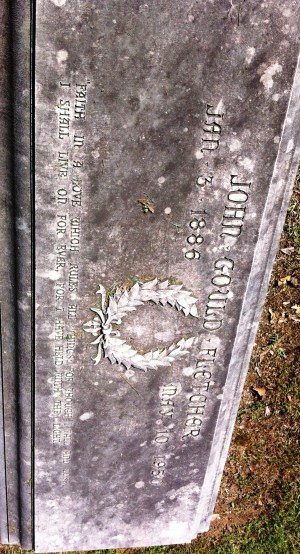
In 1939, John Gould Fletcher became the first Southern poet to win the Pulitzer Prize for Poetry.  He was born into a prominent Little Rock family in 1886.  Fletcher was awarded the prize for his collection Selected Poems which was published by Farrar in 1938.  Two years earlier, he had been commissioned by the Arkansas Gazette to compose an epic poem about the history of Arkansas in conjunction with the state’s centennial.

Fletcher is buried next to his wife, author Charlie May Simon and his parents (his father was former Little Rock Mayor John Gould Fletcher).  Other relatives are buried nearby in the cemetery.

The other Pulitzer Prize winner buried in Mount Holly is J. N. Heiskell, the longtime editor of the Arkansas Gazette.  It was Heiskell, in fact, who asked Fletcher to compose the poem about Arkansas.  Heiskell served as editor of the Gazette from 1902 through 1972.  He died at the age of 100 in 1972.

Under his leadership, the Gazette earned two Pulitzer Prizes for its coverage of the 1957 desegregation of Little Rock Central High.  One was for Harry Ashmore’s editorial writing and the other was for Public Service.

Heiskell remained in charge of the Gazette until his death in 1972.  He is buried alongside his wife with other relatives nearby.  Also not too far from Mr. Heiskell are two of his nemeses, proving that death and cemeteries can be the great equalizer. In the early days of his Gazette stewardship, he often locked horns with Senator (and former Governor) Jeff Davis. Later in Mr. Heiskell’s career, he vehemently disagreed with Dr. Dale Alford, who had been elected to Congress on a segregationist platform.

Drive (or walk or bike) to MISS DAISY

TWT DMDBecause of the success and awards of the movie version, and the way some of the lines have entered the vernacular especially as comic punch lines, it is easy to forget that Alfred Uhry’s Driving Miss Daisy is a quiet, unassuming play. He did not set out to write a “great” play or a social screed, in fact it was quite a surprise when it won the 1988 Pulitzer Prize for Drama.

The Weekend Theater brings Uhry’s episodic drive through the decades to life in its current offering. Under Andy Hall’s deft direction, it avoids the treacly trap that can often befall productions of this three-hander.

It is not that Hall’s production is without sentiment, but the emotions on stage are grounded in the moment. There is no mawkish lingering when the characters make an emotional connection. Considering that the script calls for cyclical closeness and distance among the trio, keeping emotions in check and in the moment serves the story and the playwright.

The plot, as if anyone needs a précis, involves a well-off (but don’t call her rich) Jewish widow, her businessman son, and the African American chauffer engaged by said son to transport said mother. Even if the audience was unfamiliar with the plot, it is pretty obvious that the titular matron and her driver will move from adversaries to unlikely friends. While the destination may be a formulaic and foregone conclusion, just like taking a trip, joy can be found in the journey.

Jermaine McClure plays the driver, Hoke. He avoids the stereotype of being the long-suffering, noble, simple-but-wise, African American. Though the part is not written that way, it has often been acted that way. His Hoke is kind, respectful, joyous, and a bit mischievous. McClure is obviously enjoying his part as much as Hoke enjoys interacting with both Daisy and her son. As he ages in the play, he doesn’t try to take on too much affectation—his character may move a bit slower—but he adds little touches such as prolonged squinting to show failing eyesight.

The role of the son, Boolie, is part instigator, part comic relief, and part time-filler so that the other two actors can be made to look older backstage. But Jay Clark imbues him with depth and pathos. He clearly enjoys the more comic moments (including wearing the most ridiculous Christmas outfit this side of Christmas Vacation), while also bringing heart and humanity to his quieter moments as well. Clark has a strong connection with each of his co-stars.

As good as the two gentlemen are, the evening clearly belongs to Judy Trice as Daisy Werthen. Her Daisy is a woman who has always been in control and is now grappling with the loss of that power. Her fussiness comes from frustration rather than from malice. Daisy is a complex woman who can see the biases in others without recognizing her own. Trice is not trying to be the lovable “little old lady” of heartwarming literature nor the stern battle-axe with a heart that needs to be awakened. Instead she presents a multi-faceted woman who is set in her ways but still has a desire to live a fulfilling life. With a sly smile and a drawn out word, she can be dangerous as she drops a veiled insult or commit theatrical larceny by stealing a scene through uttering a simple witticism.

Trice seems to get physically frailer as the play progresses, but that is not the most remarkable part of her transformation. Throughout the play her eyes sparkle with a vivacity that substantiates the sharp tongue and sharper mind of the heroine. Those eyes glimmer, that is, until the final scene. As she sits in near silence with a vacant, unfocused stare, it is hard to believe this is the same actress who has been so full of life throughout the rest of the play. Yet moments later the twinkle returns as she steps out to take her well-earned bow at the curtain call.

This production serves as a reminder that an enjoyable experience at the theatre does not need bells and whistles. It merely needs a strong story, adept actors, and a director who is able to meld the two.

Driving Miss Daisy continues at the Weekend Theater through April 17. Performances are at 7:30 on Fridays and Saturdays and Sunday matinees at 2:30.

Go to the WOODS

TST ITWSince the rights became available in the early 1990s, Stephen Sondheim and James Lapine’s Into the Woods has been popular for theatres of all levels from youth to professional regional theatres. It is, on the surface, a show that is easy to do adequately allowing for singers and actors of varying levels of expertise to perform. As such, I have seen numerous productions of this title (my interest stemming partly from being a cousin of the Brothers Grimm on whose work this musical is based).

The Studio Theatre’s production of Into the Woods is a reminder why it is worthwhile to go on the journey again. Whether you have seen outstanding or dreadful productions in the past or never seen the show before, this production of Into the Woods highlights the many charms of the property.

(It also reminded me that despite some judicious trims here and there, the first act is very long. So be forewarned and visit the restroom beforehand.)

Director Rafael Castanera has assembled a strong cast and then made sure they carry out his vision. Given the physical confines of the space, he has created a world in which the stage is always bustling with activity but never seems to be crowded. This is a very wordy script, but Castanera also trusts his cast with silence. Some of the most memorable moments (touching and comic) were achieved with no words. That is the hallmark of deft directing.

The show is truly an ensemble effort with uniformly solid performances. As the Baker around whom much of the action centers, Michael Goodbar gives a nice dramatic turn. Often seen in the outrageously comic Red Octopus Theatre productions, his layered performance here is a revelation. He has great chemistry with Angela Kay Collier as the Baker’s Wife. She is an even match for him in a performance that is both strong (but not strident) and vulnerable. Erin Martinez turns in yet another memorable characterization as the Witch. Her vocal prowess is on display in numbers ranging from rap (Sondheim did it here long before Hamilton) to tender song to power ballad.

Brandon Nichols brings an animalistic swagger to his performance as the Wolf. He is predatory and sensual without being obscene, which is especially important since the object of his lupine affection is an adolescent girl. In his other role, he is a hilariously vainglorious and charming Prince. With an arched eyebrow or shift in posture, he both echoes fairy tale princes and spoofs them.   His brother in arms in the narcissism department is Ryan Heumier as his brother the other Prince. Heumier can sing to another character all the while primping in front of his ever-present handheld mirror. The fraternal duet “Agony” is a highlight of the first act (and gleefully reprised in the second).

As the object of Nichols’ princely pursuit, Rachel Caffey brings a clear voice and clear eye to the role of Cinderella. She is equally at home among the ashes as she is running through the woods in a ballgown. Grace Pitts is a delightful Red Riding Hood alternating between assertive and susceptible, innocent and knowing. Often juvenile actors can be cloying (which may be why this part is usually played by someone older). But Pitts is never mawkish in her portrayal. Even as the character comes to grip with a new reality, Pitts’ performance lets the audience know she is still a young girl with enthusiasm and vulnerability.

Evan Patterson offers a dim-witted but well-intentioned Jack (of Beanstalk fame). The part is sometimes played doltishly. But Patterson’s portrayal focuses on the humanity of the character who happens to be more absent-minded than stupid. As his mother, reliable Beth Ross tempers her exasperation at her son with her devotion to him and her desire to provide for him. David Weatherly plays the narrator who fills in for Jack’s cow Milky White at times and also appears briefly as a eponymously named “Mysterious Man.” His talents for facial expressions and cud-chewing helped bring out much of the humor in the script.

Rounding out the cast in various roles were Courtney Speyer (whose dulcet tones were on display as she sang a sort of siren’s song), Amy G. Young (having fun as a not too weak Granny), Daniel Collier (as the officious and official steward), Katie Eisenhower, Brooke Melton and Autumn Romines. The latter three were the deliciously wicked step-relatives of Cinderella.

The cast was clad in intricately detailed costumes designed by Castanera. The clothing skillfully defined the characters and added whimsically to the story. Every square inch of fabric was there for a purpose. There were many accents and accessories, so each time an actor came on stage it was possible to discover something new. But the costumes served the actors and did not distract from the performances or the story. The clothing was abetted by Robert Pickens’ exquisite wigs.

Pickens is also the set coordinator. The set is a marvel. In a relatively small space there are a variety of platforms and ramps which depict many different settings. The set mainly consists wooden planks in groupings framing the proscenium. With this wood, a few ropes and some canvas, the story unfolds before the audience’s eyes. In a subtle reminder of the storybook nature of the evening, the stage is littered with hundreds of books stacked in any possible nook and cranny. The proceedings are well-lit by Joey DiPette who manages to make sure the actors are always seen while still conveying changes in settings and shifts from day to night.

While not a through-sung musical, Into the Woods has much, much music!. Even when the actors are not singing, the music rarely stops. Musical Director Bob Bidewell has made sure that the singers maximize their musical moments in the woods. He and the orchestra never play over the singers, but definitely enhance the mood and the overall musical experience by supporting the songs and the singers.

Like revisiting stories from childhood, it was pleasant to revisit Into the Woods, especially in a strong, cohesive production currently running at the Studio Theatre. Performances continue through March 26 (7pm Thursdays through Saturdays and 2pm on Sundays).

Go INTO THE WOODS this month at the Studio Theatre

Grace Pitts as Little Red Riding Hood - Photography by Grant Dillion for The Studio Theatre

Grace Pitts as Little Red Riding Hood – Photography by Grant Dillion for The Studio Theatre

Once upon a time, Pulitzer Prize winners Stephen Sondheim and James Lapine wrote a musical based upon the folk tales of the Brothers Grimm. Into the Woods ran for over 700 performances on Broadway and won 3 Tony Awards, spawned a Tony winning revival and a movie. Now the Studio Theatre brings it back to Little Rock.

Directed by Rafael Colon Castanera (who also designed the costumes), other members of the creative team are Jennifer Caffey (assistant director), Bob Bidewell (musical director), Robert Pickens (wig designer) and Carrie Henry (stage manager).

The cast includes Rachel Caffey, Angela Kay Collier, Daniel Collier, Katie Eisenhower, Michael Goodbar, Ryan Heumier, Erin Martinez, Brooke Melton, Brandon Nichols, Ethan Patterson, Grace Pitts, Autumn Romines, Beth Ross, Courtney Speyer, David Weatherly, and Amy G. Young

The production opens tonight and runs through March 26. Performances are at 7pm Thursdays through Saturday and Sunday matinees at 2pm.