

One of the few images of the 1868 Little Rock City Hall.
On January 22, 1868, a charity ball (including a supper) was the first special event held in the new Little Rock City Hall located at 120 to 122 West Markham.
The two story building featured city offices downstairs, including an engine house for the volunteer fire department. Upstairs was the council chambers and a special event space. The facility was the width of two storefronts. The upstairs was accessed by a central staircase which went from street level through an archway directly up to the second floor. The first floor had a stone exterior and the second floor was a combination of brick and woodwork.
Records do not indicate when the first city council in the new building took place. At the January 21, 1868, meeting, the body formally accepted the building and cancelled any clauses in the contract about penalties should the contractor not meet the construction deadline. But there is no indication whether that meeting took place in the new building or in the previous city hall. (The location of that prior city hall is a mystery.). The minutes from the council meetings just prior to and just after the January 21 meeting give no indication as to which building was the site for the meeting.
It IS known that March 30, 1908, was the date of the final council meeting in the 1868 City Hall. After that meeting, city offices completed their move to the edifice at Markham and Broadway, which still serves as Little Rock City Hall.
As early as November 1867, the City Council was getting requests for special events to be held in the new city hall. In November and December the council refused to take action on any requests because the building was still under construction.
The January 22, 1868, event was created to help the destitute in Little Rock. The ARKANSAS GAZETTE encouraged people to be generous and purchase tickets. Even the day before the event, the weekly version of the GAZETTE (which at the time had added daily editions in addition to its weekly issue) was assuring people there would be plenty of space in the splendid new building so there was still room for additional ticket purchases. Tickets were $5 to admit a lady and a gentleman. (That would be the equivalent of $83.71 today. While cheap for two people to attend a Little Rock event in 2018, in the post-Civil War era, it was a definite hit to the pocketbook.)
The unnamed organization which put on the charity event was led by W. W. Wilshire (president), George W. Clark (secretary), Joseph Meyer (treasurer) and a standing committee of Dr. C. M. Taylor, Dr. P. O. Hooper, A. Adams, F. H. Moody, and E. Langley. Donations could be made to any of the officers. The arrangements for the event were handled by Joseph Meyer, A. Adams, J. P. Jones, Alexander George, Jr., Joseph W. Bossert, and Daniel Ottenheimer. The reception committee was W. D. Blocher, H. C. Ashley, A. McDonald, P. W. McWhorter, T. Lafferty, and F. H. Moody. Tickets could be purchased at the stores of J. E. Reardon, G. H. Gibbs, Joseph Meyer, Lafferty & Raleigh, S. L. Griffith, McAlmont & Stillwell, Beideman & Co., and Dodge & Co as well as at the Anthony and Commercial Houses. (It is interesting to note how so many people at the time were publicly listed by only their first initial.)
The building stood for 56 years after City Hall vacated it. It housed a variety of businesses over the years. The building was torn down in 1964 as part of Urban Renewal efforts. Today the land on which it stood is the site of part of the Statehouse Convention Center. It is directly across from the One-Eleven restaurant side of the Capital Hotel.
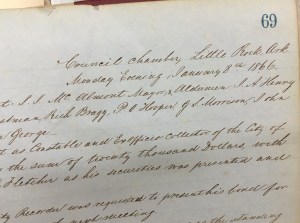 One hundred and fifty four years ago today (on January 8, 1866), Little Rock City Hall resumed functioning after the Civil War. The City government had disbanded in September 1863 after the Battle of Little Rock. From September 1863 through the end of the war (on on through part of Reconstruction), Little Rock was under control of Union forces.
 100 Years Ago
 The Democrat (an afternoon paper) ran an article stating that New Year’s celebrations in DC were somewhat muted, perhaps because of concerns about the health of President Wilson, who had suffered a stroke in October 1919. There was also an article about planning being underway for the 300th anniversary of the Mayflower with events set for England, Holland, and the US.
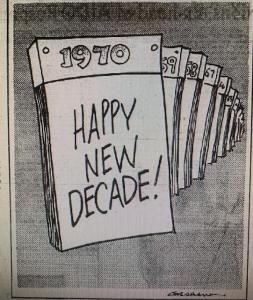 As 1970 dawned, the Gazette and Democrat both carried stories about Vietnam and the Department of Justice seeking a delay in implementation of school desegregation. Locally, it was announced that KATV was purchasing the old Worthen Bank Building at Main and Fourth Streets. The Hogs were getting ready to face Ole Miss in the Sugar Bowl (which the Razorbacks would lose by a score of 27 to 22 to the Archie Manning led Rebels).
 Teamsters Union president Jimmy Hoffa, in the middle of an eight year prison term, had indicated he would share information with authorities in return for President Nixon commuting his sentence. In local crime news, City Hall and the municipal garage behind the building had been broken into. While there had been a failed attempt to pry open the Collector’s office, thieves had apparently only been able to get a small amount of cash by breaking a vending machine in the building.
 Join the UA Little Rock History Department for the last lecture in this year’s Evenings with History series!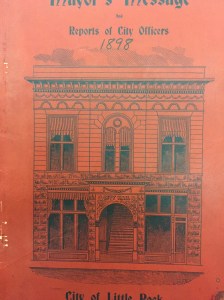
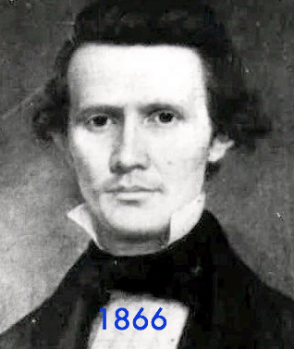 Following the cessation of Little Rock municipal government in September 1863, there was no mayor of Little Rock for the remainder of the Civil War.
 Little Rock Culture Vulture