Final Dunbar High School Graduation – May 27, 1955

On May 27, 1955, on the stage of Robinson Auditorium, the Dunbar High School senior class graduated. This academic year marked not only the 25th anniversary of Dunbar’s opening, but it was the last year that the school building would offer junior high through junior college classes.

In the fall of 1955, the new Horace Mann High School would open. Dunbar would continue to be open, but only as a junior high.  (Though no reason was ever publicly given, the junior college component ended in May 1955.)

The new Mann High School was constructed, in part, as a way to delay any integration plans for the Little Rock School District.  With a new second all-white high school in the works for Little Rock, it was thought that a new African American school would placate the African-American community by not only giving them a new building, but relieving the overcrowding at Dunbar.

But on May 27, 1955, and the days leading up to it, the focus was on celebrating the final graduation class and the 25th anniversary of Dunbar High School.  On May 25, teachers who had taught for 25 years at the school, and original teachers who retired from the school were honored.

The school’s original principal, Dr. John H. Lewis, was the commencement speaker.  The current principal, Dr. L. W. Christophe presided over the awarding of the diplomas and announcements of scholarships.  Among the higher education institutions to which they received scholarships were the University of Michigan, Wiley College, Tennessee State, Arkansas AM&N, Talladega College, and Philander Smith College.

While the Arkansas Gazette and Arkansas Democrat  both DID run stories on the graduation, it was hardly equal to the coverage they gave Central High School.  In fact, on the day after Dunbar’s graduation, the Democrat ran a photo of two Central graduates huddled under an umbrella in the rain – three days after the ceremony took place.

In 1971, Mann ceased its status as a high school as well.  Today, both Mann and Dunbar serve as middle schools within the Little Rock School District.

The Hall is alive with THE SOUND OF MUSIC – (Robinson Center Performance Hall, that is)

A brand new production of THE SOUND OF MUSIC is currently on tour across North America! The spirited, romantic and beloved musical story of Maria and the von Trapp Family  features music by Richard Rodgers, lyrics by Oscar Hammerstein II, book by Howard Lindsay and Russel Crouse, suggested by “The Trapp Family Singers” by Maria Augusta Trapp.

Performances are this weekend at Robinson Center Performance Hall.  The Sound of Music is brought to Little Rock by Celebrity Attractions.  Show times are Friday, May 24 at 7:30pm, Saturday, May 25 at 2pm, Saturday, May 25 at 7:30pm, and Sunday, May 26 at 2pm.

The cast includes Jill-Christine Wiley (as Maria), Mike McLean (as the Captain), Amelija Hill, Hunter Brown, Lauren Kidwell, Jake Mills, Lauren O’Brien, Kate Turner, Ethan Douglas Cutillo, Riley O’Kane, Jenna Seasholtz, Emily Strugatsky, Quinn Titcomb, and Edward Turner.

The creative team includes Matt Lenz (tour director), Jonathan Warren (tour choreographer), Douglas W. Schmidt (scenic design), Jane Greenwood (costume design), Natasha Katz (lighting design), Shannon Slaton (sound design), and Michael GIlden (music director/conductor). The tour is based on a 2015 tour which featured direction by Jack O’Brien and choreography by Danny Mefford.

Little Rock Look Back: Dan Sprick

Future Little Rock Mayor Dan T. Sprick was born on May 19, 1902.  He served three terms on the Little Rock City Council (from 1935 to 1941).  In 1945, he was elected Mayor of Little Rock and served one term. During his tenure on the City Council, he was the sole vote against locating Robinson Auditorium at Markham and Broadway.  He had favored another location.
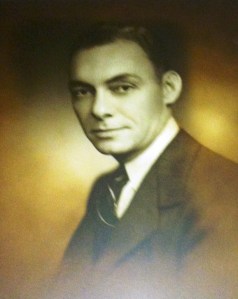
He was not alone, however, in being held in contempt of court and spending part of the day in jail.  On Monday, December 4, a dozen of Little Rock’s aldermen (which included Sprick) reported to the county jail to serve sentences for contempt of court. The previous Monday, the twelve council members had voted against an ordinance which had been ordered by the judge in an improvement district matter. The other aldermen had either voted in the affirmative or had been absent. Because the twelve had refused to change their votes since that meeting, the judge ordered them jailed.  After the aldermen changed their votes later in the day, they were freed.

His tenure as Mayor was relatively quiet. He took office the same month that World War II ended. While in office, the Sprick administration was marked by growth in the city budget and in city positions. As a part of that growth, there were many more new purchases taking place which had prompted extra scrutiny of the City’s purchasing procedures. A thorough investigation toward the end of his tenure found no malfeasance or misfeasance, it did note that the city needed to do a better job of anticipating cash flow. Much of the City’s focus during the Sprick tenure was on growth and keeping up infrastructure needs.

Sprick later served for ten years in the Arkansas State Senate (from 1961 to 1970).  During his tenure in the Senate, Sprick was closely aligned with Gov. Orval Faubus.  When the Little Rock high schools had been closed a year to ensure segregation, Sprick had served on the board of a private school set up by some of the leaders of the segregation movement.

His time in the Senate was also marked by controversy.  He was one of three Senators to opposed Muhammad Ali’s speaking at the University of Arkansas at Fayetteville.  After an Arkansas Gazette editorial lambasted him, Sprick sued the paper for libel. The Gazette settled with him out of court because his health was poor.

One of the landmark pieces of legislation he guided through the Arkansas General Assembly allowed cities to collect advertising and promotion taxes.  The 1972 and 1973 upgrades to Robinson Center were funded by this tax (as have some subsequent upgrades). So the building he voted against while on the LR City Council benefited from legislation he championed while in the General Assembly.

Sprick died in January 1972.

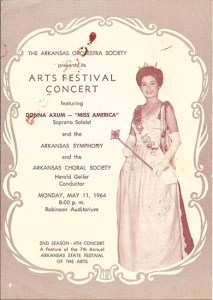
There She Was: Donna Axum as Miss America sings at Robinson Auditorium in May 1964

Photo from Encyclopedia of Arkansas, courtesy of Mike Polston

While she had made a few other appearances in Little Rock during her reign as Miss America, on May 11, 1964, Donna Axum appeared in concert at Robinson Auditorium.

She sang with the Arkansas Symphony (not directly connected with the current Arkansas Symphony Orchestra) and the Arkansas Choral Society.

The concert was part of the Arkansas State Festival of the Arts which was an annual event from the late 1950s until the late 1960s.

Before her death in the fall of 2018, her final two appearances at Robinson were in conjunction with the Miss Arkansas pageant being held there.

In June 2017, she appeared, along with several other former Miss Arkansas title holders, at the 2017 Miss Arkansas pageant.  She was joined on stage by Savvy Shields, who like Miss Axum, was a former Miss Arkansas who held the title of Miss America. She and Savvy were both back at Robinson in June 2018 for the Miss Arkansas pageant.

When the Miss Arkansas pageant is back on stage at Robinson in June 2019, there will undoubtedly be a tinge of sadness that Donna Axum is not on stage with the other former title holders.

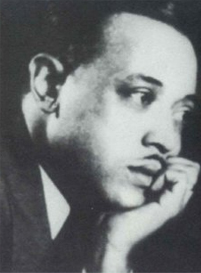
Dr. William Grant Still, born on May 11, 1895 – A leading 20th Century American composer

Long known as the Dean of African American composers, Dr. William Grant Still was a legend in his own lifetime. Though not born in Little Rock, he spent much of his youth in the city.

Dr. Still, who wrote more than 150 compositions ranging from operas to arrangements of folk themes, is best known as a pioneer. He was the first African-American in the United States to have a symphonic composition performed by a major orchestra.

He was the first African American to conduct a major symphony orchestra in the US; the first to conduct a major symphony in the south; first to conduct a white radio orchestra in New York City; first to have an opera produced by a major company. Dr. Still was also the first African-American to have an opera televised over a national network

Dr. Still was born May 11, 1895 in Woodville, Mississippi to parents who were teachers and musicians. When Dr. Still was only a few months old, his father died and his mother took him to Little Rock. Inspired by RCA Red Seal operatic recordings, his musical education began with violin lessons.  He graduated from Gibbs High School in Little Rock.

After his studies at Wilberforce University and the Oberlin Conservatory of Music, he played in orchestras and orchestrated for various employers including the great W. C. Handy. For several years he arranged and conducted the “Deep River Hour” over CBS and WOR.  He also played in the orchestra for the 1921 musical Shuffle Along, which was the first Broadway musical to feature an all African-American cast and writing team.

In the 1920’s, Still made his first appearances as a serious composer in New York. Several fellowships and commissions followed. In 1994, his “Festive Overture” captured the Jubilee prize of the Cincinnati Symphony orchestra. In 1953, he won a Freedoms Foundation Award for “To You, America!” which honored West Point’s Sesquicentennial Celebration. In 1961, he received honors for this orchestral work, “The Peaceful Land”. Dr. Still also received numerous honorary degrees from various colleges and universities, as well as various awards and a citation from Arkansas Governor Dale Bumpers in 1972.

In 1939, Dr. Still married journalist and concert pianist Verna Avery, who became his principal collaborator. They remained together until Dr. Still’s death in 1978.  In a proclamation marking the centennial of Dr. Still’s birth, President Bill Clinton praised the composer for creating “works of such beauty and passion that they pierced the artificial barriers of race, nationality and time.”

In 1995, Dr. Still was posthumously inducted into the Arkansas Black Hall of Fame.  In 2016, the ballroom at Robinson Center was named in his honor. In 2018, Opera in the Rock performed Still’s opera Troubled Island.

Relive the magic of E.T. with live music from Arkansas Symphony Orchestra this weekend

The Arkansas Symphony Orchestra, Philip Mann, Music Director and Conductor, presents the fourth and final concert of the 2018-2019 Acxiom Pops Live! season: E.T. The Extra-Terrestrial: In Concert!, Saturday, May 11th at 7:30 p.m., Sunday, May 12th at 3:00 p.m. at the Robinson Center.

Audiences will relive the magic of E.T. The Extra Terrestrial on the big screen accompanied by a magnificent, live performance of the Arkansas Symphony Orchestra, being led by ASO Associate Conductor Geoffrey Robson.

Director Steven Spielberg’s heart-warming masterpiece is one of the brightest stars in motion picture history. Filled with unparalleled magic and imagination, E.T. The Extra-Terrestrialfollows the moving story of a lost little alien who befriends a 10-year-old boy named Elliott. Experience all the mystery and fun of their unforgettable adventure in the beloved movie that captivated audiences around the world, complete with John Williams’ Academy Award®-winning score performed live by a full symphony orchestra in sync to the film projected on a huge HD screen!

The Pops Live! Series is sponsored by Acxiom.

Tickets are $16, $36, $57, and $68; active duty military and student tickets are $10 and can be purchased online at www.ArkansasSymphony.org; at the Robinson Center street-level box office beginning 90 minutes prior to a concert; or by phone at 501-666-1761, ext. 1. All Arkansas students grades K-12 are admitted to Sunday’s matinee free of charge with the purchase of an adult ticket using the Entergy Kids’ Ticket, downloadable at arkansassymphony.org/freekids. Please note: the Entergy Kids’ Ticket Voucher must be redeemed for a reserved seat by calling the Box Office or presenting it at the Box Office beginning 90 minutes prior to a concert.

E.T. The Extra-Terrestrial is a trademark and copyright of Universal Studios. Licensed by Universal Studios Licensing LLC. All Rights Reserved. Available on Blu-ray and DVD from Universal Pictures Home Entertainment.