Explore Little Rock’s civil rights history with new app

Little Rock-area residents and visitors have a new way to explore the city’s rich civil rights history.

The University of Arkansas at Little Rock Institute on Race and Ethnicity and Little Rock city officials  have unveiled the Arkansas Civil Rights History Tour app.

The free Apple and Android app guides users on an excursion through some of the city’s most influential historical sites, going back to the 1840s. Each of the 35 stops on the GPS-guided tour includes compelling narratives, historic photos, audio, and links to related content.

Tour stops range from the L.C. and Daisy Bates House to the Trail of Tears. The tour includes a total of three National Historic Landmarks, three National Register Historic Districts, and numerous buildings on the National Register of Historic Places.

Narrated in both English and Spanish, the app also offers information about Jewish history in Little Rock, Hispanic migrations to Arkansas, and Native American tribes.

Organizers recommend app users begin their route at Broadway and West Ninth Street in downtown Little Rock, but the app can help people customize their own path.

A collaboration of the Institute on Race and Ethnicity, the City of Little Rock, the Mayor’s Tourism Commission, and KUAR, UALR’s public radio station, led to the creation of the Arkansas Humanities Council-funded app.

“The institute’s mission is to remember and understand the past, to inform and engage the present, and to shape and define the future in the area of race and ethnicity,” said Dr. John Kirk, director of the Institute on Race and Ethnicity.

“The tour app helps us to do all those things: It powerfully sheds light on the past, it allows people to engage with the past in the present moment, and it helps us to consider how those legacies and lessons can shape and define the future of the city and state.”

The app can be found in the Apple App Store and on Google Play by searching for “Arkansas history.”

Arts & culture advocate, Dr. Joel Anderson to retire as UALR Chancellor

jeasmile-444x668University of Arkansas at Little Rock Chancellor Joel E. Anderson announced today that he will retire following a 13-year tenure as chancellor and a 45-year career at the university. His retirement will be effective June 30, 2016.

Anderson became UALR chancellor in 2003, bringing with him more than 30 years of university and community service. He had previously served UALR as provost and vice chancellor for Academic Affairs and as founding dean of the Graduate School.

Chancellor Anderson’s announcement comes on the heels of a 1.2 percent increase in enrollment at UALR, including a 19 percent increase in first-time college students and a 7.1 percent increase in first-time transfer students.

“It has been a tremendous pleasure to see UALR grow and mature into the excellent, comprehensive university that it has become,” said Chancellor Anderson. “The faculty and staff of UALR deserve more credit than they will ever receive for their tireless efforts to help students achieve the dream of a college education that will enable students to adjust to a changing future and support themselves and their families.”

University of Arkansas System President, Donald R. Bobbitt will form a search committee in the coming weeks with the goal to complete the search by July 1, 2016.

One of the achievements he was most passionate about was the founding in 2011 of the Institute on Race and Ethnicity, a center designed to move Arkansas forward on the broad front of racial and ethnic justice through education, research, dialogue, community events, and reconciliation initiatives.

As professor, dean, provost, and chancellor, Anderson always related success of the university to success of the students UALR served. As chancellor, he launched numerous initiatives to recruit and retain more students and to reach out to underserved student populations. His signature is on more than 26,836 diplomas and the university’s fall-to-fall retention rate is the highest it has ever been.

“Joel is a true gentleman who cares about the university more than himself”, said Dr. Dean Kumpuris, chair of the UALR Board Visitors.  “He has no ego and has sought our advice and support more than he probably had to,” “His primary goal has been to shepherd the university to a better place, which he has done. We are lucky to have had him as a leader for so many years.”

Anderson, who grew up on a farm east of Swifton in northeast Arkansas, received a BA degree in political science from Harding University, an MA degree in international relations from American University, and a Ph.D. in political science from the University of Michigan. He also completed the Institute for Educational Management at Harvard University.

“The university has good momentum. I need time to catch up on a backlog of books and also to see my grandchildren more often,” Anderson said.  “All the while I will watch with pride as UALR grows and changes.”

Highlights of his service as chancellor include:

  • The Windgate Charitable Foundation awarded UALR a grant of $20.3 million for a new Visual Arts and Applied Design center.
  • Since 2003, UALR has purchased the University Plaza shopping center which is now home of KUAR-KLRE Public Radio as well as the current home of the applied design center.

  • As part of the Coleman Creek Greenway project, the Trail of Tears Park was completed in 2011 to recognize the historical significance of the location on the south end of campus where the Choctaw and Chickasaw tribes stopped for water along Coleman Creek.

  • Establishment of a Dance major, the only one in the state, within the Department of Theatre Arts and Dance.
  • Much of the campus’s infrastructure has undergone substantial renovations including the Stella Boyle Smith Concert Hall. Likewise, there has been an added emphasis on the promotion and maintenance of public art on campus.

  • Chancellor Anderson served as a “Scholar in Residence” in 2010 at the Center on Community Philanthropy at the Clinton School for his work on issues of race and ethnicity.

  • Dr. Anderson launched the Institute on Race and Ethnicity in 2011 to move Arkansas forward on the broad front of racial and ethnic justice through education, research, dialogue, community events, and reconciliation initiatives.  One of their projects has been the annual Civil Rights Heritage Trail installation.

  • In 2015, as part of its 40th anniversary celebration, the Winthrop Rockefeller Foundation honored Chancellor Anderson as one of 40 Community Leaders in the categories of community, education, nonprofits, and prosperity.

Sculpture Vulture: National Bow Tie Day

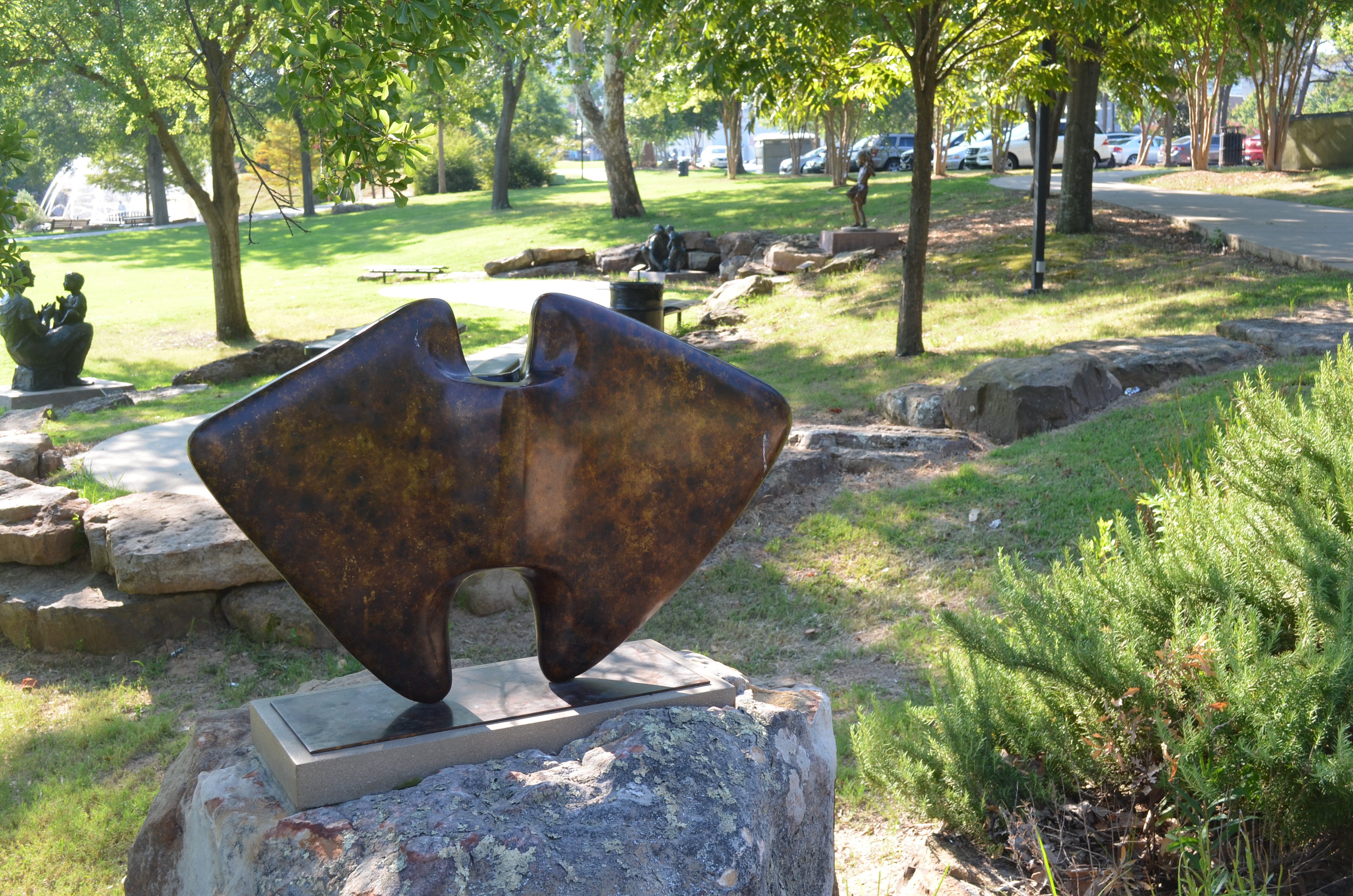
DSC_0701Today is National Bow Tie Day.  Though there is not specifically a sculpture in Little Rock with a bow tie, one of the newest sculptures in Riverfront Park mimics the shape of a bow tie.  Valerie Jean Schafer’s Butterfly Banner evokes not only a butterfly but a bow tie.  However, the imagery goes beyond that.

This is drawn from a visual vocabulary inspired by Native American artifacts from prehistory. While a banner was originally a small stone or wood counterweight for the atlatl (a weapon predating the bow and arrow) this enlarged representation speaks of the beauty of Native American culture beyond the usual stereotypes. The sculpture embraces tradition, as it reveals Native Americans as inhabitants of the Americas far longer than most people believe. At the same time, the simplicity of the form evokes a sense of elegance with a decidedly contemporary feel.

Dean Kumpuris 2014It is fitting that it is located in Riverfront Park. The Trail of Tears went through the park as Native Americans were forcibly moved west.  It serves as a reminder of the heritage of Little Rock. Not all of the City’s past was glorious; but in remembering the past, it helps to look forward to a better future.

It is also appropriate to feature this sculpture today for another reason.  A driving force behind the placement of sculptures in Little Rock is bow tie clad City Director Dr. Dean Kumpuris.

Noon today, the Clinton School and Butler Center’s Legacies & Lunch present Justice Troy Poteete, executive director of the National Trail of Tears Association

PoteeteToday at noon, the Clinton School Speaker Series and the Butler Center’s Legacies & Lunch jointly present a program.  Justice Troy Poteete, executive director of the National Trail of Tears Association will speak at the Ron Robinson Theater.

Troy Poteete was appointed to the Cherokee Nation Supreme Court by Chief Chad Smith in 2007 and is the executive director of the National Trail of Tears Association, an organization he helped found. Justice Poteete also founded the Historical Society in Webbers Falls, Okla., served as executive director of the Cherokee Nation Historical Society, and was a delegate to the Cherokee Nation Constitutional Convention. In 2000, Justice Poteete was appointed executive director of the Arkansas Riverbed Authority, a tribal entity jointly created by the Chickasaw, Choctaw, and Cherokee Nations to administer their interests in the 96-mile section of the Arkansas River between Muskogee, Okla. and Fort Smith, Ark.

The Trail of Tears was actually several trails.  Little Rock is one of the only cities (if not the only city) that members of all six relocated tribes passed through.  Little Rock’s emerging merchant class benefited from the relocation efforts as the Federal government paid for goods and services in Little Rock.

Trail of Tears Commemoration Day

Today is Trail of Tears Commemoration Day.  There were several different routes on the Trail of Tears.  Little Rock was one of the only places (if not the only one), in which each of the tribes passed through on the way out west.

Much research on the Trail of Tears has been conducted by the UALR Sequoyah National Research Center (SNRC).

The SNRC recently opened an exhibit entitled “Toy Tipis and Totem Poles: Native American Stereotypes in the Lives of Children.”

"Ten Little Indians" spinning top for SNRC exhibit

Ten little Indians spinning top; Photography by George Chambers

The exhibit runs through Dec. 19. Held in the Dr. J.W. Wiggins Native American Art Gallery, the purpose of the event is to create awareness of the variety of native cultures and the achievements of contemporary American Indians and Alaska Natives.

The exhibit comes from the Hirschfelder-Molin Native American Stereotypes Collection, a collection of more than 1,500 museum objects and archival documents, possibly the largest such collection in the world.

The items were donated to SNRC in 2012 by Arlene Hirschfelder and Paulette Molin, professional educators and authors with decades-long experience in Native American education and Native American studies. SNRC archivist Erin Fehr will curate the exhibit with Hirschfelder, Molin, and SNRC staff.

The exhibit will highlight the areas of the collection dealing with children and Native American stereotypes omnipresent in the lives of American children.

By examining childhood objects – dolls, toys, books, games, clothing, sports memorabilia – the exhibit will create awareness of the inculcation of the images and the difficulty of changing mainstream thinking about Native American stereotypes.

In addition to presenting the stereotypes themselves, positive images and responses from Native people will be presented as an alternative.

UALR’s Sequoyah National Research Center is dedicated to the collection and preservation of all forms of Native American expression. Located in the University Plaza, SNRC has served as an archive for Native Americans for more than 30 years. The gallery is open Monday through Friday from 8 a.m. to 5 p.m.

For more information contact Erin Fehr at ehfehr@ualr.edu or 501.569.8336.