
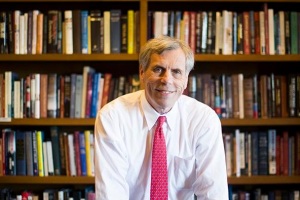
Skip Day! Happy Birthday to Skip Rutherford!

Though a native of Batesville (and a proud booster to this day), James L. “Skip” Rutherford has lived in Little Rock for many years. While he was a student at the University of Arkansas, he probably never envisioned the impact he would have on the cultural scene of Little Rock.

After moving to Little Rock, Skip (and his wife Billie) became civic boosters which often involved attending or promoting cultural events.  However, by the mid-1990s, this moved into a whole new realm.

Skip was one of the visionaries behind the creation of a Central High Visitors Center.  His interest in this project combined his interests in public service, public policy, and public schools. This was an extension of his work as an aide to Senator David Pryor from 1979 to 1983 and a Little Rock School Board member from 1987 to 1991.  As the 40th anniversary of the integration of Little Rock Central High approached, Skip worked with Mayor Jim Dailey and others to plan the 1997 commemoration activities as well as the 1998 recognition of the Women’s Emergency Committee.

A few weeks after the Central High 40th anniversary events in September 1997, President Clinton announced that Little Rock would be the site of his Presidential Library.  As President of the Clinton Foundation, he was involved in the planning for not only the construction of the building but also the grand opening festivities.  Through his efforts, the City’s major cultural institutions all had events in conjunction with the opening of the Clinton Presidential Center.

In 2006, he followed Sen. David Pryor in the role of Dean of the Clinton School of Public Service.  Among his accomplishments in this role has been the expansion of the Clinton School Speaker Series. This free series of lectures and public discussions has added immensely to Little Rock’s cultural life. Topics range from foreign relations to domestic policy, from social services to community philanthropy, The lecture series has also focused on productions at the Arkansas Repertory Theatre, guest artists with the Arkansas Symphony Orchestra, books by historians, and many other cultural topics over the years.

That he would oversee the expansion of this lecture program should not be a surprise.  He is also the founder (in 1983) of the Political Animals Club. While the original, non-partisan group still meets regularly in Little Rock, several other affiliates have been created in other portions of the state. He has always been one for civil, civic dialogue.

In April and May 2018, Skip was one of the civic leaders who stepped up to promote efforts to save the Arkansas Repertory Theatre. He was also involved in the planning and promotion of the Elizabeth Eckford Bench which was installed near Little Rock Central High School in September 2018.  Later that month, he presided over an event celebrating the 60th anniversary of the Women’s Emergency Committee.

Earlier this month, the Clinton School partnered with UA Little Rock Downtown for the a Clinton School program which discussed the 1930s mural which has been restored and now hangs in the new UA Little Rock space.  2019 will offer more opportunities for his civic and cultural boosterism, as well.

Little Rock Look Back: HAIR brings Age of Aquarius to Robinson Center

Ad for the original production of HAIR in Little Rock. Note the ticket prices. And that they could be purchased at Moses Music Shops.

Forty-seven years ago today, on January 18, 1972, the musical Hair settled in for a week-long run at Robinson Auditorium.  The saga to bring the national tour to Little Rock had actually begun eleven months earlier.

In February 1971, a young Little Rock attorney named Phil Kaplan petitioned the Little Rock Board of Censors to see if it would allow a production of Hair to play in the city. He was asking on behalf of a client who was interested in bringing a national tour to Arkansas’ capital city. The show, which had opened on Broadway to great acclaim in April 1968 after an Off Broadway run in 1967, was known for containing a nude scene as well for a script which was fairly liberally sprinkled with four-letter words. The Censors stated they could not offer an opinion without having seen a production.

By July 1971, Kaplan and his client (who by then had been identified as Southwest Productions) were seeking permission for a January 1972 booking of Hair from the City’s Auditorium Commission which was charged with overseeing operations at Robinson Auditorium. At its July meeting, the Commissioners voted against allowing Hair because of its “brief nude scene” and “bawdy language.”

Kaplan decried the decision. He stated that the body couldn’t “sit in censorship of legitimate theatrical productions.” He noted courts had held that Hair  could be produced and that the Auditorium Commission, as an agent for the State, “clearly can’t exercise prior censorship.” He proffered that if the production was obscene it would be a matter for law enforcement not the Auditorium Commission.

The Commission countered that they had an opinion from City Attorney Joseph Kemp stating they had the authority. One of the Commissioners, Mrs. Grady Miller (sister-in-law of the building’s namesake the late Senator Robinson, she had served on the Commission since 1940), expressed her concern that allowing Hair would open the door to other productions such as Oh! Calcutta!

On July 26, 1971, Southwest Productions filed suit against the Auditorium Commission. Four days later there was a hearing before federal Judge G. Thomas Eisele. Judge Eisele offered a ruling on August 11 which compelled the Auditorium Commission to allow Hair to be performed. Prior to the ruling, some of the Auditorium Commissioners had publicly stated that if they had to allow Hair, they would close it after the first performance on the grounds of obscenity. To combat this, Judge Eisele stated that the Commission had to allow Hair to perform the entire six day engagement it sought.

Upon hearing of the Judge’s ruling, Commissioner Emily Miller offered a succinct, two word response. “Oh, Dear!”

In the end, the production of Hair at Robinson would not be the first performance in the state.  The tour came through Fayetteville for two performances in October 1971 at Barnhill Arena.

On January 18, 1972, Hair played the first of its 8 performances over 6 days at Robinson Auditorium.  In his review the next day, the Arkansas Gazette’s Bill Lewis noted that Hair “threw out all it had to offer” and that Little Rock had survived.

The ads promoting the production carried the tagline “Arkansas will never be the same.”  Tickets (from $2 all the way up to $8.50–the equivalent of $12 to $51 in 2019 dollars) could be purchased at Moses Melody Shops both downtown and in “The Mall” (meaning Park Plaza). That business is gone from downtown, but the scion of that family, Jimmy Moses, is actively involved in building downtown through countless projects. His sons are carrying on the family tradition too.

Little Rock was by no means unique in trying to stop productions of Hair.  St. Louis, Birmingham, Los Angeles, Tallahassee, Boston, Atlanta, Charlotte NC, West Palm Beach, Oklahoma City, Mobile and Chattanooga all tried unsuccessfully to stop performances in their public auditoriums.  Despite Judge Eisele’s ruling against the City of Little Rock, members of the Fort Smith City Council also tried to stop a production later in 1972 in that city. This was despite warnings from City staff that there was not legal standing.

Within a few years, the Board of Censors of the City of Little Rock would be dissolved (as similar bodies also were disappearing across the US). Likewise, the Auditorium Commission was discontinued before Hair even opened with its duties being taken over by the Advertising and Promotion Commission and the Convention & Visitors Bureau staff.  This was not connected to the Hair decision; it was, instead, related to expanding convention facilities in Robinson and the new adjacent hotel.  Regardless of the reasons for their demise, both bygone bodies were vestiges of earlier, simpler and differently focused days in Little Rock.

Tonight – Clinton School and UA Little Rock present program on The Struggle in the South mural

Today (January 16) at noon, UA Little Rock officially cuts the ribbon on the new UA Little Rock Downtown campus in the River Market district.

Tonight at 6pm, the Clinton School Speaker Series in conjunction with UA Little Rock presents a panel discussion on the Joe Jones mural, “The Struggle in the South” which is featured in that new space.  It will take place in the UA Little Rock Downtown location.

In 1935, famed American artist Joe Jones created “The Struggle in the South,” a provocative depiction of Southern sharecroppers, coal miners and a black family in fear of a lynching.

Originally painted in the dining hall at Commonwealth College near Mena, Arkansas, this 44-by-9-foot work was recently restored with a $500,000 grant from Arkansas Natural and Cultural Resources Center.

During this program, moderator Senator Joyce Elliott will join Brad Cushman, UA Little Rock Department of Art and Design Gallery director and curator; author Guy Lancaster; Dr. Brian Mitchell, UA Little Rock professor of history; Dr. Bobby L. Robert, former UA Little Rock archivist and Central Arkansas Library System executive director; and Taemora Williams, UA Little Rock student, to discuss the artwork’s historical significance and importance of its new home in UA Little Rock Downtown’s reflection room.

All Clinton School Speaker Series events are free and open to the public. Reserve your seats by emailing publicprograms@clintonschool.uasys.edu or by calling (501) 683-5239.

2nd Friday Art Night – Christ Church

Christ Episcopal Church will open a new art exhibit in its Gallery on Friday, January 11, 2019. Brenda Fowler will be the featured artist from January 11 through the end of March 2019.
Fowler’s paintings will be on display for purchase in the Gallery. The exhibit is entitled “Life Changes,” which, Fowler explains, embraces the essence of an ever-changing life, as well as the emotions experienced throughout these changes.

Fowler is an Arkansas artist whose original contemporary abstract expressionist paintings are intended to convey the creative energy and passion for expression through which all artists go. Her mixed media, large-scale paintings on deep, gallery-wrapped canvas, are comprised of multiple layers of strong, vibrant, high-quality fine art acrylic colors, often with added texture. Each piece begins with a concept, a thought, or an idea with the intent to convey emotions and are reflective of their titles.

Fowler received her formal education at the University of Arkansas Little Rock and the Arkansas Arts Center Museum School. Her paintings have been displayed at numerous art galleries and interior design firms throughout Arkansas and in Dallas.

Christ Church believes that artists, whether painters or singers or sculptors or poets, show something of God when they show us the world’s truth and beauty through their talents. The Gallery is open to the public each weekday during regular business hours and is also a regular stop on downtown Little Rock’s Second Friday Art Night. The exhibition will open with a reception for the artist on Friday, January 11 from 5 pm-8 pm.

18 Cultural Events of 2018 – UA Little Rock unveils restored Joe Jones mural from 1930s

As curator Brad Cushman said at the unveiling of the Joe Jones mural, “There is absolutely no reason this mural should still exist.”  But it does.  And now fully restored Jones’s 1935 mural The Struggle in the South is a centerpiece of the new UA Little Rock Downtown Campus in the heart of the River Market.

First painted in the 1935 to be placed at Commonwealth College in Mena, it spent many years lining two closets in a house after it had been taken down from its original location. When that house was being torn down, someone called Bobby Roberts because they thought it might be something worth saving.

Dr. Roberts drove to west Arkansas, picked it up, and brought it back to Little Rock.  For years it sat in storage at UA Little Rock. While that probably stopped its deterioration, it did nothing to restore it.

In 2009, the St. Louis Art Museum restored one panel of it to include in an exhibition on Jones, a native of the Gateway City.  That prompted Cushman to push even harder to have the rest of it restored.  In 2012, the Arkansas Natural and Cultural Resources Council provided a grant which made restoration possible.  Additional funding came from the University and the National Endowment for the Humanities.  The 29 pieces of the mural were sent to Helen Houp Fine Art Conservation in Dallas.

The mural consists of three sections that brutally but honestly tell tales of the South in the first third of the 20th Century.  The first section depicts coal miners about to go on strike, the middle section shows a lynching of an African American man, and the third shows an African American family in fear inside a wooden shack – both in the shadow of the lynching and an impending tornado set to destroy the land they are working.

It is a difficult piece. It is intended to be disquieting. But UA Little Rock also sought to put the piece in context. They did not do this to explain away or make excuses. But they did it to relate it to events in Little Rock both during that time period and other times in the City’s history.  It is designed to encourage dialogue, scholarship, and collaborations.

The space in which the mural is displayed was designed by architect Steve Rousseau.  Credit goes to the UA Little Rock Board of Visitors, Chancellor Andrew Rogerson, and many other faculty and staff at the campus for making the UA Little Rock Downtown campus a reality and a showcase for this important mural.

Legacies & Lunch today at noon – When Arkansas was part of Missouri

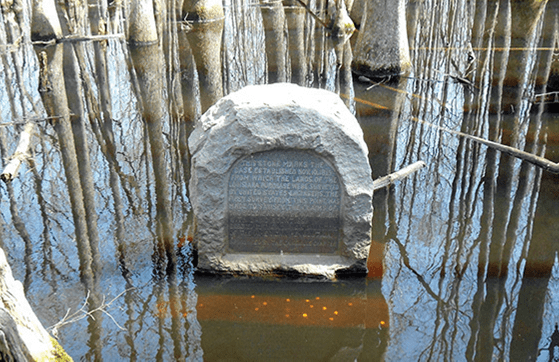
Survey marker erected in 1926 at what is now Louisiana Purchase Historic State Park, photo by Brandon Rush

Today (January 2) at 12 noon, the Central Arkansas Library System Butler Center for Arkansas Studies kicks off its programming for 2019. First up is the monthly Legacies & Lunch program. Today’s focus is on the creation of the Arkansas Territory. The year 2019 marks 200 years since Arkansas was separated from Missouri.

Author and professor S. Charles Bolton, who taught history at University of Arkansas Little Rock for over three decades, will discuss the early history of the geographical region that became the state of Arkansas.

The state was formed on land that was part of the Louisiana Territory for a time before becoming the Missouri Territory. The federal government eventually sent the Hunter-Dunbar Expedition up the Ouachita River, and designated a spot in eastern Arkansas as the starting point for land surveys west of the Mississippi River. The U.S. government also built a military installation on the future site of Fort Smith. These actions  led to the eventual creation of Arkansas Territory in 1819, followed by statehood in 1836.

About Legacies & Lunch

Legacies & Lunch is a free monthly program of the CALS Butler Center for Arkansas Studies that highlights Arkansas-related topics. Programs are held from noon to 1 pm on the first Wednesday of the month. Attendees are invited to bring a sack lunch; drinks and dessert are provided. A library parking discount is available upon request. For more information, contact 501-918-3030.


18 Cultural Events from 2018 – Windgate Center for Art + Design opens at UA Little Rock

Image may contain: sky, cloud, tree and outdoor

Photo of Windgate Center (courtesy UA Little Rock Department of Art and Design)

2. In February, the new WIndgate Center for Art + Design opened on the UA Little Rock campus.  This 65,000 square foot building put, for the first time, all of the art and design programs under the same roof.  In addition to classrooms, it features two gallery spaces.

The Windgate Center of Art + Design building is physically divided into two distinct architectural forms based on the distinctly unique use of the spaces. However both forms are connected and share common building utilities and circulation patterns. The Applied Design area of the building is a single story high bay industrial style space that lends itself to 3 dimensional forms of art. The Visual Arts portion of the building is a 3-story structural steel framed building to house the typical classrooms, galleries, lecture hall, admin area and other miscellaneous spaces that make up the visual arts program.

The Windgate Center of Art + Design building is designed to have a strong community presence to help strengthen the various community partnerships that have been forged over the years. Access for gallery shows, art festivals and other events is an important component in the building design.

Sustainable measures are fully integrated into the building orientation, exterior envelope and support systems to support energy and long-term maintenance efficiencies. The building will pursue LEED Gold and is currently being registered in the LEED Certification program.

As part of the Windgate Foundation’s commitment to the project, the University pledged to raise $3 million in scholarships for art students.

In October of 2018, a new seven foot tall wooden sculpture by Robyn Horn was installed at the entrance to the building and dedicated.