
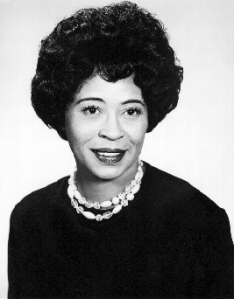
 Daisy Lee Gatson Bates and her husband were important figures in the African American community in the capital city of Little Rock. Realizing her intense involvement and dedication to education and school integration, Daisy was the chosen agent after nine black students were selected to attend and integrate a Little Rock High School.
Bates guided and advised the nine students, known as the Little Rock Nine, when they enrolled in 1957 at Little Rock Central High School. President Clinton presented the Little Rock Nine with the Congressional Gold Medal and spoke at the 40th anniversary of the desegregation while he was in office.
Daisy Bates was involved in more than the Little Rock Nine. In January 1956, she led 27 African American students in their attempt to integrate four Little Rock schools. While the efforts were not successful, they did serve to put the Little Rock School District on notice that the African American community was expecting action on school integration.
In 1959, she was arrested for refusing to provide City leaders with the membership of the local NAACP chapter. The case ended up going to the US Supreme Court as Daisy BATES et al., Petitioners, v. CITY OF LITTLE ROCK et al. The decision had far-reaching impact in stopping government entities from requiring membership rolls as a means of intimidation or curbing the right of public assembly.
When Mrs. Bates died, a memorial service was held at Robinson Center on April 27, 2000. Among the speakers were President Bill Clinton, Secretary of Transportation Rodney Slater, and Rev. Rufus K. Young, pastor of the Bethel AME Church. Others in attendance included Lt. Gov. Winthrop Paul Rockefeller, Mayor Jim Dailey, Presidential diarist Janis Kearney, former senator and governor David Pryor, and five members of the Little Rock Nine: Carlotta Walls Lanier, Ernest Green, Minnijean Brown Trickey, Jefferson Thomas, and Elizabeth Eckford.
It was during his remarks at the service that President Clinton announced he had asked that Bates’ south-central Little Rock home be designated as a national historic landmark.
 One hundred and seven years ago today, Winthrop Rockefeller was born in New York. After moving to Arkansas in the early 1950s, he would establish himself as a positive force for the development of the state.
 The next generation of two longtime Arkansas political families will be the focus of a Clinton School program this evening (March 29).
 Upon his retirement (the first time) from Arkansas Rep, founder and artistic director Cliff Fannin Baker was feted with a special performance celebrating his career with the Rep. The entire evening was called “Ovation!” and included a pre-performance reception, a special revue celebrating Cliff’s career, and a performance of As Bees in Honey Drown, which Cliff directed.
 Little Rock Culture Vulture