Russian Winter (though outside it might as well be Spring)

The warmth and passion of Russian composers are on the bill at the Arkansas Symphony Orchestra this weekend.  Under the baton of Music Director Philip Mann, the ASO performs works by Sergei Prokofiev, Dmitri Shostakovich and Pyotr Ilich Tchaikovsky.

The program begins with one of the greatest of neoclassical works, Prokofiev’s Symphony No. 1 in D Major, Op. 25 “Classical.” This presents the ASO in a masterwork full of youthful vitality. A virtuoso task for the orchestra, its vivacious charm has endeared it to musicians and audiences alike.

Legendary pianist, Dmitri Alexeev, follows with a special performance of Shostakovich’s Concerto for Piano No. 2 in F Major, Op. 102. Shostakovich created this work for his 19 year old son, Maxim, it is a lively and jolly work of light-hearted flair, interrupted by a soulful, romantic second movement which conjures colors and harmonies reminiscent of Rachmaninoff.

Tchaikovsky closes the program with his Symphony No. 2 in C Minor – “Little Russian Symphony.” The work is one of his most optimistic and jubilant works. It is a true masterpiece, successful from its premiere, and full of folk music and fire.

Performances are at Robinson Center Music Hall on Saturday, January 28 at 8pm and Sunday, January 29 at 3pm.

2011 a Record Year for Zoo Attendance

Over 300,000 people visited the LR Zoo in 2011, which was the highest attendance in over ten years.  Daily attendance was 286,815, which was a 16.7% increase over 2010.  When special events were factored in, the attendance figures rose to 307,437.

According to Zoo director Mike Blakely, “There’s no doubt that the public is very excited about the new penguin exhibit and that more people are returning to the Zoo to see the penguins,” he said. “The Zoo also features more daily activities and events such as the Wild Wonders Animal Show and animal encounters that give guests an up-close-and-personal learning experience with animals.”

He Did Return

Today marks the birthday of one of Little Rock’s most reluctant native sons.  Douglas MacArthur was rarely at a loss for words, opinions, or nerve.  But when it came to admitting he was born in Little Rock, he was, reticent.

MacArthur was born in Arkansas by mistake. His mother, the product of multiple generations of Virginia breeding, had wanted all of her children born in Virginia. His father, being a career military man, was stationed in a variety of places outside of Virginia. Thus, the problem.

Mrs. MacArthur was not able to get back to Virginia from her husband’s new assignment in Little Rock. So on January 26, 1880, Douglas MacArthur was born in Little Rock at the U.S. Army Arsenal.  He would be baptized at Christ Episcopal Church, but the family left Little Rock in June 1880.

MacArthur would not visit Arkansas again until 1952 when he was testing the waters for a potential Presidential bid.  At the time, Little Rock had its first (and to date only) Republican Mayor in Pratt C.  Remmel.  The park which now stood where the former military arsenal was located had been named in MacAthur’s honor in 1942.

In the 1952 visit, MacArthur made a speech from the Foster Bandshell in MacArthur Park. He also visited Christ Episcopal Church, though the existing building had been built after his baptism.

The only structure remaining from the Arsenal, the Tower Building, is purportedly the building in which MacArthur was bornSince 2001, that building has housed the MacArthur Museum of Arkansas Military History.  That museum is dedicated to telling Arkansas’ military history past from territorial days onward. While it does have an exhibit about MacArthur, the museum is not solely dedicated to him.

A previous tenant of the building, the then-Museum of Science and Natural History, hosted the premiere of a movie about General MacArthur entitled MacArthur. Gregory Peck played the five star general and attended the premiere.  Though partially inspired by the success of Patton earlier in the decade, this film was not as successful.

General MacArthur is also featured as one of the twenty-five Medal of Honor recipients with Arkansas connections.  The Arkansas State Capitol features a memorial to the honorees.

Arkansas Rep’s TO KILL A MOCKINGBIRD

Scout, Jem, Atticus, Calpurnia and Boo Radley come to life as the Arkansas Repertory Theatre presents the stage version of Harper Lee’s classic To Kill a Mockingbird. This deceptively simple episodic tale of life in the South was adapted for the stage by Christopher Sergel. All of the drama and humor from the novel and subsequent movie are found in the stage version as well.

Arkansas Rep’s Producing Artistic Director Bob Hupp directs this production.  After previews, opening night is Friday, January 27; the production runs through February 12.

John Feltch portrays the noble Atticus Finch with Abby Shourd and Damon McKinnis as his children. Others in the cast include Spencer Davis, Laura E. Johnston, John-Patrick Driscoll, Lawrence Hamilton, Michael Jones, Sam Kitchin, Kathy McCafferty, Jason Collins, Briana Pozner, Alanna Hamill Newton, Verda Davenport, Jackie Stewart, and Tricia H. Spione.  Will Frueauff and Julia Landfair understudy the children’s roles.

The creative team for this production includes Mike Nichols (scenery), Marianne Custer (costumes), Michael J. Eddy (lighting), Matt Duvall (properties) and M. Jason Pruzin (sound).

Art of Architecture: William E. Massie – “Physical Delineations”

This month brings two editions of the “Art of Architecture” lecture series.  Tonight is the second as William E. Massie discusses Physical DelineationsThe program begins at 6:00pm in the lecture hall of the Arkansas Arts Center.

William E. Massie received a Bachelor of Fine Art in Architectural Studies from Parsons School of Design, New York, NY. He subsequently received a Master of Architecture from Columbia University Graduate School of Architecture. Upon graduation he worked for Robertson + McAnulty Architects and James Stewart Polshek and Partners. In 1993 he started his own company while simultaneously accepting a teaching position in the Graduate School of Architecture at Columbia University where he was appointed as the Coordinator for Building Technologies Research.

Massie is currently the Architect-in Residence / Head of Architecture Department at Cranbrook Academy of Art in Bloomfield Hills, Michigan and a Tenured Professor of Architecture at Rensselear Polytechnic Institute in Troy, NY. He has taught at Montana State University in Bozeman, Montana and Parsons School of Design in New York City.

He has participated as a visiting critic at many institutions nationally including, Harvard, Yale, California Polytechnic Institute and Lawrence Technological University. In 2005 he participated as the Keynote Speaker and appointed Bruce Goff Chair at the University of Oklahoma on the future of technology and digital processes in architecture and architectural education.

The 2011-2012 Art of Architecture lecture series is sponsored by the Architecture and Design Network, with support from the Central Arkansas Chapter of the American Institute of Architects, the Arkansas Arts Center and the Fay Jones School of Architecture.

QQA Preservation Conversations: Historic LR Schools

The Quapaw Quarter Association continues its monthly education series this year entitled “Preservation Conversations.” They take place the third Monday of each month at historic Curran Hall, which serves as the QQA headquarters in addition to being the Mayor’s Official Reception Hall.

The 2012 series kicks off tonight with “Historic Schools of Little Rock.”  The featured speaker is Rachel Silva, who is the Preservation Outreach Coordinator for the Arkansas Historic Preservation Program.

This city has a rich history of architecturally significant schools.  Though quite a few have been lost due to lack of care or disinterest in preservation, many are still standing today – even if they do not function as school buildings. The Kramer School, East Side Junior High and West Side Junior High now all serve as residential properties in part or toto. Lee Elementary is now the Willie L. Hinton Neighborhood Resource Center. But Little Rock Central High School, Pulaski Heights Elementary and Middle School and Dunbar Middle School are all historic structures which still serve as schools.

Beginning at 5:00, Curran Hall will be open for patrons to enjoy a glass of wine, programs start at 5:30 p.m. and last for one hour.  After the official program concludes, all are invited to keep the conversation going and enjoy a discounted dinner at nearby Copper Grill, 300 East Third Street.

The Quapaw Quarter Association is a non-profit historic preservation advocacy organization whose mission is to promote the preservation of the historic buildings and neighborhoods of Greater Little Rock. Rhea Roberts is the Executive Director.

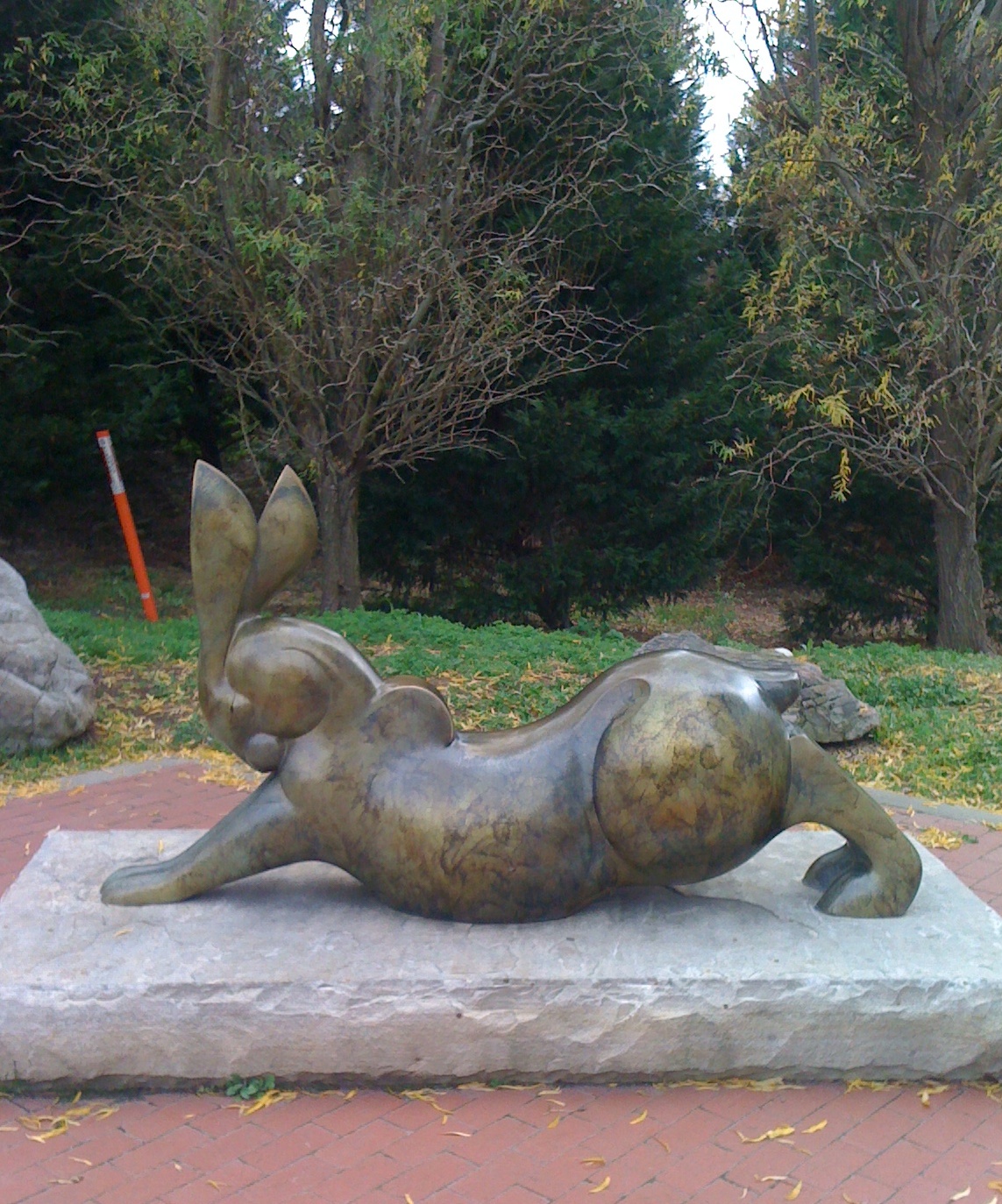
Sculpture Vulture: RABBIT REACH

Tomorrow is the Chinese New Year — it marks the start of the Year of the Dragon.  That means today is the last day of the Year of the Rabbit.

In honor of that, today’s Sculpture Vulture features Tim Cherry’s Rabbit Reach.

The sculpture is located at the corner of Sherman Street and President Clinton Avenue across from the Museum of Discovery.

The sculpture is a gift from Whitlow Wyatt and the Carey Cox Wyatt Charitable Foundation. It was given in memory of George Wyatt and Frank Kumpuris.  Those two gentlemen were the fathers of Whitlow Wyatt and Dean & Drew Kumpuris.

Cherry’s sculpture was selected for this spot because of its proximity to children at the Museum and in the River Market district.  The design and size of the sculpture encourages children to climb on it and to play around the rabbit.  While some public art is situated so it cannot be touched, this one is situated to be touched as part of the appreciation experience.