See SPOKES at Old State House as Car-Free Week Concludes in Little Rock

spokes-small-wideA good way to mark the conclusion of the Mayor’s Car-Free Challenge Week is to visit the exhibit Different Spokes at the Old State House Museum. The exhibit looks at the history of bicycling and places cycling in Arkansas within a worldwide historical context. Visitors will be able to view galleries of artifacts, historical pictures and video to learn the history of bicycles.

As cities and towns begin dedicated services and trails for cyclists, it’s important to note that the enthusiasm for bikes in Arkansas has roots that go back over 100 years,” said Old State House Museum Director Bill Gatewood. “The interest at the turn of the 20th century in bicycles was very similar to the one that we are seeing at the turn of the 21st century.”While the exhibit mainly explores the technological advances of cycling in the past 130 years, Different Spokes also tells the story of competition, economics, and social life. The history of trail systems, cycling communities and history in Arkansas is explored in videos produced by the Old State House Museum. From an 1880 wooden bicycle built from white oak and agricultural implements to the world’s first carbon-fiber bicycles made by Brent Trimble of Berryville, Different Spokes contains artifacts that show this history from past to present. Gatewood says the Museum relied on contributions from the cycling community to present this story. The exhibit will remain on view to February 2016.

“I have not participated in any other exhibit that has had this kind of immediate response from the community,” Gatewood said. “The passion these people have for their pursuit is overwhelming, and I believe it will be reflected well in this exhibit.”

The Old State  House Museum is a division of the Department of Arkansas Heritage.

Little Rock Look Back: Donald Mehlburger, LR’s 62nd Mayor

Mayor D L MehlburgerOn October 19, 1937, future Little Rock Mayor Donald Lee Mehlburger was born in Little Rock.  His parents were Max A. Mehlburger and Mary Lou Covey Mehlburger who also had another son Max C. Mehlburger.

Mehlburger’s first run for the City Board of Directors was in November 1968 when there was an open seat.  At the time he was 30, the youngest one could be and be elected to the City Board.  He lost that race, but eight years later ran again.  This time Mehlburger won the race.  At his first meeting on the City Board, Mehlburger was selected as Mayor of Little Rock by his colleagues.

Prior to running for the City Board the second time, Mehlburger had been appointed to the Planning Commission.  Planning and growth were two important emphases for Mayor Mehlburger, in addition to public safety.  He stressed the importance of quality growth in the edges of the city and a push for a revitalized downtown.  Mayor Mehlburger was also an advocate for public mass transit.

Due to business interests taking up too much of his time, he resigned from the City Board a few months before his term was up.  But he remained engaged in civic affairs.  Historic preservation was important to Mehlburger.  In addition to owning historic properties, he was a founding board member of the Historic Preservation Alliance of Arkansas.  He had graduated from the University of Arkansas and was a member of Trinity Episcopal Cathedral.  He had also been active with the Junior Chamber of Commerce (Jaycees) and Rotary Club 99.

Mehlburger died on May 25, 1992 and was buried at Mount Holly Cemetery.  His grave marker features an engraved sextant which pays tribute to his career as an engineer.  It also notes that he was Mayor of Little Rock.  Mayor Mehlburger was survived by his wife Susan and his three children – Donald Lee Jr., Harry and Katherine.

LR Cultural Touchstone: Kaki Hockersmith

KakiKaki Hockersmith creates art as a designer. In addition, she promotes arts and heritage through her tireless efforts on behalf of numerous cultural institutions.

In 2010, she was appointed to the President’s Advisory Committee on the Arts for The Kennedy Center.  In that capacity, she serves as a national ambassador for The Kennedy Center. She has also brought programs from The Kennedy Center to Arkansas to help established and emerging arts organizations. She also serves as a commissioner on the cultural committee of UNESCO – the United Nations Educational, Scientific and Cultural Organization.

In 1993, she redesigned the interior of The White House during the Clinton Administration. She was also appointed a member of the Committee for the Preservation of The White House.  Her work on this American landmark was featured in Hillary Clinton’s book An Invitation to the White House: In Celebration of American Culture.

Locally, she serves on the Board of Trustees for the Arkansas Arts Center and the Arkansas Governor’s Mansion Association. She is an active supporter of many cultural organizations in Little Rock.  She and her husband Max Mehlburger open their home to host receptions and fundraisers for numerous cultural institutions and organizations.  Earlier this year she was recognized for this support at Ballet Arkansas’ Turning Pointe gala.

Professionally, she has been honored by the national ASID organization as well as the Washington D.C. chapter. Her projects have won 16 regional ASID awards, including seven gold awards.

Little Rock Look Back: Little Rock becomes Capital of Arkansas

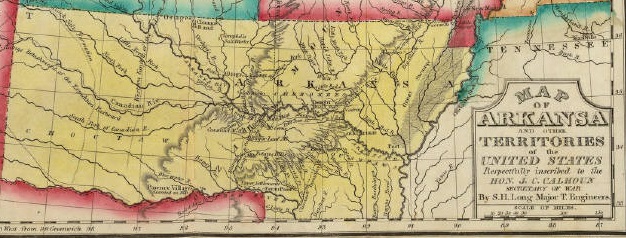
Arkansas TerritoryOn October 18, 1820, Territorial Governor James Miller signed legislation designating Little Rock as the new capital for Arkansas.  This was a mere 10 months after the first permanent settlement was established in Little Rock.

The Act provided that after June 1, 1821, the sessions of the Legislature and the Superior Court would be held at Little Rock.  This caused Arkansas Post, the first territorial capital, to fade from prominence.

The move was made based on the lobbying of Amos Wheeler, Chester Ashley and William Russell.  These men all owned land in the Little Rock area and would benefit from the move of the Capital to Little Rock. The official reason given was Little Rock’s geographical center to the Arkansas Territory and that it was elevated land less prone to flooding.

But as important, Messrs. Wheeler, Ashley and Russell promised to donate land for a capitol building and a guarantee of $20,000 for construction of a suitable building. (That would be the equivalent of $408,000 today.)

Around the time the legislation was approved, several members of the Territorial legislature purchased land around Little Rock.  When a subsequent effort to relocate the Capital upstream was launched, it failed due to the financial ties of these legislators to land in Little Rock.

Brass Blaze at this Weekend’s Arkansas Symphony Orchestra concerts

Photo by Kelly Hicks

Photo by Kelly Hicks

The Arkansas Symphony Orchestra (ASO), Philip Mann, Music Director and Conductor, presents the second concert in the 2014-2015 Stella Boyle Smith Masterworks Series: Blazing Brass. Arkansas Symphony Orchestra‘s Principal Trumpet Richard Jorgensen performs the classic Trumpet Concerto in E-Flat Major by Haydn, and Bruckner’s colossal Symphony No. 7 in E Major completes the program. The Masterworks Series is sponsored by the Stella Boyle Smith Trust. The concert is sponsored by Aristotle, Inc.

The concert takes place at the Maumelle Performing Arts Center, 100 Victory Lane, Maumelle, AR, Saturday, October 18 at 7:30, 2014 p.m., & Sunday, October 19 at 3:00, 2014 p.m.

American Airlines Concert Conversations – All concert ticket holders are invited to a pre-concert lecture an hour before each Masterworks concert.  These talks feature insights from the Maestro and guest artists, and feature musical examples to enrich the concert experience.

Tickets are $19, $35, $49, and $58; active duty military and student tickets are $10 are can be purchased online at www.ArkansasSymphony.org; at the Maumelle Performing Arts Center box office beginning 90 minutes prior to a concert; or by phone at 501-666-1761, ext. 100. All Arkansas students grades K-12 are admitted to Sunday’s matinee free of charge with the purchase of an adult ticket using the Entergy Kids’ Ticket, downloadable at the ASO website.

ARTISTS
Richard Jorgensen, trumpet
Philip Mann, conductor

PROGRAM:
HAYDN: Trumpet Concerto in E-Flat Major
BRUCKNER: Symphony No. 7 in E Major

PROGRAM NOTES:
Anton Weidinger, a trumpeter with the Vienna Court Orchestra, sought a new concerto to show off his new, more versatile type of trumpet. Several composers responded to his request, and Weidinger was delighted to hear of Haydn’s desire to compose the Trumpet Concerto.

The ecstatic reception of the premiere of Bruckner’s Symphony No. 7 – including 15 minutes of applause – marked the greatest success of Bruckner’s life. The work presents all of Bruckner’s principal characteristics: rich spacious themes, rustic dance rhythms in the scherzo, and the extra degree of exaltation which was his alone.

www.arkansassymphony.org/concerts/blazing-brass

About the Arkansas Symphony Orchestra
The Arkansas Symphony Orchestra celebrates its 49th season in 2014-2015, under the leadership of Music Director Philip Mann. ASO is the resident orchestra of Robinson Center Music Hall, and performs more than sixty concerts each year for more than 165,000 people through its Stella Boyle Smith Masterworks Series, ACXIOM Pops LIVE! Series, River Rhapsodies Chamber Music Series, and numerous concerts performed around the state of Arkansas, in addition to serving central Arkansas through numerous community outreach programs and bringing live symphonic music education to over 26,000 school children and over 200 schools.

Little Rock Look Back: City Flag Adopted

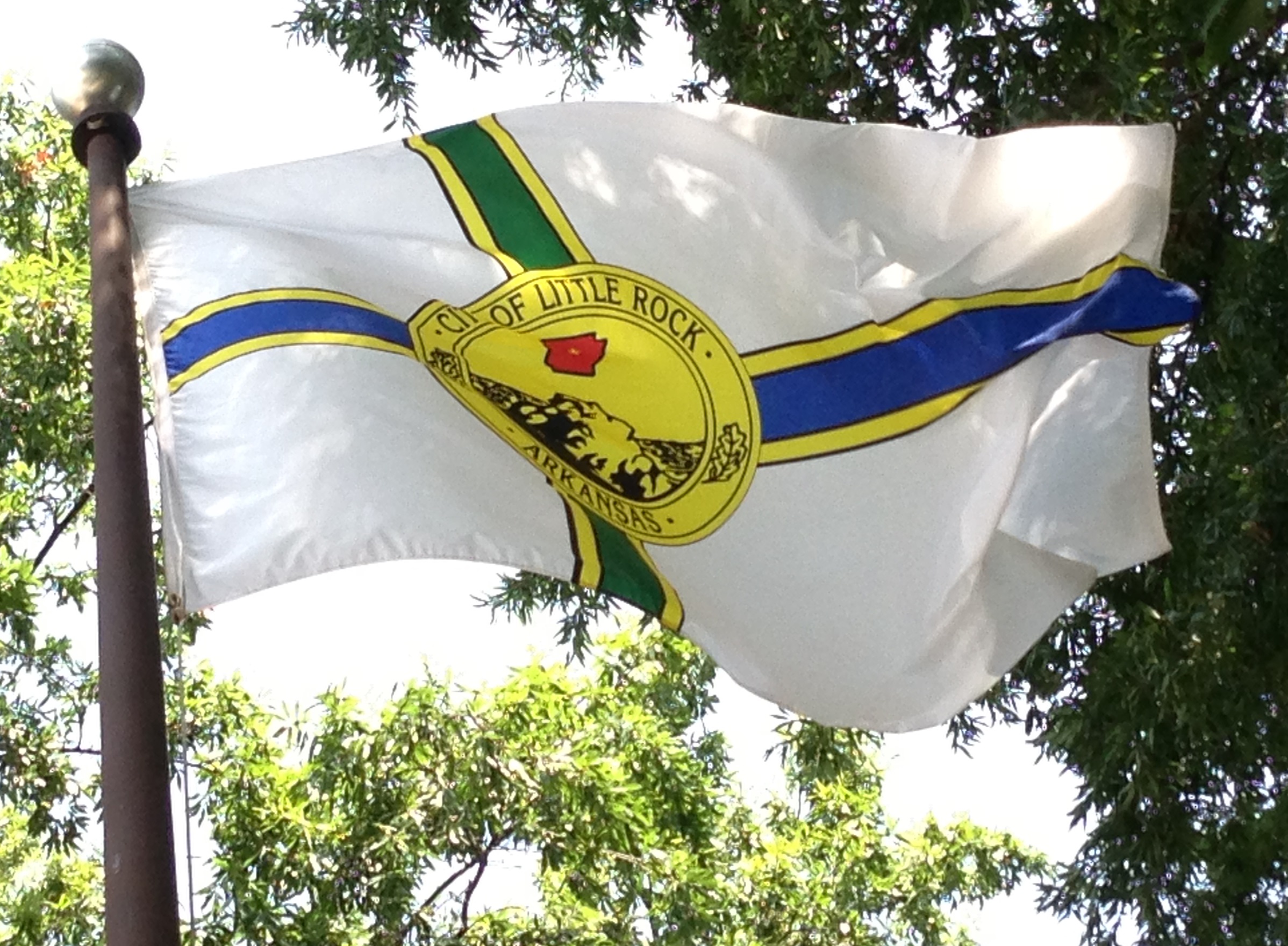
City FlagOn October 18, 1988, the City of Little Rock Board of Directors adopted the first official flag for the City of Little Rock.

The adoption of Ordinance No. 15,566 was the culmination of a design competition which had been spearheaded by Little Rock City Director Sharon Priest (later Little Rock Mayor, Arkansas Secretary of State and now Executive Director of the Downtown Little Rock Partnership).

Prior to the Official Board of Directors meeting that day, a press conference was held in the Little Rock City Board Chambers for presentation of the City’s flag.  The City Beautiful Commission, a commission of the Department of  Parks and Recreation, sponsored a the contest which received a total of fifteen flag designs.

The flags were judged October 12, 1988, by City Directors and City Beautiful Commission Members. Director Sharon Priest presented the winning flag and introduced David Wilson, a law clerk at the Mitchell Law Firm, who designed the flag chosen for the $1,000 first prize. The second-place winner was Craig Rains, who received $500; and the third-place recipient was David Tullis, who received $250.

The flag was adopted by the City Board that night by a 6-0 vote; former mayor and current director Charles Bussey was absent.  Those voting to adopt the flag were Mayor Lottie Shackelford and directors Sharon Priest, Tom Prince, Buddy Villines, Buddy Benafield and Tom Milton.  Priest would be a future mayor while Prince, Villines and Benafield had all served as mayor.

The official description of the flag is as follows:

As the official flag of the City of Little Rock, its symbolism is described as follows: A clean white background of the banner represents the optimism and open potential that the city has to offer. The royal blue horizontal broad stripe symbolizes the Arkansas River which borders Little Rock, and has served as an economical and historical emblem since the city’s beginning. The forest green stripe runs vertical to the royal blue stripe, creating a cross which symbolizes the location and statute of Little Rock—a city serving not only as the crossroads of Arkansas, but a crossroad of the mid-southern United States as well.

The strong forest green color depicts the fields, parks and forests which contribute to the natural beauty of the city. The seal of the flag is a modernized adaptation of the current Little Rock seal. The razorback red silhouette of the great State of Arkansas shows her capitol, the City of Little Rock, represented by the centered star. The star rises directly above “The Little Rock”—the protruding cliff along the Arkansas River, which was discovered in 1722 by French explorer La Harpe, when the city was given the name. The Arkansas River behind the rock and the symmetrical oak leaves in the border of the seal are a stylized illustration of what the flag’s stripes represent—the natural beauty of the city. Finally, the gold color of the seal and bordering stripes symbolize the superior economic history, and the future economic potential that is available in the City of Little Rock, Arkansas.

LR Cultural Touchstone: Garbo Hearne

garboGarbo Watson Hearne has moved from nurturing patients as a nurse to nurturing artists and art collectors.  As the Director of Pyramid Art, Books & Custom Framing and Hearne Fine Art, she has been cultivating artists and collectors for over 25 years.

In 1988, Garbo left her nursing career to establish Pyramid Gallery.  Over the years, the business has expanded its focus and changed locations.  Since 2010, she has been located in the historic Dunbar neighborhood.   Over the years, she has championed local, regional and national African American artists and authors. She has introduced many emerging artists to established collectors.  Having her as a champion has allowed some artists to be able to take risks and to move into different mediums or styles.

The 2010 move to Dunbar positioned Garbo’s businesses (as well as the medical practice of her physician husband) to be anchors in the newly designated Dunbar Historic Neighborhood.  That neighborhood seeks to maintain its historic structures and return to its roots as a mix of residential and office space.  In 2008, she and her husband, Dr. Archie Hearne, published Collaborations, Two Decades of African American Art: Hearne Fine Art 1988 – 2008.

Hearne has served on the board of directors of the Mid-America Arts Alliance, National Assembly of State Arts Agencies, the Arkansas Arts Council (including a term as Chair) and the board of the Arkansas Humanities Council.