Little Rock Look Back: Would Little Rock get a new City Hall and Auditorium in 1906?

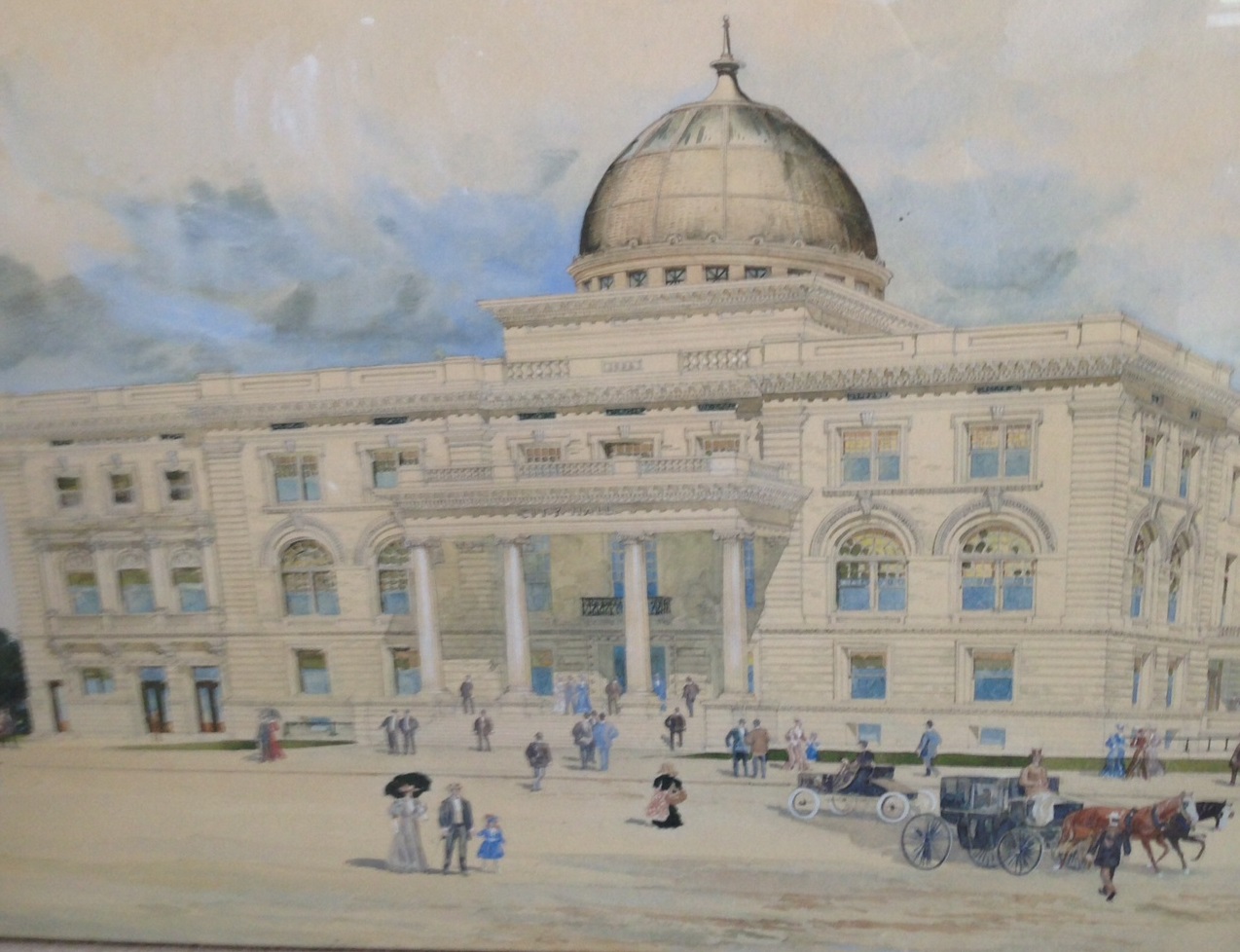
The 1906 plans for City Hall with the Municipal Auditorium on the left portion.

The 1906 plans for City Hall with the Municipal Auditorium on the left portion.

Last week: Little Rock Mayor Warren E. Lenon had been advocating for a new City Hall a municipal auditorium since shortly after taking office in April 1903. After plans were approved in July 1906, a group of citizens, led by Arkansas Gazette publisher J. N. Heiskell, filed suit to stop the City.

The closing arguments in the trial against plans for a new City Hall and auditorium complex had been heard on Monday, July 30.  The case was heard by Chancery Judge J. C. Hart.  Serving as an advisor to Chancellor Hart throughout the trial (though with no official legal standing) was Pulaski County Circuit Court Judge Robert J. Lea.  To accommodate the expected large attendance, the trial had been moved into his courtroom which was larger than Chancellor Hart’s.

On Friday, August 3, Pulaski County Chancery Judge J. C. Hart issued an injunction to keep the City from signing a contract for the construction of a city hall, jail and auditorium.  Chancellor Hart concurred with the plaintiffs that Arkansas’ constitution and laws dictated all taxation must be for public purposes.  He found there was nothing in Arkansas case law which defined an auditorium to be used for conventions as a public purpose.

As had been the case throughout the trial, the tone of the coverage of the decision differed greatly in the city’s two daily papers.  The subheading in the Democrat noted that the plaintiffs would be liable for any losses to the municipal government’s coffers due to a delay in commencing the construction if Little Rock eventually prevailed.  That fact is not mentioned by the Gazette.  Both papers did make note that Judge Lea agreed with the Chancellor’s decision.

For now, it looked as if the City of Little Rock would be stuck in the 1867 City Hall on Markham between Main and Louisiana.  Mr. Heiskell and his compatriots waited to see if the City would appeal the decision.

While August would be a quiet month publicly, work would go on behind the scenes.  More on that, in the future.

Jazz, Funk and Soul Tonight as Art Porter Music Education Week Wraps Up

Art Porter weekThe Art Porter Music Education Work of Art Jazz Week ends tonight with a concert at the Cabe Theatre at Wildwood Park for the Arts.

The evening starts at 8pm and features Jazz, Funk, Soul composed of Jeff Lorber, Paul Jackson, Jr., and Everette Harp as well as the APME Scholarship Award Presentation with musical performances by Dizzy 7 Band and Lexington Porter.

Jeff Lorber is famous for launching the career of Kenny G and his productions and collaborations with such greats as Dave Koz, Janet Jackson, Lalah Hathaway and Miles Davis. He is one of the most sought after producers and performers in Jazz!

Los Angeles session guitarist Paul Jackson, Jr. was one of the most prolific players in R&B during the ’70s and ’80s.  He has supported artists ranging from Michael Jackson  to the Temptations, Whitney Houston, Patti LaBelle, Chicago, Elton John, Dave Koz, Al Jarreau,  and many others.

Everette Harp has recorded and shared the stage with such musical giants as Aretha Franklin, Luther Vandross, Billy Joel and Patti LaBelle. A hit maker in his own right, Jazziz magazine hails his “amazing virtuosity” and Jazz Times calls him “a rare talent.”

Since Jazz Funk Soul began touring in 2013, the popularity of the group and the audience’s enthusiasm has been tremendous. This new album was created to satisfy the demand from their growing audience.

The Dizzy 7 plays music that ranges from Motown to Big Band, Latin to Dixie. It features a full rhythm section, a three-man horn section, and female and male vocalists. Dizzy 7 is composed of accomplished musicians who love what they do.

Alex Bugnon Headlines A Work of Art Concert at Sway

ab_homepageA Work of Art – the Art Porter Music Education Jazz Week continues tonight with two concerts by Alex Bugnon taking place at Sway.  Shows take place at 7pm and 9pm.

He is a jazz pianist and composer from Montreux, Switzerland.  Bugnon studied at the Paris Conservatory and the Mozart Academy in Salzburg. At age nineteen, he moved to the U.S. and attended the Berklee School of Music.

His recording career began with his 1989 debut album “Love Season” which reached the pop charts and the Top 40 of the R&B charts as did his follow-up “Head Over Heels.”  Bugnon toured with “Gospel Leviticus” in the Deep South. He has won two Soul Train Music Awards.

For more information or to purchase tickets, visit the Art Porter Music Education website.

The Studio Theatre celebrates grand opening today

studiotheatreLittle Rock’s newest live performance venue, The Studio Theatre and The Lobby Bar, will celebrate its grand opening this Thursday, July 31. The celebration begins at 2pm with a ribbon cutting hosted by the Little Rock Chamber of Commerce. A reception follows along with theatre tours and live musical performances in The Lobby Bar until 1am.

Located in downtown Little Rock, this is a 99 seat venue. “There are other live performance spaces within walking distance of The Studio Theatre,” says President of the Board and Musical Director, Bob Bidewell. “Lovers of the performing arts now have another first class performance space to consider when making their plans.”

In August, The Studio Theatre and Lobby Bar have a schedule of  productions:

Monday’s at 8pm- Open Mic Night (Lobby Bar-FREE Admission)

August 7- Songwriters Rena Wren & Rodger King (Lobby Bar- FREE Admission)

August 15 & 16- Broadway Concert (Studio Theatre- Ticket Price: $12)

August 29- Rodney Block (Studio Theatre- Ticket Prices: $10-$25)

August 30- Arkansas’ Masters of Illusion (Studio Theatre- Ticket Prices to be announced)

Additionally, Community Theatre of Little Rock recently moved to The Studio Theatre and just wrapped up sold out performances of Rent. CTLR’s next performance is a series of One Acts and runs August 22-24. Visit www.ctlr-act.org for details.

In September, Little Shop of Horrors takes the stage with 10 performances beginning September 11.

Built in 1921, The Studio Theatre and The Lobby Bar are located in the former Balfour Printing building in downtown Little Rock.  For more information, call 501-940-4646 or visit thestudiotheatre.org and on Facebook .

Little Rock Look Back: Jim Dailey – LR’s 71st Mayor

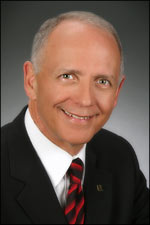
cityoflr_img_board_dailyOn July 31, 1942, future Little Rock Mayor Dalton James “Jim” Dailey, Jr. was born to Dalton and Ellen Dailey.  After graduating from Little Rock Catholic High School, he attended the University of Arkansas at Fayetteville.  He graduated with a Bachelor of Science degree in Business Administration. He joined his father in the family business, Dailey’s Office Furniture.

In 1974, Dailey was elected to the City of Little Rock Board of Directors.  He served one four-year term. The last two years of that term, he was the Vice Mayor of Little Rock.

Following that term, he remained engaged in civic activities including serving in leadership capacities in community campaigns.  He also served as president of the National Office Products Association – the first Arkansan to do so.  Dailey also served as the founding chair of Leadership Greater Little Rock.

In 1988, Dailey was elected to return to the City Board.  He was reelected in 1992.  Dailey served as Vice Mayor in 1991 and 1992.  In January 1993, he was chosen by his fellow City Directors to serve a two year term as Mayor.  Under his leadership, the Future-Little Rock goal-setting process took place.

Following a voter-approved change to the City structure, the position of Mayor was changed to be elected by the people while maintaining the City Manager form of government.  On January 1, 1995, Jim Dailey was sworn in as the first popularly-elected Mayor of the City of Little Rock in over 38 years.

cityoflr_img_mayor_01Dailey has served on the Board of Directors for the Little Rock Regional Chamber of Commerce, Metroplan, Communities in Schools, Arkansas BioVentures and New Futures for Youth. He was appointed to the National League of Cities Board of Directors and the Municipalities in Transition on Public Finance.

As Mayor, he served as Chair of the Intergovernmental Advisory Committee of the Federal Communications Commission. He was also a member of the United States Conference of Mayor’s Communications Task Force.  He also served as president of the Arkansas Municipal League in 2002 and 2003.

While he was Mayor of Little Rock, he was a strong proponent of the development of the River Market and worked to locate the Clinton Presidential Library in Little Rock.  He also worked to increase public safety support.  He also oversaw the establishment of Central Arkansas Water, the development of downtown headquarters for Acxiom Corporation and Heifer International, and the creation of Prevention, Intervention and Treatment programs.  In addition, he was instrumental in leading the efforts for the 40th anniversary of the integration of Little Rock Central High in 1997.

Mayor Dailey was re-elected in 1998 and 2002.  His fourteen years as Mayor of Little Rock set a longevity record.  Upon his retirement the City’s fitness center was renamed the Jim Dailey Fitness and Aquatic Center.  This was in recognition of his lifelong interest in wellness activities.

Since leaving office, he has continued his civic involvement by serving as a member of the Little Rock Airport Commission which oversees the Bill and Hillary Clinton National Airport. He is also involved in commercial real estate.

Since 1965, he has been married to the former Patti Murphy.  They have four children and six grandchildren.

Phone Home – E.T. Closes Out the 2014 Movies in the Park Season

MitP10 ETThe 10th anniversary season of Movies in the Park closes out with the 1982 classic E.T.  Steven Spielberg’s tale of an extraterrestrial who is trying to get home has been a hit since it debuted.

The film stars Henry Thomas, Drew Barrymore and Robert McNaughton as three siblings who befriend the creature. Dee Wallace is their mom.  Others in the cast include Peter Coyote and C. Thomas Howell.

Bring the Reese’s Pieces, ride your bicycle and plan for a magical evening of glowing fingertips, amazement and the uttering of the name “Elliott.”

E. T. was nominated for nine Oscars including Best Picture.  It took home four trophies: Sound, Visual Effects, Sound Effects Editing and Score. The latter award went to John Williams for yet another iconic masterpiece.

Now in its 10th season, Movies in the Park is a free outdoor film series at the First Security Amphitheater in Riverfront Park.  The move starts at dark (around 8:30).

Movies in the Park has grown to a season of eight films per year, on average, reaching audiences of up to 7,000 people. It’s a staple event in Central Arkansas. Communities from across the state, and the country, have reached out for guidance as they have tried to implement similar programs in the own communities.

Since 2008, the Little Rock Convention & Visitors Bureau has been managing Movies in the Park.

Little Rock Look Back: Actor and author Ben Piazza

BdP book photo

BDP LRHS

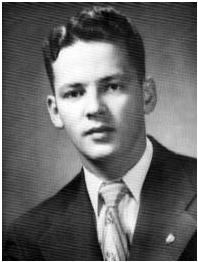
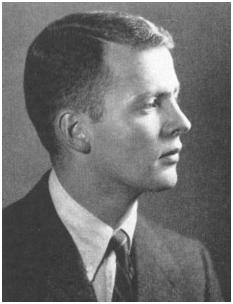
Actor-director-playwright-author Ben Piazza was born on July 30, 1933, in Little Rock.  Piazza graduated from Little Rock High School in 1951 as valedictorian. He also had starred in the senior play that year (The Man Who Came to Dinner) and edited the literary magazine.

Keeping the Tiger as his mascot, Piazza attended college at Princeton University.  While there he continued acting, including an appearance in a Theatre Intime production of Othello.  Following his 1955 graduation, he moved to New York City and studied at the Actor’s Studio.

BDP PU

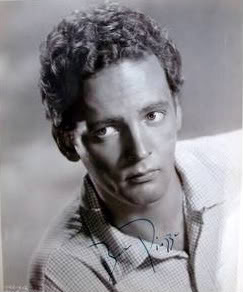
Piazza was an understudy in the 1956 play, Too Late the Phalarope at the Belasco Theatre.  In February 1958, he starred in Winesburg, Ohio sharing the National (now Nederlander) Theatre stage with James Whitmore, Dorothy McGuire, and Leon Ames. Other cast members included Claudia McNeil (who originated the part of Lena in A Raisin in the Sun) and Sandra Church (who originated the part of Gypsy Rose Lee in Gypsy).

In April 1959, Piazza starred in Kataki at the Ambassador Theatre. This two actor play also featured Sessue Hayakawa, who played a Japanese soldier who spoke only his native language.  Therefore, Piazza’s part was largely a very lengthy monologue.  For his performance, Piazza received one of the 1959 Theatre World Awards.

As the 1960s dawned, Piazza joined a small cadre of actors who had achieved status on Broadway who then also returned to acting Off Broadway.  Colleen Dewhurst, George C. Scott, and James Earl Jones were others in this select group who helped establish Off Broadway as an entity in itself, instead of being just a farm team for Broadway.

Piazza started the 1960s on Broadway starring at the Eugene O’Neill Theatre in A Second Stringwith Shirley Booth, Jean-Pierre Aumont, Nina Foch, Cathleen Nesbitt, and Carrie Nye.   Following that, he started his association with Edward Albee by appearing as the title character inThe American Dream.  That play opened at the York Playhouse in January 1961.  Later that year, he appeared in Albee’s The Zoo Story opposite original cast member William Daniels at the East End Theatre.

piazza

Also in 1961 Piazza starred in several plays during a South American tour sponsored by the American Repertory Company.  He played Christopher Isherwood in I Am a Cameraand Chance Wayne in Sweet Bird of Youth.  In 1962, he starred in a series of plays at the Cherry Lane Theatre.  Piazza returned to Broadway to star along with Jane Fonda and Dyan Cannon in The Fun Couple at the Lyceum Theatre. This play had a troubled rehearsal period, which was documented in a short film about Jane Fonda.

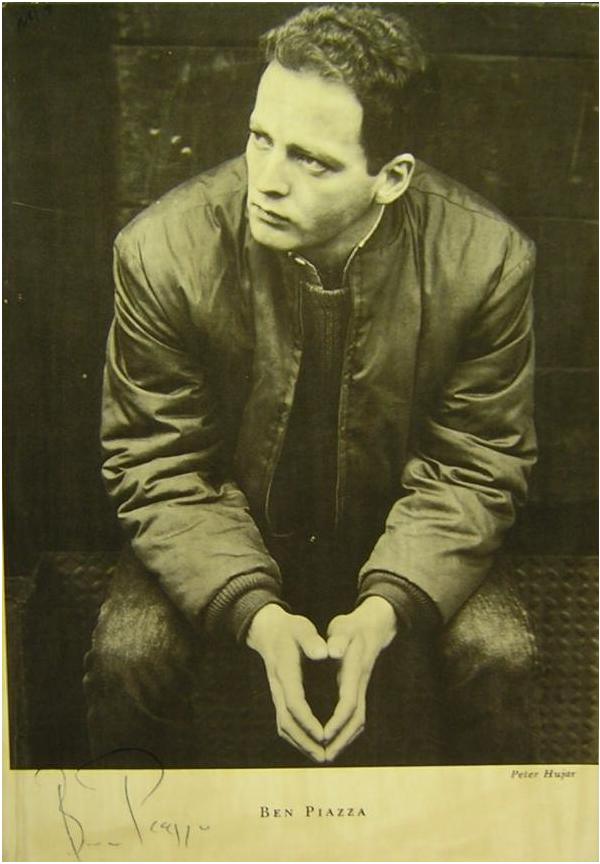
Ben Piazza stayed on Broadway and returned to Albee in February 1963.  He took over the role of Nick in the original run of Who’s Afraid of Virginia Woolf? when original actor George Grizzard left to play Hamlet at the Guthrie Theatre.  (He had participated in earlier readings of the play prior to it being mounted on Broadway.)

This play was at the Billy Rose Theatre, which marked a return for Piazza. He had acted at this theatre when it was the National while doing Winseburg.  Piazza played Nick for the remainder of the run and acted with Uta Hagen, Arthur Hill, fellow Arkansan Melinda Dillon, Eileen Fulton, Nancy Kelly, Mercedes McCambridge, Rochelle Oliver and Sheppard Strudwick.
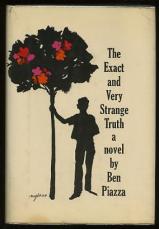
Exact and Very Strange cover

During the run of this show, Piazza’s novel The Exact and Very Strange Truth was published.  It is a fictionalized account of his growing up in Little Rock during the 1930s and 1940s.  The book is filled with references to Centennial Elementary, Westside Junior High, Central High School, Immanuel Baptist Church and various stores and shops in Little Rock during that era.  The Piazza Shoe Store, located on Main Street, was called Gallanti’s.

Following Virginia Woolf, he starred in The Zoo Story at the Cherry Lane Theatre in 1965.  In August of 1967, his play The Sunday Agreement premiered at LaMaMa.  This was Piazza’s first playwright output to be professionally staged.

As Sunday Agreement was opening, Piazza was in rehearsal for his next Broadway opening. He appeared with Alfred Drake in The Song of the Grasshopper in September 1967.  In 1968, he returned to Albee and starred in The Death of Bessie Smith and The Zoo Story in repertory on Broadway at the Billy Rose Theatre.

Later that season, in March 1969, a double bill of his one-acts: Lime Green/Khaki Blue opened at the Provincetown Playhouse.  It was directed by future Tony nominee Peter Masterson and starred Louise Lasser, Robert Walden (who starred in the 2013 production of Death of a Salesman at Arkansas Repertory Theatre), Clinton Allmon and Dolores Dorn-Heft, to whom Piazza was married at the time.

Throughout the 1960s and early 1970s, Piazza toured in many plays nationally and internationally. He also appeared in major regional theatres as an actor and a director.  During this time period he was in productions of Bus Stop, Who’s Afraid of Virginia Woolf?, You Know I Can’t Hear You when the Water’s Running  and Savages.  In 1970, he starred as Stanley Kowalski in a production of A Streetcar Named Desire in New Orleans.  As the 1970s progressed, he turned his focus to television and movies.
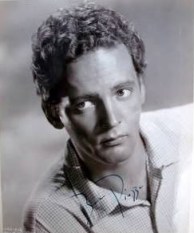
BDP early

Piazza’s film debut was in a 1959 Canadian film called The Dangerous Age. That same year, his Hollywood film debut came opposite Gary Cooper, Karl Malden, Maria Schell and George C. Scott in The Hanging Tree.  Though he received positive reviews for his performances, Piazza chose to return to New York and perform in stage and TV productions.

Throughout the 1950s and 1960s, he appeared in a number of TV shows including Studio One, Kraft Theatre, Zane Grey Theatre, The Naked City and Dick Powell Theatre.  He had a recurring role during one season of Ben Casey and appeared on the soap opera Love of Life.

In the 1970s, he starred in the films Tell Me That You Love Me, Junie Moon; The Candy Snatchers and I Never Promised You a Rose Garden.  He also starred as the City Councilman who recruits Walter Matthau to coach a baseball team in The Bad News Bears.

Among his numerous TV appearances in the 1970s were The Waltons, Mannix, Switch, Barnaby Jones, Gunsmoke, Mod Squad and Lou Grant (where he was reunited with Walden).

BDP final

In the 1980s, he appeared in The Blues Brothers, The Rockford Files, Barney Miller, Hart to Hart, Family Ties, The Winds of War, Dallas, Dynasty, Too Close for Comfort, The A Team, Saint Elsewhere, Santa Barbara, The Facts of Life, Mr. Belvedere, Moonlighting and Matlock.

Piazza’s final big screen appearance was in the 1991 film Guilty by Suspicion.  He played studio head Darryl Zanuck in this Robert DeNiro-Annette Bening tale of Hollywood during the Red scare.

Ben Piazza died on September 7, 1991.