Little Rock Look Back: Little Rock City Hall resumes after Civil War

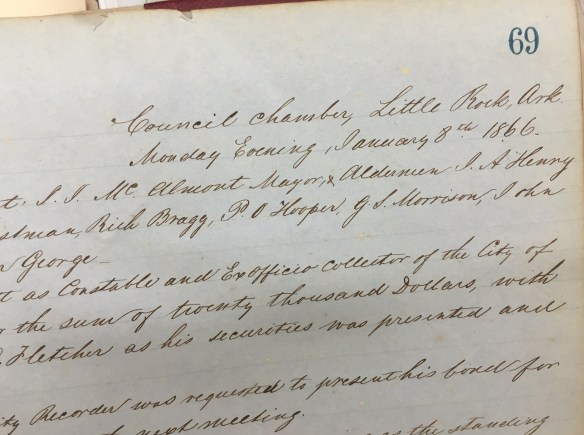
Jan 1866 minsOne hundred and fifty years ago this month, Little Rock City Hall resumed functioning after the Civil War.  The City government had disbanded in September 1863 after the Battle of Little Rock.  From September 1863 through the end of the war (on on through part of Reconstruction), Little Rock was under control of Union forces.

Following the April 1865 conclusion of the Civil War, plans were made to restart local government in Little Rock.  Even though Arkansas would not have Congressional representation in Washington until June 1868 (becoming the second Confederate state after Tennessee), the establishment of local government took place in January 1866.

The first City Council meeting took place on Monday, January 8, 1866. The council met again on Tuesday, January 9 and Monday, January 15 as they were trying to establish committees and rules for the new government.

The first post-Civil War mayor was Dr. J. J. McAlmont, who was a physician and pharmacist. Following his service as the city’s chief executive, he would later be a co-founder of what is now UAMS.  The initial aldermen were I.A. Henry (who had been on the City Council when it ceased in 1863), Henry Ashley, M. H. Eastman, Rick Bragg, P. O. Hooper, G. S. Morrison, John Collins and Alexander George.

Their first action was to approve the bond of Thomas C. Scott as Constable and City Collector.  Vouching for him were S. H. Tucker and John Gould Fletcher.  The Recorder was asked to present his bond and the next meeting.

The Mayor then established several committees of the City Council and named his appointments. Among the committees were Finances, Streets, Ordinances, Mount Holly Cemetery, Fire Department and Police.

That meeting and the following two meetings, the City continued to approve motions, resolutions and ordinances to set up the duties and responsibilities of a government.

Ordinance Number 1 established the rates of Licenses for 1866.  Among those were:

  • $100 for the privilege of selling goods at auction
  • $20 for a one-horse wagon, paid quarterly
  • $35 for a two-horse wagon, paid quarterly
  • $50 for a four-horse wagon, paid quarterly
  • $25 to run a cab or bus (which would have been in some horse drawn conveyance), paid quarterly
  • $40 a month to sell liquor, wine, ale, beer, etc., by the glass or bottle to be consumed in a store, tavern, shop or store
  • $25 each quarter for each billiard table
  • $50 each quarter for each ten pin alley


Little Rock Look Back: Robinson Baskeball Arena

Former entrance to Robinson off Garland Street. Used to attend basketball games.

Former entrance to Robinson off Garland Street. Used to attend basketball games.

While Joseph Taylor Robinson Memorial Auditorium is known today as a performance and meeting venue, in its early days it was also the home to sports. Seventy-six years ago tonight the first basketball game was played at Robinson.

One of the first regular activities which took place in the lower level exhibition hall was a series of boxing and wrestling matches.  Building on the success of this, basketball came to the convention hall in January 1940.

A series of games featuring Little Rock High School and North Little Rock High School were announced by Coach Earl Quigley to take place from January 11 through February 16, the official opening day for the facility.

At that time, neither high school had a gymnasium; therefore both schools played their basketball games on their school auditorium stages with fans seated in the audience. The convention hall offered a regulation size floor (made of pecan block parquet) with seating for over 1,300 people along the sidelines and in the balcony.  The first men’s basketball game in Robinson Auditorium took place between the Little Rock High School Tigers and the North Little Rock High School Wildcats on January 11, 1940.

The Tigers lost the game before a crowd estimated to be 1,300.  Earlier in the evening there had been an exhibition between two women’s basketball teams.  The cost for admission to the games was 35 cents for the reserved seating and 25 cents for general admission.

Little Rock Look Back: Final meeting of Pulaski Heights City Council

Final PHCC mtg

The signatures by Recorder A. M. Edwards and Mayor L. H. Bradley on the final Pulaski Heights City Council minutes.

100 years ago today, the Pulaski Heights City Council held its final meeting.  Following the January 4 annexation election, Mayor L. H. Bradley convened the Pulaski Height City Council for the final time on January 10, 1916.

Five of the eight aldermen were present for the final meeting.  E. T. Reaves, R. G. Trickett, W.A. Turner, J. B. Webster, and H.C. Locklar.  Absent were J. S. Murphy, J.H. Hicks, and W. H. Keeton.

The City Recorder was A. M. Edwards, while O. E. White was Treasurer and Jonathan P. Streepey was City Attorney.

At the meeting, bills were paid and allowances were made for the transfer of assets and responsibilities to the City of Little Rock.  The minutes do not reflect if there were any valedictory addresses by any of the elected officials, which were common at that era.

Once Mayor Bradley and the Council had worked their way through the agenda, Alderman Reaves made the motion to adjourn the council sine die which was seconded by Alderman Webster. The motion passed unanimously.  With that, the Pulaski Heights City Council, which had first met in 1904, finished its business.

Little Rock Look Back: Senator Joseph T. Robinson Funeral at Little Rock First Methodist

Senator Joseph Taylor Robinson

Today, Arkansas political icon and longtime United States Senator Dale Bumpers is being remembered in a memorial service at Little Rock’s First United Methodist Church.

On another Sunday afternoon, this time in July 1937, another United States Senator and former Arkansas Governor was also remembered in a service in the same church.  That man was Joseph Taylor Robinson.

Unlike Senator Bumpers, Senator Robinson died in office. Both men, however, shared many of the same qualities. Both were recognized as leaders within their parties and within the Senate. Both were counselors to Presidents. Senator Robinson was usually President Franklin Roosevelt’s point person to shepherd legislation on Capitol Hill.  Senator Bumpers worked closely with Presidents Carter and Clinton.  Both men flirted with national politics. Robinson was the Vice Presidential nominee of the Democratic Party in 1928. Bumpers seriously contemplated a run for the White House on more than one occasion.

It seems fitting that Senator Bumpers would be memorialized at a place of worship which had also been the site of the final rites for another Arkansas lion of the Senate.

Senator Robinson died in Washington D.C. on July 14, 1937.  His wife was in Little Rock making preparations for a trip the couple was to take. Following his demise, Mrs. Robinson went to Washington to accompany her husband’s body back to Arkansas.

The Senator was honored with a memorial service in the Senate chambers on Friday, July 17.  President Roosevelt and the cabinet joined members of the senate on the floor in what was described as a state funeral without pomp.  Mrs. Robinson sat with her brothers and two nephews as well as Bernard Baruch and Arkansas Power & Light’s Harvey Couch, who were Senator Robinson’s closest friends.  Eleanor Roosevelt was one of the many crowded in the senate galleries observing the service.  Following the service his body remained in the chambers until it was transferred to a train to make the journey to Little Rock.

The funeral train bore his body, his family, 50 senators and over twenty congressmen. It reached Little Rock around 8am on Sunday the 19th.  From there, Senator Robinson’s body was taken to his house on Broadway Street until noon.  It subsequently lay in state at the Arkansas State Capitol until being escorted by military to First Methodist Church.

1,500 people packed the church a half hour before the service began. The sun shone through the windows onto the flag-draped coffin as Rev. H. Bascom Watts led the service. Among the pallbearers was former Vice President Charles G. Dawes. Governor Carl Bailey of Arkansas was joined by Governors Richard Leche of Louisiana and E.W. Marland of Oklahoma.

As the funeral procession reached Roselawn Cemetery, thunder echoed. The skies which had alternated between sun and rain that day, returned to rain. A deluge greeted the end of the service and sent visitors hurrying for shelter at the end.


Arkansas Rep welcomes WINDFALL creative team to LR

In June, the Arkansas Repertory Theatre will close out its 40th season with the world premiere of Scooter Pietsch’s WINDFALL. 

The playwright, director and producer of the play are in Little Rock this weekend to start the audition process for that production. 

The play will be directed by Tony winner Jason Alexander and produced by John Yonover.  It will run from June 8 to June 26. 

WINDFALL is set in a small data processing business in Ohio. It examines the impact that winning the lottery might have on four co-workers out to escape from working for a maniacal boss. A dark comedy, it combines wordplay and physical action as it showcases the workers in their dreary workplace. 

Following auditions in Little Rock, Pietsch, Alexander, Yonover will travel with Rep Producing Artistic Director Bob Hupp to New York City for more auditions. Rehearsals will begin in Little Rock in May. 

Sculpture at the River Market Show seeking artists; 2016 Monument Sculpture Competition winner will be placed at Central High

Sculpture at the River MarketThere is a very rare opportunity for an artist to have their work permanently displayed on the grounds of historic Central High School.  The recipient of the Sculpture at the River Market 2016 Monument Sculpture Commission Competition will have just that chance.  The installation will take place in 2017 to commemorate the 60th anniversary of the integration of Central High School.

This will be a $60,000 to $80,000 Award.  Artists selected into the 2016 Sculpture at the River Market Show & Sale in Little Rock, Arkansas will be eligible for the Central High School Monument Commission Competition. Only 50 artists will be selected to participate in the Show and Sale.

The River Market Sculpture Show and Sale dates are April 22-24, 2016.
Click here for a SHOW application.     Deadline to submit an application to the show is January 14.
centralentranceThe site for this year’s contest will be a space where two sidewalks converge to start the curved ramp that will lead to the front doors of Central High School. The site is street level, so the sculpture can be seen from both sides of the street and will be a focal point as you start ascending to the porch and the front doors.
The design should not be restrained by the historical events that occurred at Central High School. The entry can convey some aspect of the events of 1957, but can represent many other feelings such as hope, togetherness, the importance of education, opportunity, or any other positive feeling that would impact students and visitors to this important landmark. It can be solemn or whimsical, or it can be figurative, abstract or interactive.

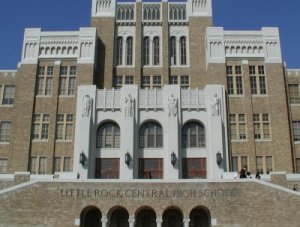
About Central High School:  In 1957, the nation watched the Little Rock Nine story unfold as nine black students attempted to enter the previously all-white school. With the help of television news, then in its infancy, the events commanded worldwide attention. Little Rock came to symbolize the federal government’s commitment to eliminating separate systems of education for blacks and whites. When Little Rock Central High School was built in 1927, the American Institute of Architects named Central High School, “The Most Beautiful High School in America”. The high school is still operating today and is the only functioning high school to be located within the boundary of a national historic site.

Click here for a drawing of the COMPETITION site and more information about the COMPETITION.

For Show information visit www.sculptureattherivermarket.com or email SculptureAtTheRiverMarket@ymail.com.

The Arkansas Arts Center seeking entries for 58th Annual Delta Exhibition

58thDeltaThe Arkansas Arts Center, the state’s premiere center for visual and performing arts, announces a call for entries for the 58th Annual Delta Exhibition which will be on display June 10 – August 28, 2016. The deadline to submit entries is March 11.

“As one of the most anticipated Arkansas Arts Center events of the year, the 58th Annual Delta Exhibition offers a unique snapshot of the talent located in the Delta region,” said Arkansas Arts Center Executive Director Todd Herman. “This exhibition allows artists to lead and inspire their communities through art, education and cultural excellence.”

The competition is open to all artists who live in or were born in one of the following states: Arkansas, Louisiana, Mississippi, Missouri, Oklahoma, Tennessee and Texas. All work must be completed during the last two years and must not have been exhibited previously at the Arkansas Arts Center.

Elizabeth K. Garvey will serve as juror for the 58th Annual Delta Exhibition. Garvey is the co-founder and owner of Garvey-Simon Art Access, Inc. Prior to her current role, she was co-director of the venerable Schmidt-Bingham Gallery in New York, where she worked from 1989-1998; and then president and owner of EKG Art Advisory, (1999-2009). She has been a fine art dealer and advisor in New York City for over 20 years and leverages her professional relationships with galleries, auction houses, private dealers and artists to offer clients a relaxed entry into the often intimidating visage of the New York art world. Garvey maintains a boutique gallery in Manhattan that is focused on drawing, works on paper, unusual materials and design; while also acting as curator and advisor to select private clients. She is a member of ArtTable, and a founding member of the New York chapter of the Association of Women Art Dealers.

Garvey will select the artworks to be exhibited and will assign the $2,500 Grand Award and two $750 Delta Awards. Additionally, a $250 Contemporaries Delta Award will be selected by the Contemporaries, an auxiliary membership group of the Arkansas Arts Center. Artists and AAC members will be invited to attend a special reception and exhibition preview on Thursday, June 9 during which the 58th Annual Delta winners will be announced.

The Delta Exhibition of Painting and Sculpture was founded in 1958 to feature contemporary work by artists from Arkansas and the bordering states. Today, the Annual Delta Exhibition has grown to encompass works in all media and is a showcase for the dynamic vision of the artists of the Mississippi Delta region. The diversity of their art reflects the region’s strong traditions of craftsmanship and observation, combined with an innovative use of materials and an experimental approach to subject matter.

Artists will be responsible for all shipping arrangements. Interested parties may enter their information and upload images of their work at ArkansasArtsCenter.org/delta by March 11, 2016. The entry fee is $20 for one entry and $10 for each additional entry. Artists are limited to three entries. Notifications will be mailed on March 30 and all accepted work must be received by April 27. This year’s exhibition will be on view June 10 – August 28.

The 58th Annual Delta Exhibition is sponsored by Isabel and John Ed Anthony, Bank of the Ozarks and the Delta Regional Authority. The Grand Award is supported by The John William Linn Endowment Fund. The exhibition is supported by the Andre Simon Memorial Trust in memory of everyone who has died of acquired immune deficiency syndrome (AIDS).