RobinsoNovember: Ribbon Cuttings at Robinson Center

j-v-and-ewilda

In this ARKANSAS GAZETTE photo, Mayor Satterfield looks on as Mrs. Robinson cuts the ribbon to open Robinson Auditorium.

Today (Thursday, November 10) at 10am, the ribbon will be cut on the newly restored Robinson Center.  It seems like a good chance to look back at two prior ribbon cuttings for the building.

The original ribbon cutting was supposed to be outside on the evening of Friday, February 16, 1940.  It was moved indoors due to rain and cold temperatures.  The ribbon was originally to be stretched across the front columns, but instead was stretched across the front curtain.  The white satin ribbon stood out against the royal blue velvet curtains.

Four people participated in the ribbon cutting:  Little Rock Mayor J. V. Satterfield, Mrs. Ewilda Robinson – widow of Senator Robinson, Mrs. Emily Miller – sister-in-law of Senator Robinson and a member of the auditorium commission, and a D. Hodson Lewis of the Little Rock Chamber of Commerce.  Mr. Lewis emceed the brief program, which was was broadcast live on a Little Rock radio station.  It consisted of Mr. Lewis introducing Mayor Satterfield, Mrs. Robinson and Mrs. Miller.  Mrs. Robinson chose not to make remarks.  Mayor Satterfield spoke briefly (a whopping twenty-nine words).  Then Mrs. Robinson cut the ribbon.  It took a couple of tries for her to get the scissors through the fabric on the ribbon.

Following that the building was officially opened.

In the late 1960s, City leaders started making plans for a renovation and expansion of Robinson Auditorium into a convention center.  In September 1973, a second ribbon cutting was held to celebrate the opening of the renovated space.  That ribbon was bright red and stretched from Ashley Street along Markham, wrapped into the side doors, and then back outside across the front of the building.  At the ceremony, Advertising and Promotion Commission Chairman Warren “Bud” Baldwin joked that they were having the longest ribbon and the shortest ceremony.

While the ribbon may have been long, the ceremony was not short.  Well, perhaps by ribbon cutting standards it was short, but it was certainly longer than the 1940 edition.  Among those participating in the ribbon cutting were Governor Dale Bumpers, Little Rock Mayor Bill Walters, and Miss Little Rock Risa McLemore.  The ribbon was cut by Miss McLemore and Ken Johnson of the Central States Shrine Association.  Over 14,000 Shriners were the first large convention in the new space.

Little Rock Look Back: Roosevelt Thompson

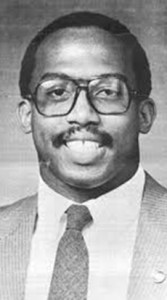
thompson-rooseveltThis evening, Calhoun College of Yale University will have a special ceremony to officially dedicate the dining hall in memory of Roosevelt Thompson.

Thompson, who had been named a Rhodes Scholar, was killed in a traffic accident in March 1984 during his senior year.  He was returning from a visit to his hometown in Little Rock.

An undergraduate prize for public service is named in his memory. Recipients of the Roosevelt L. Thompson Prize are Yale College seniors judged to be outstanding for dedication to public service–service to “the team, the college, the community” and exemplify great human warmth, commitment to fairness, compassion for all people, and the promise of moral leadership in the public sphere.

Yale has produced a video about Thompson, which can be seen here.

Thompson was an outstanding student while at Little Rock Central High School.  His funeral was held in the auditorium there, which has since been named in his memory.  Among those who attended his funeral were Governor and First Lady Clinton.  Gene Lyon wrote an obituary for him which appeared in an April 1984 issue of Newsweek.  In addition to the Central High auditorium, a west Little Rock CALS library branch is also named in his memory.

Born on January 28, 1962, to the Reverend C. R. and Dorothy L. Thompson, he was active in school plays, the school newspaper, and various academic groups, and he was named the All-Star player on the football team in his senior year, during which he also served as student-body president. He went on to become a National Merit Scholar.  The 1980 Pix yearbook is filled with images of him.

He continued to make a lasting impact at Yale.  In 2015, a movement started to rename Calhoun College in his honor. The feeling was that John C. Calhoun, as a slaveholder, was not a worthy eponym for the college.  While the university trustees opted to not rename the college, the head of the college used her prerogative to name the dining hall in his memory.  As a student of Calhoun College, Thompson spent much time in this selfsame dining hall.

RobinsoNovember: Duke Ellington

On September 1, 1961, Duke Ellington announced he was cancelling his upcoming appearance at Robinson Auditorium. Ellington, who had previously appeared at Robinson at least once prior (on November 7, 1951), had been announced for a concert in late August.

In those days, Robinson did not have a formal box office.  Tickets were sold at various businesses, usually record stores.  When some African Americans called to inquire about tickets and were told they were only available in the segregated seating section of the balcony, they protested to the NAACP.  The local chapter then announced that it would encourage Ellington to cancel his concert.  The NAACP had a policy that they would boycott performers who ever played at segregated houses.  Since Robinson was still segregated, future Ellington appearances would have been met with boycotts.

The local presenters for the Ellington concert tried to negotiate a deal with the Auditorium Commission.  They were not successful.  One misguided commissioner stated, “Integration may be the law of the land, but it is not the law of Robinson Auditorium.”  When they commission refused to back down, Ellington cancelled.

This was only the latest in a string of issues surrounding the desegregation of Robinson.  The theatrical and opera producer organizations had both indicated that their touring shows would no longer play at segregated houses.  More and more entertainers were declining to play at segregated houses.

The Auditorium Commission was trying to balance their fear of lost revenue from cancelled bookings with their fears of poor attendance by audiences that did not want integration.  In a decade of rapid change, the commissioners tended to be older less likely to embrace change.

In 1962, a lawsuit was filed to integrate Robinson, city parks, and other public facilities.  It was settled in 1963 when the federal judge ruled against the City.  The Duke Ellington incident was often mentioned in media stories around the lawsuit.

RobinsoNovember: Election Days in 1937, 1940 and 2013

Since today is Election Day, it is appropriate to look back at the three different campaigns to build, furnish, and restore Robinson Center Music Hall.  (Note, there have been at least two other General Capital Bond elections which contained money for Robinson, but those were not stand alone elections about the auditorium and have thus been excluded.

1937-robinson-election1937

On January 26, 1937, Little Rock voters were asked to approve three bond programs which would build a municipal auditorium, expand the City library, and construct a park for African Americans.  Each issue had its own group of supporters, though they all encouraged “Yes” votes for each question.  The “Forward Little Rock Committee” (sometimes referred to as the “Little Rock Forward Committee) was headed by W. H. Williams and led the charge for the auditorium.   The bonds for the auditorium would be $468,000 in general obligation bonds which would be paid off between 1940 and 1971.  This was toward a total cost of $760,000 for the entire project.

The campaign stressed the economic benefits from all the conventions which would be held in Little Rock after an auditorium was constructed.  The focus was as much, if not more, on the exhibition hall space as it was about the music hall space.   The Municipal Auditorium had the lowest level of support of all three issues, but it still passed overwhelmingly.  It is interesting to note that the design featured in the campaign ad bears little resemblance to the project which was actually constructed.

The final vote total was 1,518 for and 519 against. The project passed in each of the City’s 23 precincts.


1940-robinson-election1940

Because the project ran out of money, Robinson Auditorium opened in February 1940 with out any landscaping, furnishings in the meeting rooms, and a lack of equipment in various areas throughout the facility.  To remedy this, additional bonds for the auditorium were added to a request put to the voters on April 2, 1940.  The dollar amount was $30,000 for the completion of the project.  The other two issues were additional fire equipment and establishment of an administrative building at the municipal airport.

The campaign for the new bonds used a similar structure and message as the 1937 election to build the auditorium.  There were newspaper ads by the steering committee (this time simply called the Citizen’s Committee and led by Omar Throgmorton) and support from civic organizations.  One thing very different from the 1937 campaign was the presence of an actual building.  On Sunday, March 31, just two days before the election, there was an open house for the public to explore the edifice.  From 1:00 p.m. to 9:00 p.m., members of various Little Rock Boy Scout troops led 4,000 visitors on tours of the auditorium.  Visitors were shown all over the building; one scout calculated that the walking tour equated to two miles.  Though most people were from Little Rock, the guest registry indicated visitors from California and Pennsylvania

On election day, the Auditorium bonds passed with a vote of 1,413 to 423.  Every precinct in every ward of the city voted in favor of the new bonds.


restore-robinson-20132013

In an effort to bring Robinson Center Music Hall into the 21st Century, the Advertising and Promotion Commission (which took over administration of Robinson in 1971) leadership decided to dedicate the renewal of their bonds to the renovation of Robinson.  What had been built as a 1940 civic auditorium did not meet the artistic or convention needs of the 2010s.  The Restore Robinson Committee was led by former LR Mayor Jim Dailey, civic leader Charles Stewart and A&P Commissioner Capi Peck.  In campaign literature Mr. Stewart noted: “An upgraded Robinson will allow thousands of children and residents from Little Rock to enjoy future dance recitals, graduations and community gathering in a spectacular new performance and events center.”

Plans called for taking the historic building down to its exterior walls (except for the front lobby which remained).  The music hall level was to be dropped 30 feet to street level.  A new conference center would wrap around the northern facade of the structure.

The referendum passed with 5,183 For vs. 1,800 Against.

The building closed on July 1, 2014 with a ceremonial breaking of the stage flooring.  On July 1, 2015, the reconstruction “topping out” ceremony took place.  The ribbon cutting for the new structure will take place on November 10, 2016, at 10 a.m.

Little Rock Look Back: November 8 Presidential Election Arkansas Newspapers

November 8 has been a Presidential Election Day in Arkansas six times.  The first time such a date happened in the US, Arkansas did not participate because it was 1864.  The times it has happened have been 1892, 1904, 1932, 1960, 1988, and today.

A look back at newspaper headlines from the previous years tells a lot about not only the elections, but also the way news was delivered.  For the 1892 and 1904 elections, only the Arkansas Gazette is available.  Though the Arkansas Democrat existed, it did not yet publish every day.  Tuesdays do not appear to have been dates it was published.  (The Gazette itself would not be at seven days until the early 1900s when it finally started publishing a Monday edition.)

elex-ag-1892The 1892 election day Gazette intersperses news stories with advertisements.  One headline states poetically:  “Ballots: Like flakes of snow they will gently fall throughout the Union today.”  Another headline stated “Confident.  Democrats everywhere feel assured of Grover Cleveland’s election today.”  Indeed, Cleveland returned to the White House in 1892 after four years of Benjamin Harrison.

elex-ag-04By 1904, most front page advertising at the Gazette had been banished from the front page, although an small box ad for Blass Department Store is at the top.  Only three of the seven columns on the front page have above-the-fold headlines devoted to election stories, and two of those are about the State of New York.  This reflects new editor J. N. Heiskell’s desire to have the Gazette be national in scope. While early Gazettes often relied on national news to fill space, by the post Reconstruction era, the focus was largely on local news.   The lone local headline was “Arkansas will go Democratic” which was certainly a foregone conclusion at the time.  While Arkansas did go Democratic, Theodore Roosevelt kept the presidency in the hands of the GOP.  Interestingly another headline was about efforts to get Prohibition adopted in the state.  It would become an election issue for years to come.

elex-ag-32By 1932, both the Gazette and Democrat published Election Day editions.  The Gazette’s stories included predictions that FDR would win and a record number of ballots would be cast.  There were also separate stories which highlighted the final day of campaigning for both FDR and Hoover.  One of Mr. Heiskell’s above-the-fold editorials encouraged voting No on a variety of measures which dealt with public school financing, sales tax reduction, bond issuance, and reorganization of county election commissions and state government.

elex-ad-32The afternoon Democrat featured stories on Hoover and FDR in the last hours of the campaigns. Like the Gazette it anticipated a record turnout and showed that Pulaski County was experiencing heavy turnout.  The headline trumpeted that FDR had a lead as early results were starting to trickle in.  The Democrat also offered succinct analysis of key battleground states.  In the end, FDR did carry 42 of the 48 states in an election that saw a record of 38,582, 531 people casting votes for one of the two top candidates.
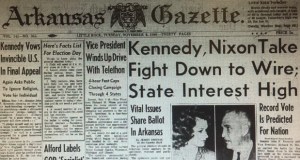
elex-ag-60The 1960 election ended up being one of the closest in popular vote in US history, with only 112,827 votes separating JFK from Nixon.  The Gazette headline was “Kennedy, Nixon take fight down to wire; State interest high.”  The front page also featured stories about Kennedy’s and Nixon’s last full day on the campaign trail.  A box on the front page reminded readers that liquor stores and beer sales could not take place during polling hours. Only persons who had paid their 1960 poll tax were eligible to vote–with an exception made for those who turned 21 after the poll tax deadline and through election day.  The last reminder was that the names of the parties, but not the candidates themselves, would appear on the ballot in the presidential race.
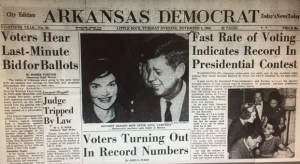
elex-ad-60The afternoon Democrat ran a large photo of Jackie and JFK after they had voted and a slightly smaller one of the Nixon family voting.  Two stories discussed the record turnout that appeared to be taking place — one was on a national scale, and the other was focused on Arkansas.  There was also a story on last minute campaigning.  In the end, over 68,000,000 votes were cast which was a record at the time.

elex-ag-88The most recent presidential election to take place on November 8 was in 1988.  It featured Vice President George H. W. Bush against Massachusetts Governor Michael Dukakis.  The Gazette (covering its final presidential election — though no one knew it at the time) featured a story on Bush and Dukakis in the final day of campaigning.  It also featured a guide to watching the returns and discussed how the networks made their decisions about calling states.  There was also a box highlighting key battleground states which included Massachusetts, Pennsylvania, New York, Illinois and Texas.  Interestingly, two of those were the home states of the candidates.

elex-ad-88By 1988, the Democrat had been a morning paper for several years going head to head with the Gazette.  It carried its own photos of Bush and Dukakis on the final full day of campaigning.  An inside story was highlighted on the cover which featured a Monday rally in Little Rock with Texas Senator Lloyd Bentsen (Dukakis’ running mate).  The 1988 campaign was long, by the standards of the time, but would be considered abbreviated today.  The 1988 election would mark the third consecutive presidential election that the GOP candidate carried Arkansas.

Little Rock Look Back: Election Day 1966

The Britts, Rockefellers and Hammerschmidts

Fifty years ago today was Election Day 1966. It was a seismic election for Arkansas. Winthrop Rockefeller was chosen as Arkansas’ 37th Governor, defeating Jim Johnson. (An earlier version of this incorrectly listed Jim’s wife, Virginia.  She would run for the Democratic primary in 1968, losing to Marion Crank.) In addition, Maurice “Footsie” Britt was elected Lieutenant Governor, Joe Purcell was chosen as Attorney General, and John Paul Hammerschmidt & David Pryor were both new faces in the Arkansas congressional delegation.

Rockefeller, Britt, and Hammerschmidt made waves as the first Republicans to hold those offices since Reconstruction.  But perhaps more importantly, when joined by Pryor and Purcell, the five represented a new face and outlook on Arkansas politics. They were progressive and centrist. They saw a different role for government in social and moral questions.

This election set the stage for Arkansas of the 1970s and 1980s. It was a repudiation of the overtly racist Faubus-era political old guard.  It was certainly not the end, however. In the 1968, 1970 and 1972 elections, Faubus and his cronies would try to reassert themselves in statewide races and would continue to see allies win local races.

But it would be the 1966 election which marked a turning point in Arkansas politics.

Little Rock Look Back: Airport Commission Created by LR Voters

lr-airport-commission-electionOn November 7, 1950, Little Rock voters approved the creation of the Little Rock Airport Commission.  This was an extremely rare initiated ordinance.

Local business leaders had tried two times prior to get the City Council to create an Airport Commission.  At the time, the Airport was managed by the Council’s Airport Committee, composed of aldermen.  Both times, the Council rejected the measure.  This prompted an organization called the Private Flyers Association to begin the drive to collect the signatures to place the ordinance on the ballot.  Mayor Sam Wassell was in favor of the creation of the separate commission to oversee the airport and was a member of the Private Flyers Association.

At the general election on November 7, 1950, the ordinance was on the ballot.  It passed with an overwhelming majority: 13,025 voters approved of it, and only 3,206 opposed it.  The Arkansas Gazette had been a proponent of the switch, endorsing it with a front page editorial entitled “An Airport for the Air Age.”

In many ways this movement was a precursor to Little Rock’s switch to the City Manager form of government later in the decade.  Where once the business leadership and city council had been one and the same, over the 1940s the two diverged.  Business leaders were less interested in party politics (and at the time the city races were partisan affairs) and more interested in professionally run government.  The main argument for a separate commission was that it would allow the airport to be run more efficiently and removed from party politics.  These would be the same arguments used by the Good Government Committee in 1956.

Also on the ballot in 1950 was a GOP challenger to a Democrat for one of the aldermen positions.  George D. Kelley, Jr., ran against incumbent Lee H. Evans.  Kelley was the first GOP contestant for a city race since Pratt Remmel ran unsuccessfully for City Council in 1938.  Remmel would be back on the ballot in 1951, this time for the position of mayor in a successful effort.