
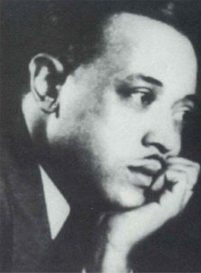
Little Rock Look Back: Dr. William Grant Still

Long known as the Dean of African American composers, Dr. William Grant Still was a legend in his own lifetime.

Dr. Still, who wrote more than 150 compositions ranging from operas to arrangements of folk themes, is best known as a pioneer. He was the first African-American in the United States to have a symphonic composition performed by a major orchestra. He was the first to conduct a major symphony orchestra in the US; the first to conduct a major symphony in the south; first to conduct a white radio orchestra in New York City; first to have an opera produced by a major company. Dr. Still was also the first African-American to have an opera televised over a national network

Dr. Still was born May 11, 1895 in Woodville, Mississippi to parents who were teachers and musicians. When Dr. Still was only a few months old, his father died and his mother took him to Little Rock. Inspired by RCA Red Seal operatic recordings, his musical education began with violin lessons.  He graduated from Gibbs High School in Little Rock.

After his studies at Wilberforce University and the Oberlin Conservatory of Music, he played in orchestras and orchestrated for various employers including the great W. C. Handy. For several years he arranged and conducted the “Deep River Hour” over CBS and WOR.  He also played in the orchestra for the 1921 musical Shuffle Along, which was the first Broadway musical to feature an all African-American cast and writing team.

In the 1920’s, Still made his first appearances as a serious composer in New York. Several fellowships and commissions followed. In 1994, his “Festive Overture” captured the Jubilee prize of the Cincinnati Symphony orchestra. In 1953, he won a Freedoms Foundation Award for “To You, America!” which honored West Point’s Sesquicentennial Celebration. In 1961, he received honors for this orchestral work, “The Peaceful Land”. Dr. Still also received numerous honorary degrees from various colleges and universities, as well as various awards and a citation from Arkansas Governor Dale Bumpers in 1972.

In 1939, Dr. Still married journalist and concert pianist Verna Avery, who became his principal collaborator. They remained together until Dr. Still’s death in 1978.  In a proclamation marking the centennial of Dr. Still’s birth, President Bill Clinton praised the composer for creating “works of such beauty and passion that they pierced the artificial barriers of race, nationality and time.”

In 1995, Dr. Still was posthumously inducted into the Arkansas Black Hall of Fame.  In 2016, the ballroom at Robinson Center was named in his honor.
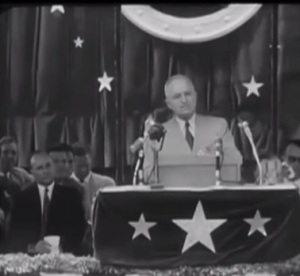
Little Rock Look Back: President Harry S. Truman

On May 8, 1884, future US President Harry S. Truman was born in Lamar, Missouri.

Truman spent most of his youth on the family farm.  Serving in World War I, he saw combat in France and rose to the rank of Captain.  After the war, he returned to Missouri and became involved in Democratic Party politics.  After serving as a county official, he was elected US Senator in 1935 backed by the powerful Kansas City Pendergast machine.

In 1941, he headed a Senate Committee which exposed corruption and fraud in wartime contracts.  He also worked to show he was not just a puppet of the Pendergast machine (which was crucial once Pendergast went to prison).  In 1944, Democratic leaders were trying to knock the incumbent Vice President, Henry Wallace, off the ticket as FDR’s running mate.  Wallace was viewed as too far to the left.  Truman was a compromise candidate and was chosen to serve as FDR’s running mate.

He took office as Vice President in March 1945.  When President Roosevelt died in April 1945, they had spent little time together.  He oversaw the dropping of the atomic bomb on Japan in his hopes of ending World War II with fewer soldier casualties.

Following the war, he supported the creation of the United Nations, sought to contain communism through the Truman Doctrine, and worked to rebuild Europe.  In his quest to stem the spread of communism, he involved the US in the Korean War.

Domestically, he struggled with civil rights issues (including integrating the military) and labor issues (including the threat to draft striking railway workers into the military). His election in 1948 for a full four-year term is often seen as the biggest upset in US Presidential political history.

At the time he became President, Truman was still living in a small apartment with his wife and daughter.  Though they lived in the White House for a bit, they later vacated it for the Blair House so that the structure could be completely renovated.

By the approach of the 1952 presidential election, Truman’s popularity had waned again.  He half-heartedly ran in the New Hampshire primary because he did not like any of the candidates currently in the field.  After finishing second to Sen. Estes Keafauver, he announced he would not be a candidate.  He left office in 1953 and returned to Missouri.

From 1953 onward, he served as the senior statesman and father confessor of the Democratic Party.  Many political leaders made pilgrimages to visit him.  In 1965, President Johnson signed the bill establishing Medicare at the Truman Library with President and Mrs. Truman in attendance.

He died on December 26, 1972, after having been admitted to the hospital earlier in the month for pneumonia.

Truman made two visits to Little Rock while President.  In June 1949, he attended an Army division reunion and spoke at the dedication of War Memorial Park.  (He also spoke twice at Robinson Auditorium during this visit.) In 1952, he visited Little Rock while in the state to speak at the dedication of Bull Shoals Dam and Norfork Dam.

Little Rock Look Back: Rabbi Ira Sanders

On May 6, 1894, Ira Eugene Sanders was born in Missouri.  After receiving an undergraduate degree and rabbinate degree in Cincinnati, he was ordained a rabbi in 1919.  He served congregations in Pennsylvania and New York before coming to Little Rock in September 1926.
Shortly after arriving to lead the B’nai Israel congregation, Rabbi Sanders became active in the Little Rock community.  Among his projects were the Little Rock Community Fund, Little Rock School of Social Work (which he founded), Central Council of Social Agencies, and University of Arkansas Extension Department. During the Great Depression, he helped organize the Pulaski County Public Welfare Commission.  Other areas of involvement over his career included the Arkansas Human Betterment League, Urban League of Greater Little Rock and Arkansas Lighthouse for the Blind.  On November 3, 1930, Rabbi Sanders debated Clarence Darrow about the existence of God in front of a packed house at Little Rock High School.

For his many involvements, he received an honorary Doctor of Humanities degree in 1951 from the University of Arkansas.  Three years later he received an honorary Doctor of Divinity degree from Hebrew Union College’s Jewish Institute of Religion.

A lifelong supporter of a Jewish state, he participated in nineteen bond drives for the state of Israel.  In August 1963, he retired as the leader of B’nai Israel after over 35 years. He would remain as Rabbi Emeritus until his deal in 1985.

In January 1978, Rabbi Sanders tendered his resignation from the Central Arkansas Library board of directors.  The City Board of Directors passed resolution 5873 which noted that he had served for 51 years on the Library Board. He was first appointed in 1926.  He served during 19 different Mayoral administrations from Charles Moyer’s first term through Donald Mehlburger’s.

On April 8, 1985, Rabbi Ira Eugene Sanders died of natural causes.  He is buried in the City’s Oakland Jewish Cemetery.  The Central Arkansas Library System honors his memory with an annual distinguished lecture series.

Little Rock Look Back: Museum of Fine Arts Established

On May 6, 1935, the Little Rock City Council formally established the Museum of Fine Arts by Ordinance 5235.  The ordinance was sponsored by Alderman Henry G. Leiser.

The ordinance authorized the construction of the museum in City Park.  The money for the construction was all privately raised. Once the building was completed, it would become the property of the City.

The ordinance also created the museum’s board. The original members were named by the ordinance.  They were: Fred W. Allsopp (appointed as a life member), Mrs. Frederick Hanger, Mrs. F.B.T. Hollenberg, George B. Rose, Mrs. C.M. Taylor, Mrs. Frank Tillar, and Dr. Frank Vinsonhaler. In addition, the Mayor and President of the Fine Arts Club were ex-officio members.

The building would start construction in 1936. The groundbreaking was in January 1936, and the cornerstone was laid in October 1936. The Museum of Fine Arts opened in October 1937.

Little Rock Look Back: ARKANSAS GAZETTE wins 2 Pulitzer Prizes

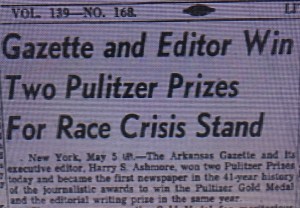
On May 5, 1958, it was announced that the Arkansas Gazette had received two Pulitzer Prizes.  These were for the coverage of the 1957 integration (or lack thereof) at Little Rock Central High School.
The first Pulitzer was for Public Service.  It was awarded to the newspaper.  The citation stated:

For demonstrating the highest qualities of civic leadership, journalistic responsibility and moral courage in the face of great public tension during the school integration crisis of 1957. The newspaper’s fearless and completely objective news coverage, plus its reasoned and moderate policy, did much to restore calmness and order to an overwrought community, reflecting great credit on its editors and its management.

The second Pulitzer was for Editorial Writing.  It was awarded to Harry Ashmore.  The citation read:

For the forcefulness, dispassionate analysis and clarity of his editorials on the school integration conflict in Little Rock.

This was the first time that the Pulitzer for Public Service and Editorial Writing went to the same publication in the same year.

The newspaper coverage in the afternoon Arkansas Democrat and morning Arkansas Gazette was provided by the Associated Press.  The Democrat‘s story ran on the afternoon of the announcement. The front page story had the headline “Pulitzer Honors Go to Gazette.”  The next morning the Gazette ran a longer story under the headline “Gazette and Editor Win Two Pulitzer Prizes for Race Crisis Stand.”  It included a quote from publisher Hugh Patterson, Jr.  He stated, “This recognition belongs to every member of the staff of the Gazette.  I am proud to be associated with these men and women.”

The Pulitzer for National Reporting went to Relman Morin of the Associated Press for his coverage of the events.  His citation noted:
for his dramatic and incisive eyewitness report of mob violence on September 23, 1957, during the integration crisis at the Central High School in Little Rock, Arkansas.

Photographer Will Counts of the Arkansas Democrat was the unanimous choice of the jury to receive the Pulitzer in photography for his photo of the crowd jeering at Elizabeth Eckford.  The board overruled that selection, as was their purview. Speculation was that the board may not have wanted to award four Pulitzers for the same news story.

Little Rock Look Back: SOUTH PACIFIC wins Pulitzer Prize

On May 5, 1950, the Rodgers and Hammerstein musical South Pacific captured the Pulitzer Prize in Drama. This would receive special attention in the Arkansas Gazette. The reason this carried such weight in Arkansas was that the musical had a connection to Little Rock.
The 1950 Pulitzer for Drama went to a musical, for only the second time in the history of the awards. The recipient was South Pacific by Richard Rodgers, Oscar Hammerstein II and Joshua Logan. The character was the leading lady of Nellie Forbush. She was an Navy ensign and a nurse stationed on an exotic island during World War II. The musical was based on a Pulitzer Prize winning novel, James Michener’s Tales of the South Pacific.

In the Michener novel, Miss Forbush is not from Little Rock. She is actually from a small town in Alabama. The part was written for Mary Martin from Weatherford, Texas. Rodgers, Hammerstein & Logan did not discuss why they relocated Nellie’s birthplace.

Originally the musical contained a song entitled “My Girl Back Home” in which Nellie sang of being from “Little Rock, A-R-K” while another character sang of being from “Philadelphia, P-A” and “Princeton, N-J.” It is possible the change to Little Rock was made because it offered more lyrical possibilities, but that is only a supposition on the part of the Culture Vulture. That song did appear in the movie version in which Mitzi Gaynor played Nellie Forbush. It was also featured in the 2008 Broadway revival, this time with Kelli O’Hara playing Nellie.

In the musical, Nellie struggles with her own prejudices. This issue of prejudice became an instance of fact meeting fiction. In 1957, a few weeks after Eisenhower sent troops into Little Rock to ensure that Central High would be desegregated, a production of South Pacific on Long Island was temporarily halted when the audience booed and yelled after Nellie mentioned she was from Little Rock. Interestingly, the movie was released in 1958, but retained references to Little Rock. That was either a testament to the expense of re-editing it, or the fact that audience reaction had lessened.

Little Rock and World War I – City Auditorium goes to war

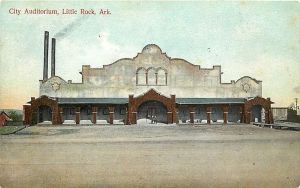
From 1906 until 1920, a temporary structure stood next to City Hall.  It was Little Rock’s first city auditorium.

It was a flexible use structure consisting of a large room with a stage on one end. It had a variety of uses including a roller skating rink.  In the lead up to US involvement in the Great War, the Arkansas National Guard obtained permission to use it as a rifle range when it was not being used for other purposes.

Once the US entered the Great War, the facility was also used as a place for recreation for officers stationed at Camp Pike.  It was the site of dances as well as basketball games and other sporting competitions.

In addition, various organizations used the facility for patriotic rallies and music concerts.

(Note, after 1912, the front of the facade which appears in the photo was removed.  The new Central Fire Station was constructed between the auditorium and Markham Street. A new entrance to the auditorium was built off of Arch Street.)

May is Heritage Month in Arkansas.  The 2017 theme is World War I.  On Thursdays in May, the blog will look at various ways Little Rock took part in the Great War.