Unknown's avatar

About Scott

A cultural thinker with a life long interest in the arts and humanities: theatre, music, architecture, photography, history, urban planning, etc.

The Wildflowers on stage tonight at Ron Robinson Theater

wildflowersArkansas Sounds brings the Sounds of Arkansas to the stage of the Ron Robinson Theater.  Tonight is a special treat as three songstresses join forces performing as The Wildflowers.

Amy Garland, Bonnie Montgomery, and Mandy McBryde have recently formed the Wildflowers, performing music with folk, country, rock, and blues influences.

This concert will feature a brief solo set by each artist, followed up with a full set to be performed by the trio all-star back up band (Nick Devlin on guitar, Bart Angel on drums, Brent LaBeau on upright bass and Geoffrey Robson on fiddle).

The concert starts at 7pm. Tickets are $10 for the general admission seating.

Little Rock Look Back: John Fitzgerald Kennedy

JFK LROn October 3, 1963, President John F. Kennedy delivered remarks at the Arkansas State Fairgrounds.  Only a few weeks later, he would be felled by an assassins bullet in Texas.  In the speech, the President praised Arkansas’ congressional delegation including Senators John McClellan and J. William Fulbright and Congressmen Took Gathings, Bill Trimble, Wilbur Mills and Oren Harris.  Each of these men held senior leadership positions in key committees.  The main focus of the speech was to discuss President Kennedy’s vision for a new economy in the South.

The President was actually in the state to speak at the dedication of the Greers Ferry Dam. He agreed to make that appearance as a part of a negotiation with Congressman Mills as they were deadlocked over changes to the tax code.  He had previously visited Little Rock in 1957 when he came to the state to address the Arkansas Bar Association meeting in Hot Springs.

John Fitzgerald Kennedy was born on May 29, 1917, the second of nine children. Groomed for leadership by his father Joe and mother Rose, he was thrust even more into the path of political greatness following the World War II death of his elder brother Joe Jr.  A war hero himself, following his leadership after the attack of PT-109, he was first elected to Congress from Massachusetts in 1946. He would be re-elected in 1948 and 1950.  In 1952, he challenged incumbent Senator Henry Cabot Lodge and beat him.  He was re-elected to the Senate in 1958.

Kennedy had been seen as a strong potential Vice Presidential candidate for the Democrats in 1956. But his father discouraged this fearing that a loss to Eisenhower/Nixon would set him back in the future.  In 1960, the young, dashing Senator from the Bay State sought the Democratic nomination.  After a contentious primary season where he often ran against senate colleagues, Kennedy headed into the Democratic convention with the most delegates.  He added his chief rival, Texas Senator Lyndon Baines Johnson as his running mate.

After a close election, the Kennedy-Johnson ticket bested Vice President Richard Nixon and his running mate Henry Cabot Lodge (the selfsame former Senator who had been defeated by Kennedy 8 years earlier).

Following the oldest President (at the time), the young Kennedy administration seemed to captivate the country.  During his 1000 days in office, Kennedy faced many challenges both foreign (Bay of Pigs, Cuba missile crisis, start of Vietnam) and domestic (civil rights, organized crime). His ambitious “New Frontier” focused on education, additional services to rural areas and medical care for the elderly.  He also focused on getting the US to the moon.

On the personal front, in 1953 he married Jacqueline Bouvier. In addition to their daughter Caroline and son John Jr., who survived their father, the Kennedy’s had a miscarriage, a stillborn daughter, and son Patrick who died after two days.

Together with Franklin Roosevelt and Ronald Reagan, JFK embodied not only his generation but the mood of the country.  And his quotes resonate today including:

My fellow Americans, ask not what your country can do for you, ask what you can do for your country.

Let every nation know, whether it wishes us well or ill, that we shall pay any price, bear any burden, meet any hardship, support any friend, oppose any foe to assure the survival and the success of liberty.

Ich bin ein Berliner

 

Heritage Month – Knoop House

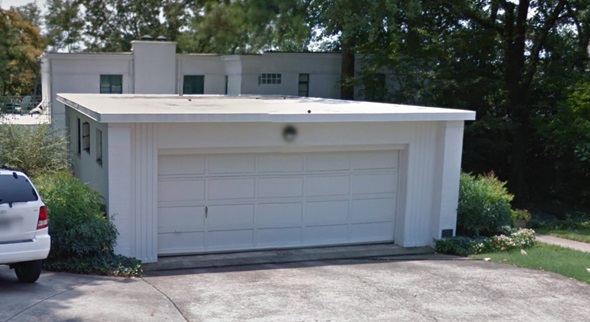
Knoop HouseToday’s historic property is unique for Little Rock.  It is one of the only (if not the only) Art Moderne style residences in Little Rock.

The Knoop House was built in 1936-1937 in Hillcrest for Werner and Faith Knoop. Designed by the architectural firm of Brueggeman, Swaim & Allen, the Art Moderne style of the house departed dramatically from, the mere typical period revival styles of the Hillcrest neighborhood. The Knoop House was (and still is) an outstanding Modernistic architectural statement in an area filled predominantly with English Revival, Colonial Revival, American Four Square, and Bungalow styles.

The house was built by Werner and Faith Knoop in 1936-1937.  In 1948, the original garaged was enlcosed and a new garage was added to the front of the house. Mr. Knoop was a mechanical engineer and founding principal in what is now the Baldwin & Shell Construction Company.  After having served on the school board, in 1957 Mr. Knoop became the first Mayor of Little Rock under the “new” city manager form of government and continued to serve the City on various committees even after his term as Mayor ended. Faith Yingling Knoop was a well-published author of magazine articles, textbooks, and children’s books.

The Knoop House’s simple, restrained detailing is typical of the Art Moderne style, as is the emphasis upon large uninterrupted expanses of smooth wall surface, the preference far a light palette and the selection of such modern materials as metal casement windows and glass block.

The Knoop House was added to the National Register of Historic Places in August 1990.

The Science of Space tonight at the Museum of Discovery

science spaceIn space, no one can hear you scream!

But they can hear you have fun learning about the Final Frontier tonight at the Museum of Discovery.

Tonight offers a great lineup for May’s Science After Dark! The Central Arkansas Astronomical Society will be there with telescopes and more, a planetarium will be set up downstairs, Kevin Delaney will present ‪#‎thespacestrugglesarereal‬ and more!

Plus don’t forget to bring cash for Damgoode Pies and Stone’s Throw Brewing!

Science After Dark is only for those kids who are aged 21 years and up.  Admission is $5, but is free for Museum members.


Bueller? Bueller? Bueller? tonight at Ron Robinson Theater

ferrisbFerris Bueller may have taken the day off, but his shenanigans are on the screen tonight at the Ron Robinson Theater.

Matthew Broderick, Alan Ruck and Mia Sara star in this ultimate movie about skipping school.  Jeffery Jones plays Broderick’s nemesis Dean Edward Rooney with Jennifer Grey playing his other nemesis, Jeanie Bueller. Cindy Pickett and Lyman Ward (who fell in love while filming the movie and are now married) play the Bueller parents while Edie McClurg, Charlie Sheen, Virginia Capers and Kristie Swanson make cameos.  Former Nixon speechwriter Ben Stein steals his scenes as the droning social studies teacher discussing the Laffer Curve and Voodoo Economics.

The sights and sounds of Chicago are showcased in this John Hughes masterpiece from 1986.

The movie starts at 7pm tonight. Admission is $5. Concessions are available for purchase as well.

Heritage Month – Villa Marre

villamarreThe Villa Marre is located at 1321 Scott Street. The Second Empire-style Villa Marre was built in 1881 by Italian immigrant and Little Rock saloonkeeper Angelo Marre, who also served on the Little Rock City Council.

The distinctive home features a mansard roof covered in patterned slate, a central tower topped by wrought-iron cresting, and hood molding above the doors and windows. Marre died in 1889, and his widow, Jennie, remained in the house until about 1900. Arkansas Governor Jeff Davis rented the house for a few years, and in 1905, the home was purchased by E. B. Kinsworthy, former state senator and attorney general of Arkansas.

It is probably most famous today for being the outdoor exterior of Sugarbakers design firm in the CBS sitcom “Designing Women.”  For several years, it was the home of the Quapaw Quarter Association. It later returned to a private residence.  Currently it is a venue for weddings and other events.

It was added to the National Register of Historic Places on June 15, 1970.

Tonight at South on Main’s Local Live Concert – Luke Pruitt

llsom lukepAt 7:30 tonight, Luke Pruitt will take the stage at South on Main for the Oxford American’s Local Live free concert series . Call ahead at (501) 244-9660 to reserve your seat at a table for this popular series. Local Live is made possible by the generous support of Ben and Jane Hunt Meade.

Although Luke Pruitt spent several years honing his songwriting craft in Nashville, Tennessee, it was moving back to his hometown of Fort Smith that gave the songwriter the inspiration for his Songs of Home album series, which Pruitt describes as “a sort of op-ed about the American Dream in a post 9/11 world.”

In Pruitt’s debut EP Songs of Home, pt. 1, released in 2014, we hear the story of a young millennial kid playing for tips and dreaming of a future in music success, as well as a hometown story about Vietnamese immigrants in Fort Smith who were forced to adapt to a new home after the fall of Saigon, and have built their own American Dream as restaurant owners. Part 1 gives good insight into Pruitt’s influences not only in songwriting, but in classic American literature, as his stories have both poetic and prosaic tendencies.

Songs of Home, pt. 2 will be Pruitt’s first full length release, due out in 2015, and will finish the story of the American Dream that the writer started in part 1.