
Little Rock Look Back: LR votes to Restore Robinson!

restore-robinson-121013On Tuesday, Dec. 10, 2013, voters of Little Rock overwhelmingly chose to renovate the historic Joseph Taylor Robinson Memorial Auditorium.

By a vote of 5,183 For and 1,800 Against, Little Rock citizens approved a plan to use a portion of the city’s existing 2 percent restaurant and hotel tax to repay bonds for a renovation of Robinson Center.  The campaign was chaired by businessman Charles Stewart, restaurateur Capi Peck and former LR Mayor Jim Dailey.

Robinson has long been a landmark in central Arkansas. Construction of the Joseph T. Robinson Memorial Auditorium began in 1938 (after a December 1937 groundbreaking under a deadline) and officially opened February 1940. The structure was a PWA (Public Works Administration) project, and is an excellent example of the Art Deco style architecture of the time. The building was added to the National Register of Historic Places in 2007.

The facility is owned by the City of Little Rock and managed by the Little Rock Convention & Visitors Bureau.

The 1940 structure suffered from a wide array of deficiencies, including stage loading and unloading, stage size, acoustical insufficiency, dressing room access and inadequate wing space within the performance hall. Also, structural, mechanical and electrical issues, public circulation and outdated conference center spaces existed within the facility.

Knowing the center is in need of major upgrades if the facility is to continue to serve central Arkansas into the future, the Little Rock Advertising and Promotion Commission (LRA&P) empanelled a Robinson Center Concept Team in October 2011. The group was tasked with evaluating all aspects of the existing facility, researching user needs, proposing conceptual solutions and estimating the cost and construction schedule of the proposed additions and renovations. The concept team was led by Mike Steelman of SCM Architects, PLLC, and included representatives from WD&D Architects, Shuler Shook Theatre Planners, Jaffe-Holden Acoustical Consultants, TME Inc. Mechanical and Electrical Engineers, ECI Inc. Structural Engineers, McClelland Consulting Engineers Inc. Civil Engineers, East Harding Construction, HVS Consulting and Hunt Construction Group.

Additionally, stakeholder and tenant organizations representing the Arkansas Symphony Orchestra, Celebrity Attractions of Tulsa, Oklahoma and the Double Tree Hotel participated in the planning. The concept team findings were presented publicly on June 5, 2012.

On January 17, 2013 the LRA&P announced the selection of Polk Stanley Wilcox Architects, partnered with Ennead Architects, as the architectural and design team for the future renovations. On March 28, 2013 CDI Contractors LLC, partnered with Hunt Construction Group, were selected by LRA&P as the general contractors and construction managers.

On September 23, 2013 the final schematic renderings and cost estimates were presented publicly. The schematic plans depict major interior upgrades within the performance hall including additional volume to create a two-balcony setup, increased lobby space, acoustical improvements, theatrical upgrades, loading dock expansion, a larger stage area, and new dressing room facilities. Additionally, an enhanced modern ballroom and small conference center was unveiled. New technology, mechanical systems, and outdoor plaza spaces were included in the presentation.

Construction would begin on July 1, 2014.  It reopened on schedule and on budget on November 10, 2016.

Little Rock Look Back: Robinson Auditorium hits construction milestone in 1939

Many months behind schedule, it was 77 years ago today (December 8, 1939) that the construction of the Joseph Taylor Robinson Memorial Auditorium was declared “substantially finished.”

On December 8, 1939, the work of the general contractor was complete. The building’s utilities were all fully connected as the steam line and electric transformer were hooked up. While the work of the general contractor was through, there was still much work to be done.

Though there were still unfinished portions of the structure, the exterior was complete and finished surfaces had been installed on the interior. Until the building was officially turned over to the City, the federal Public Works Administration still had to give approval for any uses of the building.Mayor J. V. Satterfield, Jr. told the press that he wasn’t sure when the City would formally accept the building. The connection of the utilities had used up the remaining funds, so there was uncertainty as to when the final tasks would be completed.

When it was built, Robinson Auditorium was the first municipal auditorium in the south central United States to be air conditioned. However, the air conditioning unit was not sufficient to cool both the music hall and the convention hall at the same time. In warm weather months concurrent events would not be able to take place on the two levels.

The Arkansas Arts Center chooses Studio Gang as design architect

The Arkansas Arts Center (AAC) announced on Tuesday the selection of Studio Gang as design architect for its upcoming building project.
“We had a number of highly qualified firms respond to our RFQ, and narrowing this impressive group down to the five finalists was extremely difficult,” said Todd Herman, executive director for the Arkansas Arts Center. “All five finalists were incredibly talented with international reputations and credentials. The Arts Center would have been well served by any one of them. We were in a great position to choose from such an impressive pool of talent.”

The five firms selected as finalists were Allied Works (Portland, Ore./New York), Shigeru Ban (New York/Paris/Tokyo, Japan), Studio Gang (Chicago/New York), Thomas Phifer (New York) and Snohetta (Oslo, Norway/New York/San Francisco).

Herman said the selection committee felt Studio Gang was the best fit for the project, due to the firm’s elegant and smart approach to architecture, their understanding of the issues posed by the AAC’s current facility, their vision for the center as a cultural beacon for Central Arkansas and their commitment to sustainability and strength as urban planners.

Founded by MacArthur Fellow Jeanne Gang, Studio Gang is an award-winning architecture and urbanism practice based out of Chicago and New York. A recipient of the 2013 National Design Award, Jeanne Gang was also named the 2016 Archiitect of the Year by the Architectural Review and the firm was awarded the 2016 Architizer A+ award for Firm of the Year.

Studio Gang is recognized internationally for a design process that foregrounds the relationships between individuals, communities and environments. The firm has extensive knowledge in museum, theatre and artist studio spaces, with projects ranging from the Writers Theatre in Glencoe, Ill. to the Aqua Tower in Chicago to the expansion of the American Museum of Natural History in New York.

“Designing a re-envisioned Arkansas Arts Center is a truly exciting commission,” Gang said. “Its extraordinary collection, historic MacArthur Park setting, and rich mix of programs present a unique opportunity to redefine how the arts can strengthen local communities and surrounding regions. We look forward to working closely with the AAC to discover how architecture can enhance the Center’s important civic and cultural mission by creating new connections between people and the arts in Little Rock and beyond.”

An RFQ for a local architect to collaborate on the project will be issued later this month.

“When the Arkansas Arts Center project is completed, it will not just be a renovated facility, it will be a re-envisioned experience,” Little Rock Mayor Mark Stodola said. “The enhanced building will offer opportunities for an even higher level of exhibits, classes, children’s theatre productions and special events, making the Arkansas Arts Center not only a signature tourist attraction, but an even more important cultural anchor for the arts community in Little Rock.”

“It is well known that businesses looking to locate or expand look at a city’s quality of life offerings,” Stodola said. “An enhanced Arkansas Arts Center will be a showcase which will enable us to attract and retain quality job creators in a variety of sectors.”

Herman said he is looking at the project holistically, including Historic MacArthur Park, and reevaluating how the Arts Center meets the needs of its community.

“This project is about more than just addressing the physical issues of the current building. It requires rethinking how the AAC fits into the downtown fabric,” said Herman. “How can we best serve the community, and how do the AAC and MacArthur Park connect to other social and cultural nodes in downtown Little Rock? We want to do more than build; we want to transform the cultural experience.”

The five finalists presented their firm’s general project approach and design philosophies to the selection committee on November 1, 2016. The presentations took place in the AAC lower lobby lecture hall and were open for public viewing. More than 100 people were in attendance at the presentations, including students, community members and media.

The committee determined their selection at a public meeting on December 6, 2016. The selection committee included: AAC Executive Director Todd Herman; City Director Dean Kumpuris; Director of Little Rock Parks and Recreation Truman Tolefree; AAC Board Chair Mary Ellen Irons; AAC Board members Isabel Anthony, Van Tilbury and Chucki Bradbury; AAC Foundation Chair Bobby Tucker; Little Rock Small Business Development official Chauncey Holloman; and past Director of the Central Arkansas Library System Bobby Roberts.

A technical review panel was responsible for reviewing all proposals and recommending a slate of finalists to the selection committee, based on specialized criteria outlined in an RFQ that reflected the specific needs and goals of the AAC.  The technical review panel included: AAC Executive Director Todd Herman, AAC Chief Curator Brian Lang, Architect Ken Sims, Dean of the Fay Jones School of Architecture Peter MacKeith, Chair of the AAC Buildings and Grounds Committee Kaki Hockersmith and international museum consultant Deborah Frieden.

The leadership phase of a capital campaign to maximize the impact of public dollars dedicated to the project is currently underway.

“Anyone and everyone can participate in the creation of a new Arkansas Arts Center,” Herman said. “The Arts Center is a symbol of the importance that this community ­– and state – places on culture, arts education and quality of life, and all Arkansans will have the opportunity to share in that civic pride.”

RobinsoNovember: Election set to create auditorium

muni aud elect ad editedOn November 30, 1936, Little Rock Mayor R. E. Overman asked the City Council to call a special election for January 1937 for approval of the issuance of bonds for a municipal auditorium.  Prior to asking the aldermen to call the election, the mayor had been in Washington DC to visit with Public Works Administration (PWA) officials. The mayor was assured that the auditorium project would be approved for federal funds.

While the mayor was meeting with federal officials, architects Eugene Stern, George Wittenberg and Lawson Delony were meeting with local PWA officials in Little Rock.  They were reviewing the plans for the funding request.  Though there were still a few refinements to be completed in the documents, the local officials seemed satisfied.  With these assurances in hand, Mayor Overman moved forward with putting the request before the City Council.

Though there were many things discussed at length during the November 30 City Council meeting, there was virtually no conversation regarding the structure before the 15-0 vote by the City Council to refer the auditorium bonds to the voters.  There were three different bond programs to be put before the voters in January 1937: a municipal auditorium, expansion of the public library and creation of a park for African Americans.

The bonds for the auditorium would be $468,000 in general obligation bonds which would be paid off between 1940 and 1971.  This was toward a total cost of $760,000 for the entire project.  At the time of the initial auditorium application in 1935, the mayor had noted that if the PWA failed to approve funding for the entire project, it could be submitted to the voters for the issuance of municipal bonds.  This was ultimately the course of action that would come to pass.  The PWA grant would only cover a portion of the project.  The government did agree it would purchase the financing bonds if no other entity did.

The election would be held on January 26, 1937.

RobinsoNovember: James Rice and Jim Rice

J Rice 1920On June 7, 1920, the Little Rock City Council finally authorized the demolition of Little Rock’s 1906 temporary auditorium.  The structure had originally been built as a skating rink which, when chairs were added, could be used for public meetings.  Since the mid 1910’s, the City Council had discussed tearing it down over safety concerns.  But since Little Rock had no other structure as a substitute, the Council kept delaying the decision.

In 1920, though there was not alternative space available, the Council decided that the structure had to come down.  So City Engineer James H. Rice was authorized to have the building removed.

JimRice RobinsonToday, Rice’s grandson, also known as Jim Rice is the COO of the Little Rock Convention & Visitors Bureau.  In that capacity he oversaw the renovation of Little Rock’s 1940 municipal auditorium – Robinson Center Music Hall.

While his grandfather was efficient at demolishing a worn out building that was beyond repair, Jim deftly helped make sure that the existing city auditorium was refitted and restructured so that it would no longer be worn out.

Little Rock Look Back: A Dozen Years of the Clinton Library

SkipIt has been twelve years.  Have you warmed up yet?
Many remember November 18, 2004, for the rain and cold wind which greeted visitors to the opening of the William Jefferson Clinton Presidential Center and Park.  In the years which lead up to that day, November 18, 2004, was known simply as “Game Day” for a group of people.  The chief one was Skip Rutherford.

Overseeing the planning for the Clinton Presidential Center and the events surrounding it had been the focus of James L. “Skip” Rutherford for many years. A FOB for decades, he had stayed in Little Rock when so many went to Washington DC in 1993.

He oversaw the planning for the Clinton Library and led the Clinton Foundation.  No detail was too small or insignificant for him to consider. For months leading to the opening he led meetings to help restaurants, hotels, and attractions understand the scope of the opening.

Together with Dean Kumpuris and Bruce Moore on behalf of the City of Little Rock and Stephanie Streett of the Clinton Foundation, he reviewed plans for the Clinton Presidential Park and the streets and neighborhoods around the Clinton Presidential Center.

Skip used his connections with the business community in Little Rock and throughout the state to discuss the importance of a Presidential Library regardless of one’s personal political affiliations.  He withstood critics who second-guessed everything from the cost, the design, the location, the purpose, and even the anticipated tourism and economic impacts.

Finally the big day had come.  If the weather was not ideal, that was almost inconsequential. It was still the culmination of more than seven years hard work.  As he remarked later that evening when discussing the weather “Many who attended today go to events like this all the time.  This is one they won’t forget!”

However, the opening of the Clinton Presidential Center was not the end of the task. It merely was the move from one phase to another. A few years later, Skip’s role would change as he would leave the Foundation and become the second Dean of the Clinton School of Public Service.

RobinsoNovember: Auditorium Commission Abolished

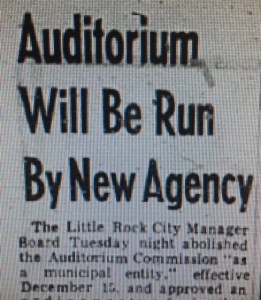
aud-com-abolOn November 16, 1971, the City of Little Rock Board of Directors abolished the Auditorium Commission which oversaw Robinson and transferred duties to the Advertising and Promotion Commission. This was done with the full support of both commissions.  The transfer took place immediately, with all assets and loose ends to be wrapped up by December 15, 1971.

With the adoption of a hospitality sales tax, by state statute, Little Rock had to have an A&P Commission.  By 1971 plans were afoot to use the A&P tax to build a conference center using some of the existing space in Robinson and adding space.  It did not make sense to have two separate commissions overseeing the same building.

For the Auditorium Commission members, it was possibly a relief.  For years, overseeing the building had been a quiet duty.  But with the social changes of the 1960s, they had been confronted ending the policy of segregation as well as changes in content and subject matter of acts booked at Robinson.  Being agents of social change was doubtful what any of them had envisioned when they joined the commission.  Emily Miller had been a member of the body since January 1940 and others had been on it for many years.

Transferring Robinson to the A&P Commission ushered in a new era for the building. It saw increased booking of meetings which led to a better revenue stream.  The use of the A&P tax would mean the opportunity to give the building an upgrade from 1972 to 1974.

Robinson would eventually prove to be inadequate for all of Little Rock’s needs, which led to the creation and subsequent expansion of Statehouse Convention Center.  But the action 45 years ago today set the stage for the transformation Robinson has undergone as it reopened last week.