Legacy of LR architect Ed Cromwell to be discussed tonight

CromwellTonight the Architecture and Design Network will host a panel discussion on the legacy of longtime Little Rock architect Ed Cromwell.
The panelists are:
  • Charles Penix, Chief Operating Officer, Cromwell Architects and Engineers
  • Bill Worthen, Director, Historic Arkansas Museum
  • Don Evans, architect and associate of the late Ed Cromwell

Chris East is the program’s moderator.  It will take place at 6pm at the Arkansas Arts Center, following a reception at 5:30pm.

After working at various jobs during the early years of the Depression, Ed Cromwell, who graduated from Princeton in 1931 with a degree in architecture, moved to Little Rock in 1935 to take a position with the  Resettlement Administration. After a year with the agency, he left to devote full time to the practice of architecture, a career which spanned forty-eight years, from 1936 to1984. Cromwell, who remained active in the community after his retirement, died in 2001, leaving a legacy that continues to impact people’s lives.

There would be no Maumelle if it hadn’t been for Cromwell’s vision of a planned community on the 5,000 acres of land owned by Jess P. Odum, an Arkansas businessman and insurance executive. The Capital Hotel might have been taken out by the wrecker’s ball if it hadn’t been for his determination to save the historic structure. An advocate for the city’s riverfront development, he understood its importance long before others did. He championed historic preservation and  chaired the commission of the Arkansas Territorial  Restoration (now the Historic Arkansas Museum). Cromwell Architects and Engineers, the firm he founded, has to its credit the design of many public buildings and facilities throughout the state and beyond.

The three panelists will explore Cromwell’s legacy as a creative architect, a visionary planner and a champion of  historic  preservation. Architecture and Design Network (ADN) lectures are free and open to the public. For additional information, contact ardenetwork@me.com.

ADN’s supporters include the Arkansas Arts Center, the University of Arkansas Fay Jones School of Architecture, the Central Section of the Arkansas Chapter of the American Institute of Architects and friends in the community.

3rd annual Summer Suppers schedule announced by QQA

Curran HallThe Quapaw Quarter Association has announced their third annual Summer Suppers schedule.

Colors at Curran

Sunday June 14 – 5:00 PM; Curran Hall

Bring the family, meet Uncle Sam and visit Historic Curran Hall for a southern picnic to celebrate Flag Day. The Little Rock Visitor Foundation recently acquired the original 1859 square grand piano that belonged to the Woodruff family and sat in Curran Hall from the 1860s to the 1990s. Come take a look and listen to Arkansas music from the past 150 years.

MENU: BBQ, traditional summer side dishes, beer, and ice cream

HOSTS (Little Rock Visitor Foundation and Board of Directors): Aaron Ruby, Lauren Bridges, Joanne Hinson, Shannon Treece, Larry Carpenter, Brendan Monaghen, Jim Montgomery, Jim Rule, Barry Travis, Carolynn Coleman, Cherry Light, and Jason Campbell.

Limited to 100 people. Cost is $20 a person.


Sunset at the Fountainebleau

Saturday June 20 – 6:00 PM; Rogers House, 400 West 18th Street

Revisit Miami Beach in the 1950s with the glamour and fun of the tropics and the cuisine of Little Italy Complete with bocce ball on the lawn and a Bellini bar poolside. Cocktail hour music provided by Dino, Frank and Sammy.


MENU: An Italian Feast! Antipasto, salad, pasta, featuring homemade bread and sausage a la familia Dalla Rosa, finished off with a themed dessert bar. Gluten-free and vegan options available, so everyone can join the fun!


HOSTS: Jilly Judy and Mark Brown, Karen Form, Harry and Robin Loucks, Michelle and Rick Harper, Sandy Griffith, Stuart and Hillis Schild, Laura and Ed Sergeant, Marcella and Marvin Dalla Rosa, Karol Zoeller, and David and Alex Robinson


Limited to 100 people. Cost is $75 a person.


Third Annual Welcome to the Gayborhood

Saturday June 27 – 6:30 PM; Sam Scull House 2300 State Street


Come to a relaxing evening in a speakeasy atmosphere at this 1914 Craftsman style home. Enjoy heavy hors d’oeuvres from Trio’s and a dessert bar by Chef Ted. Libations this year are presented in consultation with noted mixologist Spencer Janson and include a Moscow Mule bar, white sangria (vastly improved recipe), give and really good tonic, iced tea and bourbon and possible more! There will be non-alcoholic alternatives, also. Gay people have always been a large part of historic preservation. Meet several of them and learn something about gay history. Casual dress because of the heat, but no heels please! Enjoy the food and drink. Guests are encouraged to tour the entire house and enjoy the vast art collection.


HOSTS: Ted Holder and Joe van den Heuvel


Limited to 35 people. Cost is $75 a person.


Stone’s Throw Brewing Beer Dinner

Wednesday, July 29 – 6:30pm; Southern Gourmasian, 219 West Capitol


Spend the evening at Southern Gourmaisian’s new downtown brick and mortar location for dinner pairing unique dishes from the king of the Little Rock food truck scene with beers and ciders brewed by Stone’s Throw Brewing. Chefs Justin Patterson and Pat Beaird will prepare five courses of Asian-Southern fusion cuisine to pair with six different artisanal brews. Chefs and brewery representatives will be on hand to talk about each pairing and chat over dinner.


HOSTS: Stone’s Throw Brewing, Southern Gourmasian, Ashli Ahrens and Kelley Bass, Shana and Soloman Graves, Gabe Holmstrom, John Herzog, Kathy McCarroll, Jarrod Johnson, and Rhea Roberts


Limited to 50 people. Cost is $50 a person.


Hognado! at The Joint in Argenta

Friday August 7 – 6:30 PM; Crush Wine Bar, 318 Main & The Joint, 301 Main, NLR


Begin your evening enjoying historic Argenta with appetizers and libations at Crush Wine Bar before heading to The Joint for an 8 p.m. show. HOGNADO! Is The Main Thing’s first disaster comedy, about a super-sized storm system that cuts the Natural State a new one! See how Arkansans adapt and survive when a giant tornado swoops up the last remaining wild hogs in the Ozarks and hurls them at Little Rock at 180 miles per hour.


HOSTS: Greg Nabholz, John Gaudin and Corky Patton, and Cheddy Wigginton


Limited to 25 people. Cost is $40 a person.

Heritage Month – Pfeifer Brothers Department Store

Pfeifer Brothers Department Store was an important part of imageMain Street’s commercial character. Built in 1899, the building’s interior was remodeled in 1939 and the exterior was remodeled in 1960. Pfeifer Brothers Department Store was originally occupied by Arkansas Carpet and Furniture Company. In 1911 Joseph Pfeifer leased the building for his clothing company. 
In 1912, the redevelopment of the building for the Pfeifer Brothers Department Store was designed by prominent Arkansas architect Charles Thompson.  The structure had originally been built in two stages. The south half being built first in 1899 and the north half added about a year later. In 1939 Pfeifer Brothers remodeled the interior first floor with streamlined, chrome-trimmed fixtures. A marble façade was added on the Sixth Street elevation.
A major exterior renovation was undertaken in 1960 when a false façade of granite panels was wrapped around the Main and Sixth street elevations, covering all openings and detail. At this time the original cornice was destroyed but the majority of historic detail remained.In 1963 Pfeifers was bought by Dillard’s Department Stores and as a new entity the store continued in business at 524 Main until closing in 1990. In 1996 a new owner undertook rehabilitation of the historic structure by removing the granite panels and exposing original windows and terra cotta elements.
The building, now called the Arkansas Building, is an anchor of the Creative Corridor revitalization. It will house Ballet Arkansas, additional space for the Arkansas Repertory Theatre, Cranford Co. and Matt McLeod’s art studio on the first floor. The Arkansas Symphony Orchestra will be on the ground floor of the Arkansas Building and in an adjacent building.  The upstairs will be apartments.
The building was listed on the National Register of Historic Places fifteen years ago today on May 18, 2000.

Happy Birthday Mayor Stodola

colr_mayor_mark_stodolaToday, May 18, is the birthday of current Little Rock Mayor Mark Stodola.

Mark Stodola was elected as Mayor for the City of Little Rock, beginning his term in January 2007 and re-elected in 2010 and 2014.  Mayor Stodola has been key in promoting the revitalization of Little Rock’s Main Street, resulting in the City having been awarded a “Greening of America’s Capitals Grant” from the Environmental Protection Agency and an “Our Town Grant” from the National Endowment for the Arts for the creation of an Arts District in the heart of the downtown core.  The UA’s Community Design Center, which includes faculty and staff members from the school, won a 2014 Honor Award from the American Institute of Architects for its work on the Creative Corridor, on which it collaborated with Marlon Blackwell Architect of Fayetteville.

Prior to becoming Mayor, he served as a senior partner in the Little Rock Law Firm Catlett & Stodola, PLC.  While at that firm, he served as General Counsel to the Little Rock Airport Commission.   Having previously served the City of Little Rock as its City Attorney for six (6) years, he was elected as Prosecuting Attorney for the 6th District in 1990 and was re-elected again in 1992 and 1994.   Mayor Stodola is Past President of the Arkansas Prosecuting Attorneys Association and the Arkansas City Attorneys Association, as well as Past Chair of the Municipal Operations Section of the International Municipal Lawyers Association.  In addition, he is a member of various State, regional and national legal and professional associations.

Mayor Stodola is a graduate of Leadership Greater Little Rock, and served as Chair of Class 16 for that program. In addition, he is a member of the Heights Neighborhood Association and serves as Co-Chair of the Downtown Partnership’s Main Street Task Force.  Mayor Stodola has served on the Board of the Arkansas Repertory Theatre (for which he was the attorney who incorporated the Rep) and is Past-President of the Quapaw Quarter Association and the Historic Preservation Alliance of Arkansas.  He has worked with the Big Brothers/Big Sisters Program and is currently a member of the Rotary Club of Little Rock.

Mayor Stodola graduated from the University of Iowa with a double major in Political Science and Journalism, and received his law degree from the University of Arkansas School of Law in Fayetteville.  Mayor Stodola is married to Jo Ellen and has three (3) children:  a daughter, Allison; and twin sons, Robert and John Mark.

Heritage Month – Albert Retan House

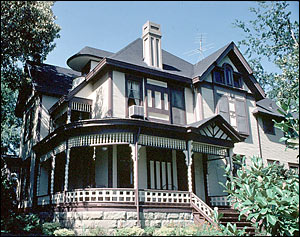
Albert Retan HouseHistoric homes in Little Rock are certainly not limited to downtown.  Today’s is the Albert Retan House, built in 1893 in what would become Pulaski Heights.

Due to geography, by the late 1800s, the land west of Little Rock stood as the only logical direction for the city to expand.  A group of Michigan investors saw the potential of this area of rolling hills and pine forests as sound investment property and conceived the development of Pulaski Heights, Little Rock’s first planned suburb.  In 1891 this investment syndicate organized the Pulaski Heights Land Company and proceeded to purchase 800 acres located three miles west of Little Rock.  Eight of the investors, including Albert Retan, brought their families to Arkansas to settle in the new suburb.

Retan built his house in 1893 and it remains an important symbol of the founding, growth and success of the Pulaski Heights community.  Architecturally, the structure represents a transitional style incorporating the fluent decorative woodwork of the Queen Anne in its sweeping porch with spindle frieze and the stately lines of the Colonial Revival mode in its hip roofs with projecting cross gables and its Palladian windows.  The suburb attracted professionals and businessmen who desired an alternative to living in the central area of the city without forfeiting convenient access to their places of business in downtown Little Rock.

Once established as a popular neighborhood, Pulaski Heights grew steadily.  As a result, it was incorporated as a town in 1905 and soon after, in 1916 the “Heights” was annexed to the city of Little Rock.  Never having suffered the decay that has threatened many of Little Rock’s other older neighborhoods, Pulaski Heights remains a prominent residential area in Little Rock with the Albert Retan House surviving as an important reminder of the origins and history of the city’s first planned suburb.

It was added to the National Register of Historic Places on December 3, 1980.

Heritage Month – U.S. Arsenal Tower Building

MacPark ArsenalToday is Armed Forces Day.  It is an appropriate day to look at the U. S. Arsenal Tower Building.  Construction on the Little Rock Arsenal began in 1838 and was completed in 1840.  The complex grew to include more than thirty buildings. The arsenal building itself was a two story brick building with an unusual central octagonal tower between two wings. The tower was actually used to move munitions between floors of the building. Other buildings included office buildings, a storehouse, a magazine, a guardhouse, a hospital and other service structures. The hospital and service structures were built of wood.

On 25 Jul 1873 the Little Rock Arsenal became the Little Rock Barracks and remained that until the facility was abandoned 25 Sep 1890. The tower building was converted into married officer quarters. Douglas MacArthur was born 26 Jan 1880, in the tower building at the Little Rock Barracks to then Captain Arthur MacArthur, Jr. and his wife.

The site was turned over to the city 23 Apr 1892, stipulated for use as a city park. In return, the City of Little Rock gave the U.S. Government 1,000 acres  on which Fort Logan H. Roots was established by the U.S. Congress on the same date, 23 Apr 1892. All of the remaining buildings on the original site were sold or destroyed except the Arsenal Tower building.

The land became known as City Park and later MacArthur Park.  The Tower Building remained empty and in deteriorating condition until the late 1930s, when the City of Little Rock renovated the building.  For many years, the Aesthetic Club met in the building as the only tenant.  When others refused to pay the utilities, the Aesthetic Club members did.  The organization continues to meet in the building.

In 1942, the Museum of Natural History and Antiquities opened in the building; it had previously been located in Little Rock’s City Hall. The name of the museum changed in 1964 to the Museum of Science and Natural History, and again in 1983 to the Arkansas Museum of Science and History. In 1997, the museum moved to a new location in the River Market, where it now is known as the Museum of Discovery.

In May 2001, the MacArthur Museum of Arkansas Military History opened in the building.

The structure was listed in National Register of Historic Places on July 28, 1970.  It was designated a National Historic Landmark on April 19, 1994.

Heritage Month – Lamar Porter Field

Lamar PorterLamar Porter Athletic Field is located in the Stifft Station neighborhood. Construction started in 1934 and continued for 18 months by the Works Progress Administration on a 10 acre site.

The 1,500 seat grandstand included club rooms, shower and locker rooms and a concession stand. It was first used by Boys’ Club teams in 1936. By 1937, City leagues and American Legion teams used it.  A playground, softball field and tennis courts were constructed next to the baseball field.

Lamar Porter Field is remarkable not only for its architecture, but also for its history.  Thousands of boys growing up in Little Rock played ball here.  One of those was future Baltimore Oriole Hall of Fame third baseman Brooks Robinson.  He has come back numerous times and has aided in fundraising efforts to restore the field.

The baseball sequence from A Soldier’s Story with Denzel Washington was filmed at Lamar Porter Field.

The field is named in memory of Lamar Porter, whose family donated the land and some money to help with the construction.  A Little Rock native, he was killed in May 1934 while he was attending Washington and Lee University.

Today Lamar Porter Field and the multipurpose field are home to RBI (Reviving Baseball in the Inner-city) which is an official program of Major League Baseball. Both Catholic High School and Episcopal Collegiate use Lamar Porter as their home field.

Lamar Porter Field was placed on the National Register of Historic Places on December 6, 1990.