Septaquintaquinquecentennial of Christ Church in Little Rock (that means 175 years)

christchurch_scaledThough there have been several churches and institutions in downtown Little Rock for over a century, Christ Episcopal Church has been at Scott and Capital Streets since 1840. That marks probably the longest continuous single use of one location in Little Rock’s history.

Today, the church marks its Septaquintaquinquecentennial.  The first church service was held on March 10, 1839, at Little Rock’s Presbyterian Church, which was then on what is now Second Street. The Rt. Rev. Leonidas Polk, missionary bishop of Arkansas, conducted the service.  After it was concluded, a group met in the home of Senator Chester Ashley and organized Christ Episcopal Church, named after Christ Church in Alexandria, Virginia, of which several of those present had been members.

Among the early members of the church were several future Little Rock Mayors including Lambert J. Reardon, John Wassell, Samuel Webb and Gordon Peay.  Nicholas Peay, Gordon’s father and a member of the church, served on the Little Rock City Council.  Future Little Rock Mayor William Ashley was the first Little Rock resident to be married at Christ Church.

The first sanctuary was constructed in 1840-1841 and was later destroyed by fire in 1873 (most likely due to a lightning strike).  After meeting in a variety of places, a chapel was constructed on the property and served as the church’s primary place of worship while the new sanctuary was being built.  It opened in 1887.  It was in the chapel that future General Douglas MacArthur was baptized as an infant while his family resided in Little Rock.

In 1928, a Parish Hall was built. This was one of the first church buildings in the South which featured a gym and other spaces available for use not just by church members but by the entire city.  It would later serve as the temporary sanctuary of Christ Church.  On October 1, 1938, the second sanctuary burned just as a renovation had been completed.  Though there was no official cause of the fire, it was most likely due to spontaneous combustion of construction materials.

The cornerstone for the third, and current, sanctuary was laid on October 1, 1940.  Construction was completed in 1941.  It was designed by Edwin Cromwell with the unofficial assistance of the then-Rector, Rev. Dr. William Postell Witsell. (Dr. Witsell appreciated architecture and the arts. He was very instrumental in the design of the stained glass windows which hang in the church today.  Charles Witsell, one of the founders of the Witsell, Evans, Rasco firm, is a grandson of Dr. Witsell.) In the 1980s, an addition was built along Scott Street to connect the sanctuary with the Parish Hall.

Along with the revitalization of downtown, Christ Church has been active in implementing innovative programming in a variety of areas including sustainability and the arts. The Rector, Rev. Scott Walters, and Associate Rector, Rev. Dr. Kate Alexander, often pepper their sermons with references to poetry, music (both sacred and secular), writers, artists and even comedians.

The Arts at Christ Church program has brought such varied artists as Mavis Staples, Baltimore Konsort and the Vienna Boys Choir to Little Rock. In 1990, Nichols & Simpson, a Little Rock based organ builder of international renown, constructed a new organ for the Christ Church sanctuary replacing a 1954 organ.  While used in worship, it is also used for a variety of organ recitals throughout the year.  Christ Church has been a sponsor of the Arkansas Literary Festival for the past several years and participates in the 2nd Friday Art Night with a rotating gallery of Arkansas artists. In addition, the Undercroft debuted in late 2013. This intimate music space is located underneath the sanctuary and offers a venue for acoustic music.

To mark the 175th anniversary, Rt. Rev. Larry R. Benfield, the thirteenth Bishop of the Diocese of Arkansas will be conducting an Evensong service this evening.  Prior to being named Bishop, he served as Rector of Christ Church.

Sandwich in History at LR’s Christ Church today

christchurch_scaledOn Friday, March 7 at 12 noon, the Arkansas Historic Preservation Program’s monthly “Sandwiching in History” program will visit Christ Church, Little Rock’s downtown Episcopal church since 1839.

Located at Capital and Scott Streets in downtown, the current sanctuary was built in 1940-41, designed by local architect Edwin Cromwell. That building replaced an 1887 structure which had burned in 1938.  The 1887 edifice itself replaced an 1840-1841 building which had been destroyed by fire in 1873.  A Parish House was constructed in 1928 adjacent to the sanctuary which is still in use today.

The “Sandwiching in History” program is a series of tours that seeks to familiarize people who live and work in central Arkansas with the historic structures and sites around us. The tours take place on Fridays at noon, last less than an hour, and participants are encouraged to bring their lunches so that they can eat while listening to a brief lecture about the property and its history before proceeding on a short tour. A representative from the property is encouraged to attend also and address the group.

The tours are organized by the Arkansas Historic Preservation Program, an agency of the Department of Arkansas Heritage. All tours are free and open to the public.

Architect Michael Rotondi discusses Hybrid of Extremes tonight

RotondiTonight at the Arkansas Arts Center, the latest in the continuing series of lectures about architecture. HYBRID OF EXTREMES, a lecture by Michael Rotondi, FAIA, architect and educator. He is founding partner and principal of RoTo Architects, Los Angeles, and a Professor in Practice of the Arizona State University School of Architecture.

Based in Los Angeles, Michael Rotondi has been the co-founder of two esteemed architectural firms. He and Thom Mayne, with whom he had a productive partnership, founded Morphosis in 1975. Almost two decades later he established RoTo Architects, a firm committed to enlarging the scope of architectural practice to include issues of socio-economic concern and the environment.

The 2009 recipient of the Los Angeles Chapter the American Institute of Architects gold medal for creating a body of work of lasting influence on the theory and practice of architecture, Rotondi has emphasized  architecture’s role  in “making the world a better place”. He has stressed the importance of architects being aware of the impact of their work on people, places and communities.

Rotondi and a group of friends were instrumental in the 1972 founding of the Los Angeles based California Institute of Architecture (SCI-Arc). Among the school’s first graduates, the innovative young architect who had earned a degree from California State Polytechnic University in 1971, later served as SCI-Arc’s director (1987-1997). Currently a member of its Board of Trustees, he also teaches there. Rotondi has lectured and taught all over the world.

Rotondi’s participation in Architecture and Design Network’s 13/14 lecture series has been made possible by the Fayetteville based University of Arkansas Fay Jones School of Architecture where he ls this year’s John G. Williams Distinguished Visiting Professor.

In addition to the School of Architecture, Network supporters include the Arkansas Arts Center and the Central Arkansas Chapter of the American Institute of Architects. All ADN lectures are free and open to the public. For additional information contact ardenetwork@icloud.com.

Little Rock Look Back: Grand Opening of Robinson Auditorium

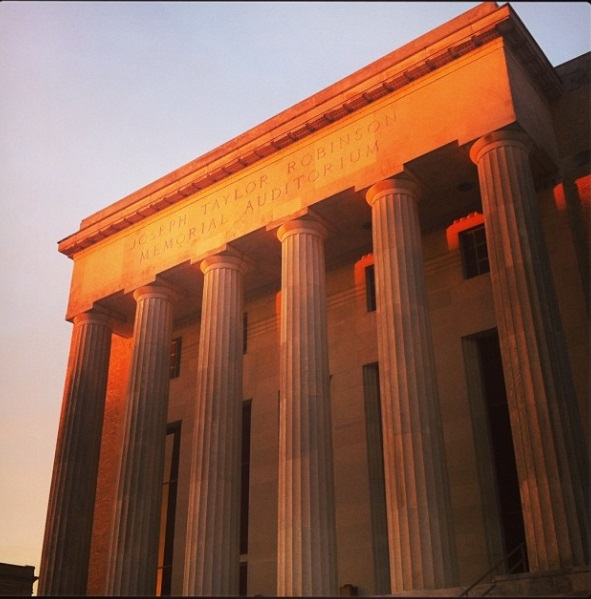
auditoriumduskOn February 16, 1940, after three years of planning and construction, the Joseph Taylor Robinson Memorial Auditorium officially opened. It was a cold, rainy night, but those in attendance did not care.

Searchlights painting arcs in the sky greeted attendees. They were borrowed from the Arkansas National Guard. Newspaper accounts noted that only a few of the men who attended were in tuxedos, most were simply in suits. The work to get the building opened had been so harried, that it was discovered there was not an Arkansas Flag to fly in front of the building. Mayor Satterfield found one at the last minute courtesy of the Arkansas Department of the Spanish War Veterans.

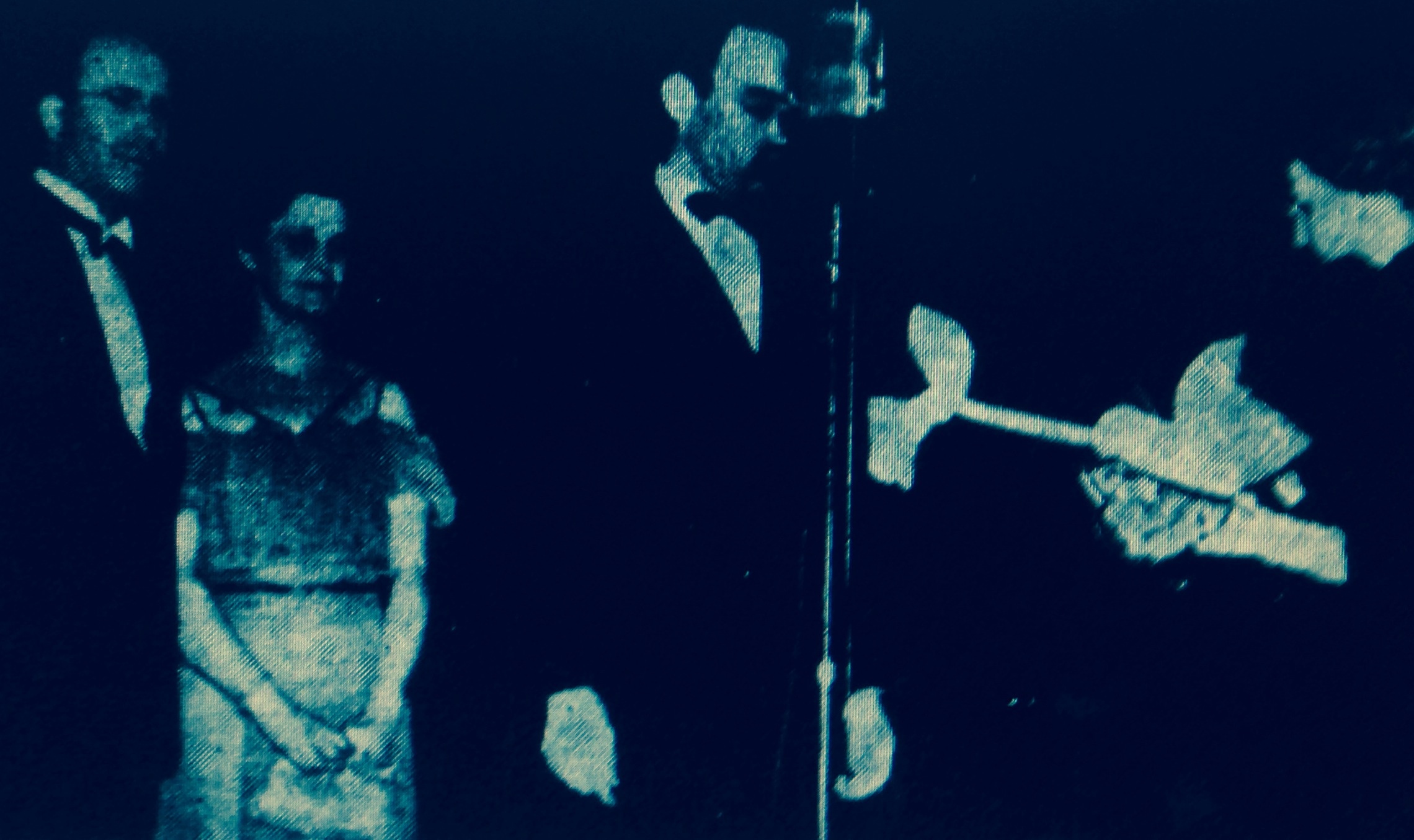
The weather delayed arrivals, so the program started fifteen minutes late. Following a performance of Sibelius’ Finlandia by the fledgling Arkansas State Symphony Orchestra, Mayor J. V. Satterfield, Mrs. Joseph T. Robinson, Mrs. Grady Miller (the Senator’s sister-in-law and a member of the Auditorium Commission) and D. Hodson Lewis of the Chamber of Commerce participated in a brief ribbon cutting ceremony. Mrs Robinson cut the ribbon on her second attempt (once again proving that nothing connected with getting the building open was easy).

The ceremony was originally set to be outside of the building but was moved indoors due to the inclement weather. The ribbon cutting took place on the stage with the ribbon stretched out in front of the curtain. The opening remarks were broadcast on radio station KGHI.

Though he had previously discussed how he had voted against the auditorium in 1937 before entering public life, the mayor’s remarks that evening were appropriately gracious, statesmanlike and a testament to the effort he had invested to get it open upon becoming mayor. “We hope you have a very pleasant evening and hope further that it will be the first in a long series which you will enjoy in this, your auditorium.”

Tickets for the event, advertised as being tax exempt, were at four different pricing levels: $2.50, $2.00, $1.50 and $1.00.

The estimated attendance was 1700. Following the ribbon cutting, the main performance took place. The headliner for the grand opening was the San Francisco Opera Ballet accompanied by the new Arkansas State Symphony Orchestra (not related to the current Arkansas Symphony Orchestra). The featured soloist with the ballet was Zoe Dell Lantis who was billed as “The Most Photographed Miss at the San Francisco World’s Fair.”

At the same time that the gala was going on upstairs in the music hall, a high school basketball double-header was taking place in the downstairs convention hall. North Little Rock lost to Beebe in the first game, while the Little Rock High School Tigers upset Pine Bluff in the marquee game.

20140215-172047.jpg

Little Rock Look Back: Lincoln Avenue Viaduct

ahpp_nom_lincolnaveviaduct_largeSince today is Abraham Lincoln’s birthday, the focus is on the Lincoln Avenue Viaduct.  This arched bridge is traversed by thousands of cars each day, with most having no idea the name of the structure.

The Lincoln Avenue Viaduct is the arched bridge connecting LaHarpe with Cantrell Road which (literally) bridges downtown with the west along Highway 10.

The Lincoln Avenue Viaduct is a reinforced concrete rainbow arch bridge. It was opened at 2:05p.m. on Friday, December 28, 1928, and, despite later alterations, it remains particularly well
preserved. The Missouri Pacific Railroad Company, considered the most important railroad company in the state, constructed the bridge amid a series of improvements in Little Rock made necessary by the damage wrought by the infamous spring floods of 1927.

Though the bride was constructed by the railroad, the City had to give authorization to do so, this was accomplished by the passing of Ordinance 4,335, at the May 28, 1928, City Council meeting.

Lincoln Avenue was one of several names for stretches of Highway 10 in Little Rock. By the 1960s, the areas west of the Lincoln Avenue viaduct were all renamed Cantrell in honor of the man who had developed much of the area west of the Heights. The longest stretch of the road already carried that name. There had been an effort to rename Highway 10 (including sections named Lincoln, Q, and Cantrell) in Little Rock for Senator Joseph Taylor Robinson in 1930. He declined the offer because he did not want to diminish the contributions of Mr. Cantrell.  Over time the entire stretch bore the name Cantrell.

The stretches east of the viaduct which involved a couple of names were renamed La Harpe Boulevard in honor of the French explorer who first saw the Little Rock.

Though the street has been renamed, the bridge still carries the name of the 16th President of the United States.

Little Rock’s 9th Street and Ark Rep’s CLYBOURNE PARK focus of Mosaic Templar FRIDAY Lunch Program

ClybourneRescheduled from earlier in the week, as part of the Mosaic Templars Cultural Center lunchtime “It’s in the Bag” lecture program, members of the Ninth Street Community and Clybourne Park cast members will discuss how Arkansas Rep’s production of Clybourne Park relates to issues of race, property, history and legacy in our own communities.

The “It’s in the Bag” Lunch ‘n Learn Series offers a chance to learn about a host of topics designed to educate, inspire and entertain. Mosaic Templars Cultural Center provides soda and water, and attendees bring their own lunch. “It’s in the Bag” Lunch ‘n Learn Series is free and open to the public.

For decades, Little Rock’s Ninth Street with the hub of African American business and social life in Little Rock.  This can be traced back to 1854 when the family of Chester Ashley gave land to a group of black Methodists so that they could erect a church at 8th and Broadway.

Through urban renewal efforts and changing migration patterns as well as the integration of previously all-white businesses, Ninth Street lost its identity as an important hub for Little Rock’s African American community.  With the opening of the Mosaic Templar’s Cultural Center and efforts to restore the Dreamland Ballroom on the top floor of Arkansas Flag and Banner, efforts are underway to remind others of the important role this area played in Little Rock’s history.

The program begins at 12 noon.  Mosaic Templar’s Cultural Center is located at 9th and Broadway in downtown Little Rock.

The Mosaic Templar’s Cultural Center is an agency of the Department of Arkansas Heritage.

ASO musicians in Capital Hotel lobby this evening

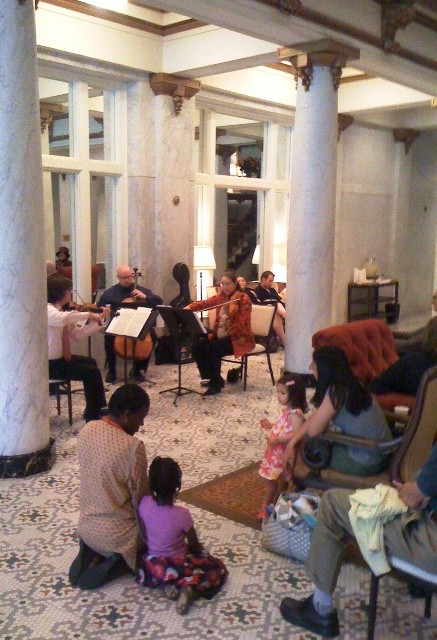
ASO at CHMusicians from the Arkansas Symphony Orchestra will be performing this evening in the lobby of the historic Capital Hotel. The music will start at 5:00 pm.

In 2011, the ASO started these free concerts in the lobby of the Capital Hotel.  The marble and tile of this historic lobby provide a wonderful acoustic backdrop for the musicians.

The concert will feature short, accessible pieces along with commentary from the musicians.

Unlike concerts in music halls, guests here are encouraged to bring drinks to their seats or to stand and move around while the musicians are playing.  It is a relaxed, informal atmosphere where the audience and musicians alike are able to interact with each other.

This concert is part of the ASO’s ongoing efforts to play throughout the community under the leadership of Music Director Philip Mann and Executive Director Christina Littlejohn.  In addition to the Capital Hotel concerts, they offer occasional free concerts at UAMS and have recently started the INC (Intimate Neighborhood Concerts) subscription series.