Tonight at 7, Arkansas Sounds salutes composers Florence Price and William Grant Still at Ron Robinson Theater

AR Sounds price_stillTwo of the leading American classical music composers in the first half of the 20th Century were from Arkansas and were African American.  Tonight (February 26) Arkansas Sounds pays tribute to Florence B. Price and William Grant Still in a program at 7pm at the Ron Robinson Theater.

Arkansas Sounds pays tribute to two of Arkansas’s most highly acclaimed African American classical composers with a screening of The Caged Bird: The Life and Music of Florence B. Price followed by performances of Price’s and Still’s compositions by members of the Arkansas Symphony Orchestra (ASO) and the ASO Youth Orchestra. The film’s length is approximately 1 hour.

Little Rock native Florence Price (1887-1953) was the first African American female classical composer to have her composition played by a major American symphony orchestra. The Caged Bird: The Life and Music of Florence B. Price traces Price’s life, detailing her cultured childhood in an extraordinarily gifted family, her struggles and eventual departure from the South due to racial tension, and her great artistic impact and success. Her compositions were favored by famed soprano Marian Anderson, and in 1933, her “Symphony in E Minor” was performed at the Chicago World’s Fair by the Chicago Symphony.

Born in Woodville, Mississippi, and raised in Little Rock, William Grant Still (1895-1978) achieved national and international acclaim as a composer of symphonic and popular music and, as an African American, was hailed for breaking race barriers of his time. His Afro-American Symphony was the first symphony composed by an African American to be played by a major symphony orchestra and is still performed today. Still was a prolific composer whose work includes symphonies, ballets, operas, chamber music, and works for solo instruments, totaling nearly 200. He also received numerous honors and achievements such as the Guggenheim Fellowship in 1934, 1935, and 1938. He also received eight honorary degrees from institutions such as Oberlin College, the University of Arkansas, Pepperdine University, and the Peabody Conservatory of Music.

The Arkansas Symphony Orchestra (ASO) comprises the state’s most sought-after professional musicians and is celebrating its 50th season. The ASO Youth Orchestra comprises over 200 student musicians, ages 9-18, who travel from over thirty-seven communities throughout Arkansas.

Black History Month Spotlight – Pike-Fletcher-Terry Mansion

IMG_5151The new Arkansas Civil Rights History Audio Tour was launched in November 2015. Produced by the City of Little Rock and the University of Arkansas at Little Rock allows the many places and stories of the City’s Civil Rights history to come to life an interactive tour.  This month, during Black History Month, the Culture Vulture looks at some of the stops on this tour which focus on African American history.

In 1958, in this stately antebellum home, seventy-six-year-old Adolphine Fletcher Terry helped to organize the Women’s Emergency Committee to Open Our Schools (WEC). Always involved in civic activities, she was dismayed that the four high schools in Little Rock remained closed rather than become integrated. Mrs. Terry told Arkansas Gazette editor Harry Ashmore that “It’s clear to me that the men are not going to take the lead in turning this thing around and so the women are going to have to.” She organized the Women’s Emergency Committee (WEC).

When segregationist school board members tried to fire forty-four teachers and administrators who supported integration in the public schools, the WEC worked with a group of businessmen who had organized a Stop This Outrageous Purge (STOP) campaign to elect new school board members who favored integration. High schools were reopened with token integration in August 1959. The WEC operated in secret because of concerns about harassment or worse. In 1998, on the fortieth anniversary of its founding, the names of WEC members were released for the first time. Those names are now etched in the window panes of the house.

Originally built in approximately 1840 by Albert Pike, it was purchased by Lou Krause from the Pike family in 1886. In 1889, she sold it to her brother-in-law, former Little Rock Mayor John Gould Fletcher. He was the father of Adolphine Fletcher Terry, who grew up in the house.  Since the 1970s, it has been property of the City of Little Rock for use by the Arkansas Arts Center.  This was stipulated in the wills of Mrs. Terry and her sister Mary Fletcher Drennan.

The app, funded by a generous grant from the Arkansas Humanities Council, was a collaboration among UALR’s Institute on Race and Ethnicity, the City of Little Rock, the Mayor’s Tourism Commission, and KUAR, UALR’s public radio station, with assistance from the Little Rock Convention and Visitors Bureau.


The Honorable Timothy C. Evans delivers 2016 Arkansas Black Hall of Fame Laureate Lecture tonight at Mosaic Templars Cultural Center

ABHOF TCE 2012The Arkansas Black Hall of Fame and the Mosaic Templars Cultural Center tonight present the The Honorable Timothy C. Evans as the Distinguished Laureate Lecture tonight (February 25) at 6pm.  Doors open at 5:30.

Native Arkansan, The Honorable Timothy C. Evans, is the Chief Judge of one of the largest circuit court systems in the world. He is the first African American to be elected to this position where he oversees 400 judges and more than 2,700 non-judicial employees. He is the recipient of the prestigious William H. Rehnquist Award for Judicial Excellence, presented annually by the Chief Justice of the United States Supreme Court. Judge Evans is returning to Arkansas to share his experiences as Chief Judge and his insight on:

  • Social and racial Justice in America
  • Alternative sentencing for juveniles and nonviolent offenders
  • Criminal justice system reform
  • Interpretations of the laws governing Grand Jury decisions

The discussion of these and other topics from the perspective of an award winning judge, tasked with leading one of the largest judicial systems in the world, will provide additional insight as Little Rock and Arkansas address similar challenges.   Chicago has garnered national media attention with increased incidences of crime, violence and police shooting incidents in minority communities. This discussion is sure to evoke community conversations that will allow Arkansas to seek solutions for social and racial justice issues in our state, cities and communities.

To RSVP, click here.


Black History Month Spotlight – TESTAMENT sculpture on State Capitol grounds

Testament 006The new Arkansas Civil Rights History Audio Tour was launched in November 2015. Produced by the City of Little Rock and the University of Arkansas at Little Rock allows the many places and stories of the City’s Civil Rights history to come to life an interactive tour.  This month, during Black History Month, the Culture Vulture looks at some of the stops on this tour which focus on African American history.

In 1957, nine African-American students enrolled at Little Rock’s Central High School, beginning the process of desegregating Little Rock’s public schools and marking a seminal event in America’s civil rights movement. This sculptural grouping was dedicated in August 2005 to honor the courage of those students, known collectively as the Little Rock Nine. Quotations from each of the Nine are featured around the bronze figures, which are the work of artists John and Cathy Deering.

The site for the statues was selected to face the end of the building which contains the Arkansas Governor’s Office.  It was from those windows that then-Governor Orval Faubus would have looked as he was making decisions to deny the Little Rock Nine entry into Little Rock Central. It is out those windows now that any governor since 2005 looks to see the statues.

The app, funded by a generous grant from the Arkansas Humanities Council, was a collaboration among UALR’s Institute on Race and Ethnicity, the City of Little Rock, the Mayor’s Tourism Commission, and KUAR, UALR’s public radio station, with assistance from the Little Rock Convention and Visitors Bureau.

Black History Month Spotlight – Arkansas State Capitol

Arkansas birthdayThe new Arkansas Civil Rights History Audio Tour was launched in November 2015. Produced by the City of Little Rock and the University of Arkansas at Little Rock allows the many places and stories of the City’s Civil Rights history to come to life an interactive tour.  This month, during Black History Month, the Culture Vulture looks at some of the stops on this tour which focus on African American history.

The Arkansas state capitol has been the site of a number of civil rights events over the years. In 1964, Ozell Sutton, a local African American leader, was denied service at the capitol’s basement cafeteria because of his race. The cafeteria then reincorporated as a private members-only club to avoid integration. A number of conflicts occurred when local black students from Philander Smith College and an interracial group of Arkansas Student Nonviolent Coordinating Committee members tried, on several occasions, to desegregate the cafeteria. In 1965, the courts finally ordered the cafeteria to open its doors to blacks and whites on an equal basis.

In 1968, after the assassination of Martin Luther King, Jr., Arkansas governor Winthrop Rockefeller held a memorial service on the capitol steps for the slain civil rights leader—the only southern governor to make such a gesture of reconciliation. His actions are credited with limiting the impact of the violence that rocked other cities in the wake of the King assassination. In 2005, John and Cathy Deering’s “Testament” bronze sculpture of the Little Rock Nine was dedicated on the north side of the building. It was the first civil rights monument erected on the grounds of a southern state capitol.

The app, funded by a generous grant from the Arkansas Humanities Council, was a collaboration among UALR’s Institute on Race and Ethnicity, the City of Little Rock, the Mayor’s Tourism Commission, and KUAR, UALR’s public radio station, with assistance from the Little Rock Convention and Visitors Bureau.

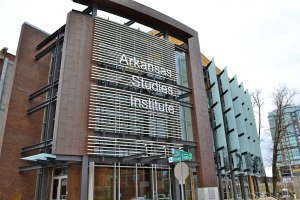
Black History Month Spotlight – Arkansas Studies Institute

ASI CALS UALRThe new Arkansas Civil Rights History Audio Tour was launched in November 2015. Produced by the City of Little Rock and the University of Arkansas at Little Rock allows the many places and stories of the City’s Civil Rights history to come to life an interactive tour.  This month, during Black History Month, the Culture Vulture looks at some of the stops on this tour which focus on African American history.

The Arkansas Studies Institute building is a Central Arkansas Library System (CALS) facility. It houses both the Butler Center for Arkansas Studies (a CALS department) and the Center for Arkansas History and Culture, a department of the University of Arkansas at Little Rock (UALR).

Exterior and interior panels are featured showing Arkansas African American life through historic photographs. Both archives offer genealogy and photography collections, and visual, audio and reference materials relating to African American history and civil rights topics in Arkansas. The Encyclopedia of Arkansas History and Culture, a Butler Center project, has many entries on African American history.

The Arkansas Sounds music collection contains materials relating to black musicians William Grant Still, Florence Price, Louis Jordan, Sister Rosetta Tharpe, and Al Bell. The Butler Center’s galleries feature local art, jewelry and crafts, many by Arkansas black artists.

The UALR Center for Arkansas History and Culture contains extensive archives, including virtual exhibits relating to the Civil War, Gov. Winthrop Rockefeller, and the city of Little Rock. Adding another dimension to the struggle for civil rights are documents and art from the World War II Japanese American Relocation Camps at Rohwer and Jerome, Arkansas, and two large Jewish history collections.

The app, funded by a generous grant from the Arkansas Humanities Council, was a collaboration among UALR’s Institute on Race and Ethnicity, the City of Little Rock, the Mayor’s Tourism Commission, and KUAR, UALR’s public radio station, with assistance from the Little Rock Convention and Visitors Bureau.

New movie RACE about Jesse Owens shown tonight at the Ron Robinson Theater

Clinton Center Race filmJoin the Clinton Foundation on Monday, February 22, for a special showing of the new movie Race, in celebration of Black History Month.

Race is based on the incredible true story of Jesse Owens, the legendary athletic superstar whose quest to become the greatest track and field athlete in history thrusts him onto the world stage of the 1936 Olympics, where he faces off against Adolf Hitler’s vision of Aryan supremacy. As a student and athlete in Depression-era America, James Cleveland “Jesse” Owens (portrayed by Stephan James of Selma) bears the weight of family expectations, racial tension at his college Ohio State University, and his own high standards for competition.

Race, MPAA-rated “PG-13,” is an enthralling film about courage, determination, tolerance, and friendship, and an inspiring drama about one man’s fight to become an Olympic legend.

This event is held in partnership with Focus Features and the City of Little Rock.

Ron Robinson Theater

Monday, February 22

Doors open at 5:30 p.m. | Program begins at 6:30 p.m.