Skip to primary content
Skip to secondary content

Little Rock Culture Vulture

Cultural events, places and people in the Little Rock area

Little Rock Culture Vulture

Main menu

  • Home
  • About the Little Rock Culture Vulture
  • Little Rock Cultural Institutions and Organizations (alphabetical)
  • LR Cultural Sites by Discipline
  • Pulitzer Prize
  • Shows Seen
  • Theatre Reviews
    • Lucky 13
    • NPHS Fall of the House of Usher, ushers in fall
    • PIPPIN’s Magic Just for You
    • The Lullaby of a Golden Tent Season
    • Thoroughly Enjoyable Millie(s)
  • Tony Awards
    • 2014 Tony Award Predictions
    • 2015 Tony Awards
      • 2015 Tony Award Nomination Predictions
      • Tony Award Nomination Analysis
    • 2016 Tony Awards
      • 2016 Tony nomination predictions

Category Archives: Civic Engagement

Post navigation

← Older posts
Newer posts →

Remembering Jefferson Thomas

Posted on September 19, 2019 by Scott

Jefferson Thomas was a track athlete at all-black Dunbar Junior High School in Little Rock when he volunteered to integrate all-white Central High School as a sophomore in 1957.  A few days before he entered the school, he celebrated his fifteenth birthday, having been born on September 19, 1942.

Mr. Thomas was a quiet, soft spoken, unique, and special person.  He had a subtle, infectious sense of humor that served him well throughout his life.  He would find that sense of humor and his love for humanity severely tested by the hate and violence directed toward him by some of the white students at Central High School.  Mr. Thomas graduated from Central High School in May 1960.

He served as the narrator of the Oscar winning documentary short, “Nine from Little Rock.”

Mr. Thomas married in 1965 and has one child (Jefferson, Jr.), still living in Los Angeles.  Mr. Thomas, Sr. was inducted into the United States Army in 1966.  He returned to civilian life in the summer of 1968.

After obtaining a Bachelor Degree in Business Administration from Los Angeles State College, Mr. Thomas went to work as an Accounting Clerk and later, Supervisor for Mobil Oil Corporation.  When Mobil Oil moved its Credit Card Operations, Mr. Thomas remained in Los Angeles, and entered Federal Service as an Accounting Clerk with the Department of Defense.  The DOD relocated parts of its LA operations to Columbus, Ohio, in 1989.  He sold his business and moved to Columbus.

After moving to Columbus, Mr. Thomas continued his commitment to serve the local community, Mr. Thomas took time to serve as a volunteer mentor in the Village to Child Program, co-sponsored by Ohio Dominican University.

He was a frequent speaker at numerous high schools, colleges and universities throughout the country, and an eager mentor to young people.  He was the recipient of numerous awards from local and federal governmental agencies.  These awards include the NAACP Spingarn Medal, and Congressional Gold Medal, this Nation’s longest-running tradition of honor, for helping make democracy work.  He was especially proud of the life-size sculpture of the Little Rock Nine at the Arkansas State Capital in Little Rock, the first in the state honoring living citizens.

Jefferson Thomas retired in September 2004, after 27 years of Federal Service. He departed this life in 2010.  His wife, Mary, still resides in Columbus, Ohio.

Share this:

  • Share on Facebook (Opens in new window) Facebook
  • Email a link to a friend (Opens in new window) Email
  • Share on X (Opens in new window) X
  • Share on LinkedIn (Opens in new window) LinkedIn
  • Share on Tumblr (Opens in new window) Tumblr
  • More
  • Share on Reddit (Opens in new window) Reddit
Like Loading...
Posted in Civic Engagement, History, LR Look Back | Tagged Academy Awards, Army, Central High School National Historic Site, Crisis at Central High, Jefferson Thomas, Little Rock Central High School, Little Rock Dunbar Middle School, Nine from Little Rock, Oscars

More than 1,000 field service projects have been completed by Clinton School students

Posted on September 18, 2019 by Scott

Today it was announced that University of Arkansas Clinton School of Public Service students have combined to complete more than 1,000 field service projects in Arkansas, across the United States, and around the world.
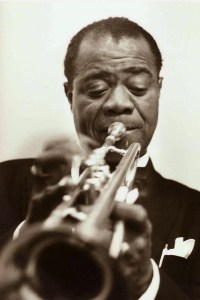
The combined work of Clinton School students has produced 367,535 hours – or more than 42 years – of civic engagement. Of the completed field service projects, 371 were based in Arkansas. Students have completed projects in 92 countries, nearly half of the U.S. State Department’s recognized independent states. Forty-four projects are in progress this fall.

“The Clinton School’s model of leadership through civic engagement is unique among graduate programs,” said James L. “Skip” Rutherford III, Dean of the Clinton School. “With high graduation rates, high career placement rates, significant community impact and student affordability, project-based learning at the Clinton School is redefining graduate school education.”

The Clinton School offers a practical approach to learning through the combination of coursework and for-credit field service projects. The Clinton School became the first public service program to integrate field service as an academic credit, with about 25% percent of the MPS degree curriculum coming from direct field service learning.

Clinton School students enrolled in the Master of Public Service degree program complete three for-credit public service projects, both domestically and abroad.

The Practicum Project is a team-based initiative during the first year that takes students into Arkansas communities to partner with organizations chosen by the Clinton School to foster community development and social change. The International Public Service Project places students with international organizations across the world during the summer after their first year. The Capstone Project is the culminating field service effort, providing second-year students with an opportunity to complete an in-depth public service project to benefit a government, for-profit, or nonprofit agency of their choosing.

Additionally, students enrolled in the Clinton School’s online degree program complete a Capstone project as the culmination of their degree work. Twenty-nine of these projects are currently underway.

Many Clinton School students have been hired by organizations they partnered with on public service projects. Nearly 85% of alumni surveyed stated that their field service experiences increased their employability. These projects not only provide practi

Share this:

  • Share on Facebook (Opens in new window) Facebook
  • Email a link to a friend (Opens in new window) Email
  • Share on X (Opens in new window) X
  • Share on LinkedIn (Opens in new window) LinkedIn
  • Share on Tumblr (Opens in new window) Tumblr
  • More
  • Share on Reddit (Opens in new window) Reddit
Like Loading...
Posted in Civic Engagement | Tagged Clinton School of Public Service, Skip Rutherford

Satchmo rebukes Ike about Little Rock on Sept. 17, 1957

Posted on September 17, 2019 by Scott

As the Civil Rights movement started taking hold in the mid-1950s, many African American entertainers were vocal in their support.  Louis Armstrong generally stayed silent.  Until, that is, September 17, 1957.
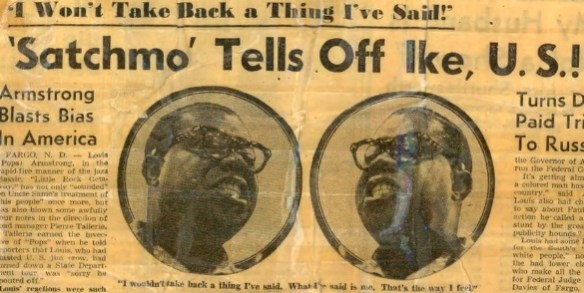
That night, in Grand Forks, North Dakota, Armstrong blasted President Dwight Eisenhower for his lack of action to make Governor Orval Faubus obey the law.  This was in an interview conducted by a 21 year old University of North Dakota journalism student named Larry Lubenow.

Journalist David Margolick wrote about the incident in The New York Times in September 2007 in conjunction with the 50th anniversary of the integration of Little Rock Central High School.  He recounted how the story, written for the Grand Forks Herald, was picked up all over the country.  The entire Margolick piece can be read here.  Margolick tells that when Armstrong was given the chance to back off the comments, he asserted that he meant all of it.

On September 24, 1957, the night that the 101st Airborne was being mobilized to come into Little Rock, Armstrong sent Eisenhower a telegram again criticizing him for lack of action. (It appears this was sent by Armstrong without knowledge of the President’s plans for intervention.) Armstrong used colorful language which sarcastically spoofed the “Uncle Tom” moniker which some of his critics had bestowed when they felt he was not doing enough for Civil Rights.  The Eisenhower Presidential Library has a copy of that telegram.

The incident between Satchmo and Ike was the basis for two different plays: Terry Teachout’s Satchmo at the Waldorf and Ishmael Reed’s The C Above C Above High C.

Share this:

  • Share on Facebook (Opens in new window) Facebook
  • Email a link to a friend (Opens in new window) Email
  • Share on X (Opens in new window) X
  • Share on LinkedIn (Opens in new window) LinkedIn
  • Share on Tumblr (Opens in new window) Tumblr
  • More
  • Share on Reddit (Opens in new window) Reddit
Like Loading...
Posted in Civic Engagement, Government, History, Music | Tagged Crisis at Central High, David Margolick, Dwight Eisenhower, Ishmael Reed, Larry Lubenow, Louis Armstrong, Terry Teachout, The New York Times

First Meeting of the Women’s Emergency Committee – September 16, 1958

Posted on September 16, 2019 by Scott

Vivion Brewer, Adolphine Terry, and Pat House with an award presented to the WEC around the time the group disbanded.

On Tuesday, September 16, 1958, the first meeting of the Women’s Emergency Committee to Open Our Schools took place at the Pike-Fletcher-Terry House in downtown Little Rock.  Fifty-eight women were in attendance at the initial meeting.

The group had been envisioned four days earlier, on September 12. At the time, Adolphine Fletcher Terry had invited Vivion Lenon Brewer and Velma Powell to her house to discuss the current school situation. Terry and Brewer were both daughters of former Little Rock mayors.  They were frustrated with the stalemate that was taking place with the Little Rock School District, the State, and the Federal Government.

In a conversation about the group with her friend Arkansas Gazette editor Harry Ashmore, Mrs. Terry stated, “The men have failed, it’s time to call out the women.”

The same day the trio met, an immediate concern superseded their general discontent.

On September 12, Governor Faubus had signed several segregationist bills into law. One of them gave him the authority to temporarily close schools in order to keep the from being integrated. After signing the bills, he issued an order closing Little Rock’s four high schools. He set October 2 as the election day for Little Rock voters to ratify or reject the closing.

The closure of the schools and impending election, gave an urgency and an immediate focus for the WEC. The women sprung into action.

The way the election law was written, keeping the schools open would require a majority of all registered voters — not just those voting in the election.  There were several other requirements written into the law that made it all but impossible to reject the closure.  Nonetheless the WEC went to work.  They wrote letters, made phone calls, made personal pleas, raised money, and placed newspaper ads.

Their need for a quick and efficient organization became even more paramount with the Governor moved the election forward to September 27.  His public reason was to remove the uncertainty; but privately he was likely concerned that there was organized opposition.

Though the voters approved keeping the high schools closed, the WEC was undaunted. They continued to work throughout the 1958-59 school year in a variety of ways. They backed candidates in the December 1958 school board elections, and succeeded in getting three moderates elected.  In May 1959, they were a crucial bloc in the campaign to recall of three segregationist school board members.

Following the reopening of the schools in 1959, the WEC continued to focus on social issues until disbanding in 1963.

The membership of the WEC was kept a secret. No official roll was kept.  With a membership which swelled to over 1,300, obviously not all attended meetings at once. There were well organized phone trees which quickly got the word out to the membership.  During elections, they would create files on all registered voters with codes for Saints, Sinners and Savable.

In an effort of intimidation (as if anyone could intimidate Adolphine Fletcher Terry), there were efforts to force the WEC to disclose membership lists. The officers and their legal counsel replied that there were no lists in existence, so there was nothing to disclose.

On March 13, 1998, the names of the WEC were made public for the first time when they were published in the Arkansas Democrat-Gazette.  This was done in conjunction with the 40th anniversary of the year of the founding.  Later in the year, the names were etched in glass in the solarium of the Pike-Fletcher-Terry House.  (In the 1970s, the house was given by the family to the City of Little Rock for use by the Arkansas Arts Center.)

A ceremony at the house in October 1998 celebrated the 40th anniversary and the names permanently etched there.  First Lady Hillary Rodham Clinton came back to Little Rock to deliver remarks at the ceremony.

Sara Murphy, a member of the WEC wrote a book about the organization which was published in 1997, shortly after her death.  Around the same time, Sandra Hubbard produced a documentary called The Giants Wore White Gloves.  On the 60th anniversary of the first WEC meeting, a sold out screening of the film was shown at the CALS Ron Robinson Theatre as a presentation of the Clinton School Speaker Series in conjunction with the Butler Center for Arkansas Studies.

Share this:

  • Share on Facebook (Opens in new window) Facebook
  • Email a link to a friend (Opens in new window) Email
  • Share on X (Opens in new window) X
  • Share on LinkedIn (Opens in new window) LinkedIn
  • Share on Tumblr (Opens in new window) Tumblr
  • More
  • Share on Reddit (Opens in new window) Reddit
Like Loading...
Posted in Civic Engagement, Government, History, LR Look Back | Tagged Adolphine Fletcher Terry, Arkansas Democrat-Gazette, Arkansas Gazette, Butler Center for Arkansas Studies, CALS, Central Arkansas Library System, City of Little Rock, Clinton School of Public Service, Clinton School Speaker Series, Harry Ashmore, Hillary Clinton, Pike-Fletcher-Terry House, Ron Robinson Theater, Sandra Hubbard, Sara Murphy, Skip Rutherford, The Giants Wore White Gloves, Velma Powell, Vivion L. Brewer, Women's Emergency Committee

Today’s the day for Open Studios Little Rock! Over 70 artists in 20 locations plus 3 Cultural Institutions

Posted on September 14, 2019 by Scott

The Little Rock Arts+Culture Commission is proud that Open Studios Little Rock is going to take place during 2019 ACANSA Arts Festival.  It is TODAY – Saturday, September 14.

Open Studios Little Rock is an event that gives the public an opportunity to meet Little Rock artists, see the spaces where they work, and see their creative processes first-hand.

Click here to see the 2019 Open Studios Map

Open Studios LR is open to all artists – visual and performing – working with the Little Rock city limits. Open Studios LR gives artists the opportunity to develop face-to-face relationships with potential buyers, gain public recognition, and be represented by the City of Little Rock’s Arts and Culture Commission.

The public can participate in FREE, self-guided tours of art-related studios, live-in/work studios and homes, galleries, schools, and other creative spaces

SATURDAY, SEPTEMBER 14, 2019 – 10am until 4pm.

ALTERNATIVE SPACE
Those artists who are unable to welcome the public into their will be set up at the alternative space, inside Cranford Co., 512 Main Street.

Share this:

  • Share on Facebook (Opens in new window) Facebook
  • Email a link to a friend (Opens in new window) Email
  • Share on X (Opens in new window) X
  • Share on LinkedIn (Opens in new window) LinkedIn
  • Share on Tumblr (Opens in new window) Tumblr
  • More
  • Share on Reddit (Opens in new window) Reddit
Like Loading...
Posted in Civic Engagement, Dance, Government, Visual Art | Tagged ACANSA Arts Festival, Cranford Co., Little Rock Arts + Culture Commission, Open Studios Little Rock

Dr. Christy Drale named 10th leader of UA Little Rock

Posted on September 12, 2019 by Scott

Image result for christy drale ualrThe Board of Trustees of the University of Arkansas today unanimously accepted UA System President Dr. Donald R. Bobbitt’s recommendation to name Christina Drale, Ph.D., chancellor of the University of Arkansas at Little Rock.
Bobbitt previously named Drale acting chancellor following the resignation of former Chancellor Dr. Andrew Rogerson that went into effect on Sept. 1. The Board voted to approve Bobbitt’s recommendation to hire Drale as permanent chancellor at its regularly scheduled meeting today at the University of Arkansas, Fayetteville.

“I’m very pleased to have been given the confidence and support from Dr. Bobbitt and the Trustees to help guide UA Little Rock into a new era of improvement in many areas on campus,” Drale said. “This is a tremendous opportunity to bring the campus and the community together and work with our students, faculty, staff and alumni to move UA Little Rock forward in the most efficient and effective ways possible. I appreciate the supportive reception I’ve gotten so far on campus and in the community, and I look forward to helping make this institution all it can be.”

Drale has served as interim executive vice chancellor and provost at UA Little Rock since October 2018. She previously served as associate vice chancellor for faculty relations and administration. She earned a doctorate degree in sociology, a Master of Arts in sociology, and a Bachelor of Arts in communications, all from the University of California, San Diego.

“Dr. Drale is widely respected on campus and is equipped with the necessary skillset to guide UA Little Rock through the challenges it currently faces and help solidify its unique standing as a comprehensive metropolitan university serving our Capital City and the entire state,” Bobbitt said. “I appreciate her stepping in recently to accept the challenge as acting chancellor and look forward to working with her and supporting her efforts to improve the institution.”

The campus started out as Little Rock Junior College in 1927 and was housed inside the new Little Rock High School (now Little Rock Central High School). After transitioning to Little Rock University, in September 1969, it joined the University of Arkansas System and became the University of Arkansas at Little Rock.

Dr. Drale is the tenth permanent leader of the campus.  Previous presidents and chancellors have been:

R.C. Hall (1927-1930)
John A. Larson (1930-1949)
Granville Davis (1950‐1954)
Carey V. Stabler (1956‐1972)
G. Robert Ross (1973‐1982)
James H. Young (1982‐1992)
Charles E. Hathaway (1993‐2002)
Joel E. Anderson (2003‐2016)
Andrew Rogerson (2016-2019)

Share this:

  • Share on Facebook (Opens in new window) Facebook
  • Email a link to a friend (Opens in new window) Email
  • Share on X (Opens in new window) X
  • Share on LinkedIn (Opens in new window) LinkedIn
  • Share on Tumblr (Opens in new window) Tumblr
  • More
  • Share on Reddit (Opens in new window) Reddit
Like Loading...
Posted in Architecture, Civic Engagement, Dance, Design, Government, Music, Science, Theatre, Visual Art | Tagged Christy Drale, UA Little Rock, UA Little Rock Alumni Association, UA Little Rock Anthropology, UA Little Rock Applied Design, UA Little Rock Art, UA Little Rock Bowen School of Law, UA Little Rock Center for Arkansas History and Culture, UA Little Rock Downtown, UA Little Rock English, UA Little Rock History, UA Little Rock School of Mass Communication, UA Little Rock Theatre and Dance

Sept. 12, 1958 – A Day of Uncertainty in Little Rock schools

Posted on September 12, 2019 by Scott

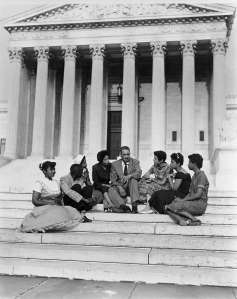
Thurgood Marshall, of the NAACP, sits on the steps of the Supreme Court Building after he filed an appeal in the integration case of Little Rock’s Central High School. The students are, from left: Melba Pattillo, Jefferson Thomas, Gloria Ray, escort Daisy Bates, Marshall, Carlotta Walls, Minnijean Brown, and Elizabeth Eckford. (AP Photo, file)

On September 12, 1958, in an extraordinary session, the U. S. Supreme Court found that “the federal judiciary is supreme in the exposition of the law of the Constitution” and all state officials must adhere to the Court’s decisions and follow the rules laid down in those decisions in similar future cases.

The genesis of this decision (Cooper v. Aaron) was at the heart of the matter as to whether the Little Rock schools would remained integrated (albeit severely limited) or return to a segregated state.  With the SCOTUS ruling, the road that was set before the LRSD was integration.

Following the decision, the Little Rock School Board issued a statement that the schools would open as planned on Monday, September 15, 1958.  One of the School Board members, Henry V. Rath, resigned his position on the board that day. He was frustrated that the School Board was caught between federal law and state law.

Later that afternoon, Governor Faubus signed several bills into law which had been passed in a special session. These bills were designed to make it more difficult to integrate public schools.  One of them gave the Governor the authority to temporarily close schools to keep them segregated.  The Governor would then call a special election for the voters in that district to decide whether to remain closed or be opened and integrated. (One of the other laws, which would come in to play later during the school year, laid out the plans for a recall of school board members.)

Shortly after signing the law which gave him the authority to close the schools, Governor Faubus did just that.  He announced that Little Rock’s four public high schools would not open on Monday, September 15.  He set October 7 as the date for the special election about keeping the schools closed.

No one seemed to know what the next steps were.

That night, high school football took place, as previously scheduled.  Central came from behind to defeat West Monroe, Louisiana, by a score of 20 to 14.

Over the weekend, there were many meetings and phone conversations as people were trying to figure out what to do.

One meeting that took place on September 12 was at the home of Mrs. Adolphine Fletcher Terry.  She invited a few friends over to discuss what role the women of the city could play in solving this crisis.  The group decided to meet on the following Tuesday, September 16, at Terry’s house.  It would eventually grow to over 1,300 members and have the name of Women’s Emergency Committee to Open Our Public Schools.

Share this:

  • Share on Facebook (Opens in new window) Facebook
  • Email a link to a friend (Opens in new window) Email
  • Share on X (Opens in new window) X
  • Share on LinkedIn (Opens in new window) LinkedIn
  • Share on Tumblr (Opens in new window) Tumblr
  • More
  • Share on Reddit (Opens in new window) Reddit
Like Loading...
Posted in Civic Engagement, Government, History, LR Look Back | Tagged Brown v. Board of Education of Topeka, Cooper v. Aaron, Earl Warren, Henry V. Rath, Horace Mann Middle School, Little Rock Central High School, Little Rock Hall High, Little Rock School Board, NAACP, Supreme Court, Thurgood Marshall b

Post navigation

← Older posts
Newer posts →

Search the Site

Archives

  • January 2020
  • December 2019
  • November 2019
  • October 2019
  • September 2019
  • August 2019
  • July 2019
  • June 2019
  • May 2019
  • April 2019
  • March 2019
  • February 2019
  • January 2019
  • December 2018
  • November 2018
  • October 2018
  • September 2018
  • August 2018
  • July 2018
  • June 2018
  • May 2018
  • April 2018
  • March 2018
  • February 2018
  • January 2018
  • December 2017
  • November 2017
  • October 2017
  • September 2017
  • August 2017
  • July 2017
  • June 2017
  • May 2017
  • April 2017
  • March 2017
  • February 2017
  • January 2017
  • December 2016
  • November 2016
  • October 2016
  • September 2016
  • August 2016
  • July 2016
  • June 2016
  • May 2016
  • April 2016
  • March 2016
  • February 2016
  • January 2016
  • December 2015
  • November 2015
  • October 2015
  • September 2015
  • August 2015
  • July 2015
  • June 2015
  • May 2015
  • April 2015
  • March 2015
  • February 2015
  • January 2015
  • December 2014
  • November 2014
  • October 2014
  • September 2014
  • August 2014
  • July 2014
  • June 2014
  • May 2014
  • April 2014
  • March 2014
  • February 2014
  • January 2014
  • December 2013
  • November 2013
  • October 2013
  • September 2013
  • August 2013
  • July 2013
  • June 2013
  • May 2013
  • April 2013
  • March 2013
  • February 2013
  • January 2013
  • December 2012
  • November 2012
  • October 2012
  • September 2012
  • August 2012
  • July 2012
  • June 2012
  • May 2012
  • April 2012
  • March 2012
  • February 2012
  • January 2012
  • December 2011
  • November 2011
  • October 2011
Blog at WordPress.com.
Little Rock Culture Vulture
Blog at WordPress.com.
Privacy & Cookies: This site uses cookies. By continuing to use this website, you agree to their use.
To find out more, including how to control cookies, see here: Cookie Policy
  • Subscribe Subscribed
    • Little Rock Culture Vulture
    • Join 668 other subscribers
    • Already have a WordPress.com account? Log in now.
    • Little Rock Culture Vulture
    • Subscribe Subscribed
    • Sign up
    • Log in
    • Report this content
    • View site in Reader
    • Manage subscriptions
    • Collapse this bar
 

Loading Comments...
 

    %d