

LR Women Making History – June Freeman

June Biber Freeman, born and reared in New Jersey, came to Pine Bluff from the University of Chicago, where she had met and married her husband, Edmond Freeman, a Pine Bluff native.

Long interested in the arts, she was instrumental in establishing the Little Firehouse Community Arts Center. Serving as its unpaid director until, with her continued vision and help, it morphed into the Arts and Science Center for Southeast Arkansas (ASC).  In 1973, she conceived and organized the  Women and the Arts: A Conference on Creativity,  the first of its kind in the region. Governor Dale Bumpers appointed her to the Governor’s Commission on the Status of Women.  In 1975,  Freeman was  hired by  Townsend Wolfe as the Arkansas Arts Center’s Director of State Services, a job  she held for the next five years.

In 1982, she was instrumental in establishing Pine Bluff Sister Cities.   She has served on the Little Rock Arts+Culture Commission as well as the boards of the Arkansas Arts Center, the Mid-American Arts Alliance and the Arkansas Arts Council. (In view of her background in psychology, she has served as a longstanding member of the UAMS Advisory Board of the Psychiatric Research Institute.)

Freeman is the founding director of the non-profit Architecture and Design Network (ADN) which got underway in 2003. Securing the support of the Arkansas Arts Center, the UA Fay Jones School of Architecture and Design (FJSAD) and the central section of the Arkansas chapter of the American Institute of Architects (AIA), Freeman launched a series of free public lectures by distinguished architects.  Retiring as director at the end of 2016, she continues to serve as a board member. She was named an honorary member of the FJSAD Dean’s Circle and, in 2013, was given an Award of Merit by the state Chapter of the AIA at its annual meeting. In 2016 the ADN board named the lecture series for her.

In 2017, she was inducted into the Arkansas Women’s Hall of Fame.  In 1995, she received the Governor’s Arts Award for Outstanding Patron.  In 2018, she became a rare two-time award recipient of a Governor’s Arts Award as she received the Lifetime Achievement Award.

Freeman and her husband, who retired as publisher of the Pine Bluff Commercial, moved to Little Rock in 1995. The couple has four children and six grandchildren.

LR Women Making History – Kaki Hockersmith

In 2015, Kaki Hockersmith was honored at the Governor’s Arts Awards.  She creates art as a designer. In addition, she promotes arts and heritage through her tireless efforts on behalf of numerous cultural institutions.  This award was only one of many recognitions she has received.
In 2010, she was appointed to the President’s Advisory Committee on the Arts for The Kennedy Center.  In that capacity, she serves as a national ambassador for The Kennedy Center. She has also brought programs from The Kennedy Center to Arkansas to help established and emerging arts organizations. She also serves as a commissioner on the cultural committee of UNESCO – the United Nations Educational, Scientific and Cultural Organization.  For the past two years, she and Stephanie S. Streett have led the efforts for FUSION which creates an arts and humanities curriculum for Arkansas teachers.

In 1993, she redesigned the interior of The White House during the Clinton Administration. She was also appointed a member of the Committee for the Preservation of The White House.  Her work on this American landmark was featured in Hillary Clinton’s book An Invitation to the White House: In Celebration of American Culture.

Locally, she has served on the Board of Trustees for the Arkansas Arts Center and the Arkansas Governor’s Mansion Association. She is an active supporter of many cultural organizations in Little Rock.  She and her husband Max Mehlburger open their home to host receptions and fundraisers for numerous cultural institutions and organizations.  In 2014, she was recognized for this support at Ballet Arkansas’ Turning Pointe gala.

Professionally, she has been honored by the national ASID organization as well as the Washington D.C. chapter. Her projects have won 16 regional ASID awards, including seven gold awards.

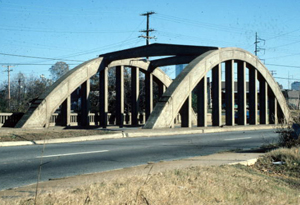
A Lincoln Viaduct Portrait

Photo courtesy of the Arkansas Historic Preservation Program

Since today is Abraham Lincoln’s birthday, it is a good day to pay tribute to the Lincoln Avenue Viaduct.  This arched bridge is traversed by thousands of cars each day, with most having no idea the name of the structure.  The Lincoln Avenue Viaduct is the arched bridge connecting LaHarpe with Cantrell Road which (literally) bridges downtown with the west along Highway 10.

The Lincoln Avenue Viaduct is a reinforced concrete rainbow arch bridge. It was opened at 2:05 p.m. on Friday, December 28, 1928, and, despite later alterations, it remains particularly well-preserved. The Missouri Pacific Railroad Company, considered the most important railroad company in the state, constructed the bridge amid a series of improvements in Little Rock made necessary by the damage wrought by the infamous spring floods of 1927.

Though the bride was constructed by the railroad, the City had to give authorization to do so, this was accomplished by the passing of Ordinance 4,335, at the May 28, 1928, City Council meeting.

Lincoln Avenue was one of several names for stretches of Highway 10 in Little Rock. By the 1960s, the areas west of the Lincoln Avenue viaduct were all renamed Cantrell in honor of the man who had developed much of the area west of the Heights. The longest stretch of the road already carried that name. There had been an effort to rename Highway 10 (including sections named Lincoln, Q, and Cantrell) in Little Rock for Senator Joseph Taylor Robinson in 1930. He declined the offer because he did not want to diminish the contributions of Mr. Cantrell.  Over time the entire stretch bore the name Cantrell.

The stretches east of the viaduct which involved a couple of names were renamed La Harpe Boulevard in honor of the French explorer who first saw the Little Rock. (La Harpe was originally an extension of Riverfront Drive. But with changes to development along the Arkansas River and the coming of I-30, the streets were reconfigured significantly in the 1950s and early 1960s.)

Though the street has been renamed, the bridge still carries the name of the 16th President of the United States.

Little Rock Look Back: LR Votes FOR a Municipal Auditorium

On January 26, 1937, Little Rock voters went to the polls to vote on three different municipal bond issues.  One of them was the construction of a municipal auditorium.

The bonds for the auditorium would be $468,000 in general obligation bonds which would be paid off between 1940 and 1971. This was toward a total cost of $760,000 for the entire project.

The official campaign for the auditorium was sponsored by the Little Rock Forward Committee which was led by W. H. Williams. In campaign advertisements it showed the value of conventions in New York City which was estimated at $100 per convention attendee. Little Rock organizers were estimating a $10 a day expenditure by visitors, which the committee stressed was very conservative. The campaign committee emphasized the importance of acting at that time due to the federal government money involved.

Various committees and organizations endorsed the auditorium project including the Little Rock Chamber of Commerce, Little Rock Federation of Women’s Clubs, and the Young Business Men’s Association.

The thrust of the campaign focused on the economic benefit to Little Rock as well as the fact that the auditorium would be for all citizens. This message was picked up in editorials by both the Democrat and Gazette. In editorials on January 23 and 25, the Democratopined that the benefits of the auditorium would be distributed among all classes of the citizenry. The next day, both papers ran editorials which touted the economic boon an auditorium would bring through conventions and meetings.

The Democrat’s approach broke down the current value of conventions to Little Rock with, what it termed, the city’s “existing inadequate” facilities. The paper emphasized a conservative estimate of what the added value to Little Rock’s economy would be with the new auditorium.

In expressing support for the auditorium the Gazette stressed the values for local, statewide and national groups. “An auditorium would provide a more convenient and better adapted community center for all kinds of local gathering,” and continued that it would make Little Rock “the logical meeting place for state conventions of every sort.” In discussing the value of state, regional and national meetings the paper stressed that the outside money spent by convention attendees has an impact beyond stores, hotels and restaurants.

Both papers also echoed the importance of the federal government financing to make this possible. The Democrat noted that the Public Works Administration grant and federal low cost loan made this an ideal time.

On January 26, 1937, Little Rock voters approved the auditorium bond by a vote of 1,518 to 519. It passed in each of the city’s 23 precincts. Little Rock Mayor R. E. Overman expressed his pleasure at the outcome of the vote and extended his thanks to the voters.

After the election, a Gazette editorial commented on the low turnout for the special election by commenting that the weather had been nice and there were no other barriers to voting. The editorial writer opined that those not voting in the election must not have been opposed to the endeavor.

Little Rock Look Back: LR FINALLY takes possession of Robinson Auditorium

Robinson Auditorium

On January 25, 1940, the City of Little Rock officially took complete possession of the Joseph Taylor Robinson Memorial Auditorium. By assuming custody of the structure from the contractor and the PWA, the City accepted responsibility for any of the remaining work to be completed.  This event happened one day shy of the third anniversary of the election which approved plans to issue bonds for an auditorium.  The act took place only about five months behind schedule.

E. E. Beaumont, the Auditorium Commission chairman, stated that an opening date could not be set until more work was completed. A major unfinished task was the laying of the front sidewalk which had been delayed due to cold weather.

The night before Little Rock took possession, Robinson Auditorium had been a topic of discussion at the Little Rock Chamber of Commerce annual meeting. The new Chamber president Reeves E. Ritchie (who as an Arkansas Power & Light executive had been engaged in the lengthy discussions about the installation of the steam line and transformers of the building) pledged that the Chamber would work to bring more and larger conventions to Little Rock at the Joseph Taylor Robinson Memorial Auditorium.

Little Rock Look Back: Cornice installed at Robinson Auditorium

On June 1, 1939, the cornice was installed on Robinson Auditorium.  This granite slab noted the name of the building as the Joseph Taylor Robinson Memorial Auditorium.  (It is interesting to note that it used the more modern “u” instead of the classical “v” which was often used in buildings during prior decades – as evidenced by the Pvlaski Covnty Covrt Hovse across the street.)

This was a milestone marking the completion of the front facade of the structure.  Much work would continue on the interior of the structure.  This step in the construction was considered major enough that the Arkansas Gazette mentioned it in a news article.

On this date in 2015 and 2016, the cornice was again surrounded by construction materials and braces. But the restoration of Robinson Center finished in November 2016. Once again, the cornice stands proudly atop the six columns with no impediments around it.

Finalists for $60,000 Sculpture Competition Announced

The winner of a $60,000 commission to place a sculpture at the Southwest Community Center in 2018 will be announced on Sunday, April 23, 2017, as the 10th Sculpture at the River Market Show and Sale concludes.

The three semifinalists for the 2017 Sculpture at the River Market Public Monument Competition were announced Friday night at the conclusion of the Preview Party for the 2017 Sculpture at the River Market Show and Sale. The three semifinalists are:

  • Jack Hill – “On a Roll”
  • Ted Schaal – “Dropsy”
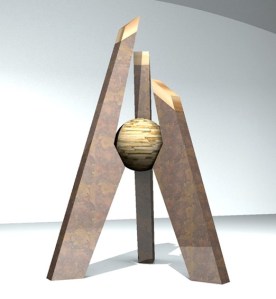
  • Stephen Shachtman – “A”

ON A ROLL

DROPSY

A

Sculpture at the River Market invited all artists participating in the 2017 Show & Sale to submit a proposal for its $60,000 Public Monument Competition. This is the seventh such competition in the ten years of the Show & Sale.

Of the 50 artists in the 2017 Show & Sale, 29 artists submitted a proposal.  The proposals of the seven semifinalists were displayed during the event’s Preview Party on the evening of April 21, and Preview Party guests voted for their 1st, 2nd and 3rd choice.  All votes were tallied and the top three finalists were announced at the end of the evening.

The top three proposals will be juried on April 22 and 23, and the 2017 winner will be announced at 3PM on Sunday, April 23.  The winner will be installed at the Southwest Community Center in 2018.

The other semifinalists were: Terry & Maritza Bean, Craig Campbell, Jane DeDecker, and Mark Leichliter.

Previous Public Monument Competition winners have been:

  • 2011 – Chapel for The Center installed in Riverfront Park
  • 2012 – Bryan Massey for Nautilus installed in Riverfront Park
  • 2013 – Ted Schaal for Open Window installed in Riverfront Park
  • 2014 – Lorri Acott for Peace installed at 2nd Street and Main Street
  • 2015 – Michael Warrick for Mockingbird Tree installed at Chenal Parkway and Chenal Valley Drive
  • 2016 – Clay Enoch for United which will be installed at Central High School in September 2017.

More information is available on the web at http://sculptureattherivermarket.com/.