Little Rock Look Back: 1959 Labor Day Bombings

Labor Day Bomb

ARKANSAS GAZETTE photos showing the exterior and interior of the LRSD building after the bomb blast.

A

On September 7, 1959, a peaceful Labor Day in Little Rock was shattered by the explosions of three dynamite bombs.

The locations were Fire Chief Gene Nalley’s driveway on Baseline Road at 10:20pm, Baldwin Company offices at Fourth and Gaines at 10:53pm (where Little Rock Mayor Werner Knoop was a partner–the company is now known as Baldwin Shell), and the School District offices at 10:58pm (then located at Eighth and Louisiana streets).

Given the three targets, it was fairly quickly assumed that there was a connection between the bombings and the lingering effects of the 1957 integration crisis. In light of that, police officers were stationed at the homes of all Little Rock City Directors and School Board members.

The investigation into the bombings turned up a purported fourth location for a bomb. That was the office of Letcher Langford. (Culture Vulture Editorializing Note:  This could have been a ploy to throw investigators off the scent. Langford was the only City Director who had been backed by segregationist candidates and had been openly hostile to the Women’s Emergency Committee — to the point of threatening them with legal action for not disclosing their membership rolls.)

Investigators determined that the bombing had been planned in late August by members of the Ku Klux Klan.  Five individuals were arrested.  They were J. D. Sims, Jesse Raymond Perry, John Taylor Coggins, Samuel Graydon Beavers, and E. A. Lauderdale.  The latter had twice been an unsuccessful candidate for the City Board of Directors.

Sims pleaded guilty and started serving a prison term later in September 1959.  Perry, Coggins and Beavers all went to trial in October and November.  Each was found guilty. Their terms ranged from three to five years.  Lauderdale was convicted, but appealed his decision. Though the Arkansas Supreme Court upheld the verdict against him, he did not start serving his sentence until the court decision in February 1961.

Governor Faubus commuted the sentences of Perry, Coggins and Beavers.  All three served less than six months.  Lauderdale’s sentence was reduced by Faubus so that he, too, was eligible for release after six months.  Sims, who was first to plead, served the longest: nearly two years.

Sadly, this would not be the last bombing in Little Rock tied to 1957. In February 1960, Carlotta Walls’ house was bombed.

Elizabeth Eckford Bench Dedicated Today

Sixty-one years ago today, Elizabeth Eckford took the long walk down Park Street as she was trying to enter Little Rock Central High for her first day of classes there.

Met by a mob and kept out of the school by the soldiers she thought were there to protect her, Eckford finally made her way to a bus bench at Sixteenth and Park Streets.

Today at 4:30 pm, a replica of that bench is being dedicated at that location.

Little Rock Central High School National Historic Site is collaborating with the Central High Memory Project students and additional partners for the ceremony.

September 4, 1957, was supposed to be the first day of school for the African American students who were selected to integrate Little Rock Central High School.  Due to the mobs gathered outside of the school and interference from Governor Orval Faubus, the students would not get in the school that day.

The most famous images from that day are the photos of Elizabeth Eckford walking in front of the school, only to be rebuffed by soldiers and tormented by the crowds. Elizabeth’s decision to walk through the mob of protesting segregationists to enter school, only to be turned away became world news. The story of the desegregation of Central High School was thrust into a defining role within the Civil Rights Movement. Elizabeth’s efforts to overcome the fear and uncertainty that she faced that morning resulted in her seeking refuge at a lonely bus stop bench.

In order to highlight this aspect of the story and create more personal connections with this turning point in history for students and visitors, the National Park Service and the Central High Memory Project Student Team will work with community partners in a new public history project.  The Bench Project includes building a replica of the bus stop bench, creating a mobile app for the students’ audio walking tour of eyewitness accounts of that first day of desegregation, and developing a storycorps recording booth for interviews and student podcasts.

The partnership includes: Bullock Temple C.M.E., Central High School and their EAST LAB, the Little Rock School District, the City of Little Rock, the Clinton School of Public Service, Central Arkansas Library System’s Butler Center for Arkansas Studies, Good Earth Garden Center, Friends of Central High Museum Inc., Home Depot, Little Rock Club 99 and other Rotary International Clubs,  Unity in the Community, and others.

The groundbreaking ceremony will be held at the corner of Park and 16th Street starting at 4:30 p.m. The program will include remarks by the NPS Superintendent and the directors of some of the partnering organizations regarding the projects that will be completed in connection with this effort. The Central High Memory Project Student Team will be on hand to meet the public and share details about their work.

Little Rock Look Back: Arkansas Arts Center study group heads to China

TIna Poe, Raida Pfeifer and Jeane Hamilton at the Great Wall of China (photo from collection of Jeane Hamilton)

On September 1, 1975, a group from the Arkansas Arts Center left Little Rock for a study tour of China. This was the first non-governmental group from the United States who had been authorized to tour the People’s Republic of China.

Fred Poe, of Poe Travel, and Jeane Hamilton were the organizers of the trip.  It was part of the annual travel seminars the Arts Center  would take to locations throughout the world to learn more about art and culture.  It took many months of planning as wells as mounds and pounds of paperwork to get this trip underway.

Persons interested in the trip had to apply and be approved by the Chinese government in order to participate in the trip.   The Chinese government selected eighteen AAC members from submitted applications and the group visited Beijing, Shanghai, Changsha, Kweilin, and Guangzhou.

The AAC Traveling Seminar participants in front of Mao’s birthplace. (Photo from the Jeane Hamilton collection.)

Little Rock Look Back: Memorial Services for Senator Robinson

As Arizona Senator John McCain is being remembered in a series of memorial services, it seems an appropriate time to recall the series of services for Arkansas’ senator who was on a national party ticket. That man was Joseph Taylor Robinson.
Like Senator McCain, Senator Robinson was honored in services both in the state he represented as well as at the US Capitol.

Senator Robinson died in Washington D.C. on July 14, 1937.  His wife was in Little Rock making preparations for a trip the couple was to take. Following his demise, Mrs. Robinson went to Washington to accompany her husband’s body back to Arkansas.

The Senator was honored with a memorial service in the Senate chambers on Friday, July 17.  President Roosevelt and the cabinet joined members of the senate on the floor in what was described as a state funeral without pomp.  Mrs. Robinson sat with her brothers and two nephews as well as Bernard Baruch and Arkansas Power & Light’s Harvey Couch, who were Senator Robinson’s closest friends.  Eleanor Roosevelt was one of the many crowded in the senate galleries observing the service.  Following the service his body remained in the chambers until it was transferred to a train to make the journey to Little Rock.

The funeral train bore his body, his family, 50 senators and over twenty congressmen. It reached Little Rock around 8am on Sunday the 19th.  From there, Senator Robinson’s body was taken to his house on Broadway Street until noon.  It subsequently lay in state at the Arkansas State Capitol until being escorted by military to First Methodist Church.

1,500 people packed the church a half hour before the service began. The sun shone through the windows onto the flag-draped coffin as Rev. H. Bascom Watts led the service. Among the pallbearers was former Vice President Charles G. Dawes. Governor Carl Bailey of Arkansas was joined by Governors Richard Leche of Louisiana and E.W. Marland of Oklahoma.

As the funeral procession reached Roselawn Cemetery, thunder echoed. The skies which had alternated between sun and rain that day, returned to rain. A deluge greeted the end of the service and sent visitors hurrying for shelter at the end.

The Clinton Center seeks feedback on future exhibit ideas

Be a Museum Curator for a Day – or at least for a few minutes.
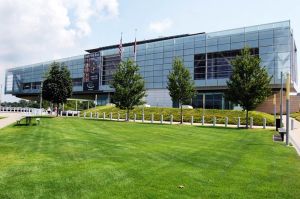
The Clinton Presidential Center is seeking public input on future temporary exhibit ideas. They want to hear from you!

What temporary exhibits would you like to see on display at the Clinton Center? Share your opinion and be entered into a drawing for a Clinton Center prize pack!

Complete the short survey here:

Little Rock Look Back: The 1944 launch of the USS Little Rock

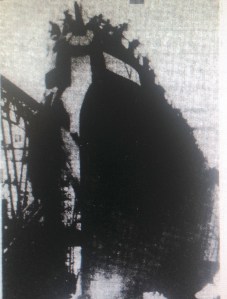
On August 27, 1944, the first USS Little Rock was launched in Philadelphia at the Cramp Shipbuilding Company shipyards.  A 10,000 ton Cleveland Class light cruiser, it first touched water in the Delaware River.
The sponsor of the ship (who broke the champagne bottle on the hull) was Mrs. Ruth May Wassell, the wife of Little Rock alderman Sam Wassell.  The main address was delivered by Congressman Brooks Hays, whose district included Little Rock.  A crowd of 5,000 was gathered to witness the launch.

According to the Associated Press Congressman Hays called light cruisers, “the hottest item of naval combat.”

The congressman further elaborated:

The people of Little Rock are proud to have such a ship as this bear their city’s name.” said Mr. Hays. “Even those of us who know little about the classification of naval vessels know that the cruisers have distinguished themselves in the Pacific war and that this is the outstanding type of combat vessel for that area. The navy men tell us that the cruiser is the ‘work horse of the navy.’ big enough to go into any battle, fast enough to lead any task force.

Carrying, as it has, the heaviest load in the Pacific where the greatest battles have taken place, the cruisers have added luster to naval history. We hope that, in the time remaining before our enemies are put down, the Little Rock will take her place along side the Boise, the San Francisco, the Helena,and the Chicago, preserving the prestige of the cruisers.

We are glad to honor the workmen and the company for which they work.  I am sure we are all impressed with the spirit of teamwork which produced the results we observe today.  In March 1943, the keel was laid and for 18 months materials for the ship have come from everywhere. The taxes to pay for it will be assessed against men and women of great and little resources. Teamwork from beginning to end did the job.

So with the war.  A glorious victory lies ahead, but there is much remaining to be done. Only teamwork can supply the dynamic power yet needed to complete that victory. Every ship launching is a reminder of the power that comes to a people who work together to achieve.”

Other guests at the ceremony included United States Senator John L. McClellan and Congressman and senator-elect J. William Fulbright. Alderman Sam Wassell was also present.  He and his wife hosted a dinner for the Arkansas delegation and other dignitaries the night before the christening while they were in Philadelphia.

At the request of the Secretary of the Navy, Little Rock Mayor Charles Moyer designated Mrs. Wassell for the honor of sponsoring the USS Little Rock. There are not details as to why Mayor Moyer made the designation.  A first cousin of Alderman Wassell, Dr. Corydon Wassell had been an early World War II hero and was a favorite of President Franklin Roosevelt.  Paramount had released a movie about him earlier in 1944. That may have been a reason for the designation.

The Little Rock City Council sent a bouquet of roses to the ceremony, fitting since the city’s nickname at the time was “City of Roses.” After the launch, Mrs. Wassell sent a telegram to Mayor Moyer and the Council

Thanks a million for the beautiful bouquet of red roses. They made the christening of the cruiser Little Rock perfect. I wish it could have been possible for you to have been present.  The cruiser is 600 feet long and will have a crew of 1,200 men.  I was so proud of our city.  Little Rock has something to be proud of.

The USS Little Rock (CL-92) was commissioned at the Philadelphia Navy Yard, on June 17, 1945.  After service during the end of World War II and the post-war era, it was decommissioned on June 24, 1949. After being refit, it was recommissioned on June 3, 1960. It was permanently decommissioned on November 22, 1976.  The following year it was towed to Buffalo where it has been a museum since then.

The current USS Little Rock was commissioned adjacent to the original USS Little Rock — the only time a new ship was commissioned next two the previous ship to bear its name.

On National Dog Day, a Look at Four Canine Sculptures in Little Rock

August 26 is National Dog Day!  To mark this occasion, here are four sculptures found in Little Rock which feature dogs.  Two are in the Vogel Schwartz Sculpture Garden, one is in the Bill Clark Wetlands, and the other is at the Little Rock Animal Village.

Ken Newman’s FOREVER READY was donated in 2009 by the Sculpture at the River Market.   It is sited in the Vogel Schwartz Sculpture Garden.  Mr. Newman is a member of the National Sculptors’ Guild.  One of Mr. Newman’s specialties is animals.  Cast in bronze, Forever Ready depicts a Labrador.  Here is Mr. Newman’s artist statement on the piece.

So, ‘Forever Ready’ is that reflection of the breed (hunter, companion and teacher)…Capturing its intense nature with discipline and loyalty, I have set the lab on edge so intense, that if not given the command to go, it will just fall off. But, it is able to maintain balance – wet and ready to go again. The lab’s shadow is cast in the water below, for a I cannot think of a lab without water.

A few yards from Forever Ready, another dog stands inquisitively.  Commissioned in 2010 and unveiled in 2011, Dan Glanz’s BORIS is a likeness of Boris Kumpuris, the dog and companion of Mary and Dr. Dean Kumpuris.

Glanz captures the friendly and inquisitive nature of Boris in this work, which can be found in the Vogel Schwarz sculpture garden. Most weekends Boris can be seen with Dean as the two walk through Riverfront Park and the River Market. Boris explores and inspects the park along with Dean. Each year during the Sculpture at the River Market show, Boris visits with Dean and meets all the sculptors.

The sculpture was donated by longtime Kumpuris family friend Margaret Clark. She and her late husband Bill were two of the earliest supporters of sculpture along the Arkansas River. They donated another piece in honor of their grandchildren. A sculpture in memory of Bill was stands in the wetlands park which bears his name.

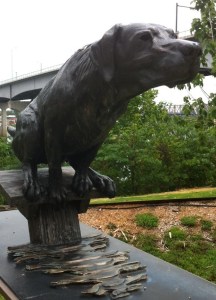
The Bill Clark Wetlands is actually the location of the third dog.  It is Chloe, Bill Clark’s faithful hunting dog.  She stands next to Bill in Clay Enoch’s sculpture STEADY.  Dedicated in 2011, it was a tribute to the man who helped build the Clinton Presidential Library.

This tribute to Clark shows Bill and Chloe in an early morning duck hunt scanning the horizon.  It is also positioned so that Bill is also gazing at the Clinton Presidential Center. His firm was the contractor on that building, and he spent thousands of hours walking in the area looking at the building during the construction.

A portion of the ground he trod during construction has been set aside as the Bill Clark Wetlands, and STEADY is placed in the wetlands as a memorial to Bill.

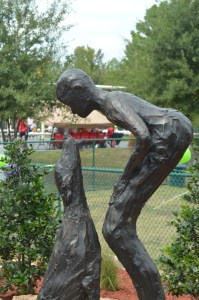
In 2015, the Little Rock Animal Village unveiled Lorri Acott’s WHO RESCUED WHO.  Located at the entrance to the Little Rock Animal Village, it depicts a person and dog looking at each other. They are sharing a bond of respect, admiration and love.

The human figure has Acott’s trademark extended length legs. These represent the ability to overcome obstacles and rise above adversity.  This is even more apt when considering the role that pets can play in our lives, as well as the role humans play in “adopting” rescued pets.

The sculpture is dedicated to the memory of Jack Adcock. It is given by his family, which includes longtime City Director Joan Adcock, their two children, eleven grandchildren, and great-grandchildren.