Little Rock Look Back: Birth of Joe T. Robinson

Future Senator Joseph Taylor Robinson was born in Lonoke in August 26, 1872.  In 1894 Robinson was elected to the Arkansas General Assembly for one term.  From 1903 until 1913, he served in the US House of Representatives as a Congressman from Arkansas’ then-Sixth District.

He chose not to seek another term in Congress and ran for Governor in 1912.  On January 3, 1913, sitting US Senator Jeff Davis died in office.  Robinson was sworn in as Governor on January 16, 1913. Twelve days later he was chosen by the Arkansas General Assembly to become the next US Senator. He became the final US Senator to be selected by a legislator instead of popular vote.  At the time, Senate terms started in March, so Robinson served as governor until March 8, 1913.

He rose through the ranks of the Senate and eventually became the first person to hold the title of Senate Majority Leader.  In 1928, he was the Vice Presidential nominee for the Democratic Party.  Four years later, he rode with Franklin and Eleanor Roosevelt to the inauguration ceremonies before FDR took the oath.  He would be President Roosevelt’s go-to man on legislative issues.

Senator Robinson died in Washington D.C. on July 14, 1937.  His wife was in Little Rock making preparations for a trip the couple was to take. Following his demise, Mrs. Robinson went to Washington to accompany her husband’s body back to Arkansas.

It was not until December 1937, that Senator Robinson’s name became attached to the municipal auditorium which Little Rock voters had approved in January 1937.  Mrs. Robinson participated in the December 24, 1937, groundbreaking for the auditorium.

Naming the auditorium after him was not Little Rock’s first attempt at honoring Senator Robinson.  In 1930, portions of Lincoln, Q, and Cantrell streets were renamed Robinson Drive in his honor. This was part of an effort to give Highway 10 (which had four different names as it wended through the City) a single name in Little Rock.  A few months later the Senator requested that the original names be returned.  Cantrell had been named in honor of a developer who was continuing to work in the area surrounding that street.  The Senator felt it should be named after Mr. Cantrell.  As part of that, the name Cantrell was extended to most of Highway 10 within the Little Rock city limits.

In 1935, on Senator Robinson’s ante-penultimate birthday, the Little Rock City Council coincidentally approved the plans for a municipal auditorium which would then be submitted to the Public Works Administration.  It was this project which would become Robinson Auditorium.

Two Centuries of the Quapaw Line

Stones placed in Riverfront Park denote where there Quapaw Line started from La Petite Roche

On August 24, 1818, the Quapaw Line was drawn.  Starting at La Petite Roche and heading due south, this line formed the boundary between the Quapaw tribal lands and public lands available for settlement.  (In the 1810s and 1820s, the Quapaw alternated between Central Arkansas and Northwest Louisiana depending on preferences of the tribal leadership.)

Though by 1824, the Quapaw were forced to give up all of their lands in the area, the line continued serve as an important marker.   In the ensuing six years, the first permanent settlement of Little Rock took place and streets were planned.

The 1818 treaty referred to La Petite Roche as the Little Rock.  Some have speculated that this is the first official use of “Little Rock” to designate the outcropping and to name the area.  When the U.S. Post Office was established in March 1820, it was given the name Little Rock.

There is a marker commemorating the beginning of the Quapaw Line located at La Petite Roche in Riverfront Park.  The first segment of the line is also noted in the park.  There are also sunken markers place along the line at various points.  In MacArthur Park, at the corner of 9th and Commerce Streets, there is a marker noting that the line passed through at that location.  A few years ago, engineers from Garver retraced the line using modern technology. They found the original surveyors’ work to be extremely accurate.

A good account of walking the Quapaw Line through downtown Little Rock can be found on this website.

Most of what is now called the Quapaw Quarter was located to the west of the Quapaw Line.  However, it did take its name from the fact that the tribe had once lived in that area and was later sequestered to lands near it.  The name for the area was chosen by a committee composed of David D. Terry, Peg Newton Smith, Mrs. Walter Riddick Sr., Dr. John L. Ferguson, and James Hatcher. They had been appointed to a Significant Structures Technical Advisory Committee to advocate for preservation of important structures as a component of the City of Little Rock’s urban renewal efforts.

Little Rock Look Back: Approval of a temporary municipal auditorium

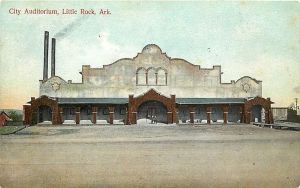
Following the court decision which forbade the City of Little Rock from using public dollars to construct a municipal auditorium, a temporary solution was sought.  On August 20, 1906, the City Council approved plans for such a structure.

Now for some context….

After the September 10, 1906, City Council meeting, the mayor told the Gazette that the Board of Public Affairs had leased part of the City’s land at Markham and Arch Streets to A. C. Read to construct the rink and auditorium.  The lease also allowed the building to extend out into Arch Street (the 1913 Sanborn Map shows it covering approximately two-thirds of the width of the street).  The mayor noted that, “It is stipulated in our lease to Mr. Read that the city shall have the use of the auditorium which he shall erect at any time.”

According to the Democrat, by September the building was already under construction.  That paper also noted that “after three years it passes into the hands of the city, when it can be repaired or remodeled to suit convention purposes.”  In the story about the new plans, the Democrat also gave the facility a very optimistic seating capacity of 9,000 people.

This announcement by Mayor Lenon should not have been a surprise to close observers of the City Council.  On August 13, 1906, A. C. Read, a businessman and real estate developer, petitioned the City for the right to construct a skating rink.  The matter was referred to the Street & Fire Committee, the Superintendent of Public Works and Aldermen Louis Volmer and Benjamin S. Thalheimer, who represented the Sixth Ward, in which the structure would be located.

Neither the Gazette nor the Democrat carried a mention of this petition in their coverage of that meeting.  By the next Council meeting a week later, the committee had reported back with a recommendation for approval.  Resolution 288 was adopted giving Mr. Read the right to build the skating rink.  Interestingly, the resolution did not contain the words “skating rink” though the original petition had.  Instead it permitted Mr. Read to construct a building “suitable for purposes as defined by the Board of Public Affairs.”

The resolution also stated that within three years the building would become property of the City.  The unnamed Gazette reporter at the August 21, 1906, City Council meeting did note in a story the day after the meeting that Mr. Read’s structure would probably be used as an auditorium in three years when the lease was up and the land use reverted back to the City.

Matters often languished in committees of the City Council for weeks; the one week turnaround of Mr. Read’s petition was highly uncommon.  It was also rare for the City Council to meet two weeks in a row.  The fact that it was reported back so quickly would be an indication that this was no standard petition from a citizen.

Civic observers might also have noted that the resolution contained language that a private citizen had been given permission to construct a building on City-owned property to the specifications of the City’s Board of Public Affairs.  Records do not indicate who concocted this scheme, but it is likely that Mayor Lenon was involved.  However his papers shed no light on that time in his administration.

Little Rock chosen as site for War Memorial Stadium on August 9, 1947

As has been noted in a previous post, War Memorial Stadium was approved by the Arkansas General Assembly in March 1947.  The work then began on the finalization of the location.

Four cities were in the running:  Little Rock, North Little Rock, Hot Springs, and West Memphis.  Each of the cities was required to donate the land for the stadium, provide parking for it, and sell local subscriptions equivalent to $250,000 to raise money for it as well.

On May 19, 1947, the City Council approved Resolution 1,747 to donate the land for the stadium in Fair Park if Little Rock was selected.  This was not the first mention of a stadium in City records.  In March of 1947, the City Council had set aside land in Fair Park to use for a playground — with the stipulation that if it was eventually needed for a stadium, it would be relinquished for that purpose.

On August 9, 1947, the War Memorial Stadium Commission met in the House Chambers of the Arkansas State Capitol to select the location for the stadium.  West Memphis dropped out prior to the meeting; they had not been able to raise the sufficient local funds.  That left the three remaining cities.  (Cities had until June 24 to file paperwork expressing their interest in applying and were to submit their proposals by August 1.)

Instead of meeting in a usual committee room, the meeting was held in the House Chambers of the State Capitol.  The location for the meeting had been set because a large crowd was expected.  And the attendance did not disappoint.  City government and business leaders from all three cities turned out in full force.

The members of the Commission were Ed Keith, Chairman, Magnolia; Gordon Campbell, Secretary, Little Rock; Ed Gordon, Morrilton; Senator Lee Reaves, Hermitage; Senator Guy “Mutt” Jones, Conway; Dallas Dalton, Arkadelphia; Judge Maupin Cummings, Fayetteville; Dave Laney, Osceola; and Leslie Speck, Frenchman’s Bayou.

For several hours the nine heard proposals from the three cities.  Little Rock’s location was in Fair Park, North Little Rock’s was near its high school, and Hot Springs was on land next to Highway 70 approximately 2.5 miles from downtown.  Finally it was time to vote.  After two rounds of voting, Little Rock was declared the winner on a weighted ballot.

The north shore’s leadership was magnanimous in their defeat.  Hot Springs, however, was far from it.  In the coming days they filed suit against the Stadium Commission alleging flaws in Little Rock’s proposal as well as improprieties by members of the commission.  A preliminary decision sided with the state.  Ultimately, Hot Springs’ relatively new mayor Earl T. Ricks opted to drop the suit.  The Spa City’s business community was concerned that fighting the location might delay construction – and could negatively impact legislative and tourists’ feelings toward Hot Springs.  (And it was entirely possible that the State Police could have been used to “discover” that there was gambling going on in Hot Springs.)

Though ground was broken later in the year, by December 1947, the stadium was still $250,000 shy of funding for the construction.  This was after the state and Little Rock had previously both upped their commitments to $500,000 each.

The building did eventually open on schedule in conjunction with the 1948 Arkansas Razorback football games.

As for Mayor Ricks of Hot Springs, he moved to Little Rock to serve as Adjutant General of the Arkansas National Guard during the governorship of Sid McMath.  He later held leadership positions in the National Guard Bureau in Washington DC.  He died in 1954 at the age of 45.  Among the ways he was memorialized was a National Guard armory in Little Rock, which stood in the shadow of War Memorial Stadium.

Birth of William E. Ashley in 1823 – first LR Mayor to have been born in LR

On August 6, 1823, future Little Rock Mayor William Eliot Ashley was born in Little Rock.  He would go on to become the first Little Rock Mayor to be born in Little Rock.  Ashley was the son of Mary and Chester Ashley; his father would later serve as a U. S. Senator from Arkansas.  He was the second of the couple’s seven children.

Though he was raised in Little Rock, he did receive some schooling out of state. The State History Commission has correspondence between eleven year old William, studying in New York, and his father. Part of the letter is a request for money.

On October 26, 1846, he married Frances Eliza Grafton at Christ Episcopal Church.  They were the first Little Rock residents to be married in that church.  The couple had five children, including triplets.  Only one of the children, Frances (who was one of the triplets) survived to adulthood.

Ashley was first elected Mayor of Little Rock in 1857. After completing a two year term, he was succeeded by Gordon N. Peay (another scion of a prominent Little Rock family).  In 1861, Ashley returned to the office of Mayor.  He was reelected to a third term in 1863.  In September 1863, following the defeat of Confederate troops by the Union forces at the Battle of Little Rock, the City of Little Rock ceased operations.  On September 21, 1863, Little Rock municipal government closed its doors, stopped collection of taxes and disbanded.  Thus Ashley’s third term ended.

In addition to his interest in local government, Ashley was a member of St. John’s College Board and a director of the newly-formed Little Rock Gas Company.

William Eliot Ashley died on August 16, 1868, at the age of 45.  He was buried in Mount Holly Cemetery (which sat partially on land that had once belonged to his family). His parents, wife and children are all buried in Mt. Holly as well.

Interestingly, for someone who grew up in a prominent family, there does not appear to be a surviving likeness of Mayor Ashley – either in painting or photograph.  Several exist of his parents, but none of him.

1906 verdict scuttles plans for new LR City Hall with Auditorium

The 1906 plans for City Hall with the Municipal Auditorium on the left portion.

Little Rock Mayor Warren E. Lenon had been advocating for a new City Hall a municipal auditorium since shortly after taking office in April 1903. After plans were approved in July 1906, a group of citizens, led by Arkansas Gazette publisher J. N. Heiskell, filed suit to stop the City.

The closing arguments in the trial against plans for a new City Hall and auditorium complex had been heard on Monday, July 30.  The case was heard by Chancery Judge J. C. Hart.  Serving as an advisor to Chancellor Hart throughout the trial (though with no official legal standing) was Pulaski County Circuit Court Judge Robert J. Lea.  To accommodate the expected large attendance, the trial had been moved into his courtroom which was larger than Chancellor Hart’s.

On Friday, August 3, Pulaski County Chancery Judge J. C. Hart issued an injunction to keep the City from signing a contract for the construction of a city hall, jail and auditorium.  Chancellor Hart concurred with the plaintiffs that Arkansas’ constitution and laws dictated all taxation must be for public purposes.  He found there was nothing in Arkansas case law which defined an auditorium to be used for conventions as a public purpose.

As had been the case throughout the trial, the tone of the coverage of the decision differed greatly in the city’s two daily papers.  The subheading in the Democrat noted that the plaintiffs would be liable for any losses to the municipal government’s coffers due to a delay in commencing the construction if Little Rock eventually prevailed.  That fact is not mentioned by the Gazette.  Both papers did make note that Judge Lea agreed with the Chancellor’s decision.

For now, it looked as if the City of Little Rock would be stuck in the 1867 City Hall on Markham between Main and Louisiana.  Mr. Heiskell and his compatriots waited to see if the City would appeal the decision.

While August would be a quiet month publicly, work would go on behind the scenes.  More on that, in the future.

Happy Birthday to Jim Dailey! Little Rock’s 71st Mayor and current Director of Tourism for Arkansas

On July 31, 1942, Dalton James “Jim” Dailey, Jr. was born to Dalton and Ellen Dailey.   He would serve fourteen years as Little Rock’s 71st mayor and is now continuing his public service as the Director of Tourism for the Arkansas Department of Parks and Tourism.

After graduating from Little Rock Catholic High School, he attended the University of Arkansas at Fayetteville.  He graduated with a Bachelor of Science degree in Business Administration. He joined his father in the family business, Dailey’s Office Furniture.

In 1974, Dailey was elected to the City of Little Rock Board of Directors.  He served one four-year term. The last two years of that term, he was the Vice Mayor of Little Rock.

Following that term, he remained engaged in civic activities including serving in leadership capacities in community campaigns.  He also served as president of the National Office Products Association – the first Arkansan to do so.  Dailey also served as the founding chair of Leadership Greater Little Rock.

In 1988, Dailey was elected to return to the City Board.  He was reelected in 1992.  Dailey served as Vice Mayor in 1991 and 1992.  In January 1993, he was chosen by his fellow City Directors to serve a two year term as Mayor.  Under his leadership, the Future-Little Rock goal-setting process took place.

Following a voter-approved change to the City structure, the position of Mayor was changed to be elected by the people while maintaining the City Manager form of government.  On January 1, 1995, Jim Dailey was sworn in as the first popularly-elected Mayor of the City of Little Rock in over 38 years.

As Mayor, he served as Chair of the Intergovernmental Advisory Committee of the Federal Communications Commission. He was also a member of the United States Conference of Mayor’s Communications Task Force.  He also served as president of the Arkansas Municipal League in 2002 and 2003.

While he was Mayor of Little Rock, he was a strong proponent of the development of the River Market and worked to locate the Clinton Presidential Library in Little Rock.  He also worked to increase public safety support.  He also oversaw the establishment of Central Arkansas Water, the development of downtown headquarters for Acxiom Corporation and Heifer International, and the creation of Prevention, Intervention and Treatment programs.  In addition, he was instrumental in leading the efforts for the 40th anniversary of the integration of Little Rock Central High in 1997.

Mayor Dailey was re-elected in 1998 and 2002.  His fourteen years as Mayor of Little Rock set a longevity record.  Upon his retirement the City’s fitness center was renamed the Jim Dailey Fitness and Aquatic Center.  This was in recognition of his lifelong interest in wellness activities.

Since 1965, he has been married to the former Patti Murphy.  They have four children and six grandchildren.