Challenges of Democracy & Leadership in South topic of Clinton School noontime talk

Today at noon, the Clinton School Speaker Series will feature a program on democracy and leadership in the South.

In “Uniting Mississippi,” Eric Thomas Weber, associate professor of public policy leadership at the University of Mississippi and executive director of the Society of Philosophers in America, applies a new, philosophically informed theory of democratic leadership to Mississippi’s challenges.  These challenges could also be applied to Arkansas and most Southern states.

the book begins with an examination of Mississippi’s apparent Catch-22, namely the difficulty of addressing problems of poverty without fixing issues in education first, and vice versa. These difficulties can be overcome if we look at their common roots, argues Eric Thomas Weber, and if we practice virtuous democratic leadership. Since the approach to addressing poverty has for so long been unsuccessful, Weber reframes the problem.

The challenges of educational failure reveal the extent to which there is a caste system of schooling. Certain groups of people are trapped in schools that are underfunded and failing. The ideals of democracy reject hierarchies of citizenship, and thus, the author contends, these ideals are truly tested in Mississippi. Weber offers theories of effective leadership in general and of democratic leadership in particular to show how Mississippi’s challenges could be addressed with the guidance of common values.

The book draws on insights from classical and contemporary philosophical outlooks on leadership, which highlight four key social virtues: wisdom, courage, moderation, and justice. Weber brings to bear each of the virtues of democratic leadership on particular problems, with some overarching lessons and values to advance.


Little Rock Look Back: Little Rock becomes the Capital of Arkansas

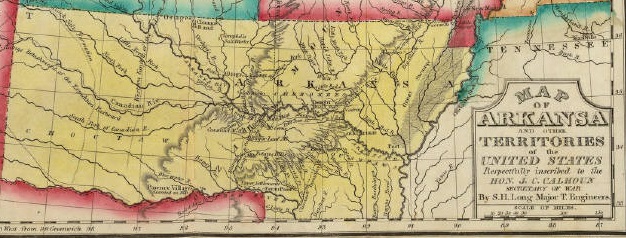
Arkansas TerritoryOn October 18, 1820, Territorial Governor James Miller signed legislation designating Little Rock as the new capital for Arkansas.  This was a mere 10 months after the first permanent settlement was established in Little Rock.

While Little Rock became the Capital, technically it was not the Capital City, since it would not be incorporated as a City until 1835. It wasn’t even incorporated as a town until 1831.

The Act provided that after June 1, 1821, the sessions of the Legislature and the Superior Court would be held at Little Rock.  This caused Arkansas Post, the first territorial capital, to fade from prominence.

The move was made based on the lobbying of Amos Wheeler, Chester Ashley and William Russell.  These men all owned land in the Little Rock area and would benefit from the move of the Capital to Little Rock. The official reason given was Little Rock’s geographical center to the Arkansas Territory and that it was elevated land less prone to flooding.

But as important, Messrs. Wheeler, Ashley and Russell promised to donate land for a capitol building and a guarantee of $20,000 for construction of a suitable building. (That would be the equivalent of $408,000 today.)

Around the time the legislation was approved, several members of the Territorial legislature purchased land around Little Rock.  When a subsequent effort to relocate the Capital upstream was launched, it failed due to the financial ties of these legislators to land in Little Rock.

Little Rock Look Back: LR City Flag Adopted

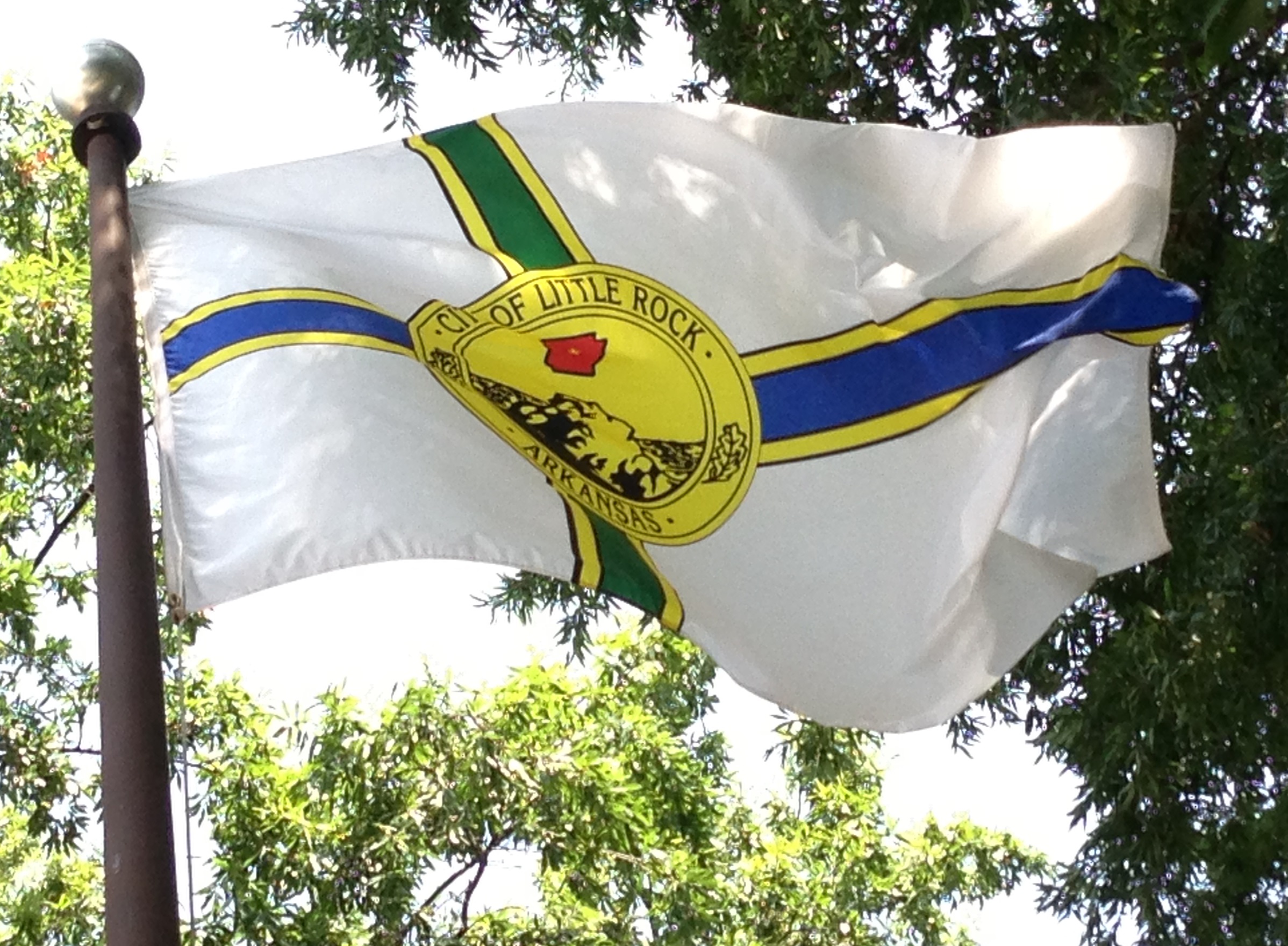
City FlagOn October 18, 1988, the City of Little Rock Board of Directors adopted the first official flag for the City of Little Rock.

The adoption of Ordinance No. 15,566 was the culmination of a design competition which had been spearheaded by Little Rock City Director Sharon Priest (later Little Rock Mayor, Arkansas Secretary of State and Executive Director of the Downtown Little Rock Partnership).

Prior to the Official Board of Directors meeting that day, a press conference was held in the Little Rock City Board Chambers for presentation of the City’s flag.  The City Beautiful Commission, a commission of the Department of  Parks and Recreation, sponsored a the contest which received a total of fifteen flag designs.

The flags were judged October 12, 1988, by City Directors and City Beautiful Commission Members. Director Sharon Priest presented the winning flag and introduced David Wilson, a law clerk at the Mitchell Law Firm, who designed the flag chosen for the $1,000 first prize. The second-place winner was Craig Rains, who received $500; and the third-place recipient was David Tullis, who received $250.

The flag was adopted by the City Board that night by a 6-0 vote; former mayor and current director Charles Bussey was absent.  Those voting to adopt the flag were Mayor Lottie Shackelford and directors Sharon Priest, Tom Prince, Buddy Villines, Buddy Benafield and Tom Milton.  Priest would be a future mayor while Prince, Villines and Benafield had all served as mayor.

The official description of the flag is as follows:

As the official flag of the City of Little Rock, its symbolism is described as follows: A clean white background of the banner represents the optimism and open potential that the city has to offer. The royal blue horizontal broad stripe symbolizes the Arkansas River which borders Little Rock, and has served as an economical and historical emblem since the city’s beginning. The forest green stripe runs vertical to the royal blue stripe, creating a cross which symbolizes the location and statute of Little Rock—a city serving not only as the crossroads of Arkansas, but a crossroad of the mid-southern United States as well.

The strong forest green color depicts the fields, parks and forests which contribute to the natural beauty of the city. The seal of the flag is a modernized adaptation of the current Little Rock seal. The razorback red silhouette of the great State of Arkansas shows her capitol, the City of Little Rock, represented by the centered star. The star rises directly above “The Little Rock”—the protruding cliff along the Arkansas River, which was discovered in 1722 by French explorer La Harpe, when the city was given the name. The Arkansas River behind the rock and the symmetrical oak leaves in the border of the seal are a stylized illustration of what the flag’s stripes represent—the natural beauty of the city. Finally, the gold color of the seal and bordering stripes symbolize the superior economic history, and the future economic potential that is available in the City of Little Rock, Arkansas.

Zoo & Aristotle Launch Interactive Lit Trees & Map for BOO

2015 BooThe Little Rock Zoo and Aristotle bring interactive fun to Boo at the Zoo this Halloween with a special Smartphone app and beacon technology that lets guests control lighted trees and provides an interactive online map of the event.

Interactive Tree Display      

Sponsored by Aristotle, the interactive tree display is located in front of the Diamond Express Train and features eight differently colored lit trees that can be controlled by a smartphone.  A part of the Internet of Things, a beacon is a small device that continually emits a specific webpage URL. When a phone is within range of the trees, the app will notify the user that a beacon is near. When visitors can select the beacon on their smart phones, a webpage with a keyboard graphic appears on the phone’s screen.  When guests press a color-coded key on the keyboard, a corresponding colored tree lights up and plays a musical note.  Up to ten (10) people within range of the trees can play at once and are allowed access for a limited amount of time.

Interactive Map

Guests who download the BeaconSage app will also be able to see an online Boo at the Zoo map on any smartphone device and can use the map to tell what rides and attractions are in a particular area. The map displays the number of tickets needed for rides and attractions as well as the age ranges for the rides and attractions.

Beacons have been strategically placed inside the Zoo so that smartphone devices will receive data transmissions from the beacons when the device is within range. Guests can participate in the interactive fun by downloading the BeaconSage app at the Apple App Store or through Google Play.

About Boo at the Zoo

Boo at the Zoo runs Oct. 17 & 18 and 23-31. Boo will feature all the fun that Arkansas families have come to expect, with trick-or-treat stations full of toys and candy to choose from, carnival rides and games, bounce house inflatables, Frankenstein’s Dance Party and the Thriller Dance performance, a nightly costume contest, live music every night, free s’mores with every ticket, free milk from Hiland Dairy, the Haunted Carousel ride, Haunted Train ride, a hay maze, face painting, glitter tattoos, kid’s area games, Haunted Bingo, and food trucks with food available for purchase each night.

Admission to Boo at the Zoo is $20 per person for wristband admission and includes all rides, attractions and six tickets for trick-or-treat stations and s’mores. Wristband admission does not include food or retail purchases or Haunted Bingo. General Admission is $10 and includes six tickets that may be used for trick-or-treat stations, s’mores, or for rides and attractions. Rides and attractions take between two and 10 tickets. Individual tickets for rides, attractions, treat stations and s’mores are also sold inside the Zoo for $.50 each and guests purchasing General Admission tickets also have the option to upgrade to a wristband if they chose. Admission passes can be purchased online starting now at www.LittleRockZoo.com/boo or at the Zoo’s front gate entrance.

Boo at the Zoo is sponsored by the Little Rock Convention and Visitors Bureau; Blue and You Arkansas Blue Cross Blue Shield Foundation; Acxiom; Ambetter of Arkansas; Coca-Cola Cumulus Broadcasting with B98.5, Alice 107.7 and KOKY 102.1; Arkansas Federal Credit Union; Aristotle; Discount Trophy; New Age Distributing; The Wonder Place; TruService Credit Union; Kroger; Target; Wal-Mart; Home Depot; and Premium Refreshment Services.


Teen Night Oct. 22

For the first time, Boo at the Zoo will offer a Teen Night for those in grades 7th through 12th. Students are asked to present their student IDs for entry or to present a document verifying their grade level. Chaperone tickets are also available at a discounted price for this event, and the Zoo has added extra security on this night to ensure that teens have a safe and fun experience. Tickets for Teen Night are $20 per person and chaperone tickets are $10 per person.

Dia de los Muertos Oct. 30

In honor of the traditional Hispanic holiday, Dia de los Muertos, the Little Rock Zoo has partnered with Hola! Arkansas to host a special Boo at the Zoo on Oct. 30. The rich culture of Dia de los Muertos will be showcased by members of Hola! Arkansas, who will set up a special altar in honor of deceased relatives – a tradition of many Hispanic families celebrating this holiday that normally falls on Nov. 1. This special night of Boo at the Zoo will also feature Hispanic dancers and performers. All regular Boo at the Zoo activities and events will also be available, and the event is open to the public.

Boo at the Zoo Background

Boo at the Zoo is Arkansas’s largest Halloween festival featuring trick-or-treating in a safe environment along with dozens of Halloween themed activities for the entire family. Now is its 24th year, Boo at the Zoo has become a staple for central Arkansas families. Boo at the Zoo is a nighttime event where the Little Rock Zoo reopens after normal operating hours to host ghosts and ghouls and everything that goes “bump” in the night in all corners of the Zoo. Costumes are not required to attend Boo at the Zoo but are encouraged. The event is known for popular attractions such as the Haunted Train where the Zoo’s miniature train is turned into a haunted nighttime attraction as well as the Haunted Carousel that is free to the public. To learn more visit www.LittleRockZoo.com/boo

Juggling Career and Family focus of Anne-Marie Slaughter remarks at Clinton School

AMS-alt2_300dpiThis evening at the Clinton School at 6pm, Anne-Marie Slaughter will be discussing her book Unfinished Business: Women, Men, Work, Family.

When Anne-Marie Slaughter, former dean of the Princeton University Woodrow Wilson School of Public and International Affairs, accepted her dream job as the first female Director of Policy Planning at the U.S. State Department in 2009, she was confident she could juggle the demands of her position in Washington, D.C., with the responsibilities of her family life in suburban New Jersey.

But then life intervened. Parenting needs caused her to make a decision to leave the State Department and return to an academic career that gave her more time for her family. After that decision and the reactions to it, she began to question the feminist narrative she grew up with and wrote an article for The Atlantic, “Why Women Still Can’t Have It All,” which created a firestorm, sparked intense national debate, and became one of the most-read pieces in the magazine’s history.

In her new book, “Unfinished Business: Women, Men, Work, Family,” Slaughter provides a powerful, persuasive, and deeply inclusive vision for how to finish the long struggle for equality between men and women, work and family.

Anne-Marie Slaughter, former dean of the Princeton University Woodrow Wilson School of Public and International Affairs, served as the first female Director of Policy Planning at the U.S. State Department. Slaughter is president and CEO of New America, a nonprofit think tank that is dedicated to the renewal of American politics, prosperity, and purpose in the digital age through big ideas, technological innovation, next generation politics, and creative engagement with broad audiences.

Our America exhibit at Arkansas Arts Center celebrates Latino presence in American Art

The Arkansas Arts Center welcomes the exhibition Our America: The Latino Presence in American Art, a major collection of modern and contemporary Latino art from the Smithsonian American Art Museum,  through January 17, 2016.

The exhibition Our America includes 93 works in all media by 72 artists who participated in various artistic styles and movements, including abstract expressionism; activist, conceptual and performance art and classic American genres such as landscape, portraiture and scenes of everyday life.

Our America presents the rich and varied contributions of Latino artists in the United States since the mid-20th century, when the concept of a collective Latino identity began to emerge. The exhibition is drawn entirely from the Smithsonian American Art Museum’s pioneering collection of Latino art.

To enhance the “Our America” exhibition, the AAC is incorporating several digital components including an exhibition preview video on YouTube, a six-part documentary film series and podcasts to accompany several works. The video can be viewed at tiny.cc/YouTubeOurAmerica.

In collaboration with the University of Arkansas at Little Rock, the AAC is hosting a free film series in six parts. Latino Americans: 500 Years of History is a landmark documentary produced by the National Endowment for the Humanities (NEH) and the American Library Association (ALA), featuring interviews with nearly 100 Latinos and exploring more than 500 years of history. Each episode will be shown Sundays at 2 p.m. in the Lower Level Lecture Hall beginning October 18 with a special community discussion led by Dr. Kristin Dutcher Mann, UALR associate professor of history and social studies education coordinator.

The film schedule is as follows:

October 18, 2015 | 2:00 p.m.
Latino Americans “Episode 1: Foreigners in their Own Land (1565-1880)”
Following the screening, Dr. Kristin Dutcher Mann, UALR associate professor of history and social studies education coordinator, will lead a community discussion about the continuing relevance of the colonial and early national periods in the U.S.-Mexico borderlands

October 25, 2015 | 2:00 p.m.
Latino Americans 
“Episode 2: Empire of Dreams (1880-1942)”

November 1, 2015 | 2:00 p.m.
Latino Americans 
“Episode 3: War and Peace (1942-1954)”

November 8, 2015 | 2:00 p.m.
Latino Americans 
“Episode 4: The New Latinos (1946-1965)”

November 15, 2015 | 2:00 p.m.
Latino Americans “Episode 5:  Prejudice and Pride (1965-1980)”
Following the screening, Edma Delgado-Solórzano, UALR doctoral candidate and visiting assistant professor will lead a community discussion about the episode which focuses on the development of the “Chicano” identity.

November 22, 2015 | 2:00 p.m.

Latino Americans “Episode 6: Peril and Promise (1980-2000)”

Additionally, the Arkansas Arts Center will offer several programs and events to complement the exhibition and enhance the impact on both English- and Spanish-speaking visitors.

Our America will feature bilingual labels for each work and a Spanish-language website created by the Smithsonian American Art Museum. Select works also feature podcasts with the artist’s commentary. Museum goers can simply call a number, scan a QR code or visit a website for more background on the artist and background on each piece—in English and Spanish.

Artists featured in the exhibition reflect the rich diversity of Latino communities in the United States. Our America showcases artists of Mexican, Puerto Rican, Cuban and Dominican descent, as well as other Latin American groups with deep roots in the United States. By presenting works by artists of different generations and regions, the exhibition reveals recurring themes among artists working across the country.

The 72 artists featured in the exhibition are ADÁL, Manuel Acevedo, Elia Alba, Olga Albizu, Carlos Almaraz, Jesse Amado, Asco (Harry Gamboa Jr., Gronk, Willie Herrón and Patssi Valdez), Luis Cruz Azaceta, Myrna Báez, Guillermo Bejarano, Charles “Chaz” Bojórquez, María Brito, Margarita Cabrera, María Magdalena Campos-Pons, Melesio “Mel” Casas, Leonard Castellanos, Oscar R. Castillo, José Cervantes, Enrique Chagoya, Roberto Chavez, Carlos A. Cortéz, Marcos Dimas, Ricardo Favela, Christina Fernandez, Teresita Fernández, iliana emilia garcía, Rupert García, Scherezade García, Carmen Lomas Garza, Ignacio Gomez, Ken Gonzales-Day, Hector González, Luis C. “Louie the Foot” González, Muriel Hasbun, Ester Hernandez, Judithe Hernández, Carmen Herrera, Carlos Irizarry, Luis Jiménez, Miguel Luciano, Emanuel Martinez, María Martínez-Cañas, Antonio Martorell, Ana Mendieta, Amalia Mesa-Bains, Franco Mondini-Ruiz, Delilah Montoya, Malaquias Montoya, Abelardo Morell, Jesús Moroles, Raphael Montañez Ortiz, Pepón Osorio, Amado M. Peña Jr., Chuck Ramirez, Paul Henry Ramirez, Sophie Rivera, Arturo Rodríguez, Freddy Rodríguez, Joseph Rodríguez, Frank Romero, Emilio Sánchez, Juan Sánchez, Jorge Soto Sánchez, Rafael Soriano, Ruben Trejo, Jesse Treviño, John M. Valadez, Alberto Valdés and Xavier Viramontes.

The exhibition is organized by E. Carmen Ramos, curator of Latino art at the Smithsonian American Art Museum.

Our America: The Latino Presence in American Art is organized by the Smithsonian American Art Museum. Generous support for the exhibition has been provided by Altria Group, the Honorable Aida M. Alvarez, Judah Best, The James F. Dicke Family Endowment, Sheila Duignan and Mike Wilkins, Tania and Tom Evans, Friends of the National Museum of the American Latino, The Michael A. and the Honorable Marilyn Logsdon Mennello Endowment, Henry R. Muñoz III, Wells Fargo and Zions Bank. Additional significant support was provided by The Latino Initiatives Pool, administered by the Smithsonian Latino Center. Support for “Treasures to Go,” the museum’s traveling exhibition program, comes from The C.F. Foundation, Atlanta.

Our America is sponsored in Arkansas by Donna and Mack McLarty, The Brown Foundation, Inc., of Houston, Consulate of Mexico in Little Rock and Alan DuBois Contemporary Craft Fund. Media sponsors include ¡Hola! Arkansas and Telemundo Arkansas.

Musical Legacy of Sister Rosetta Tharpe celebrated tonight by Arkansas Sounds, AETN at CALS Ron Robinson Theater

sister_rosettaTonight at 7pm at the CALS Ron Robinson Theater, Arkansas Sounds presents a detailed look at the life of Sister Rosetta Tharpe with a screening of The Godmother of Rock and Roll and a tribute mini-concert of her songs.

Arkansas native Rosetta Nubin Tharpe (Sister Rosetta Tharpe) was one of gospel music’s first superstars, the first gospel performer to record for a major record label (Decca), and one of the first artists to cross over from gospel to secular music. Tharpe has been cited as an influence by numerous musicians, including Bob Dylan, Little Richard, Elvis Presley, and Arkansan Johnny Cash.

In partnership with AETN, Arkansas Sounds will celebrate the 100th anniversary of her birth with a screening of the PBS American Masters documentary The Godmother of Rock and Roll, followed by a musical tribute performance of her songs.